




- Food Ingredients & Additives
- Organic Spices Market
Organic Spices Market Size, Share, Growth, and Regional Forecast, 2026 to 2033
Organic Spices Market by Product Type (Turmeric, Ginger, Chili, Pepper, Cinnamon, Clove, Garlic, Others), Form (Whole, Powder, Granular, Chopped / Crushed, Others), Distribution Channel (B2B, B2C), and Regional Analysis from 2026 to 2033

Organic Spices Market Share and Trends Analysis
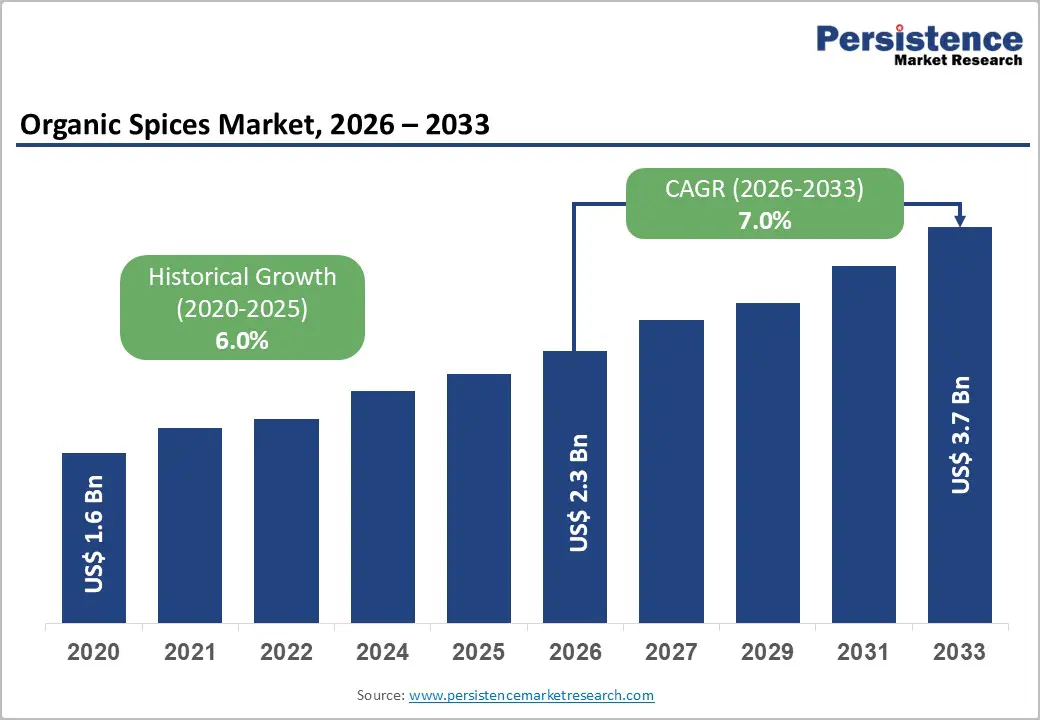
The global organic spices market size is estimated to grow from US$ 2.3 billion in 2026 to US$ 3.7 billion by 2033, growing at a CAGR of 7.0% during the forecast period from 2026 to 2033 fueled by rising health awareness, increasing demand for clean-label products, and preference for natural flavors.
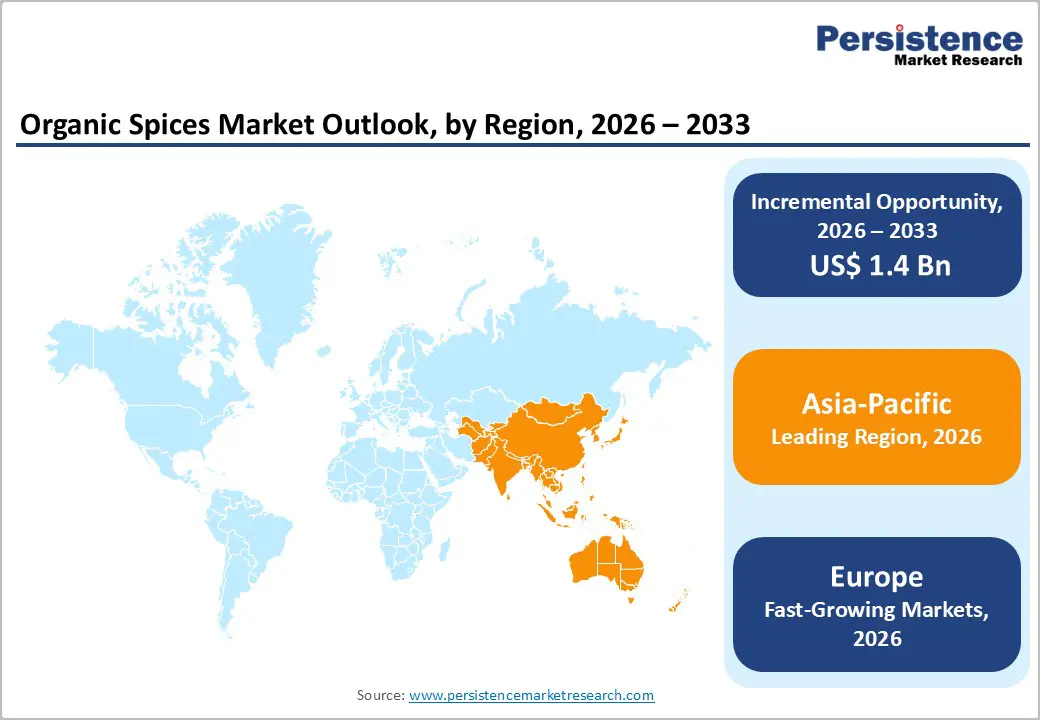
North America maintains a strong position due to its highly organized spice processing infrastructure, advanced quality testing systems, and strong presence of branded spice manufacturers that prioritize traceability and food safety while Asia-Pacific is emerging as the fastest-expanding region, supported by increasing domestic cultivation, expanding export-oriented spice processing industries, rapid growth of digital retail platforms, and rising consumer interest in premium and origin-specific spices.
Key Industry Highlights:
- Dominant Product Segment: Organic turmeric held 26.4% share in 2025, driven by its culinary versatility, health benefits, and growing use in supplements and functional foods.
- Dominant Region: Asia Pacific is the leading region in the organic spices market with 41.1% share in 2025, driven by rising health awareness, increasing disposable incomes, and strong consumer preference for natural and clean-label products. Government initiatives supporting organic farming, expanding local spice production, and growing e-commerce and retail distribution channels further strengthen the region’s dominance in the market.
- Growth Indicators: Growth is driven by increasing health consciousness, preference for natural and clean-label products, rising demand for flavorful and functional ingredients, and expansion of e-commerce channels.
- Market Opportunity: Opportunities include the development of premium and exotic organic spices, value-added processed spice products, organic spice blends, expansion into emerging markets, and strategic partnerships with retail and online platforms.
| Key Insights | Details |
|---|---|
| Global Organic Spices Market Size (2026E) | US$ 2.3 Bn |
| Market Value Forecast (2033F) | US$ 3.7 Bn |
| Projected Growth (CAGR 2026 to 2033) | 7.0% |
| Historical Market Growth (CAGR 2020 to 2025) | 6.0% |
Market Dynamics
Driver: Rising consumer health awareness and demand for natural products
Consumers are increasingly prioritizing healthier, chemical-free foods, boosting demand for organic spices. Data from the United States shows that total certified organic product sales reached approximately $71.6 billion in 2024, with a growth rate of 5.2%, significantly outpacing the overall food market, and highlighting strong consumer demand for “organic” labeled items trusted for being free from harmful pesticides and synthetic additives. Health-driven buying behaviors are also evident globally. Surveys indicate a broad shift toward healthier eating patterns: in the U.S., over 50% of consumers cite health as a major factor in food choice, and many actively seek out nutritious options. Organic products, including spices, are considered safer and more aligned with “clean-label” lifestyles because they avoid chemical residues known to raise health concerns. This trend transcends borders, supporting organic spice consumption in both developed and emerging markets.
Restraint: High cultivation and certification costs for organic spices
One of the most significant restraints on organic spice supply is the cost and complexity of organic certification. In India, for example, comprehensive certification under programs like the National Programme for Organic Production (NPOP) can require substantial fees. Accredited processes include application charges, inspection costs, and annual renewal fees with totals ranging from INR 5,000 up to INR 20,000 or more depending on farm size and inspection needs. These costs are non-trivial for smallholder farmers with limited cash flow.
Even with government support some schemes subsidize up to 50% of certification fees the financial burden remains a barrier, especially in regions where organic farming is emerging and capital is scarce. For small producers, certification expenses can outweigh short-term economic benefits. This cost hurdle affects supply expansion because uncertified spice output cannot be marketed as “organic,” restraining producers’ ability to meet rising consumer demand and slowing overall market growth.
OPPORTUNITY: Development of value-added and processed organic spice products
A major opportunity in the organic spices segment lies in value-added processing, which enhances product usability and expands market reach. Beyond raw spices, processed offerings such as organic spice blends, culinary mixes, and extract-based ingredients meet consumer demand for convenience and versatility in cooking, making organic spices more accessible to busy households and foodservice buyers alike.
Value-added products also attract new commercial applications: spice extracts are increasingly integrated into nutraceutical formulations, sauces, snacks, and beverages, opening doors into adjacent sectors like functional foods and natural health products. As convenience trends persist, ready-to-use organic spice blends and processed formats can justify higher retail premiums while helping producers differentiate offerings. With e-commerce penetration increasing and chefs incorporating more certified organic ingredients into menus, value-added organic spices present a scalable pathway to tap both household and industrial demand.
Category-wise Analysis
By Product Type Insights
Turmeric is leading with 26.4% share in 2025, due to its extensive production and ubiquitous use in both culinary and health applications. India alone contributes over 75-80% of global turmeric production, with an estimated 11.6 lakh tonnes cultivated across ~3.24 lakh ha in 2022-23, supporting its prominence in the spice trade and organic segment alike. Turmeric’s integration into traditional cuisines, decorative dyes, and medicinal systems like Ayurveda cements its demand across households and commercial food processors.
The spice’s bioactive compound curcumin has attracted global health-conscious consumers, driving turmeric inclusion in functional foods, beverages (e.g., golden milk), nutraceuticals, and natural supplements. Government backing, such as the establishment of the National Turmeric Board aimed at expanding exports and product development, also supports turmeric’s dominant position within organic spices.
By Form Insights
Powdered spices command the largest share in the organic spices market because they offer convenience, consistency, and versatility in everyday cooking and food production. Powdered spices eliminate the need for grinding whole spices, saving preparation time and enabling precise measurement a key preference for modern consumers and commercial kitchens.
Available data shows that powdered spices make up roughly ~50% of overall spice consumption and market share internationally, largely due to their streamlined use in packaged foods, processed products, and ready-to-cook formulas. Powdered forms also benefit from improved shelf life through modern packaging and enable easier distribution through organized retail and e-commerce channels, making them the go-to form for both households and industrial food processors worldwide.
Regional Insights
Asia-Pacific Organic Spices Market Trends
Asia-Pacific is the leading region in the global Organic Spices Market, contributing 41.1% of total market share and production volume, with India and China supplying the bulk of certified organic spices such as turmeric, ginger, and pepper. India alone produces over 650,000 tons, while China adds about 350,000 tons, making the region the primary global source of raw organic spice crops.
This dominance stems from the region’s longstanding spice cultivation heritage, favourable agroclimatic conditions, and large agricultural labour force, along with strong export-oriented supply chains that support global distribution. Government initiatives encouraging organic farming practices and certification also reinforce the Asia-Pacific’s role as a production and export hub.
Europe Organic Spices Market Trends
Europe is emerging as one of the fastest-growing region for organic spices owing to strong consumer demand for premium, sustainable, and traceable foods. European consumers show a high preference for organic and eco-labeled products in countries such as Germany, France, and the UK. Certified organic products comprise a significant proportion of food purchases, supported by strict EU food safety and organic certification policies.
The European Union’s Farm to Fork and organic farming support frameworks have increased organic acreage and production, enabling faster growth in domestic supply and processing infrastructures. As disposable incomes rise and sustainability preferences increase, organic spices are gaining traction, especially in ready-to-use blends, seasoning mixes, and retail formats, making Europe a high-growth market within the global landscape.
North America Organic Spices Market Trends
North America remains a key region in the organic spices market because of high consumer health awareness, strict organic certification standards, and advanced retail and distribution networks. The United States, which dominates North American organic consumption, imported 14,500+ metric tons of organic spices in recent years, underscoring strong demand supported by supermarkets and e-commerce platforms.
The region’s well-developed regulatory frameworks (such as USDA organic standards) and traceability systems ensure consumer confidence in product integrity. With organic food sales in North America valued at tens of billions of dollars and growing annually, organic spices benefit from established demand patterns for clean-label and natural seasonings across household and commercial foodservice segments.
Competitive Landscape
The organic spices market is highly competitive, led by established producers like Everest Spices, McCormick & Company, and Frontier Co-op. Companies focus on quality certification, sustainable sourcing, and product diversification, including spice blends and value-added offerings, while expanding distribution through retail, e-commerce, and international export channels to maintain market share.
Key Industry Developments:
- In November 2025, McCormick® redesigned its gourmet line of premium herbs and spices, updating packaging and product offerings. The company aimed to enhance brand appeal, improve usability, and highlight the quality and freshness of its spices. This relaunch targeted both home cooks and professional chefs, emphasizing convenience, flavor consistency, and elevated culinary experiences.
- In January 2024, Simply Organic announced its annual grants, supporting organizations tackling systemic food insecurity. The initiative provided financial aid to nonprofits and community programs focused on increasing access to healthy, organic foods for underserved populations. Through this program, Simply Organic aimed to strengthen local food systems, promote equitable nutrition, and empower communities to address hunger and food access challenges nationwide.
Companies Covered in Organic Spices Market
- Simply Organic
- Suminter India Organics
- Curio Spice Company
- McCormick & Company, Inc.
- Rapid Organic
- Paleovalley
- Red Monkey Foods
- Frontier Co-op
- Organic Spices Inc.
- Spicely Organics
- Others
Frequently Asked Questions
The global organic spices market is projected to be valued at US$ 2.3 Bn in 2026.
Rising health awareness, clean-label demand, functional food trends, e-commerce growth, and increasing disposable incomes drive growth.
The global organic spices market is poised to witness a CAGR of 7.0% between 2026 and 2033.
Value-added spice products, organic blends, emerging market expansion, e-commerce growth, and functional food integration offer opportunities.
Simply Organic, Suminter India Organics, Curio Spice Company, McCormick & Company, Inc., Rapid Organic, Paleovalley.


