




- Pharmaceuticals
- Multiple Sclerosis Drugs Market
Multiple Sclerosis Drugs Market Size, Share, and Growth Forecast 2026 - 2033
Multiple Sclerosis Drugs Market by Drug Class (Immunomodulators, Immunosuppressants), Route of Administration (Oral, Injection), Distribution Channel (Hospital Pharmacy, Retail Pharmacy, Online Pharmacy), and Regional Analysis, 2026 - 2033

Multiple Sclerosis Drugs Market Size and Trend Analysis
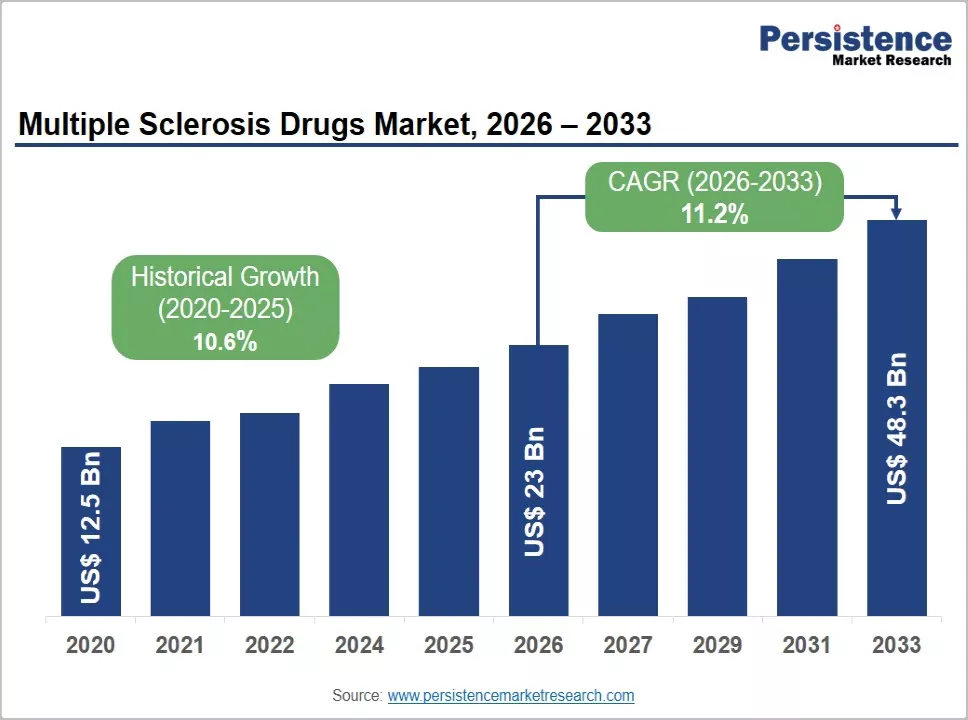
The global multiple sclerosis drugs market size is likely to be valued at US$ 23.00 billion in 2026 and is projected to reach US$ 48.30 billion by 2033, growing at a CAGR of 11.2% during the forecast period between 2026 and 2033.
Earlier diagnosis, a clinical shift toward high-efficacy therapy from the start of treatment, and a deepening pipeline of B-cell depleting antibodies and Bruton's tyrosine kinase (BTK) inhibitors anchor this trajectory. The Multiple Sclerosis International Federation estimates that around 2.9 million people live with the disease worldwide, and the condition is typically diagnosed between the ages of 20 and 40, which means therapy often continues for decades. Anti-CD20 antibodies such as ocrelizumab, ofatumumab, and ublituximab have reset treatment expectations, while subcutaneous and long-interval formulations are making administration more convenient.
Key Industry Highlights
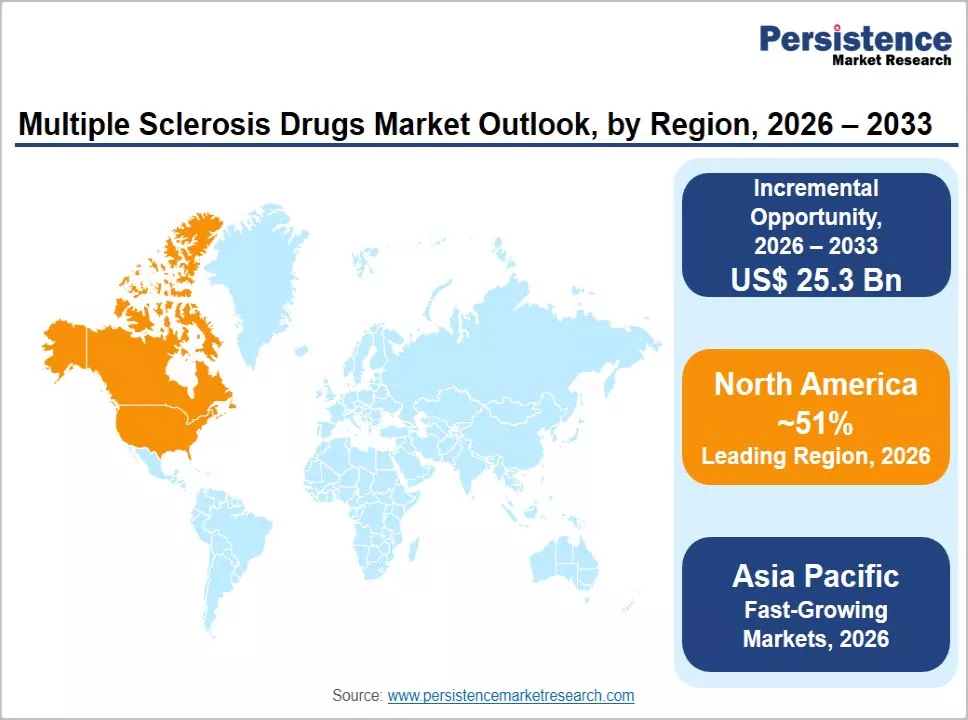
- Dominant Region: North America is forecast to command around 51% of multiple sclerosis drugs market share in 2026, propelled by a large diagnosed patient population, early access to newly approved high-efficacy therapies, and premium pricing, dynamics that will sustain regional leadership through 2033.
- Fastest-growing Region: Asia Pacific is likely to be the fastest growing region, expanding at an estimated CAGR of 13.4%, as improved neurological diagnosis, expanding reimbursement for disease-modifying therapies in China, and rising specialist capacity increase the treated patient base from a low starting level.
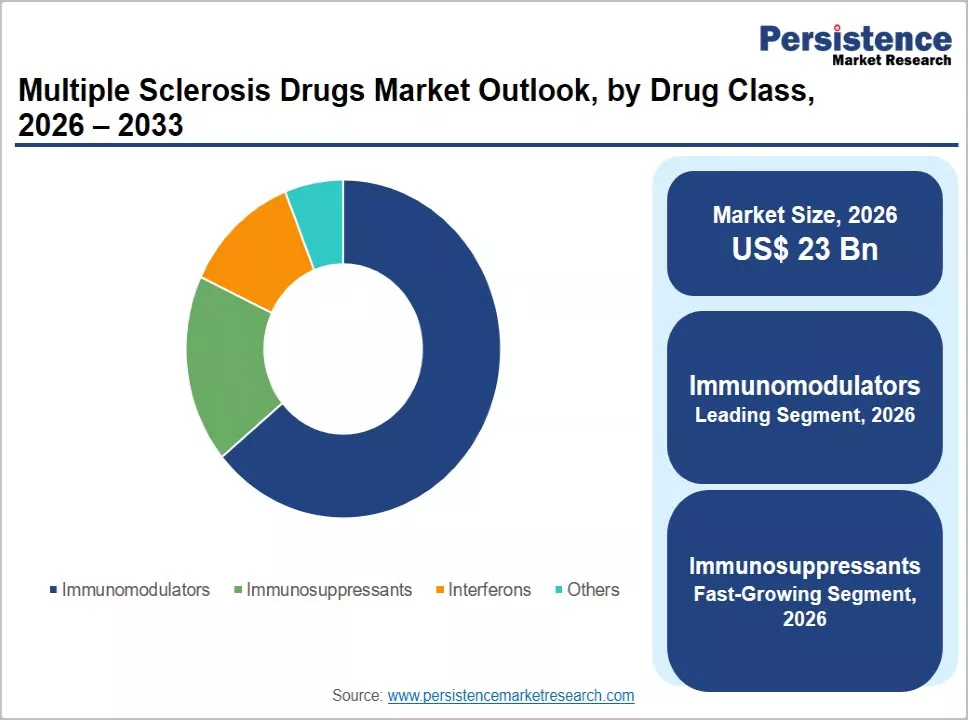
- Leading Drug Class: Immunomodulators account for 64% of drug class share in 2026, covering the broad family of disease-modifying therapies that alter immune activity, while immunosuppressants are the fastest-growing drug class as anti-CD20 antibodies and other cell-depleting therapies gain use as early first-line options.
- Dominant Route of Administration: Injection hold 61% of route share in 2026, driven by infusion and self-injected biologics, whereas subcutaneous administration is the fastest-growing route, supported by monthly and twice-yearly formulations that reduce clinic time.
- Fastest-growing Distribution Channel: Online pharmacy is likely to be the fastest-growing channel as mail-order specialty fulfilment and digital prescription platforms improve adherence, while hospital pharmacy remains the leading channel because of infusion-based therapies.
- Key Market Opportunity: BTK inhibitors represent the most strategically consequential pipeline opportunity. Sanofi's tolebrutinib received a European positive opinion in April 2026 for non-relapsing secondary progressive disease, and other oral BTK inhibitors are in late-stage development, creating prospects for the first therapies targeting disability progression independent of relapses.
DRO Analysis
Driver - Shift to Early High-Efficacy Therapy and Expanding Use of Anti-CD20 Antibodies
Neurologists increasingly treat newly diagnosed patients with high-efficacy disease-modifying therapy rather than escalating after relapses, because early suppression of inflammation preserves long-term function. Anti-CD20 antibodies are the centerpiece of this shift, with Ocrevus, Kesimpta, and Briumvi each demonstrating strong relapse and lesion reduction. In May 2026, the U.S. FDA extended Ocrevus to pediatric patients aged ten years and older with relapsing-remitting disease, widening the eligible population.
Because patients remain on treatment for years and high-efficacy biologics carry premium prices, each patient shifted to these therapies lifts value growth, supporting double-digit market expansion over the forecast period.
Restraint - Generic and Biosimilar Erosion, Safety Monitoring Requirements, and High Treatment Costs
Several first-generation oral and injectable therapies, including fingolimod, dimethyl fumarate, teriflunomide, and glatiramer acetate, now face generic competition, and a natalizumab biosimilar has entered the market, compressing prices in older drug classes. Newer agents also require monitoring: natalizumab carries a risk of progressive multifocal leukoencephalopathy, and the U.S. FDA declined to approve tolebrutinib in December 2025 over safety concerns reported to involve the liver. High annual costs for branded therapies strain payers and limit access in lower-income regions, leaving many patients untreated or on lower-efficacy options.
Opportunity - BTK Inhibitors for Progressive Disease and Convenient Subcutaneous and Long-Interval Dosing
Progressive multiple sclerosis has long been underserved, and BTK inhibitors that act on both peripheral B cells and microglia in the central nervous system aim to slow disability accumulation independent of relapses. Sanofi's tolebrutinib gained a positive recommendation from the European Medicines Agency's CHMP in April 2026 despite the FDA response, and European approval was reported in June 2026, establishing a first reference point for the class. In parallel, the subcutaneous version of Ocrevus and monthly ofatumumab autoinjectors are reducing infusion-center time, opening opportunities for suppliers that couple efficacy with convenience and home administration.
Category-wise Analysis
Why Do Immunomodulators Account for Nearly Two-Thirds of the Multiple Sclerosis Drugs Market?
Immunomodulators are projected to dominate the drug class segment, account around 64% of market share in 2026. The class covers the principal disease-modifying therapies that alter immune cell activity, including sphingosine-1-phosphate receptor modulators such as fingolimod, siponimod, ozanimod, and ponesimod, fumarates, teriflunomide, glatiramer acetate, and monoclonal antibodies. Their breadth, established safety records, and availability in oral and injectable forms across treatment lines explain their dominance. Biogen, Novartis, Bristol Myers Squibb, and Teva maintain extensive franchises in this class, and generic versions broaden access in cost-sensitive markets.
Immunosuppressants are likely to be the fastest-growing drug class, accelerating as B-cell depleting antibodies and selective immune reconstitution therapies move into earlier lines of treatment. Ocrelizumab, ofatumumab, and ublituximab deliver strong control of relapses and new lesions, while cladribine tablets from Merck KGaA offer an oral, short-course option. The May 2026 FDA approval of Ocrevus for pediatric relapsing-remitting disease demonstrates how high-efficacy agents are extending into new patient groups.
Route of Administration Insights
Injection is expected to lead the route of administration segment, command nearly 61% of market share in 2026. Intravenous infusions of ocrelizumab, natalizumab, ublituximab, and alemtuzumab are central to high-efficacy care, while intramuscular interferon beta-1a and subcutaneous glatiramer acetate, interferon beta, and ofatumumab serve self-administering patients. High-value biologics, which are principally injected, account for a large share of therapy revenue, and clinicians prefer parenteral dosing for patients in whom adherence to oral regimens is uncertain. Oral drugs retain a substantial but lower-value share, helped by generics.
Subcutaneous administration is likely to be the fastest-growing route, driven by the shift toward convenience. Ofatumumab is given monthly by autoinjector at home, and the U.S. FDA approved Ocrevus Zunovo in September 2024, a subcutaneous formulation of ocrelizumab with hyaluronidase administered twice a year in a short injection. These options free infusion capacity and reduce patient travel, and they allow payers to shift care to lower-cost settings.
What Is Driving Hospital Pharmacy's Dominant Share of Multiple Sclerosis Drugs Distribution?
Hospital pharmacy is estimated to dominate the distribution channel segment, capture nearly 52% of market share in 2026. Many high-efficacy therapies are infused under clinical supervision, and hospitals and infusion centers purchase, prepare, and administer ocrelizumab, natalizumab, and ublituximab. Initiation of new disease-modifying therapies, requirements for pre-treatment screening, and ongoing safety monitoring also anchor patients to neurology clinics and hospital systems, supporting high channel volumes and stable purchasing relationships with manufacturers.
Online pharmacy is likely to be the fastest-growing distribution channel, as specialty mail-order fulfilment, home delivery of oral and self-injected therapies, and digital refill reminders improve adherence for stable patients. Telemedicine neurology visits are making remote prescription management practical.
Regional Insights
North America Multiple Sclerosis Drugs Market Trends and Insights
North America is projected to dominate regional market and command around 51% of market share in 2026. The region has among the highest multiple sclerosis prevalence rates in the world, with the National Multiple Sclerosis Society estimating nearly one million people living with the disease in the U.S. Rapid adoption of new high-efficacy therapies, strong insurance coverage, and a dense network of neurology centers underpin leadership, while FDA decisions, including pediatric expansion of Ocrevus and the tolebrutinib response, shape global competitive dynamics.
U.S. Multiple Sclerosis Drugs Market Size
The U.S. is anticipated to capture nearly 93% of the North America regional market in 2026. Premium list prices, early launches by Roche, Novartis, Biogen, and TG Therapeutics, and wide use of anti-CD20 antibodies create the largest single-country revenue pool. Generic entry for older orals and a biosimilar natalizumab introduce pricing pressure, but growth in high-efficacy and subcutaneous products continues to lift overall value.
Canada Multiple Sclerosis Drugs Market Size
Canada is estimated to account for 7% of the North America regional market in 2026. The country has one of the highest multiple sclerosis prevalence rates globally, and provincial drug plans reimburse a range of disease-modifying therapies. Joint pricing negotiation through the pan-Canadian Pharmaceutical Alliance moderates prices, while demand rises with growing diagnosis rates and expanding access to high-efficacy infusions.
Europe Multiple Sclerosis Drugs Market Trends and Insights
Europe is projected to hold about 17% of market share in 2026. The region has a large, well-diagnosed patient population and early access to therapies through the European Medicines Agency. The CHMP's April 2026 positive opinion for tolebrutinib in non-relapsing secondary progressive disease, followed by reported European approval in June 2026, positions the region as an early adopter of oral BTK inhibition for progressive disease, and national health technology assessments balance access against budget impact.
Germany Multiple Sclerosis Drugs Market Size
Germany is anticipated to command around 26% of the Europe regional market in 2026. Statutory insurance covers a broad range of disease-modifying therapies, and benefit assessment by the Federal Joint Committee shapes pricing. A dense network of neurologists and specialized MS centers supports rapid uptake of new agents, and Merck KGaA, a German company, anchors the domestic ecosystem with cladribine.
France Multiple Sclerosis Drugs Market Size
France is expected to hold nearly 17% of the Europe regional market in 2026. National reimbursement via the Haute Autorité de Santé, hospital-based infusion pathways, and early access programs help bring innovative therapies to patients. Sanofi, headquartered in France and developer of teriflunomide and tolebrutinib, makes the country a notable center for clinical research and domestic commercial activity.
Asia Pacific Multiple Sclerosis Drugs Market Trends and Insights
Asia Pacific is projected to be the fastest growing regional market, expanding at a CAGR of 23.4% during the forecast period between 2026 and 2033, and is estimated to hold nearly 14% of market share in 2026. Prevalence is lower than in Western countries, but better diagnosis through MRI access, and expanding reimbursement are rapidly enlarging the treated population.
China Multiple Sclerosis Drugs Market Size
China is estimated to capture nearly 34% of the Asia Pacific regional market in 2026. National regulatory approvals of newer disease-modifying therapies and the inclusion of selected products in the National Reimbursement Drug List are widening access. Expanding neurology capacity in tertiary hospitals is improving diagnosis.
India Multiple Sclerosis Drugs Market Size
India is projected to hold nearly 11% of the Asia Pacific regional market in 2026. Domestic manufacturers supply lower-cost generic oral therapies such as fingolimod and dimethyl fumarate, making treatment more affordable than in most markets. Awareness and specialist access remain concentrated in metropolitan centers, leaving substantial headroom.
Competitive Landscape
The global multiple sclerosis drugs market is moderately consolidated, with a small group of originator companies controlling most value. Roche (Ocrevus), Novartis (Kesimpta), Biogen (Tysabri), and Sanofi (Aubagio and Lemtrada) hold leading positions, while Merck KGaA, Bristol Myers Squibb, and TG Therapeutics compete with Mavenclad, Zeposia, and Briumvi. Teva defends its glatiramer acetate franchise against generics, and Sandoz participates through a natalizumab biosimilar. Competition centers on efficacy, safety monitoring burden, convenience of administration, and payer access.
Pipeline competition is intensifying in progressive disease, where Sanofi's tolebrutinib and other oral BTK inhibitors aim to establish a new standard. Generic erosion of older oral drugs is pushing companies toward subcutaneous formulations, pediatric indications, and lifecycle management. Smaller and regional players, including Indian generic manufacturers, compete on price in cost-sensitive markets.
Key Industry Developments
- In May 2026, the U.S. FDA approved Genentech's Ocrevus (ocrelizumab) intravenous infusion for pediatric patients aged 10 years and older, weighing at least 55 pounds, with relapsing-remitting multiple sclerosis, marking the first high-efficacy B-cell depleting therapy approved for this age group. The approval was supported by the OPERETTA 2 head-to-head study, which showed superior reduction in lesions compared with fingolimod, the only previously approved pediatric option.
- In April 2026, the European Medicines Agency's CHMP adopted a positive opinion recommending Sanofi's tolebrutinib for certain patients with non-relapsing secondary progressive multiple sclerosis, a recommendation that followed the U.S. FDA's complete response letter issued in December 2025 over safety concerns. European approval of the oral BTK inhibitor was subsequently reported in June 2026.
Companies Covered in Multiple Sclerosis Drugs Market
- F. Hoffmann-La Roche (Genentech)
- Novartis AG
- Biogen
- Sanofi
- Merck KGaA
- Bristol Myers Squibb
- TG Therapeutics
- Teva Pharmaceutical Industries
- Sandoz
- Viatris
Frequently Asked Questions
The global multiple sclerosis drugs market is valued at US$ 23.00 billion in 2026 and is projected to reach US$ 48.30 billion by 2033.
Growth is driven by the shift to early high-efficacy therapy, especially anti-CD20 antibodies, earlier diagnosis, label expansion into pediatric patients, and the arrival of new subcutaneous formulations that improve convenience.
Immunomodulators hold nearly 64% of drug class share in 2026, because the class spans the broad family of established disease-modifying therapies available in oral and injectable forms across treatment lines.
North America dominates the market with a 51% share in 2026, supported by nearly one million people living with multiple sclerosis in the U.S., rapid adoption of high-efficacy therapies, and strong insurance coverage.
The largest opportunities lie in BTK inhibitors for progressive disease, where tolebrutinib has gained a positive European recommendation, and in subcutaneous and long-interval formulations that reduce infusion burden.
Leading companies include Roche, Novartis, Biogen, Sanofi, Merck KGaA, Bristol Myers Squibb, and TG Therapeutics, in a moderately consolidated market where efficacy, safety monitoring, convenience, and payer access determine competitive position.


