




- Pharmaceuticals
- Food Allergy Market
Food Allergy Market Size, Share, and Growth Forecast, 2026 - 2033
Food Allergy Market by Allergen Type (Peanut Allergy, Tree Nut Allergy, Milk & Dairy Allergy, Others), Product Type (Diagnostics, Therapeutics), Diagnostic Method, End User and Regional Analysis for 2026 - 2033

Food Allergy Market Size and Trends Analysis
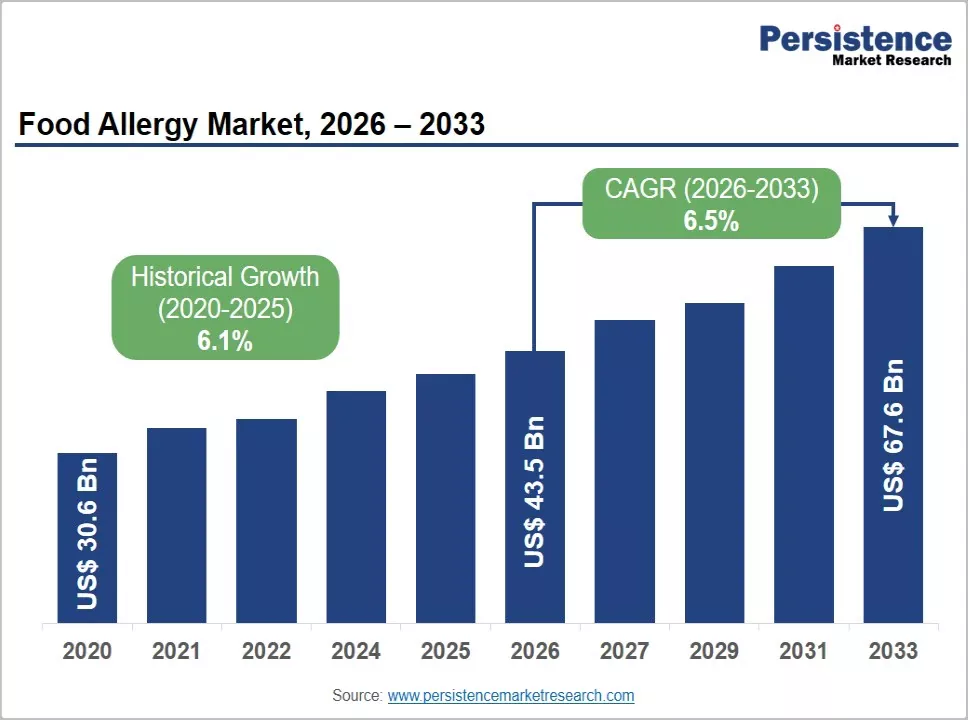
The global food allergy market size is likely to be valued at US$ 43.5 billion in 2026 and is expected to reach US$ 67.6 billion by 2033, growing at a CAGR of 6.5% between 2026 and 2033, driven by rising diagnosis rates, stricter allergen labeling requirements, and the introduction of new therapeutic options. The market stood at US$ 30.6 billion in 2020.
Food Allergy Research & Education (FARE) reports that more than 33 million individuals in the U.S. live with food allergy, roughly 1 in 13 children and 1 in 10 adults, which sustains demand for diagnostic testing, emergency epinephrine, and immunotherapy.
Key Industry Highlights
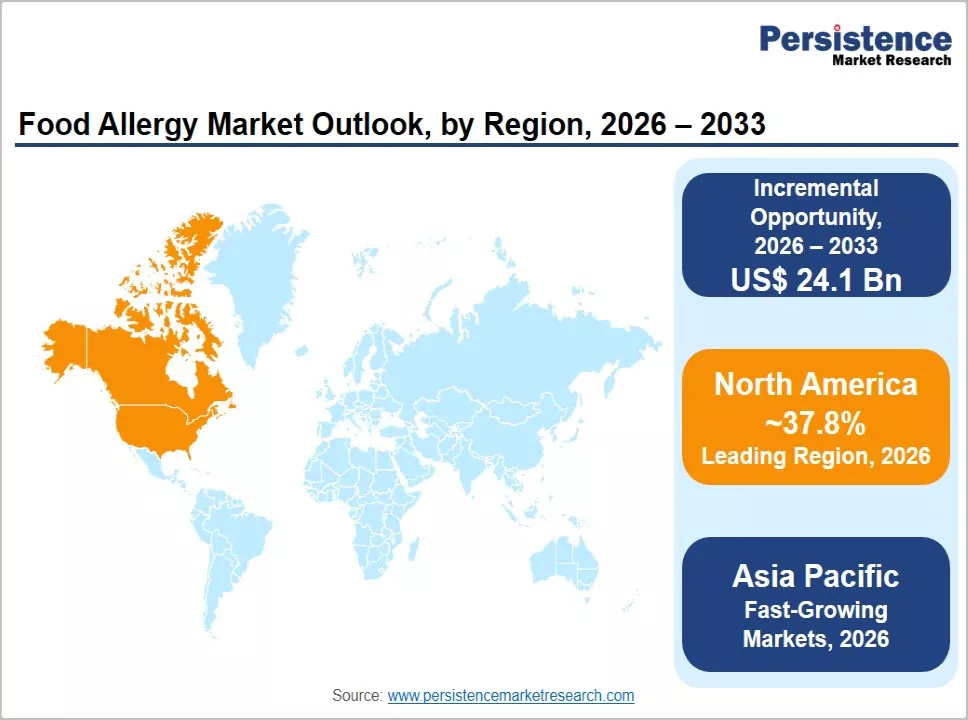
- Leading Region: North America, anticipated to account for 37.8% of the market share, supported by high diagnosis rates, established allergist networks, and early adoption of newly approved therapies.
- Fastest-growing Region: Asia Pacific, driven by rising awareness, expanding access to allergy diagnostics, and recent approvals of needle-free emergency treatments in China, Japan, and Australia.
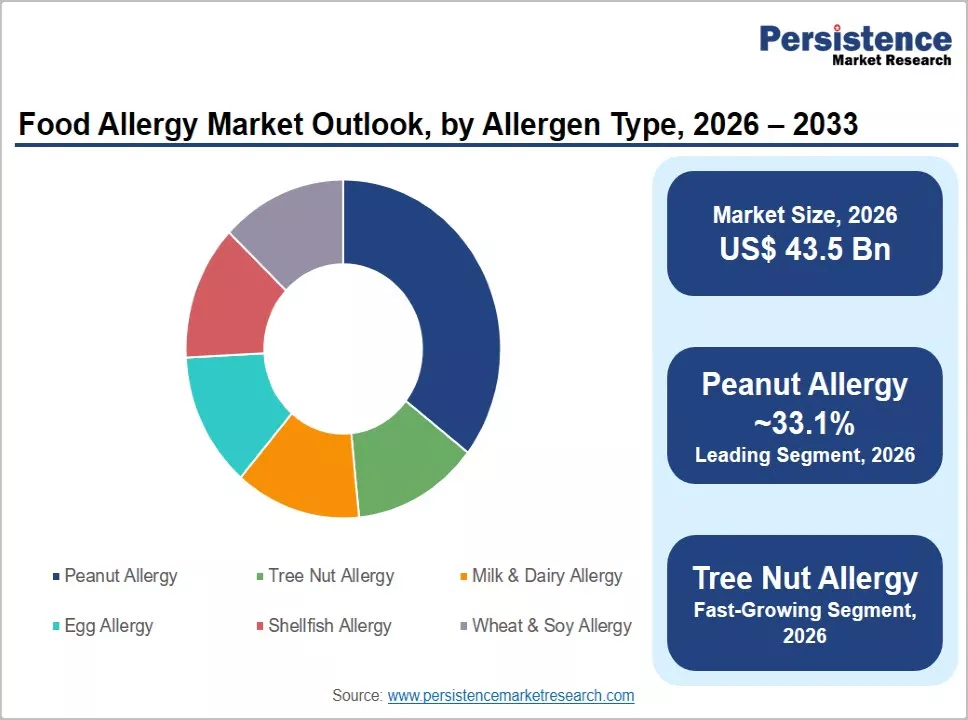
- Dominant Allergen Type: Peanut allergy, anticipated to hold approximately 33.1% of the market share in 2026, supported by persistent sensitization, severe reaction risk, and a concentrated therapeutic pipeline.
- Leading Product Type: Diagnostics, anticipated to account for approximately 44.5% of the market, driven by routine specific IgE testing, wider use of component-resolved diagnostics, and growing referral volumes.
DRO Analysis
Drivers - Rising Disease Burden and Diagnosis Rates Are Expanding Demand for Testing and Treatment
Food allergy prevalence continues to rise across major economies. The Centers for Disease Control and Prevention (CDC) reported a 50% increase in childhood food allergy prevalence in the U.S. between 1997-1999 and 2009-2011, and FARE estimates the economic cost to American families at approximately US$33 billion in 2024.
Higher awareness and wider specialist access are converting undiagnosed cases into confirmed diagnoses, which increases demand for specific IgE testing, oral food challenges, and prescriptions for emergency epinephrine. GSK notes that food allergy generates more than 3 million hospital and emergency care visits in the U.S. each year, reinforcing payer and provider interest in earlier diagnosis and prevention.
Regulatory Expansion and Therapeutic Innovation Are Strengthening Market Growth
Allergen labeling rules are widening the scope of testing and food-industry compliance. Sesame became the ninth major allergen requiring labeling in the U.S. on January 1, 2023, under the FASTER Act, while Japan made walnut labeling mandatory in March 2025 and finalized mandatory cashew nut labeling in April 2026.
New treatment formats are also lifting revenue. ARS Pharmaceuticals reported US$72.2 million in U.S. net product revenue for neffy, a needle-free epinephrine nasal spray, in its first full year of sales in 2025, indicating strong uptake of alternatives to auto-injectors.
Restraint - Treatment Burden, High Costs, and Limited Immunotherapy Adoption Constrain Market Expansion
Treatment complexity remains a structural challenge. Stallergenes Greer discontinued Palforzia, the first FDA-approved peanut oral immunotherapy, on July 31, 2026, citing complex administrative and in-office dosing requirements that limited clinical adoption. Anti-IgE therapy requires injections every 2 to 4 weeks, which places a considerable burden on families, as most patients are children.
Regulatory hurdles add further risk. The FDA issued a complete response letter for Aquestive Therapeutics' Anaphylm epinephrine film on January 30, 2026, delaying a potential launch. Strict allergen avoidance remains the primary management approach for many patients, limiting the share of diagnosed individuals who begin pharmacological treatment.
Opportunities - Needle-Free Epinephrine and Long-Acting Biologics Create New Treatment Options
Product innovation is opening new revenue pools. Regulators approved neffy in the U.S., European Union, Australia, China, and Canada between 2024 and 2026, giving patients a portable alternative to auto-injectors. DBV Technologies submitted a Biologics License Application for its Viaskin Peanut Patch in September 2026, and Aquestive Therapeutics has a March 16, 2027 FDA decision date for Anaphylm.
Biologics offer further potential. GSK's ozureprubart, a long-acting anti-IgE antibody, is designed for dosing every 12 weeks and is anticipated to serve approximately 25% of patients who are ineligible for existing therapy, with Phase IIb data expected in 2027.
Category-wise Analysis
Allergen Type Insights
Peanut allergy is anticipated to account for approximately 33.1% of the market share in 2026. The segment benefits from the persistence of peanut allergy into adulthood, a high risk of severe reactions, and the concentration of late-stage development activity. For example, DBV Technologies' Viaskin Peanut Patch, an epicutaneous immunotherapy, is supported by the Phase 3 VITESSE trial in 654 children aged 4 through 7 years, and peanut-specific IgE and component testing remain standard elements of diagnosis.
Tree nut allergy is anticipated to be the fastest-growing allergen segment, expanding at a CAGR of approximately 9.5%, driven by rising reported cases and expanding diagnostic capability. For example, Japan's national survey shows tree nuts at 24.6% of reported food allergy cases, the second-highest allergen group, with cashew nut cases rising fastest. In March 2026, Thermo Fisher Scientific added four vicilin-type allergen components for walnut and hazelnut testing to improve identification of clinically relevant sensitization.
Product Type Insights
Diagnostics is anticipated to account for approximately 44.5% of the market share. The segment includes specific IgE blood tests, skin prick tests, component-resolved diagnostics, basophil activation tests, oral food challenges, and rapid testing. Demand is supported by the requirement to confirm diagnoses before starting treatment, especially in children, and by routine referral of positive screening results to specialists. For example, Thermo Fisher Scientific's ImmunoCAP portfolio covers more than 550 whole allergens, allergen mixes, and allergen components, with 72 components cleared by the FDA.
Therapeutics is anticipated to be the fastest-growing product segment, expanding at a CAGR of approximately 9.7%, driven by new epinephrine formats, biologics, and immunotherapy candidates. For example, omalizumab (Xolair) received FDA approval in February 2024 as the first medicine to reduce allergic reactions after accidental exposure to foods in IgE-mediated food allergy, and GSK acquired ozureprubart in March 2026 to extend this approach with less frequent dosing.
Diagnostic Method Insights
In-vitro blood-specific IgE testing is anticipated to account for approximately 53% of the market share. The method requires a single blood draw, delivers quantitative results, and carries no risk of triggering an allergic reaction, which makes it suitable for infants and for patients taking antihistamines. For example, Thermo Fisher Scientific reports that its ImmunoCAP specific IgE test is cited in more than 6,000 peer-reviewed publications, supporting clinician confidence and routine adoption in hospital and reference laboratories.
Component-resolved diagnostics is anticipated to be the fastest-growing method, driven by demand for precision testing. The approach measures IgE against individual allergen proteins, which helps separate true food allergy from pollen-related cross-reactivity and estimates reaction severity. For example, the FDA cleared ImmunoCAP components for sesame and wheat in August 2022, and further tree nut components followed in March 2026, reducing unnecessary oral food challenges.
Regional Insights
North America Food Allergy Market Trends
North America is anticipated to account for approximately 37.8% of the market share. The region benefits from a high rate of diagnosed food allergy, a large specialist base, and a regulatory framework that was widened by the FASTER Act in 2023. Biopharmaceutical investment is concentrated in the U.S., while Canada serves as a growing secondary market for newly approved emergency treatments. FARE data indicate that peanut, tree nut, milk, and shellfish remain among the most common triggers in adults, which keeps multi-allergen testing panels in routine use across hospital and reference laboratory networks.
U.S. Food Allergy Market Trends
The U.S. remains the dominant market in North America due to its large patient population, advanced diagnostics infrastructure, and active development pipeline. On July 31, 2026, Palforzia exited the market, leaving the country without an FDA-approved peanut oral immunotherapy and increasing attention on alternatives. On September 29, 2026, DBV Technologies submitted a Biologics License Application for the Viaskin Peanut Patch in children aged 4 through 7 years and requested priority review; the patch holds Breakthrough Therapy Designation.
Investment activity remains strong. GSK completed its acquisition of RAPT Therapeutics in March 2026 at an aggregate equity value of approximately US$2.2 billion, and Aquestive Therapeutics resubmitted its Anaphylm application on September 16, 2026, with an FDA decision date of March 16, 2027.
Europe Food Allergy Market Trends
Europe is a mature market characterized by harmonized allergen labeling, strong specialist networks, and rising adoption of newer emergency treatments. The European Federation of Allergy and Airways Diseases Patients' Associations estimates that 17 million Europeans experience food reactions. EU Regulation 1169/2011 requires declaration of 14 allergens on food labels, which supports consistent diagnostic and compliance demand across member states. Market activity centers on diagnostics, allergen immunotherapy, and the early rollout of needle-free epinephrine across national reimbursement systems.
Germany Food Allergy Market Trends
Germany represents a major European market because of its large healthcare system and early adoption of new products. On June 26, 2025, ALK-Abelló launched EURneffy 2 mg in Germany, the first market launch in Europe, following European Commission approval in August 2024. ALK reported that it secured a price premium in Germany, indicating payer acceptance of needle-free epinephrine.
German allergists operate within the EU labeling framework, and the later approval of the EURneffy 1 mg dose for younger children is anticipated to widen the treated population. Demand for laboratory-based specific IgE and component testing remains steady in hospital and reference laboratory settings.
U.K. Food Allergy Market Trends
The U.K. remains an important market, with an estimated 2 million people living with diagnosed food allergy, equal to 1-2% of adults and 5-8% of children, according to the Food Standards Agency. Natasha's Law, effective October 1, 2021, requires full ingredient and allergen labeling on foods prepacked for direct sale, which has widened compliance requirements across the food service sector.
The MHRA approved EURneffy in 2025, shortly after the German launch. In the treatment segment, hospitals were advised not to start new patients on Palforzia after April 1, 2026, and up-dosing packs are scheduled to be discontinued by March 31, 2027, increasing attention on real-food immunotherapy approaches.
Asia Pacific Food Allergy Market Trends
Asia Pacific is anticipated to be the fastest-growing regional market due to a large patient base, expanding diagnostic access, and tightening allergen regulation. Regional regulators are approving emergency treatments, and international companies are signing licensing agreements with local partners to reach populations that previously lacked community-use epinephrine options. Rising awareness among parents, wider specialist training, and the growth of private pediatric clinics are supporting higher testing volumes in urban centers.
China Food Allergy Market Trends
China is emerging as a major growth market because of its large affected population and the recent entry of modern emergency treatments. In December 2025, the National Medical Products Administration approved neffy 2 mg for adults and children weighing 30 kg or more, the first community-use epinephrine product approved in China. Pediatrix Therapeutics holds the Chinese license, with availability expected from the spring of 2026.
Japan Food Allergy Market Trends
Japan is a mature, regulation-led market with a long-standing allergen labeling system and strong clinical research capability. Walnut became a mandatory labeled allergen on March 31, 2025, and cashew nut was moved to the mandatory list on April 1, 2026, with a transition period running to March 31, 2028. The country's national survey shows tree nuts at 24.6% of cases, with macadamia, pistachio, and cashew nuts linked to the highest rates of anaphylaxis.
Japan's regulatory approval of neffy, in partnership with Alfresa, adds a needle-free option for emergency treatment, and rising tree nut allergy cases are expected to increase demand for component-resolved diagnostics and allergen testing in food manufacturing.
Competitive Landscape
The global food allergy market is moderately fragmented, with competition among in-vitro diagnostic manufacturers, pharmaceutical and biotechnology companies, allergen immunotherapy specialists, and emergency treatment providers. Major companies compete on assay breadth, clinical evidence, regulatory approvals, delivery format, and specialist reach. Diagnostics suppliers include Thermo Fisher Scientific and Siemens Healthineers, while therapeutics participants include Novartis and Genentech, ALK-Abelló, ARS Pharmaceuticals, DBV Technologies, GSK, and Stallergenes Greer.
Leading companies are focusing on needle-free delivery, long-acting biologics, regional licensing, and expanded diagnostic menus. Competitive differentiation increasingly depends on patient convenience, strength of clinical data, and payer access. Companies are also using co-promotion agreements, patient access programs, and pipeline acquisitions to broaden their allergy portfolios.
Key Industry Developments
- In March 2026, GSK completed its acquisition of RAPT Therapeutics for approximately US$2.2 billion in aggregate equity value, adding ozureprubart, a long-acting anti-IgE antibody for food allergy dosed every 12 weeks, to its respiratory and immunology pipeline.
- In March 2026, Thermo Fisher Scientific expanded its ImmunoCAP portfolio with four vicilin-type allergen components for walnut and hazelnut, strengthening component-resolved diagnosis of tree nut allergy.
- In July 2026, Stallergenes Greer discontinued Palforzia worldwide after a strategic review, ending the only FDA-approved peanut oral immunotherapy and increasing focus on epicutaneous and biologic alternatives.
Companies Covered in Food Allergy Market
- Thermo Fisher Scientific Inc.
- Novartis AG
- F. Hoffmann-La Roche Ltd (Genentech, Inc.)
- GSK plc
- Viatris Inc.
- Teva Pharmaceutical Industries Ltd.
- Siemens Healthineers AG
- ALK-Abelló A/S
- R-Biopharm AG
- Stallergenes Greer
- ARS Pharmaceuticals, Inc.
- DBV Technologies S.A.
- Aquestive Therapeutics, Inc.
- Neogen Corporation
Frequently Asked Questions
The global food allergy market is projected to be valued at US$ 43.5 billion in 2026.
The market is expected to reach US$ 67.6 billion by 2033.
Key trends include the expansion of component-resolved diagnostics, needle-free epinephrine, long-acting anti-IgE biologics, epicutaneous and sublingual immunotherapy, at-home and rapid testing, and stricter allergen labeling regulations across major economies.
Peanut allergy is anticipated to remain the leading allergen segment, accounting for approximately 33.1% of the market in 2026.
The market is projected to expand at a CAGR of 6.5% between 2026 and 2033.
Major companies include Thermo Fisher Scientific, Novartis, Roche (Genentech), GSK, Viatris, Teva, Siemens Healthineers.


