




- Automation & Robotics
- Micro Injection Molding Market
Micro Injection Molding Market Size, Share, and Growth Forecast 2026 - 2033
Micro Injection Molding Market by Machine Type (Hydraulic, Electric, Hybrid), by Capacity (Up to 30 Tons, 30-50 Tons, Above 50 Tons), End-user (Automotive & Transportation, Medical & Healthcare, Electronics & Electrical, Packaging, Telecommunication & Optics, Others), Regional Analysis, 2026 - 2033

Micro Injection Molding Market Size and Trend Analysis
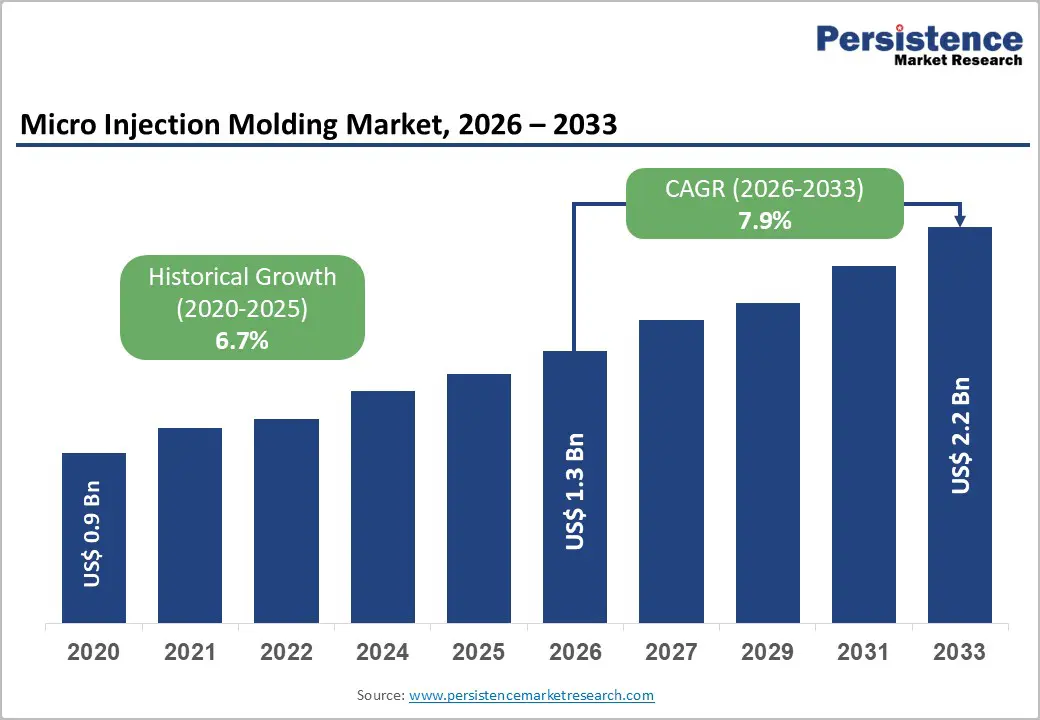
The global micro injection molding market size is likely to be valued at US$ 1.3 billion in 2026 and is expected to reach US$ 2.2 billion by 2033, growing at a CAGR of 7.9% during the forecast period from 2026 to 2033.
It is rapidly growing, driven by the rising demand for miniaturized, high-precision plastic components across medical, electronics, automotive, and telecom sectors, where micro injection molding remains the only scalable solution for ultra-tight tolerances.
Key Industry Highlights:
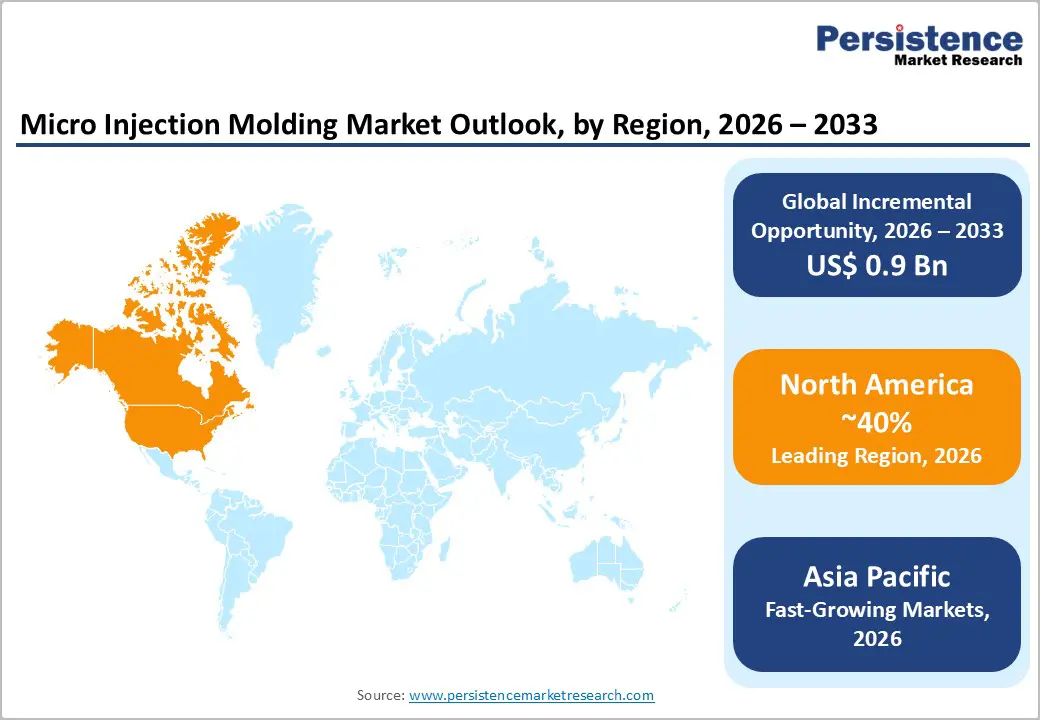
- Leading Region: North America leads the micro injection molding market, accounting for 40% share in 2026, due to strong U.S. medical device demand, strict FDA regulations, and high adoption of precision, biocompatible components across implantable, diagnostic, and minimally invasive applications.
- Fastest-Growing Region: Asia Pacific is the fastest-growing region with a CAGR of 9.7%, supported by Japan’s advanced manufacturing, China’s large-scale electronics production, and India’s policy-driven growth, collectively driving high demand for precision micro-molded components across industries.
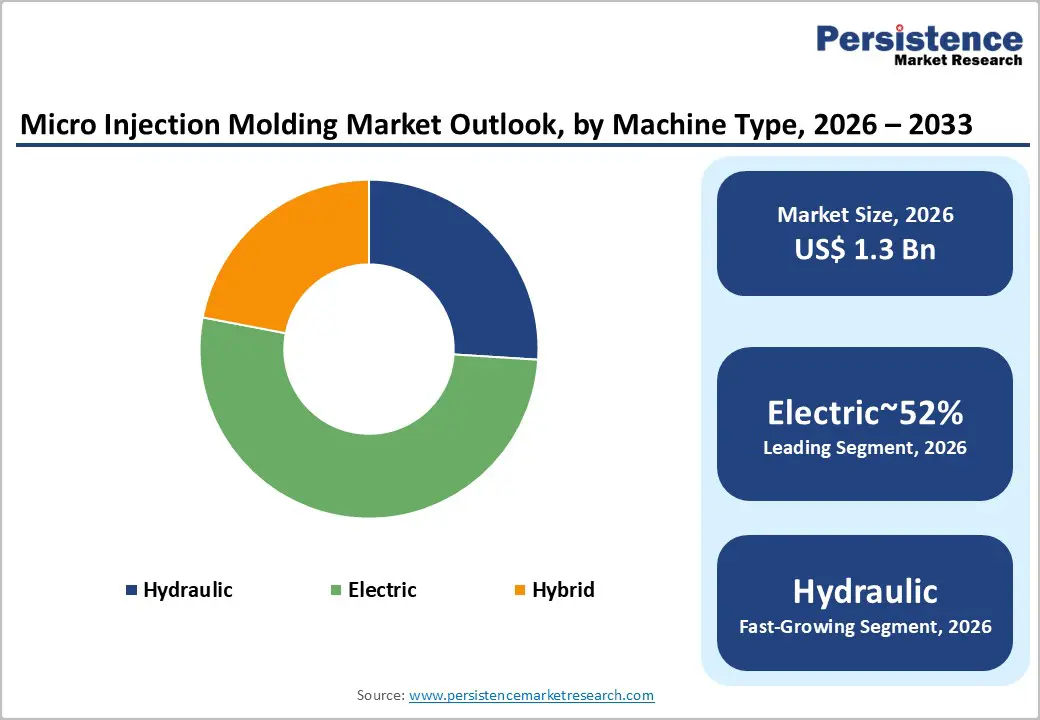
- Leading Machine Segment: Electric micro injection molding machines dominate with 52% share, due to their superior precision, repeatability, cleanroom compatibility, and energy efficiency, making them essential for high-specification applications in medical, pharmaceutical, and optical component manufacturing.
- Fastest-Growing Segment: Medical and healthcare remains the largest and fastest-growing segment, driven by increasing regulatory approvals, demand for minimally invasive devices, and the need for high-performance, biocompatible materials in precision micro-molded components.
- Key Opportunity: Advanced technologies like multi-material and 2K micro-molding are transforming the market by enabling complex component designs, expanding applications in diagnostics and electronics, and allowing manufacturers to achieve higher value and margins.
| Key Insights | Details |
|---|---|
| Micro Injection Molding Market Size (2026E) | US$ 1.3 Billion |
| Market Value Forecast (2033F) | US$ 2.2 Billion |
| Projected Growth CAGR (2026 - 2033) | 7.9% |
| Historical Market Growth (2020 - 2025) | 6.7% |
DRO Analysis
Drivers - Accelerating Miniaturisation in Medical Devices and Implantable Technologies Driving Precision Molding Demand
The global medical device industry is rapidly shifting toward smaller, minimally invasive, and implantable technologies, which is strongly increasing the demand for precision micro injection molded components. These components must meet extremely tight tolerances, high biocompatibility, and strict sterility standards. Regulatory bodies such as the U.S. FDA are approving a growing number of miniaturised Class II and Class III devices, including drug delivery micro-pumps, catheter tips, endoscopic tools, and hearing aid housings.
All of these rely on micro-molded plastic parts with tolerances as precise as ±5 microns. At the same time, the WHO projects global healthcare spending to grow by around 5% annually through 2030, with strong investment in minimally invasive and diagnostic devices. Advanced materials such as PEEK, polysulfone, and medical-grade LCP further strengthen the importance of micro injection molding in next-generation implantable and precision medical applications.
Automotive Electrification and Electronics Miniaturisation Creating Multi-Sector Demand Convergence
The rapid global shift toward electric vehicles (EVs) is creating a new and significant demand stream for micro injection molded components. According to the IEA, EV sales reached 14 million units in 2023, accounting for 18% of total car sales worldwide. Compared with traditional internal combustion vehicles, EVs require many more precision micro-components.
These include connectors for battery management systems, sensor housings for LiDAR and radar, actuator parts for braking and suspension systems, and cable management components. All these parts require high precision and consistent performance, which micro injection molding can deliver at scale. Additionally, the SAE reports that electronics content per EV exceeds $600, further boosting demand for plastic micro-components. This convergence of automotive electrification and electronics miniaturisation is significantly expanding the market opportunity for micro injection molding across multiple industries.
Restraints - Extremely High Equipment Investment and Tooling Costs Creating Barriers for Small-Volume Production
Micro injection molding requires highly specialised machines and tooling, which involve significant capital investment and act as a major barrier for new entrants. Advanced machines with precision control systems, capable of handling shot weights below 0.1 grams, can cost between $150,000 and $500,000. In addition, micro-mold tooling requires advanced manufacturing techniques such as EDM and micro-milling to achieve extremely smooth surfaces and tight tolerances, adding costs ranging from $20,000 to $150,000 per mold.
These high upfront investments make it difficult for small and medium-sized manufacturers to enter the market or compete effectively. As a result, the industry is largely focused on high-volume and high-value applications where such investments can be justified. This cost structure also extends payback periods and slows down adoption, particularly in price-sensitive and emerging markets.
Severe Process Control Complexity and Skilled Workforce Shortage Limiting Capacity Expansion
Micro injection molding involves highly complex processes that require precise control of multiple parameters, including injection speed, temperature consistency, cooling rates, and dimensional accuracy. This level of precision goes far beyond conventional injection molding, making skilled operators and engineers essential. However, there is a global shortage of professionals with expertise in precision molding and toolmaking.
Industry bodies such as the American Mold Builders Association have identified this skills gap as a major challenge. Additionally, maintaining Six Sigma quality standards, often required by medical and semiconductor clients, demands advanced inspection systems, metrology expertise, and continuous process optimisation. These requirements increase operational complexity and cost. As a result, many manufacturers struggle to scale production capacity efficiently, limiting the overall growth potential of the micro injection molding market.
Opportunities - Wearable Electronics and IoT Device Proliferation Creating High-Volume Micro-Component Demand
The rapid growth of wearable devices and IoT technologies is creating a strong and expanding demand for micro injection molded components. Products such as smartwatches, health monitoring patches, hearables, and implantable sensors require highly precise plastic parts, including housings, connectors, and optical elements. The ITU estimates that global IoT connections will reach 29 billion by 2030, with each device containing multiple micro-components. Semiconductor companies like Texas Instruments, STMicroelectronics, and Infineon are continuously reducing chip sizes, increasing the need for compact and precise plastic housings.
The rise of medical-grade wearables, such as glucose monitors and cardiac devices, is driving demand for components that combine biocompatibility with high performance. This trend is creating consistent and large-scale opportunities for micro injection molding manufacturers to supply high-precision components across consumer, healthcare, and industrial applications.
Advances in Multi-Material and Micro-Overmolding Technologies Opening New Application Frontiers
Technological advancements in multi-material micro injection molding are expanding the range of applications and creating new growth opportunities. Techniques such as micro-overmolding, two-component molding, and insert molding allow manufacturers to combine different materials, including plastics, metals, and ceramics, into a single component. This enables the production of more complex and functional parts used in advanced applications such as microfluidics, optical communication systems, and lab-on-a-chip devices.
Research institutions like NIST have identified these technologies as key enablers for next-generation medical diagnostics and photonic systems. Leading equipment manufacturers such as Arburg and Engel are investing in advanced platforms that support multi-material processing. These capabilities allow manufacturers to offer high-value, customised solutions and build strong competitive advantages, especially in industries requiring high precision and integrated functionality.
Category-wise Analysis
Machine Type Insights
Electric micro injection molding machines dominate the market with around 52% share due to their high precision, repeatability, and energy efficiency. These machines are widely preferred in industries such as medical devices and electronics, where accuracy and consistency are critical. Electric machines offer shot-to-shot repeatability of ±0.001 grams, which is significantly better than hydraulic systems. This level of precision is essential for producing micro-components where even minor variations can impact performance and safety.
The electric machines do not use hydraulic oil, making them suitable for cleanroom environments required in medical manufacturing. Regulatory standards such as FDA guidelines and ISO 13485 further support the use of clean and precise equipment. Leading products like Sumitomo Demag’s SE-EV series and Arburg’s Allrounder 170 S are considered industry benchmarks for high-performance micro injection molding.
Capacity Insights
Machines with clamping forces up to 30 tons hold the largest market share, at approximately 58%, reflecting the typical requirements of micro injection molding applications. Most micro-components have very small shot weights, ranging from 0.001 grams to 1 gram, and are produced using low-cavity molds. Applications such as micro-catheter components, hearing aid housings, optical lenses, and micro-connectors require low clamping force but high precision.
As a result, machines in this category form the foundation of the micro injection molding industry. They offer the right balance of efficiency, precision, and cost-effectiveness for producing small and complex parts. Leading manufacturers in this segment include Boy GmbH, Nissei Plastic Industrial, and Sodick, all of which offer specialised micro injection molding machines designed for high-precision, small-scale component manufacturing.
End-user Insights
The medical and healthcare sector leads the micro injection molding market with around 34% share, driven by the high demand for precision and quality in medical devices. Micro injection molding is essential for manufacturing components used in minimally invasive devices, implants, diagnostic tools, and drug delivery systems. Regulatory requirements and safety standards make it the preferred manufacturing method for such applications. The U.S. FDA reports over 3,000 annual approvals for Class II devices, many of which use micro-molded components. Materials such as PEEK, Ultem (PEI), polysulfone, and liquid crystal polymers are commonly used due to their biocompatibility and performance. These materials require specialised processing conditions, further increasing the importance of advanced micro injection molding technologies. This segment represents the highest-value and most technically demanding part of the market.
Regional Insights
North America Micro Injection Molding Market Trends
North America is the leading region in the micro injection molding market, driven by the strong presence of the U.S. medical device industry, which accounts for nearly 40% of global revenue. Strict regulatory requirements from the FDA ensure high standards for manufacturing quality and process validation, favouring advanced and established micro molding companies. In addition to healthcare, the region’s semiconductor and electronics industries also contribute to demand for precision micro-components used in sensors, connectors, and optical devices.
Research initiatives funded by organisations like DARPA are supporting innovation in areas such as microfluidics and implantable devices. These developments are creating new application areas and sustaining long-term demand. Overall, North America’s focus on innovation, quality, and regulatory compliance ensures its continued leadership in the global micro injection molding market.
Europe Micro Injection Molding Market Trends
Europe is a highly advanced market for micro injection molding, supported by strong engineering capabilities and a focus on innovation. Germany leads the region with major equipment manufacturers such as Arburg, KraussMaffei, and Wittmann Battenfeld, which are known for their advanced machine technologies. The implementation of the EU Medical Device Regulation has increased quality requirements, encouraging manufacturers to invest in high-precision and compliant production systems.
Countries like Switzerland and the Netherlands contribute through strong medical and semiconductor industries, while Austria’s Engel continues to innovate in micro-molding technologies. Additionally, Europe’s focus on sustainability and energy efficiency is driving the adoption of electric molding machines. These factors make Europe a key market for high-quality, technologically advanced micro injection molding solutions.
Asia Pacific Micro Injection Molding Market Trends
Asia Pacific is the fastest-growing region in the micro injection molding market, driven by strong electronics manufacturing and increasing medical device production. Countries such as Japan, China, South Korea, and India are investing heavily in advanced manufacturing technologies. Japan is known for its high-precision machinery from companies like Nissei and Sodick.
China is experiencing rapid growth due to its large-scale electronics production and improving healthcare infrastructure. India is also emerging as a key market, supported by government initiatives like the Production Linked Incentive scheme. Southeast Asian countries such as Singapore and Malaysia contribute through established electronics manufacturing hubs. Overall, the region’s combination of cost advantages, industrial growth, and technological advancement is driving strong demand for micro injection molding solutions.
Competitive Landscape
The global micro injection molding market has a moderately consolidated structure in terms of equipment manufacturers, with leading companies based in Germany, Japan, Austria, and the United States. However, the service provider segment remains fragmented, with many regional players. Key competitive factors include precision, repeatability, cleanroom compatibility, and the ability to process advanced materials.
Leading companies such as Arburg, Engel, and Sumitomo Demag are investing in advanced technologies like AI-based process optimisation and real-time quality monitoring. There is also a growing trend toward offering complete solutions, including machine supply, mold design, and validation services. This approach helps customers, especially in the medical sector, simplify their supply chains and ensure compliance with regulatory standards. Overall, innovation and integrated service offerings are becoming key differentiators in this market.
Key Developments:
- In February 2025, Arburg introduced its advanced electric Allrounder platform, focusing on medical applications with digital integration, intelligent control systems, and high precision capabilities, supporting efficient, automated, and cleanroom-compatible production aligned with evolving medical manufacturing requirements.
- In October 2024, Engel showcased advancements in its e-mac electric series, emphasizing improved precision, energy efficiency, and cleanroom suitability, targeting high-performance applications such as medical devices and optical components requiring consistent quality and high repeatability in micro injection molding.
- In March 2025, Sodick launched a hybrid micro injection molding machine combining electric injection and hydraulic clamping, designed to enhance cycle speed, precision, and productivity for high-volume applications in automotive electronics and wearable device manufacturing segments.
Companies Covered in Micro Injection Molding Market
- Sumitomo (SHI) Demag
- Engel Austria GmbH
- Arburg GmbH + Co. KG
- Nissei Plastic Industrial Co., Ltd.
- Sodick Co., Ltd.
- Milacron Holdings Corp.
- Husky Injection Molding Systems Ltd.
- Wittmann Battenfeld GmbH
- Boy GmbH & Co. KG
- Fanuc Corporation
- Hillenbrand Inc.
- Chen Hsong Holdings Limited
- KraussMaffei Technologies GmbH
- Haitian International Holdings Limited
- Makuta Micro Molding
- Accumold LLC
- MTD Micro Molding
- Isometric Micro Molding
- Renishaw plc
Frequently Asked Questions
The micro injection molding market is projected to reach US$ 2.2 Billion by 2033, growing at a CAGR of 7.9% from 2026.
Growth is driven by rising demand from medical devices, EV electronics, and IoT-enabled wearable technologies requiring precision micro-components.
Electric micro injection molding machines lead the market with around 52% share due to high precision and cleanroom compatibility.
North America leads the market, supported by a strong U.S. medical device industry and strict regulatory standards.
The key opportunity lies in multi-material and 2K micro-molding technologies enabling advanced, high-value applications.
Key players include Sumitomo Demag, Engel, Arburg, Nissei, Sodick, Husky, Milacron, Fanuc, KraussMaffei, and Haitian International.


