




- Healthcare Services
- LASIK Eye Surgery Market
LASIK Eye Surgery Market Size, Share, and Growth Forecast 2026 - 2033
LASIK Eye Surgery Market by Procedure Type (Conventional LASIK, Wavefront-Guided LASIK, Topography-Guided LASIK, Femtosecond LASIK), Vision Problem (Myopia, Hyperopia, Astigmatism, Presbyopia), End-User (Hospitals, Eye Clinics, Ambulatory Surgery Centers, Specialty Eye Care Centers), and Regional Analysis for 2026 - 2033

LASIK Eye Surgery Market Size & Trends Analysis
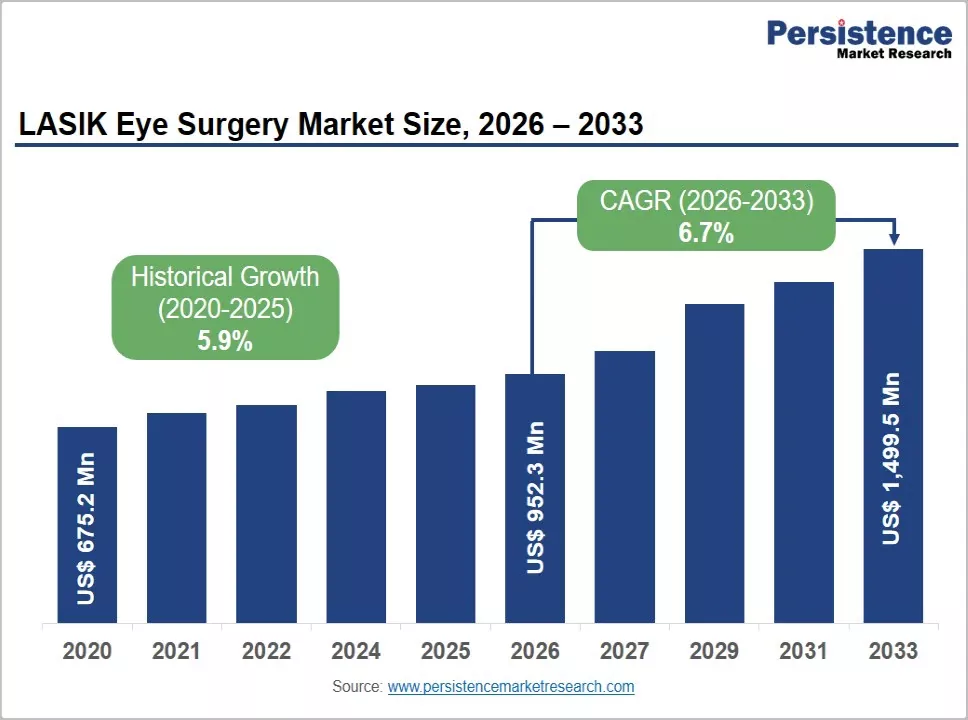
The global LASIK eye surgery market is expected to be valued at US$ 952.3 million in 2026 and projected to reach US$ 1,499.5 million by 2033, growing at a CAGR of 6.7% between 2026 and 2033.
Market growth is primarily driven by the rising global burden of refractive error and the steady clinical maturation of laser vision correction. The World Health Organization (WHO) estimates in its World Report on Vision that at least 2.2 billion people live with near or distance vision impairment, with uncorrected refractive error among the leading causes.
A landmark study published in Ophthalmology by researchers from the Brien Holden Vision Institute projects that nearly 50% of the world population, or about 4.8 billion people, is projected to be myopic by 2050. Improved safety profiles, bladeless femtosecond flap creation, and customized ablation platforms have raised patient confidence in LASIK surgery.
Key Industry Highlights
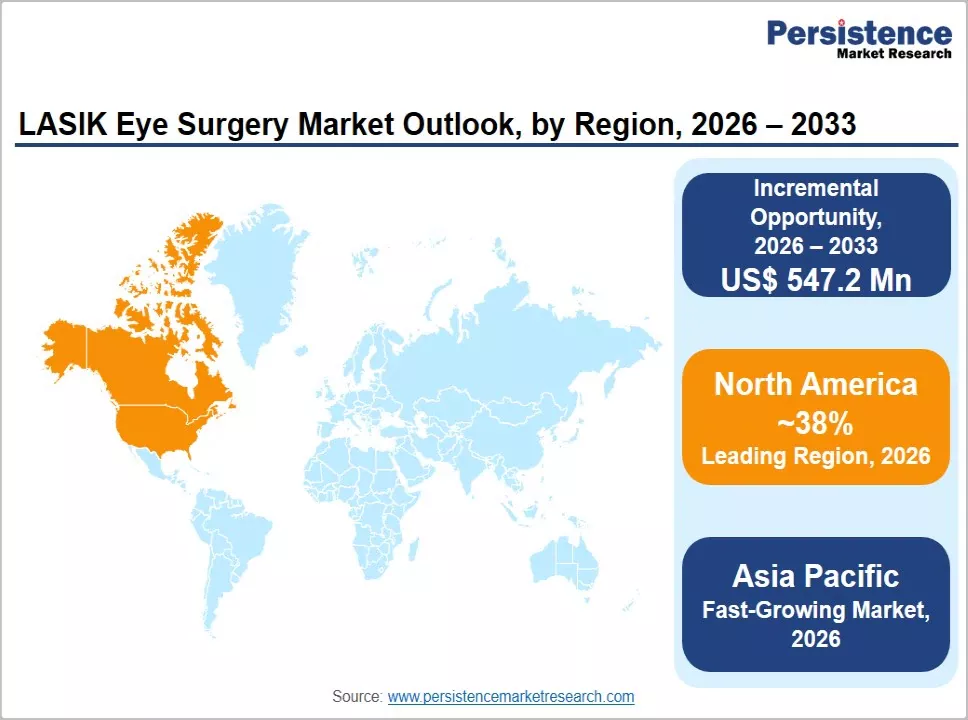
- Leading Region: North America is likely to lead the LASIK eye surgery market with about 38% share in 2026, supported by high patient awareness, availability of FDA-approved advanced laser platforms, widespread financing options, and a dense network of branded refractive surgery chains.
- Fastest-Growing Region: Asia Pacific is expected to be the fastest-growing market, growing at a CAGR of about 8.3% through 2033, driven by China's high myopia burden, expanding private eye hospital chains, and strong ophthalmic medical tourism across India and Southeast Asia.
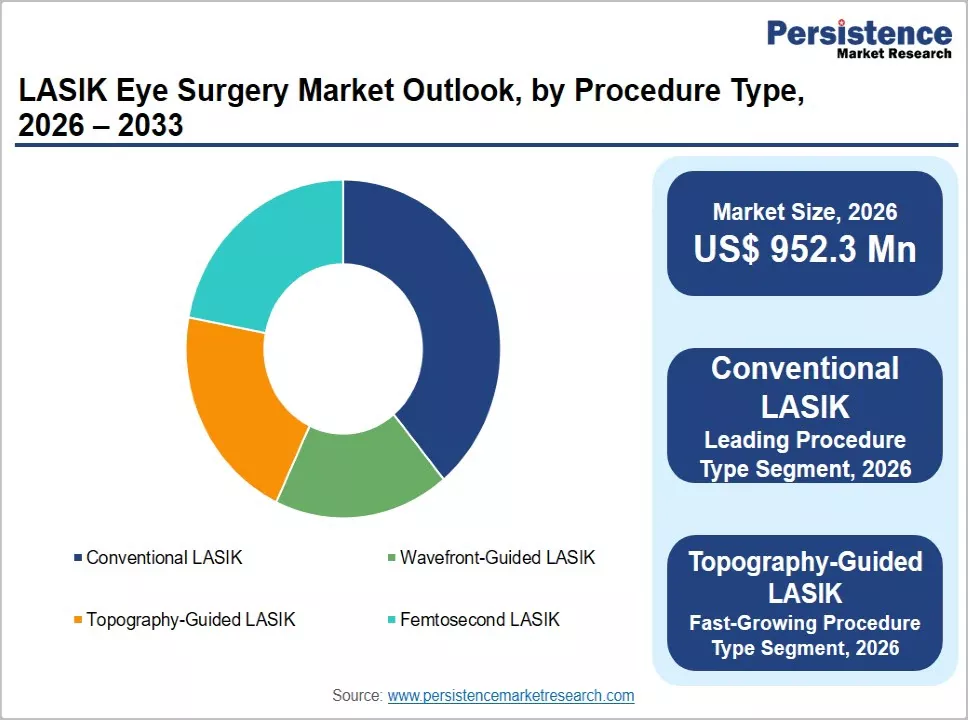
- Dominant Segment: Conventional LASIK is the leading procedure type, accounting for about 39% of the market share in 2026, owing to its large installed laser base, lower treatment cost, proven clinical track record, and strong uptake across price-sensitive emerging markets.
- Fastest-Growing Segment: Topography-Guided LASIK represents the fastest-growing procedure type segment, growing at a CAGR of about 8.4% from 2026 to 2033, as clinics upgrade to platforms that correct corneal irregularities and deliver superior visual quality and night vision.
- Key Market Opportunity: Rising presbyopia prevalence, affecting about 1.8 billion people globally, combined with Asia Pacific’s expanding medical tourism, creates immense opportunities for manufacturers offering customized ablation and blended-vision LASIK solutions.
Market Dynamics
Drivers - Rising Global Prevalence of Myopia and Refractive Errors
The rising incidence of myopia is one of the key drivers of the LASIK eye surgery market because it continuously expands the pool of surgical candidates. According to a meta-analysis published in Ophthalmology (Holden et al., 2016), myopia affected about 1.4 billion people, or 22.9% of the global population, in 2000, a figure projected to climb to 4.76 billion (49.8%) by 2050, with high myopia reaching roughly 938 million people.
The Centers for Disease Control and Prevention (CDC) reports that around 45 million people in the U.S. wear contact lenses, while a significantly larger population depends on spectacles. Prolonged near-work, digital screen exposure, and reduced outdoor time among children and young adults are accelerating myopia onset. As these cohorts reach the stable-prescription age of 18 to 40 years, the addressable base for LASIK and the wider refractive surgery devices market expands steadily.
Technological Advancements Improving Clinical Outcomes and Patient Confidence
Continuous innovation in excimer and femtosecond laser platforms has improved LASIK precision, predictability, and safety, strengthening patient willingness to choose elective vision correction. The American Academy of Ophthalmology (AAO) notes that more than 90% of LASIK patients achieve vision between 20/20 and 20/40 without glasses or contact lenses. A systematic literature review published in the Journal of Cataract & Refractive Surgery (Solomon et al., 2009), covering 2,915 patients, reported a global LASIK patient satisfaction rate of 95.4%.
Bladeless flap creation using femtosecond lasers has reduced microkeratome-related complications, while premium eye-tracking systems operating above 1,000 Hz compensate for involuntary eye movements. Topography-guided platforms such as Alcon's Contoura Vision demonstrated in U.S. Food and Drug Administration (FDA) trials that about 92.6% of treated eyes achieved 20/20 or better uncorrected vision at 12 months, reinforcing adoption within the ophthalmic lasers market.
Restraints - High Out-of-Pocket Procedure Costs and Limited Insurance Coverage
The elective nature of LASIK remains a key barrier to broader penetration, particularly among price-sensitive consumers. LASIK typically costs about US$ 2,000 to US$ 3,000 per eye and is classified as an elective procedure that is generally not reimbursed by Medicare or most standard health insurance plans. Similar exclusions apply in many European public health systems, including the National Health Service (NHS) in the U.K., which does not routinely fund laser vision correction.
Because patients need to finance the full cost themselves, procedure volumes are highly sensitive to consumer confidence, disposable income, and inflation. Historical trends illustrate this vulnerability: U.S. LASIK volumes peaked at around 1.4 million procedures in 2000 and fell sharply during the 2008-2009 recession, showing how economic downturns can defer patient demand and slow capital investment in new laser systems by clinics.
Post-Operative Complications and Competition from Alternative Procedures
Concerns over side effects continue to deter a share of eligible candidates. The FDA-sponsored Patient-Reported Outcomes with LASIK (PROWL) studies, published in JAMA Ophthalmology in 2017, found that up to 46% of participants who had no visual symptoms before surgery reported at least one new visual symptom, such as glare, halos, or starbursts, at 3 months, while up to 28% of participants without prior dry eye symptoms developed them.
The FDA also issued draft guidance in 2022 recommending more detailed LASIK patient labeling on potential risks. In parallel, competing modalities are diverting candidates, including small incision lenticule extraction (SMILE), photorefractive keratectomy (PRK), and implantable collamer lenses such as STAAR Surgical's EVO ICL, which are increasingly offered to patients with thin corneas, high myopia, or a predisposition to dry eye disease.
Opportunities - Rapid Adoption of Topography-Guided LASIK and Next-Generation Laser Platforms
Rising adoption of topography-guided LASIK offers a significant opportunity for platform manufacturers and premium clinics. Unlike conventional ablation, topography-guided systems map thousands of corneal elevation points to correct irregularities that spectacles cannot address. In the FDA pivotal study for Alcon's Contoura Vision, 64.8% of eyes achieved 20/16 or better and 34.4% achieved 20/12.5 or better uncorrected visual acuity at 12 months, supporting premium pricing.
Manufacturers are now integrating artificial intelligence-based treatment planning, faster excimer repetition rates, and connected diagnostic workflows. Companies such as SCHWIND eye-tech-solutions, Carl Zeiss Meditec, and Bausch + Lomb are expanding customized ablation capabilities, triggering upgrade cycles among existing clinics and creating opportunities for bundled diagnostic-laser solutions within the corneal topography systems market.
Expanding Demand in Asia Pacific and Growth of Medical Tourism
Asia Pacific represents a significant opportunity, supported by the region's high myopia burden and fast-growing private eye care networks. China's National Health Commission reported that the overall myopia rate among children and adolescents reached 52.7% in 2020, with prevalence above 80% among senior high school students, creating a large future pipeline of adult LASIK candidates. In Singapore, the Health Promotion Board states that about 65% of children are myopic and roughly 83% of young adults are myopic.
Meanwhile, India, Thailand, Malaysia, and South Korea are attracting international patients by offering LASIK at a fraction of Western prices in internationally accredited hospitals. Large providers such as Aier Eye Hospital Group, Dr. Agarwal's Eye Hospital, and Bumrungrad International Hospital are expanding capacity, giving laser manufacturers prospects for installed-base growth and recurring service revenues.
Category-wise Analysis
Procedure Type Insights
Conventional LASIK is the leading procedure type segment, accounting for around 39% of the LASIK eye surgery market share in 2026. Its leadership is supported by a large installed base of excimer laser systems, lower treatment costs, and decades of clinical validation since the FDA first approved excimer lasers for refractive correction in 1995. Conventional LASIK remains the entry-level option at many high-volume clinics, especially across price-sensitive markets in Asia Pacific and Latin America, where affordability outweighs the benefits of customization for patients with low to moderate, regular myopia. Surgeons also favor it due to its shorter procedure time and highly predictable workflow.
Topography-guided LASIK is the fastest-growing segment, projected to grow at a CAGR of about 8.4% during the forecast period, driven by clinic upgrades to premium platforms that correct corneal irregularities, reduce higher-order aberrations, and improve night vision quality for discerning patients. Growing availability of advanced corneal mapping and customized treatment planning is also encouraging clinics to adopt these systems for patients seeking more personalized refractive correction and improved visual outcomes.
Vision Problem Insights
Myopia is the leading segment, holding around 58% share of the market in 2026. Nearsightedness is the most common indication for laser vision correction because excimer ablation flattens the central cornea with high predictability, especially for low to moderate prescriptions. A global meta-analysis by Hashemi et al. (2018) in the Journal of Current Ophthalmology estimated myopia prevalence at 26.5% among adults, while the Brien Holden Vision Institute projects the myopic population to approach 5 billion by 2050. Young working professionals aged 20 to 40 years form the core LASIK demographic and are predominantly myopic.
Presbyopia is the fastest-growing segment, expected to grow at a CAGR of about 8.8% over the forecast period, driven by ageing populations seeking spectacle independence. Fricke et al. (2018) estimated that 1.8 billion people globally had presbyopia in 2015, supporting uptake of blended-vision and monovision LASIK techniques. Increasing demand for vision correction among middle-aged and older adults is expanding the addressable patient pool, while improvements in presbyopia-correcting techniques are supporting greater acceptance of refractive procedures.
End-User Insights
Eye clinics are expected to hold a leading position in the market, capturing around 42% share in 2026. Dedicated refractive and ophthalmic clinics dominate because LASIK is an elective, outpatient, cash-pay procedure that aligns with their consumer-focused business models, flexible scheduling, and patient financing options. Branded networks such as LasikPlus, TLC Laser Eye Centers, Optical Express, Aier Eye Hospital Group, and Centre for Sight concentrate high procedure volumes, allowing them to amortize laser systems that often cost several hundred thousand dollars. Their specialization also enables comprehensive pre-operative screening using corneal topography, pachymetry, and wavefront aberrometry.
Ambulatory surgery centers are the fastest-growing end-user, projected to expand at a CAGR of about 7.6% from 2026 to 2033, supported by lower facility overheads, the continued outpatient migration of ophthalmic procedures, and growing physician-ownership models across the U.S. and Europe. Their ability to provide streamlined patient flows, dedicated ophthalmic facilities, and same-day discharge is encouraging more refractive surgeons to use these centers for elective vision correction procedures.
Regional Analysis
North America LASIK Eye Surgery Market Trends and Insights
North America is expected to lead the global LASIK eye surgery market, holding around 38% share in 2026. The region's leadership is supported by high consumer awareness, strong disposable incomes, early access to FDA-approved laser platforms, and a well-established network of refractive surgeons and branded LASIK chains. Patient financing programs, tax-advantaged health spending accounts, and sustained direct-to-consumer marketing further support procedure volumes.
A key regional trend is the shift toward bladeless, all-laser LASIK and topography-guided procedures, which support premium pricing and higher revenue per procedure. Clinics are also adopting digital consultation tools, online candidacy screening, and artificial intelligence-assisted diagnostics to streamline patient evaluation and improve conversion rates. At the same time, growing interest in SMILE and implantable lens alternatives is encouraging providers to expand their refractive treatment portfolios, while LASIK remains a high-volume procedure among young adult patients.
U.S. LASIK Eye Surgery Market Size
The U.S. LASIK eye surgery market is estimated at around US$ 319 million in 2026. According to the CDC, an estimated 12 million Americans aged 40 years and older have vision impairment, including about 8 million due to uncorrected refractive error, while roughly 45 million people wear contact lenses. The country has a high concentration of FDA-approved excimer and femtosecond systems, including Alcon's WaveLight platforms, Johnson & Johnson Vision's iDESIGN Refractive Studio and STAR S4 IR, and Bausch + Lomb systems.
Eligibility of LASIK for Flexible Spending Account (FSA) and Health Savings Account (HSA) funds helps reduce the effective out-of-pocket cost for eligible employees. Demand is also supported by the U.S. Department of Defense Warfighter Refractive Eye Surgery Program, growing interest among young professionals, and increasing adoption of premium topography-guided treatments.
Europe LASIK Eye Surgery Market Trends and Insights
Europe is the second-largest market, accounting for about 26% of global market revenue in 2026. Regional demand is supported by high awareness of laser vision correction, established private ophthalmology networks, and the presence of leading laser technology manufacturers. Laser systems are subject to requirements under the EU Medical Device Regulation (MDR) 2017/745 and CE marking, encouraging manufacturers to strengthen clinical evidence and product compliance. Since public health systems generally do not fund elective refractive surgery, procedures are largely provided through private clinics and financed directly by patients.
A notable regional trend is the increasing adoption of minimally invasive and flapless alternatives such as SMILE and trans-epithelial PRK. This competition is encouraging LASIK providers to differentiate through femtosecond laser precision, topography-guided treatment, customized procedures, and aftercare programs. Professional bodies such as the European Society of Cataract and Refractive Surgeons (ESCRS) also support standardized outcome reporting, which helps improve transparency and patient confidence.
Germany LASIK Eye Surgery Market Size
Germany's LASIK eye surgery market is estimated at US$ 54 million in 2026. The country is home to major laser technology developers, including Carl Zeiss Meditec in Jena and SCHWIND eye-tech-solutions in Kleinostheim, supporting early access to advanced refractive platforms. Quality oversight is supported by the Commission for Refractive Surgery (KRC), a joint body of the German Ophthalmological Society (DOG) and the Professional Association of Ophthalmologists in Germany (BVA), which publishes indication guidelines and evaluates procedures.
Statutory health insurance generally does not cover LASIK, making private payment an important source of procedure funding. High disposable incomes, a large working-age population, and increasing adoption of femtosecond and topography-guided LASIK among urban clinic networks are supporting market growth through 2033.
U.K. LASIK Eye Surgery Market Size
The U.K. LASIK eye surgery market is projected to reach around US$ 40 million in 2026. Laser vision correction is delivered primarily through private providers, as the NHS does not routinely fund refractive surgery performed for convenience or cosmetic reasons. The market includes large branded chains such as Optical Express, Optimax, and London Vision Clinic, alongside hospital groups such as Moorfields Private.
Clinical governance is supported by National Institute for Health and Care Excellence (NICE) interventional procedures guidance and the Royal College of Ophthalmologists (RCOphth) refractive surgery standards, which emphasize surgeon certification and comprehensive patient counseling. Advertising oversight by the Advertising Standards Authority (ASA) also promotes greater pricing transparency. Interest-free financing plans, demand among working adults, and adoption of topography-guided and femtosecond LASIK are expected to support continued market growth.
France LASIK Eye Surgery Market Size
France is expected to hold around 18% share of the European LASIK eye surgery market in 2026. The country has an established refractive surgery ecosystem, supported by the French Society of Ophthalmology (SFO) and a broad network of private ophthalmology centers in Paris, Lyon, Marseille, and Bordeaux. Although the national health insurance system, Assurance Maladie, does not reimburse LASIK, many complementary health insurance plans (mutuelles) offer partial allowances for refractive surgery, helping reduce out-of-pocket costs. French surgeons were early adopters of femtosecond flap creation and customized ablation, while demand is concentrated among urban professionals aged 25 to 45 years. Continued investment in all-laser suites and growing adoption of presbyopia correction techniques are expected to expand the addressable patient base through 2033.
Asia Pacific LASIK Eye Surgery Market Trends and Insights
Asia Pacific represents the fastest-growing market, projected to expand at a CAGR of around 8.3% between 2026 and 2033. Growth is driven by the region's high myopia burden, rising middle-class incomes, and rapid expansion of private eye hospital networks. China is the largest contributor; the National Health Commission reported a child and adolescent myopia rate of 52.7% in 2020, while extensive networks such as Aier Eye Hospital Group operate hundreds of eye hospitals and clinics domestically and abroad.
Chinese providers are increasingly adopting femtosecond LASIK and flapless techniques to address the large young-adult patient population. Across the broader region, ophthalmic medical tourism, lower procedure costs than in Western markets, and increasing installation of topography-guided platforms are supporting demand. Government eye health programs are also expanding screening coverage, helping identify refractive errors and creating a larger pool of potential treatment candidates.
India LASIK Eye Surgery Market Size
The India LASIK eye surgery market is estimated at around US$ 30 million in 2026. Myopia among Indian urban children is rising rapidly; a meta-analysis by Priscilla and Verkicharla (2021) in Ophthalmic & Physiological Optics found prevalence increased from 4.44% in 1999 to 21.15% in 2019 and is projected to reach 48.14% by 2050. The government's National Programme for Control of Blindness and Visual Impairment (NPCBVI) is expanding refractive error screening, increasing diagnosis and awareness of vision correction needs.
Leading chains such as Dr. Agarwal's Eye Hospital, Centre for Sight, ASG Eye Hospital, Sankara Nethralaya, and L V Prasad Eye Institute are investing in femtosecond and topography-guided systems. Competitive pricing, EMI financing options, and inbound medical tourism are supporting procedure demand, while domestic manufacturer Appasamy Associates is improving access to ophthalmic equipment. These factors are supporting broader adoption of advanced refractive procedures and expansion of the LASIK treatment base.
Competitive Landscape
The global LASIK eye surgery market is moderately consolidated, with a handful of multinational laser platform manufacturers controlling a significant share of installed excimer and femtosecond systems. Alcon, Johnson & Johnson Vision, Carl Zeiss Meditec, and Bausch + Lomb lead through broad refractive portfolios, extensive clinical evidence, and global service networks, while specialized players such as SCHWIND eye-tech-solutions, Ziemer Ophthalmic Systems, NIDEK, and LENSAR compete on precision engineering and niche technologies.
Key differentiators include eye-tracking speed, ablation profile customization, femtosecond flap quality, and integrated diagnostic connectivity. Companies are prioritizing research into artificial intelligence-assisted treatment planning, topography-guided algorithms, and presbyopia correction. Emerging business models include pay-per-procedure and leasing arrangements that reduce capital barriers for smaller clinics, recurring revenue from procedure cards and consumables, and strategic acquisitions that consolidate cataract and refractive technologies under unified platforms.
Key Industry Developments
- In June 2026, Alcon launched a digital-first LASIK awareness campaign targeting Gen Z and Millennials in the U.S. The campaign uses creators on TikTok, YouTube, and Instagram, along with digital advertising and patient education, to address misconceptions and increase awareness of modern LASIK.
- In September 2025, Alcon launched wavelight plus, which it describes as the first fully personalized LASIK treatment, in the U.S. and Canada. The technology uses ray-tracing technology and the Sightmap diagnostic device to create a 3D “Digital Eye Twin” using more than 100,000 data points, including wavefront, biometry, and corneal tomography measurements.
Companies Covered in LASIK Eye Surgery Market
- Alcon
- Johnson & Johnson Vision
- Carl Zeiss Meditec
- Bausch + Lomb
- NIDEK
- Ziemer Ophthalmic Systems
- SCHWIND eye-tech-solutions
- LENSAR
- iVIS Technologies
- Lumenis
- Topcon
- BVI
- Moria
- Appasamy Associates
Frequently Asked Questions
The global LASIK eye surgery market is expected to be valued at US$ 952.3 million in 2026 and is projected to reach US$ 1,499.5 million by 2033, expanding at a CAGR of 6.7%.
Demand is driven mainly by the rising global prevalence of myopia, which is projected to affect nearly 50% of the world population by 2050.
North America is likely to lead the market with around 38% share in 2026, supported by high consumer awareness, early access to FDA-approved excimer and femtosecond systems, extensive branded LASIK chains, flexible patient financing, and eligibility of LASIK for FSA and HSA funds in the U.S., which together sustain strong procedure volumes.
Rising demand for topography-guided LASIK surgery creates a significant opportunity in the market.
Key players in the market include Alcon, Johnson & Johnson Vision, Carl Zeiss Meditec, Bausch + Lomb, NIDEK, Ziemer Ophthalmic Systems, SCHWIND eye-tech-solutions, LENSAR, iVIS Technologies, Lumenis, Topcon, BVI, Moria, and Appasamy Associates.


