




- Healthcare Services
- Laboratory Casework Market
Laboratory Casework Market Size, Share, and Growth Forecast 2026 - 2033
Laboratory Casework Market by Product Type (Base Cabinets, Wall Cabinets, Mobile Cabinets, Shelving), Material Type (Wood, Metal, Plastic), End-user (Healthcare, Education, Research and Development, Pharmaceuticals), And Regional Analysis for 2026 - 2033

Laboratory Casework Market Size and Trend Analysis
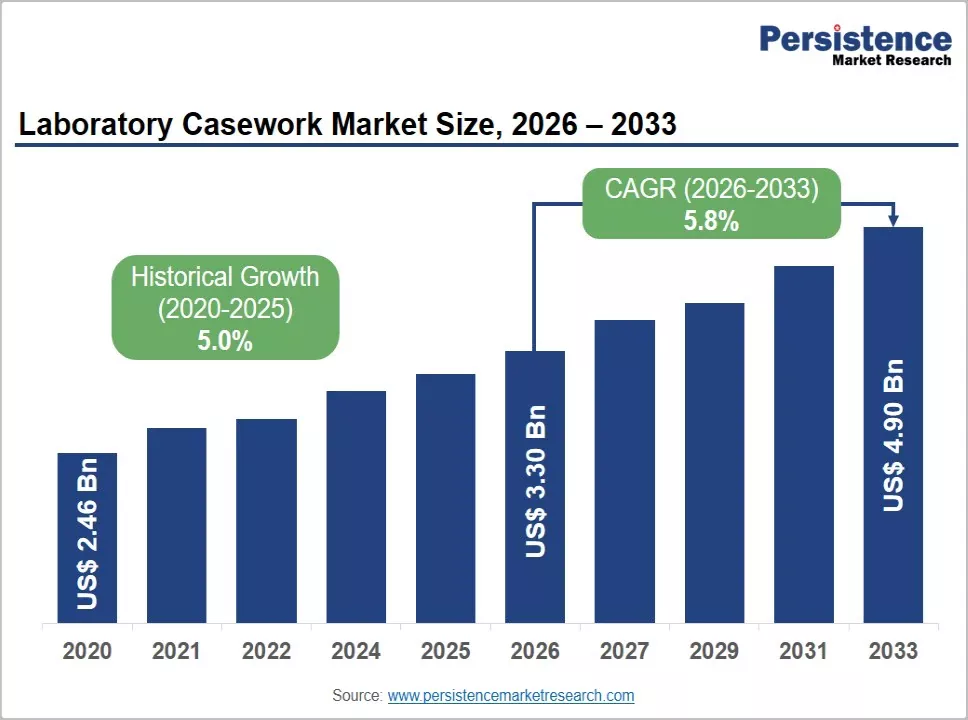
The global laboratory casework market is expected to be valued at US$ 3.30 billion in 2026 and is projected to reach US$ 4.90 billion by 2033, growing at a CAGR of 5.8% during the forecast period from 2026 to 2033. This growth trajectory reflects sustained, infrastructure-driven demand rather than a temporary increase in spending.
The United States National Institutes of Health (NIH) had a budget exceeding US$47 billion in fiscal year 2024, supporting research activities across federally funded laboratory environments. However, this represents the agency's overall budget rather than a dedicated research facilities modernization allocation. For institutional investors and procurement strategists, the laboratory casework industry represents a structurally supported, specification-driven market where long replacement cycles and high switching costs create stable revenue opportunities for established suppliers.
Key Industry Highlights
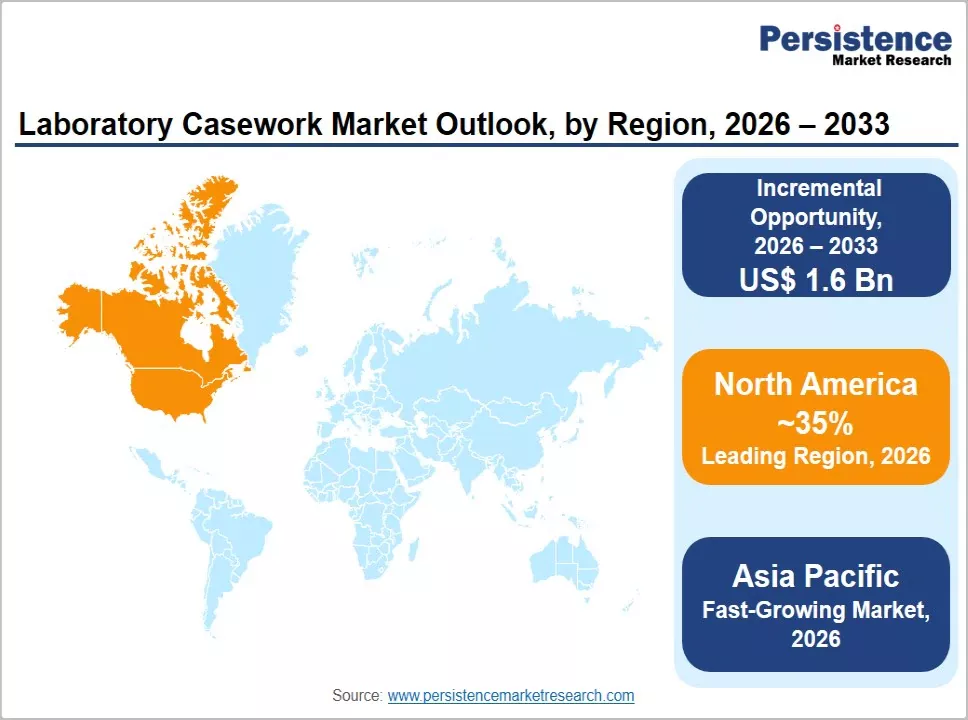
- Leading Region: North America is anticipated to hold around 35.0% share of the laboratory casework market in 2026, underpinned by its high concentration of NIH-funded research facilities and pharmaceutical manufacturing support laboratories, which sustain its regional leadership position through 2033.
- Fastest-Growing Region: Asia Pacific is the fastest-growing regional market, expanding at an estimated CAGR of 6.3%, supported by expanding laboratory networks.
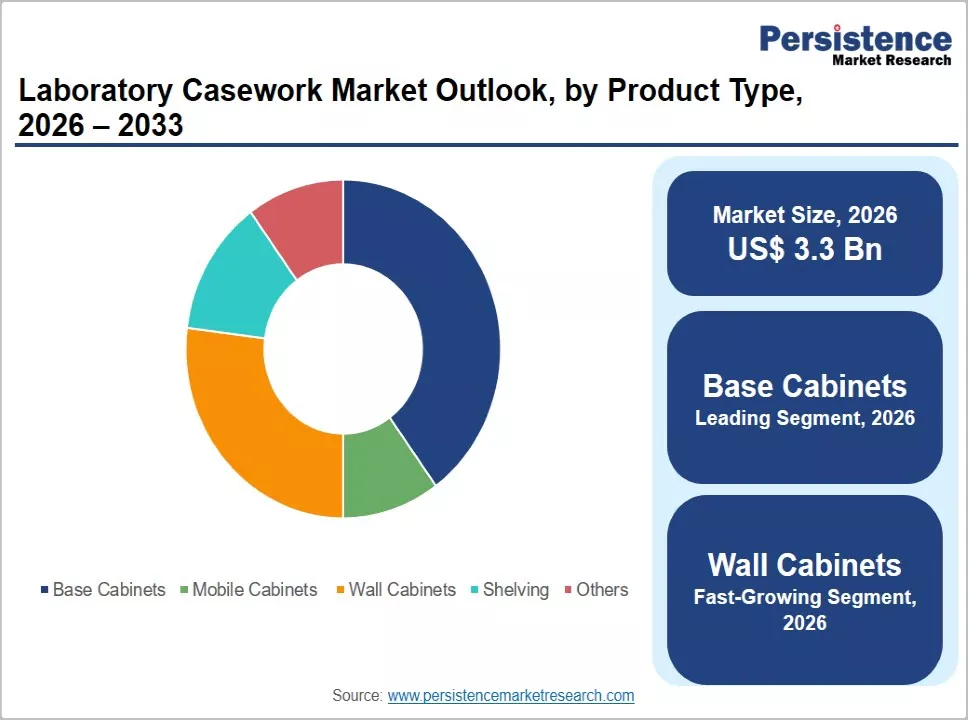
- Leading Product Type: Base cabinets represent the dominant product type, accounting for 28.5% of the market share in 2026, supported by their essential role in laboratory fit-out specifications, ranging from CAP-accredited hospital diagnostic laboratories to GMP-compliant pharmaceutical quality control environments.
- Fastest-Growing Material: Plastic casework is the fastest-growing material segment, gaining specification traction in semiconductor, cleanroom, and corrosive chemical environments where metal corrosion presents operational and maintenance challenges. Manufacturers expanding polymer casework portfolios into electronics and specialty chemical laboratory applications are positioned to capture this emerging demand.
DRO Analysis
Driver - Sustained Global Investment in Life Sciences and Pharmaceutical R&D Infrastructure
Pharmaceutical and biotechnology companies globally are expanding dedicated research campuses, creating sustained demand for specialized laboratory infrastructure. AstraZeneca committed £360 million to a new R&D center at its Cambridge Biomedical Campus in 2023, with laboratory fit-outs involving chemical-resistant bench casework and under-counter storage systems representing an important component of construction requirements.
This investment trend extends across the sector, as each new or renovated facility requires specialized laboratory furniture systems designed to meet SEFA (Scientific Equipment and Furniture Association) performance, ergonomic, and load-bearing guidelines.
Procurement teams at life sciences companies increasingly specify modular casework that accommodates future workflow reconfiguration, increasing initial contract values and creating recurring upgrade and replacement opportunities for manufacturers.
Restraint - High Upfront Capital Costs and Extended Procurement Cycles
Fully fitted laboratory casework systems, particularly powder-coated steel and phenolic resin configurations designed for specialized laboratory environments, carry significant costs per linear foot, placing pressure on budget-constrained institutions.
University facilities departments and hospital procurement committees typically require multi-stakeholder approval processes spanning 12 to 18 months, extending manufacturer order pipelines and limiting revenue recognition flexibility. Smaller regional suppliers often lack the financial resources to manage these extended procurement cycles, creating competitive pressure and potentially accelerating market consolidation.
Opportunity - Modular and Reconfigurable Casework Systems for Adaptive Laboratory Design
The shift toward open, agile laboratory layouts, driven by NIH guidelines emphasizing shared research spaces and collaborative science, is creating strong demand for demountable, modular casework that can be repositioned without structural modifications. Unlike traditional fixed millwork, modular systems allow institutions to reallocate space between wet and dry laboratory functions without undertaking capital-intensive renovations.
Thermo Fisher Scientific Inc. expanded its modular laboratory furniture portfolio in 2024 to address this reconfiguration demand, indicating growing industry interest in adaptable laboratory infrastructure. Modular systems also offer opportunities for higher average selling prices and recurring service revenue through reconfiguration and upgrade contracts.
Category-Wise Analysis
Product Type Insights
Why Do Base Cabinets Command the Largest Share of the Laboratory Casework Market?
Base cabinets represent the leading product type segment, holding the largest market share of 28.5% in 2026. This is because they serve as the structural and functional foundation of virtually every laboratory bench configuration. Clinical diagnostic laboratories in hospital settings, including those operating under College of American Pathologists (CAP) accreditation standards, rely on base cabinets to house centrifuges, refrigeration units, and hazardous chemical storage beneath continuous work surfaces, making them essential components of laboratory fit-outs.
Pharmaceutical quality control laboratories similarly specify base cabinets with chemical-resistant interiors and adjustable shelving to accommodate variations in instruments and storage requirements across product lines.
Wall cabinets are the fastest-growing product type segment, driven by increasing adoption in compact urban university laboratories where vertical storage maximizes usable bench space. Herman Miller's commercial laboratory furniture business introduced a modular wall-hung casework line in 2023 targeting research institutions retrofitting existing buildings with limited floor space, supporting the adoption of wall cabinet systems in renovation projects.
Material Type Insights
Metal casework accounts for 45.0% of the global market share in 2026, reflecting its widespread use across regulated and high-utilization laboratory environments. Biosafety Level 2 and Level 3 laboratories operating under guidelines from the U.S. Centers for Disease Control and Prevention (CDC) and the World Health Organization (WHO) require durable, cleanable, and chemically resistant surfaces. Powder-coated cold-rolled steel offers these characteristics and remains a preferred material for many laboratory applications.
Pharmaceutical GMP manufacturing support laboratories and hospital pathology departments also specify steel casework because of its durability, resistance to routine cleaning agents, and suitability for demanding laboratory environments, supporting compliance with Good Manufacturing Practice (GMP) requirements enforced by the U.S. Food and Drug Administration (FDA).
Plastic casework is the fastest-growing material segment. Waldner Laboreinrichtungen GmbH & Co. KG introduced an expanded polypropylene casework range in 2024 targeting semiconductor cleanroom and chemical synthesis environments where metal corrosion presents significant operational challenges. This development is expanding opportunities in electronics manufacturing and quality assurance laboratories.
End-User Insights
Healthcare accounts for 33.0% of the global market share in 2026, driven by the structural and regulatory requirements of hospital and clinical diagnostic laboratory environments. Acute care hospitals operating under Joint Commission accreditation maintain specimen processing, microbiology, and blood banking functions in specialized, ergonomically designed laboratory spaces, each requiring substantial fixed and mobile casework installations.
Large health system facility groups, including integrated delivery networks managing dozens of hospital campuses, issue multisite casework procurement contracts that generate significant order volumes for established suppliers.
Pharmaceuticals is the fastest-growing end-user segment, accelerated by increasing investment in biologics and cell therapy manufacturing facilities. Pfizer Inc. announced US$ 3.5 billion in U.S. manufacturing and R&D facility investments in 2023, with quality control and analytical laboratory fit-outs representing an important casework procurement opportunity as demand for GMP-compliant infrastructure expands.
Regional Analysis
North America Laboratory Casework Market Trends and Insights
North America is expected to lead the global laboratory casework market by holding around 35% share in 2026, supported by its concentration of federally funded research universities, life sciences manufacturing clusters, and hospital systems requiring ongoing laboratory renovation. The 21st Century Cures Act and subsequent NIH budget appropriations have supported continued investment in clinical and translational research facilities, contributing to replacement-cycle and new-build casework demand. North America is expected to retain its regional leadership through 2033 as pharmaceutical reshoring and domestic biotechnology expansion sustain institutional capital expenditure.
U.S. Laboratory Casework Market Size
The U.S. accounts for 88.0% of the North American market revenue, underpinned by the concentration of NIH-funded research institutions and a robust private biotechnology sector. Ongoing CHIPS and Science Act investments are supporting university science building construction and research infrastructure development, sustaining laboratory casework procurement opportunities through the latter half of this decade.
Canada Laboratory Casework Market Size
Canada represents 12.0% of the North American market share, supported by federally directed investment through the Canada Foundation for Innovation (CFI), which funds laboratory equipment and infrastructure at postsecondary institutions. The CFI's Biosciences Initiative is expected to generate incremental casework procurement demand at major research universities, including the University of Toronto and McGill University, through 2028.
Europe Laboratory Casework Market Trends and Insights
Europe is projected to hold early 20.0% share of the laboratory casework market in 2026, driven by stringent workplace health and safety requirements under EU Directive 89/391/EEC and a mature pharmaceutical and chemical industry base requiring periodic laboratory modernization.
The European Research Council (ERC) and Horizon Europe program, with a €95.5 billion budget for 2021-2027, continue to support research and innovation activities across member states, contributing to laboratory infrastructure development at universities and research institutions. Germany and the Nordic countries account for significant laboratory casework demand within the region.
Germany Laboratory Casework Market Size
Germany accounts for 36.0% of the European laboratory casework market share in 2026, reflecting the country's position as one of Europe's largest pharmaceutical and chemical manufacturing hubs. Bayer AG and BASF SE maintain extensive analytical and process development laboratories requiring continuous casework maintenance and upgrades, sustaining a stable corporate procurement base alongside demand from public universities and research institutions.
U.K. Laboratory Casework Market Size
The U.K. accounts for 17.0% of the European market share, supported by UK Research and Innovation (UKRI) capital funding streams directed toward university science infrastructure. Post-Brexit investment in domestic life sciences capacity, outlined in the Office for Life Sciences' Life Sciences Vision (2021), is supporting laboratory construction activity and recurring casework procurement throughout the forecast period.
Asia Pacific Laboratory Casework Market Trends and Insights
Asia Pacific accounts for 27.0% of the global market share in 2026 and is the fastest-growing region, registering a CAGR of 6.3% through 2033. The primary growth drivers include simultaneous investments across healthcare diagnostics, pharmaceutical manufacturing, and tertiary education laboratory infrastructure. These three demand segments are expanding across major regional economies, creating substantial opportunities for laboratory casework manufacturers.
China's 14th Five-Year Plan and India's National Education Policy 2020 identify research and laboratory infrastructure as strategic development priorities, supporting government-directed casework procurement alongside private-sector investments.
China Laboratory Casework Market Size
China accounts for 35.0% of the Asia Pacific market share in 2026, driven by government investment in pharmaceutical R&D and domestic medical and biotechnology manufacturing capabilities. The National Development and Reform Commission (NDRC) has supported large-scale biomedical industrial park developments in Shanghai, Suzhou, and Chengdu, creating demand for extensive laboratory casework installations across multi-building research campuses.
India Laboratory Casework Market Size
India is anticipated to hold a 20% share of the Asia Pacific laboratory casework market in 2026, supported by the expansion of the National Institutes of Pharmaceutical Education and Research (NIPER) network and private hospital laboratory upgrades. Domestic casework manufacturers are gaining specification share as hospital groups standardize laboratory infrastructure, with further growth expected as India's Production Linked Incentive (PLI) scheme for pharmaceuticals supports GMP-compliant facility construction through 2027.
Competitive Landscape
The laboratory casework industry operates as a moderately consolidated market at the global level, with a small cohort of specification grade manufacturers Thermo Fisher Scientific Inc., Kewaunee Scientific Corporation, Labconco Corporation, Mott Manufacturing Ltd., Waldner Laboreinrichtungen GmbH & Co. KG, and The Baker Company Inc. competing on engineering capability, SEFA compliance credentials, and project execution capacity.
Competitive advantage accrues primarily through architect and laboratory planner relationships, where earlystage specification influence determines contract outcomes months before formal procurement begins. Regional fabricators compete on price in education and light commercial segments, but lack the biosafety and GMP compliance documentation required to access pharmaceutical and clinical healthcare contracts.
Key Industry Developments:
- In August 2026, Varpar International Pvt. Ltd. highlighted modular laboratory furniture solutions for startups and small research facilities, emphasizing flexible layouts, space-efficient storage, and budget-conscious laboratory setup.
Companies Covered in Laboratory Casework Market
- Thermo Fisher Scientific Inc.
- Kewaunee Scientific Corporation
- Labconco Corporation
- Mott Manufacturing Ltd.
- Waldner Laboreinrichtungen GmbH & Co. KG
- The Baker Company Inc.
Frequently Asked Questions
The global laboratory casework market is valued at US$ 3.30 billion in 2026 and is projected to reach US$ 4.90 billion by 2033, growing at a CAGR of 5.8%.
Two primary drivers sustain market growth: federally directed research infrastructure funding, including allocations under the U.S. CHIPS and Science Act, and expanding pharmaceutical GMP facility construction mandated by regulatory bodies such as the European Medicines Agency (EMA). Both forces sustain multiyear forward procurement pipelines independent of short-term economic cycles.
Base cabinets are likely to hold the largest market share of 28.5%, reflecting their mandatory inclusion in every compliant laboratory bench configuration across healthcare, pharmaceutical, and research settings.
North America is likely to dominate the market with a 35.0% share in 2026, sustained by two structural factors: the highest global density of federally funded research universities and a mature pharmaceutical manufacturing base requiring continuous GMP-compliant laboratory maintenance.
The most significant opportunity lies in supplying modular, reconfigurable casework systems to pharmaceutical and biotechnology organizations adopting agile laboratory design standards.
Leading companies in the market include Thermo Fisher Scientific Inc., Kewaunee Scientific Corporation, Labconco Corporation, Waldner Laboreinrichtungen GmbH & Co. KG, Mott Manufacturing Ltd., and The Baker Company Inc. are the leading players.


