




- Specialty & Fine Chemicals
- HPQ Silica Pharmaceutical Market
HPQ Silica Pharmaceutical Market Size, Share, and Growth Forecast 2026 - 2033
HPQ Silica Pharmaceutical Market by Material Type (HPQ - High Purity Quartz, Fumed Silica, Silica Gel, Crystal Silica, Synthetic & Other), by Application (Pharma & Nutraceutical, Dental Fillers, Medical Devices, Glassware & Equipment, Implants & Others), and Regional Analysis for 2026 - 2033

HPQ Silica Pharmaceutical Market Size and Trend Analysis
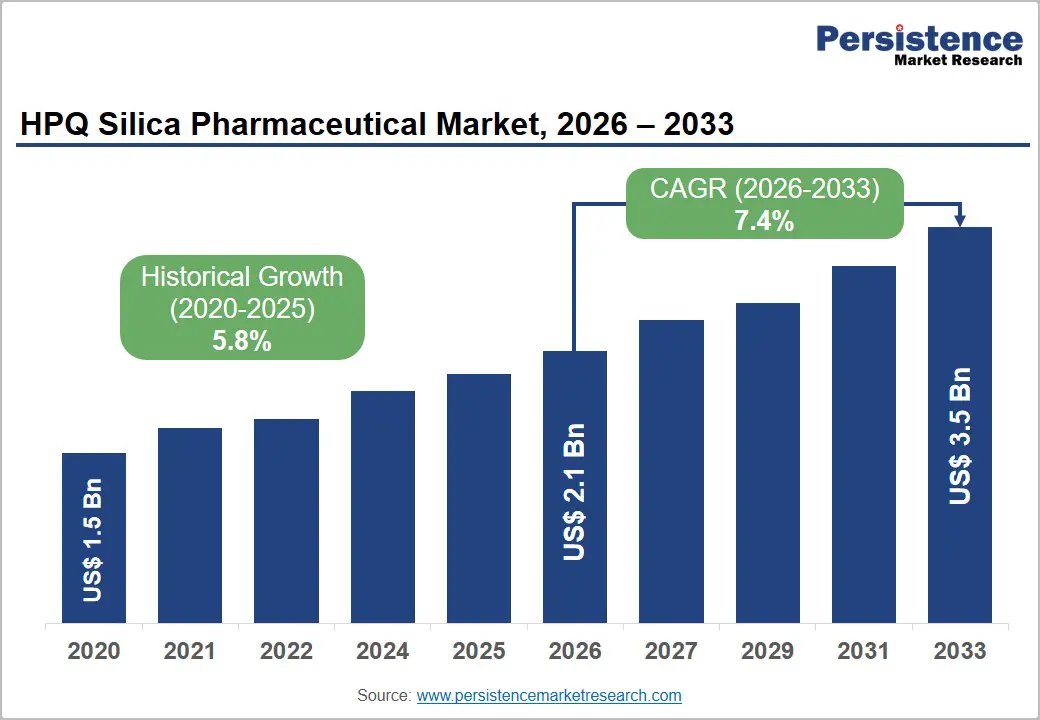
The global HPQ silica pharmaceutical market size is expected to be valued at US$ 2.1 billion in 2026 and is projected to reach US$ 3.5 billion, growing at a CAGR of 7.4% between 2026 and 2033. The expansion of global pharmaceutical manufacturing and an increasing demand for high-purity excipients that comply with stringent regulatory standards from the USP, EP, and ICH.
The World Health Organization (WHO) reports that global pharmaceutical production has grown at over 6% annually for the past decade, fueling the demand for high-purity silica excipients used in various formulations. Additionally, the rapid growth of the nutraceutical and dietary supplement markets, particularly in the Asia Pacific and North America, is enhancing the application of pharmaceutical-grade silica beyond traditional drug manufacturing into functional food and health supplement sectors.
Key Industry Highlights:
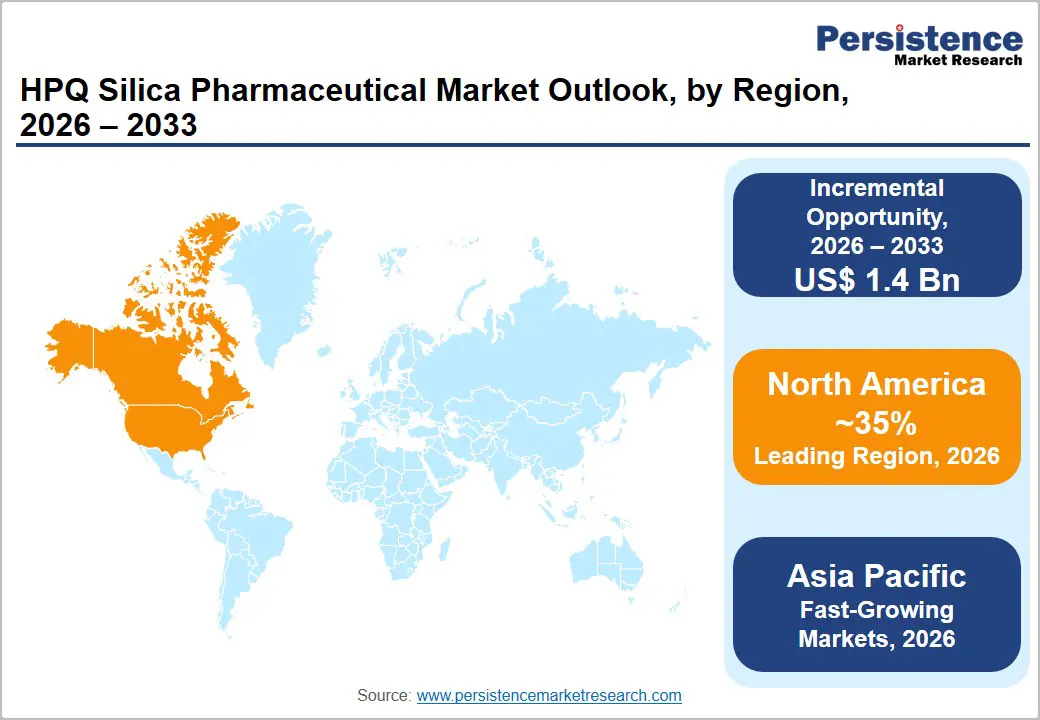
- Regional Leader: North America leads the global HPQ Silica Pharmaceutical market with approximately 35% share in 2026, anchored by the world's largest pharmaceutical manufacturing base, FDA/USP excipient quality mandates that exclude lower-purity alternatives, and accelerating IRA-backed domestic drug manufacturing investment that sustains structured pharmaceutical silica procurement through 2033.
- Fastest Growing Region: Asia Pacific is the fastest-growing regional market at an estimated CAGR of 7.2% through 2033, driven by India's PLI pharmaceutical scheme funding OSD capacity expansion, China's NMPA-ICH harmonization upgrading excipient quality requirements, and the region's rapidly expanding nutraceutical market generating above-average silica consumption growth across multiple application sub-segments.
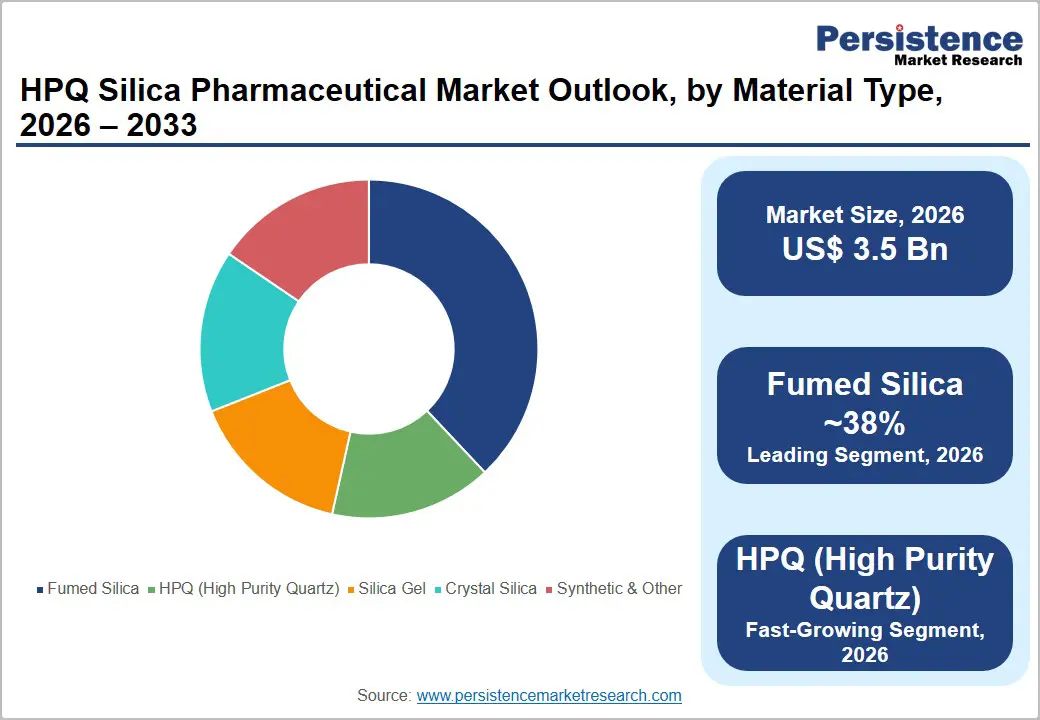
- Leading Segment: Fumed Silica dominates the material type segment with approximately 38% market share in 2026, entrenched by multi-pharmacopoeia certifications for AEROSIL and CAB-O-SIL brands, the ingredient's non-substitutable role as a tablet glidant and drug carrier, and conservative pharmaceutical formulation change protocols that create high switching barriers protecting established supplier positions.
- Fastest Growing Segment: Mesoporous Silica Nanoparticles (MSN) represent the fastest-growing material innovation category, growing at an estimated CAGR above 12%, supported by NIH-backed research demonstrating 2-8 fold bioavailability improvement for BCS Class II drugs and the EMA's 2024 updated nanotechnology guidance that signals a clearer regulatory pathway for MSN-based drug delivery platforms entering clinical development.
- Key Market Opportunity: The highest-value market opportunity lies in GMP-compliant MSN synthesis and advanced drug delivery silica platform development, where technical barriers to entry are substantially higher than commodity excipients, regulatory pathway clarity is improving, and pharmaceutical manufacturers' willingness to pay premium prices for bioavailability-enabling excipients creates structurally superior margin profiles versus standard pharmaceutical silica excipient supply.
DRO Analysis
Drivers - Global Pharmaceutical Manufacturing Expansion
The expansion of global pharmaceutical production capacity, driven by an aging population, rising chronic disease rates, and increased investments in domestic active pharmaceutical ingredient (API) manufacturing, is significantly elevating the demand for pharmaceutical-grade silica worldwide. The International Pharmaceutical Excipients Council (IPEC) has established strict standards for purity, particle size, and heavy metal content for silica in pharmaceutical applications.
Only pharmaceutical-grade fumed silica and high-purity quartz (HPQ) products meet these criteria, creating a high-barrier procurement environment that benefits certified specialty silica producers. Additionally, the FDA's Inactive Ingredient Database identifies silicon dioxide as one of the most frequently used inactive excipients in approved drug products in the U.S., highlighting its essential role across various drug formulation categories, including tablets, capsules, topical applications, and inhalation products.
Advancing Drug Delivery Technologies Driving Premium Silica Grade Adoption
The pharmaceutical industry's transition toward advanced drug delivery systems, including amorphous solid dispersions (ASD), mesoporous silica nanoparticles (MSN), controlled-release formulations, and orally disintegrating tablets, is creating demand for performance-differentiated silica grades that can only be met by high-specification HPQ and fumed silica products. Evonik Industries' AEROSIL and SIPERNAT product families, along with Wacker Chemie's HDK series, are specifically designed for applications in the pharmaceutical industry.
Such products offer controlled specific surface areas, optimized pore structures, and modifications in surface chemistry. These features enable targeted drug loading, enhance dissolution rates, and improve bioavailability. Academic research published in journals including the Journal of Pharmaceutical Sciences and International Journal of Pharmaceutics confirms that mesoporous silica-based drug carriers improve bioavailability of poorly soluble BCS Class II and IV drugs by 2-8 fold, validating the technical rationale for pharmaceutical manufacturers' premium-grade silica specification investments.
Restraints - Stringent Regulatory Compliance Burden Creating High Qualification Barriers for New Entrants
The pharmaceutical silica market's most significant structural barrier is the extensive and costly qualification process that any new material, supplier, or specification change must undergo before commercial adoption by drug manufacturers. The FDA's drug master file (DMF) requirements, EMA's Active Substance Master File (ASMF) system, and equivalents in Japan (PMDA) and China (NMPA) require producers to submit comprehensive technical dossiers documenting manufacturing process controls, analytical testing protocols, and quality system compliance, processes requiring 18-36 months and substantial investment to complete. For incumbent pharmaceutical manufacturers, supplier qualification costs and the risk of change control-triggered revalidation under 21 CFR Part 211 create powerful switching cost incentives that entrench established silica suppliers, limiting competitive entry and market price competition at the premium certified-grade tier.
High-Purity Quartz Raw Material Scarcity and Supply Chain Concentration Risk
HPQ raw material, the primary feedstock for high-purity pharmaceutical silica production, is a finite, geographically concentrated natural resource, with commercial-grade deposits limited to specific geological formations in Norway, North Carolina (USA), Brazil, and limited locations in Australia and Central Asia. The U.S. Geological Survey (USGS) identifies HPQ as a critical mineral input for multiple advanced industrial applications simultaneously competing for supply, including semiconductor manufacturing, optical fibre, and pharmaceutical processing equipment.
Supply concentration creates structural vulnerability: geopolitical disruptions, environmental permitting delays, and natural disasters affecting key mining regions can create prolonged supply tightness that raises input costs for pharmaceutical silica producers globally, directly compressing manufacturer margins and potentially affecting supply continuity for drug manufacturers dependent on single-source raw material procurement.
Opportunities - Mesoporous Silica Nanoparticles as Next-Generation Drug Delivery Platforms
Recent advancements in the scientific and clinical validation of mesoporous silica nanoparticles (MSN) as drug delivery vehicles offer a unique and commercially beneficial opportunity for HPQ silica producers and specialty silica innovators. MSN’s distinguishing features, such as controlled pore sizes (2-50 nm), high specific surface areas (up to 1000 m²/g), customizable surface chemistry, and biodegradability, enable the delivery of previously undeliverable drug molecules and allow for targeted release profiles unattainable with conventional excipients.
Furthermore, the 2024 guidelines from the European Medicines Agency (EMA) provide a clearer regulatory pathway for MSN-based drug products. Producers who invest in GMP-compliant MSN synthesis, standardized characterization methods, and Drug Master File (DMF) submissions for MSN grades will be well-positioned in a next-generation drug delivery market, where technical barriers to entry are significantly higher than those for traditional pharmaceutical excipient production.
Pharmaceutical Manufacturing Expansion in Emerging Economies
The accelerating localization of pharmaceutical manufacturing capacity across India, China, South Korea, and Southeast Asian nations, driven by post-COVID-19 supply chain security mandates and national health policy objectives, is creating the fastest-growing regional demand pipeline for pharmaceutical-grade silica globally. India's Production-Linked Incentive (PLI) Scheme for Pharmaceuticals, allocating approximately INR 15,000 crore to domestic drug manufacturing investment, is directly funding the expansion of solid dosage form manufacturing capacity that consumes pharmaceutical silica as a critical formulation ingredient.
China's 14th Five-Year Plan for pharmaceutical industry development and the National Medical Products Administration (NMPA) harmonization with ICH guidelines are raising quality standards for pharmaceutical excipients used in Chinese drug manufacturing, progressively displacing lower-grade domestic silica products with specification-compliant imports or locally manufactured certified grades from producers investing in China market qualification, creating a structural volume uplift for global pharmaceutical silica suppliers willing to navigate China's regulatory environment.
Category-wise Analysis
Material Type Insights
Fumed silica is expected to maintain a leading position in the global high-purity quartz (HPQ) silica pharmaceutical market, holding approximately 38% of the market share. Its dominance stems from its exceptional versatility as a pharmaceutical excipient, produced through high-temperature flame hydrolysis of silicon tetrachloride, which results in consistent surface area and particle size characteristics.
Notable products, such as Evonik Industries' AEROSIL and Cabot Corporation's CAB-O-SIL, are recognized as benchmarks for pharmaceutical quality and are included in major pharmacopoeias like the USP, Ph.Eur., and JP. Additionally, the pharmaceutical industry’s conservative formulation change practices entrench established excipient specifications, creating substantial barriers to the adoption of alternative silica forms.
Application Insights
The Pharma & Nutraceutical application segment is expected to lead the HPQ Silica Pharmaceutical market, capturing approximately 48% of the total market share by 2026. This segment underscores the pharmaceutical industry's role as the largest consumer of pharmaceutical-grade silica, essential for tablet and capsule manufacturing. According to the International Pharmaceutical Excipients Council (IPEC), silicon dioxide is among the top ten inactive ingredients in solid oral dosage forms, with each batch of 500,000 tablets necessitating a 0.1-1.0% w/w silica addition for optimal performance.
Additionally, the nutraceutical dimension, encompassing dietary supplements, sports nutrition, and functional foods, represents the fastest-growing sub-segment, propelled by a 7-9% annual growth rate in the global dietary supplement market, as noted by the Council for Responsible Nutrition (CRN).
Regional Insights
North America HPQ Silica Pharmaceutical Market Trends & Analysis
North America holds approximately 35% of the global HPQ Silica Pharmaceutical market share. The region's demand is driven by a high concentration of global pharmaceutical OSD manufacturing, a strong nutraceutical industry, and significant R&D investment in advanced drug delivery by major firms like Pfizer and Merck.
U.S. HPQ Silica Pharmaceutical Market Size
The United States holds approximately 88% of North American market revenues, contributing with an approximate CAGR of 5.5%. The introduction of U.S. tariffs in 2025, with rates over 145% on certain Chinese imports, has disrupted supply chains for silica products, pushing North American buyers to seek alternative Western suppliers and complicating short-term sourcing. The IRA's domestic pharmaceutical manufacturing incentives are expected to sustain capital investment in U.S. solid dosage facilities through 2033, maintaining structural silica procurement growth.
Europe HPQ Silica Pharmaceutical Market Trends, Drivers, & Insights
Europe holds approximately 28% of the global HPQ Silica Pharmaceutical market share in 2025, shaped by the continent's rigorous European Pharmacopoeia excipient quality standards, deep-rooted pharmaceutical manufacturing traditions in Germany, Switzerland, France, and the U.K.
The broader geopolitical reconfiguration of European energy markets following the Ukraine conflict has also elevated manufacturing cost structures for energy-intensive silica production processes, particularly fumed silica production, which requires sustained high-temperature combustion, compressing producer margins and sustaining the above-average ASPs that European pharmaceutical silica commands versus Asian equivalents.
Germany HPQ Silica Pharmaceutical Market Size
Germany accounts for approximately 25% of European HPQ Silica Pharmaceutical revenues with an approximate CAGR of 5.2%. Germany's domestic pharmaceutical sector, led by Bayer AG, Boehringer Ingelheim, and Merck KGaA, provides a dense OEM customer base that sustains local silica procurement at scale, reinforcing Germany's position as Europe's largest national pharmaceutical silica market.
U.K. HPQ Silica Pharmaceutical Market Size
The United Kingdom contributes approximately 18% of European HPQ Silica Pharmaceutical revenues and is growing at an approximate CAGR of 5.0% through 2033. The U.K.'s pharmaceutical silica demand is underpinned by one of Europe's largest drug manufacturing bases, including AstraZeneca, GlaxoSmithKline (GSK), and Reckitt Benckiser.
France HPQ Silica Pharmaceutical Market Size
France contributes approximately 15% of European HPQ Silica Pharmaceutical revenues, representing an approximate CAGR of 4.8% through 2033. France's demand for pharmaceutical-grade silica is driven by a robust domestic industry. The Leem (Les Entreprises du Médicament) association indicates that France is among Europe’s top three pharmaceutical producers, with leading companies like Sanofi, Servier, and Pierre Fabre depending on a reliable supply of silica for their solid dosage manufacturing.
Asia Pacific HPQ Silica Pharmaceutical Market Drivers & Analysis
Asia Pacific holds approximately 27% of the global HPQ Silica Pharmaceutical market share and is the fastest-growing regional market, expanding at an estimated CAGR of approximately 7.2% through 2033. The growth is driven by the simultaneous scale-up of pharmaceutical manufacturing in China and India, rising nutraceutical consumption across the region's expanding middle class, and government-backed domestic pharmaceutical industry development programs.
China HPQ Silica Pharmaceutical Market Size
China accounts for approximately 45% of Asia-Pacific HPQ Silica Pharmaceutical revenues, contributing an estimated US$243 million at a CAGR of approximately 7.5% through 2033. China's market is shaped simultaneously by the world's largest and fastest-growing pharmaceutical manufacturing base and by the country's position as a major HPQ silica producer.
India HPQ Silica Pharmaceutical Market Size
India contributes approximately 20% of Asia Pacific HPQ Silica Pharmaceutical revenues, representing an approximate CAGR of 8.2%, among the highest national growth rates globally. India's structural growth driver is the country's position as the world's largest generic pharmaceutical manufacturer. The Pharmexcil reports India exported pharmaceutical products valued at over USD 27 billion in FY2023-24, with every generic solid oral dosage product manufactured for regulated markets requiring certified pharmaceutical-grade silica meeting USP, Ph.Eur., or BP monograph standards.
Japan HPQ Silica Pharmaceutical Market Size
Japan accounts for approximately 22% of Asia Pacific HPQ Silica Pharmaceutical revenues, contributing an approximate CAGR of 7.4% through 2033. Japan's market is characterized by exceptionally rigorous quality standards under the Japanese Pharmacopoeia (JP) and PMDA oversight, setting among the world's strictest specifications for pharmaceutical excipients, which exclusively enable high-purity certified silica grades from global producers.
Competitive Landscape
The global HPQ Silica Pharmaceutical market is moderately consolidated at the premium pharmaceutical-grade tier, with Evonik Industries AG, Wacker Chemie AG, Cabot Corporation, and Tokuyama Corporation collectively holding an estimated 55-60% of global pharmaceutical-grade silica revenues. Market leadership is sustained through proprietary manufacturing process IP, multi-pharmacopoeia DMF/ASMF filing portfolios, global GMP-certified manufacturing networks, and decades of validated OEM specification relationships at major pharmaceutical companies.
Key Developments:
- January 2025: Evonik announced plans to close two silica production facilities in North America as part of a strategic asset optimization program. The company will relocate production to larger silica hubs to improve competitiveness, strengthen long-term supply resilience, and support reliable availability for industries including pharmaceutical and high-purity silica applications.
- April 2026: Cabot Sanmar announced a INR 220 crore (approximately US$25 million) brownfield expansion of its Mettur fumed silica facility in India. The project aims to increase domestic production capacity to meet growing demand from pharmaceutical and specialty chemical applications, strengthening local supply availability for high-purity silica products.
- January 2026: HPQ Silicon announced that its pilot-scale fumed silica reactor achieved independently verified commercial-grade “150” performance, meeting required surface area and viscosity benchmarks. This milestone validates the scalability of its plasma-based production technology and supports commercialization opportunities for high-purity silica applications across pharmaceutical and specialty material sectors.
Companies Covered in HPQ Silica Pharmaceutical Market
- Evonik Industries AG
- Wacker Chemie AG
- Cabot Corporation
- Tokuyama Corporation
- Covia Holdings LLC
- The Quartz Corp
- Jiangsu Pacific Quartz Co. Ltd.
- Solvay S.A.
- Russian Quartz LLC
- Dow (DowDuPont)
- Momentive Performance Materials
- W.R. Grace & Co.
- PQ Group Holdings Inc.
- Heraeus Holding GmbH
- AGC Inc.
Frequently Asked Questions
The global HPQ Silica Pharmaceutical market is expected to be valued at US$ 2.1 billion in 2026 and projected to reach US$ 3.5 billion by 2033, growing at a CAGR of 7.4% over the 2026 - 2033 forecast period, representing a cumulative incremental opportunity of US$ 1.4 billion, underpinned by global pharmaceutical manufacturing expansion and tightening excipient quality regulatory standards across major drug-producing geographies.
The primary drivers are the structural expansion of global pharmaceutical manufacturing, with WHO-confirmed annual industry growth exceeding 6%, and the non-substitutable role of pharmaceutical-grade silica as a tablet glidant, drug carrier, and bioavailability enhancer mandated by USP, Ph.Eur., and ICH quality standards.
Fumed Silica leads the material type segment with approximately 38% market share in 2026, entrenched by its multi-pharmacopoeia compliance status, the global specification authority of Evonik's AEROSIL and Cabot's CAB-O-SIL brands, and the pharmaceutical industry's deeply conservative formulation change protocols that lock established fumed silica specifications into approved drug products for years to decades, creating structural supply continuity that benefits certified pharmaceutical-grade fumed silica producers.
North America leads with approximately 35% of the global HPQ Silica Pharmaceutical market share in 2025, underpinned by the world's largest pharmaceutical manufacturing base, the most rigorous FDA/USP excipient quality specifications that mandate pharmaceutical-certified silica grades, and IRA-backed domestic drug manufacturing investment sustaining capital expenditure in OSD production capacity.
The primary opportunity exists in the development of GMP-certified mesoporous silica nanoparticle (MSN) grades for advanced drug delivery applications. Supported by over 200 NIH research grants, the EMA's upcoming 2024 nanotechnology guidance, and data showing a 2-8 fold improvement in bioavailability.
The leading global HPQ Silica Pharmaceutical market participants are Evonik Industries AG, Wacker Chemie AG, Cabot Corporation, Tokuyama Corporation, W.R. Grace & Co., PQ Group Holdings, Heraeus Holding GmbH, and Solvay S.A. at the premium pharmaceutical certified tier, alongside HPQ raw material producers The Quartz Corp, Jiangsu Pacific Quartz, and Covia Holdings that supply the upstream critical mineral inputs to silica processing manufacturers globally.


