




- Display Technologies
- High Speed Cameras Market
High Speed Cameras Market Size, Share, Trends, Growth, Regional Forecasts, 2026 to 2033
High Speed Cameras Market by Spectrum Type (Visible RGB, Infrared, X-Ray), Application (Automotive, Aerospace & Defense, Media & Entertainment, Industrial Manufacturing), Component (Image Sensors, Lens, Memory Systems), and Regional Analysis for 2026-2033

High Speed Cameras Market Share and Trends Analysis
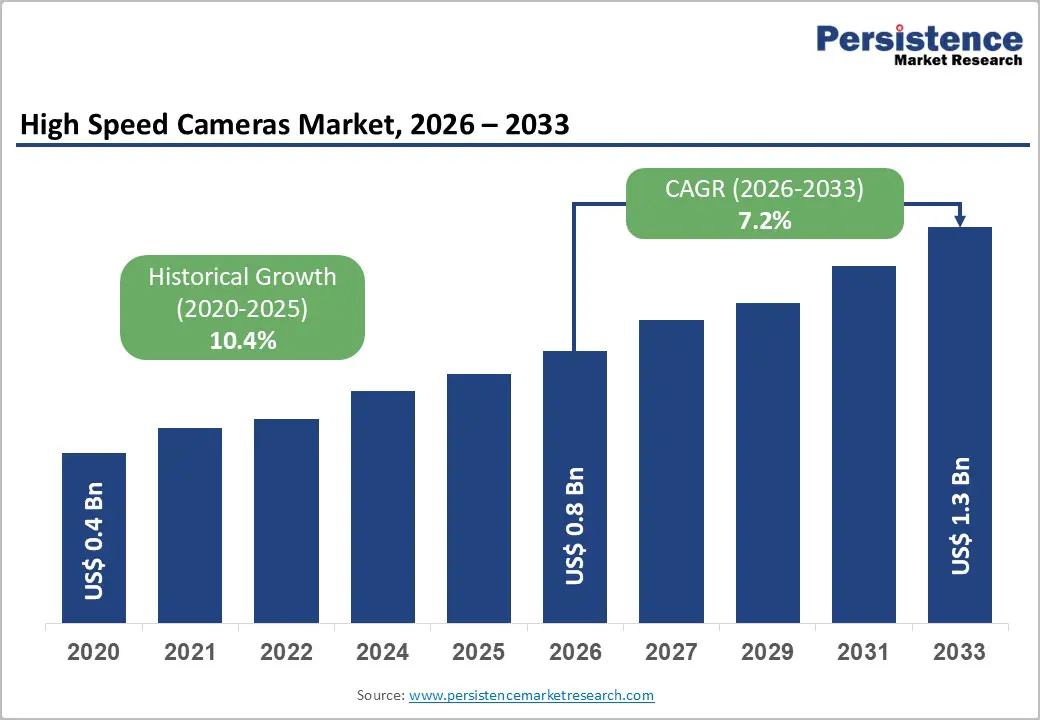
The global high speed cameras market size is likely to be valued at US$ 0.8 billion in 2026, and is projected to reach US$ 1.3 billion by 2033, growing at a CAGR of 7.2% during the forecast period 2026−2033.
The market is expected to demonstrate steady expansion driven by increasing demand across industrial automation, aerospace testing, and scientific research. The growth reflects rapid adoption in manufacturing quality control and defense applications. Continued advancements in sensor technology and rising investments in research & development (R&D) infrastructure are expected to sustain demand. Additionally, growing use in media production and sports analytics contributes to diversified application growth.
Key Industry Highlights
- Dominant Region: North America is anticipated to secure roughly 32% market share in 2026, supported by a substantial investment in R&D, and the strong demand from the automotive and aerospace sectors.
- Fastest-growing Market: The Asia Pacific market is set to experience the fastest 2026-2033 growth, owing to the rapid industrialization and technological advancements.
- Leading Spectrum Type: Visible RGB is projected to command approximately 58% revenue share in 2026 due to its broad applicability across multiple industries.
- Fastest-growing Spectrum Type: Infrared is likely to be the fastest-growing segment during the 2026-2033 forecast period, driven by its broadening use in specialized applications across defense, medical diagnostics, and semiconductor inspection.
- Market Driver: The increasing integration of high-speed cameras in automated manufacturing environments is becoming a key force driving industrial transformation.
| Key Insights | Details |
|---|---|
| High Speed Cameras Market Size (2026E) | US$0.8 Bn |
| Market Value Forecast (2033F) | US$1.3 Bn |
| Projected Growth (CAGR 2026 to 2033) | 7.2% |
| Historical Market Growth (CAGR 2020 to 2025) | 10.4% |
DRO Analysis
Rising Demand for Industrial Automation and Quality Inspection
The increasing integration of high-speed cameras in automated manufacturing environments is becoming a key force driving industrial transformation. Manufacturers are actively adopting advanced imaging systems to strengthen precision, consistency, and operational control across production lines. High-speed cameras are enabling real-time monitoring of fast-moving processes, allowing engineers to identify defects at an early stage and take corrective action immediately. Industries such as automotive and electronics are relying on these systems to ensure product quality while maintaining high production speeds. The shift toward Industry 4.0 is further encouraging the adoption of interconnected and intelligent manufacturing systems.
High-speed imaging systems are also improving production efficiency by capturing rapid events that conventional cameras cannot detect. These systems are supporting better analysis of mechanical movements, material behavior, and assembly processes under high-speed conditions. Manufacturers are using this capability to refine production techniques, reduce downtime, and enhance overall equipment effectiveness. In addition, high-speed cameras are integrating with machine vision systems and artificial intelligence (AI) to enable automated inspection and predictive maintenance. This integration is helping organizations reduce manual intervention while improving accuracy and reliability. As industrial ecosystems are becoming more connected and intelligent, demand for advanced imaging solutions is expected to continue rising, as companies are focusing on achieving higher productivity and maintaining strict quality standards.
Advancements in Sensor Technology and Imaging Capabilities
Technological progress in complementary metal-oxide-semiconductor (CMOS) sensors is continuously improving the performance of high-speed cameras. Manufacturers are enhancing sensor architecture to deliver higher resolution, faster frame capture, and better light sensitivity. These improvements are enabling cameras to capture extremely fast events with greater clarity and accuracy. Organizations such as the Institute of Electrical and Electronics Engineers (IEEE) and the International Society for Optics and Photonics (SPIE) are supporting research that is advancing imaging capabilities across multiple domains. High-speed cameras are now operating effectively in low-light environments, which is expanding their use in scientific experiments, defense testing, and industrial diagnostics.
Engineers are also refining optical components and signal processing techniques to ensure consistent image quality under challenging conditions. advancements in data processing and storage technologies are strengthening the overall efficiency of high-speed imaging systems. Modern cameras are integrating with high-performance computing platforms that are enabling faster image analysis and real-time decision-making. This capability is reducing delays in data interpretation and is supporting applications that require immediate feedback. In addition, manufacturers are gradually reducing production costs through improved fabrication techniques and economies of scale.
Integration Complexity with Existing Industrial Ecosystems
High-speed cameras are increasingly creating integration challenges as organizations are attempting to align them with existing industrial environments. Many production facilities are still relying on legacy infrastructure that is not supporting advanced imaging technologies. This gap is forcing companies to redesign workflows and adjust system configurations before deployment. Engineers are continuously modifying hardware interfaces and updating communication protocols to ensure compatibility between imaging systems and production equipment. These efforts are extending implementation timelines and are increasing operational complexity. Moreover, organizations are carefully evaluating how these systems will fit into broader digital transformation strategies under Industry 4.0, where connectivity and interoperability are becoming essential requirements.
Companies are investing in workforce development to ensure effective system utilization. Employees are undergoing training to understand imaging workflows, system calibration, and data interpretation processes. This learning phase is requiring time and resources, which is slowing down immediate productivity gains. Furthermore, integration is demanding coordination between information technology (IT) teams and operational technology (OT) teams, which is adding another layer of complexity. As industrial environments are becoming more interconnected, businesses are recognizing that successful implementation depends on both technical alignment and human expertise. Until organizations are achieving higher levels of digital readiness, integration challenges are likely to remain a significant barrier, influencing the pace at which high-speed cameras are being adopted across industries.
Skill Gap in Advanced Imaging and Data Interpretation
The growing sophistication of high-speed cameras is increasing the need for specialized technical skills across industries. Organizations are actively seeking professionals who understand image analysis, system calibration, and data interpretation in detail. These roles are requiring knowledge of both imaging technology and application-specific domains such as fluid dynamics, material science, and machine diagnostics. As high-speed cameras are becoming more advanced, users are needing a deeper understanding of system configuration and performance optimization. This requirement is creating challenges for companies that are adopting these systems without having access to trained personnel.
The shortage of skilled professionals is becoming more visible, particularly in developing regions where access to advanced technical education is still evolving. Companies are responding by investing in structured training programs and forming partnerships with academic institutions and research organizations. These initiatives are helping to build knowledge and improve workforce readiness over time. However, the learning curve associated with high-speed imaging systems is remaining steep, which is slowing down adoption in some sectors. In addition, organizations are increasingly depending on cross-functional collaboration between engineering, data analysis, and operational teams to maximize system efficiency.
Integration with AI and Machine Learning
The integration of AI and machine learning (ML) with high-speed imaging systems is reshaping how industries are analyzing and acting on visual data. Organizations are increasingly combining advanced cameras with intelligent algorithms to automate inspection and monitoring processes. These systems are identifying defects, irregular patterns, and performance deviations with greater accuracy and consistency. AI-driven models are continuously learning from captured data, which is improving their ability to detect anomalies over time. Companies are reducing reliance on manual inspection and are enhancing operational efficiency. This shift is also supporting faster decision-making, as insights are being generated in real time and are enabling immediate corrective actions across production environments.
The convergence of imaging technology with intelligent analytics is creating new opportunities across smart manufacturing and autonomous systems. High-speed cameras are providing detailed visual inputs, while machine learning models are interpreting this data to support predictive maintenance and process optimization. This combination is helping organizations anticipate equipment failures and minimize downtime. In addition, industries are exploring applications in robotics, transportation, and healthcare, where automated vision systems are playing a critical role.
Growth in Media, Entertainment, and Sports Analytics
High-speed cameras are increasingly becoming essential tools in film production, live sports broadcasting, and motion analysis. Content creators are using these systems to capture detailed visuals that standard cameras cannot record. In film production, directors and cinematographers are relying on high-speed imaging to create smooth slow-motion sequences and enhance visual storytelling. Broadcasters are using these cameras to deliver immersive viewing experiences during live events. The growth of digital streaming platforms is also encouraging studios and production houses to invest in advanced imaging technologies.
the use of high-speed cameras in sports analytics is expanding as teams are focusing on performance improvement and injury prevention. Coaches and analysts are using motion tracking systems to study player movements and identify areas for optimization. These insights are helping teams refine training strategies and improve competitive outcomes. High-speed imaging is also supporting decision-making in officiating by providing accurate visual evidence during critical moments in games. Integration with Artificial Intelligence (AI) and data analytics tools is enhancing the ability to process and interpret captured footage. Media and sports industries are continuing to evolve, the demand for advanced imaging solutions is expected to increase, contributing to sustained growth in this market segment.
Category-wise Analysis
Spectrum Type Insights
Visible RGB is expected to hold around 58% of the high-speed cameras market revenue share in 2026, due to its broad applicability across multiple industries. These cameras are widely used in industrial inspection, media production, and scientific research because they provide reliable imaging under standard lighting conditions. Manufacturers are continuously improving resolution and image clarity, which is strengthening their usability in precision-driven environments. These systems are offering cost-effective solutions compared to specialized spectrum technologies, making them more accessible to a wider range of users. Established infrastructure and ease of integration are further supporting their sustained leadership in the market.
Infrared is likely to be the fastest-growing segment during the 2026-2033 forecast period, driven by their growing use in specialized applications across defense, medical diagnostics, and semiconductor inspection. These imaging technologies are enabling detection of patterns and anomalies that are not visible through standard imaging systems. In defense and surveillance, they are supporting enhanced monitoring capabilities under challenging environmental conditions. In healthcare, they are assisting in advanced diagnostic procedures. Improvements in sensor sensitivity and imaging precision are increasing their reliability.
Application Insights
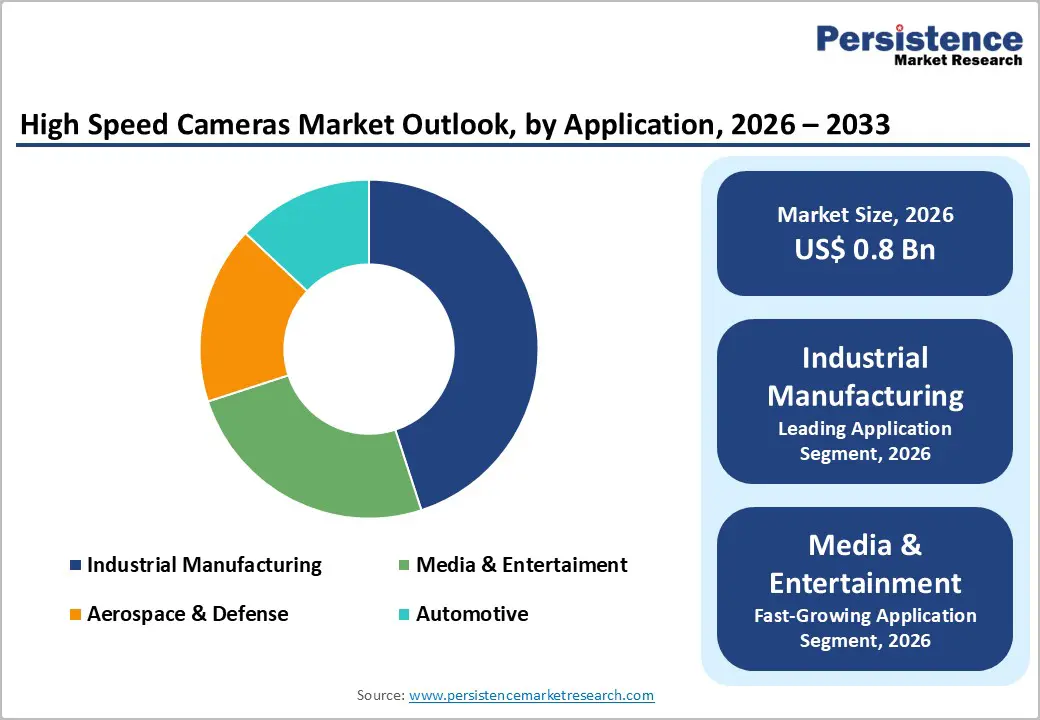
Industrial manufacturing represents the dominant application segment, capturing approximately 45% of market revenue share in 2026. Industrial manufacturing is a major application area for high-speed cameras, as companies are focusing on improving process accuracy and operational efficiency. These systems are being used to monitor fast-moving production lines, identify defects, and maintain consistent quality standards. Industries such as electronics, pharmaceuticals, and food and beverages are increasingly adopting high-speed imaging to strengthen inspection processes and reduce material waste. In addition, regulatory compliance requirements are encouraging manufacturers to implement reliable monitoring solutions. The ability to capture rapid events with precision is helping organizations optimize production workflows and enhance overall product quality.
Media & entertainment are expected to be the fastest-growing segment over the 2026-2033 forecast period. High-speed cameras are playing a critical role in the media and entertainment industry by enabling the capture of detailed slow-motion footage for films, advertisements, and sports broadcasts. Production teams are using these systems to record fast-moving scenes and present them with enhanced clarity and visual depth. This capability is improving storytelling and audience engagement across multiple content formats. The rising demand for high-quality visuals is encouraging studios and broadcasters to adopt advanced imaging technologies
Regional Insights
North America High Speed Cameras Market Trends
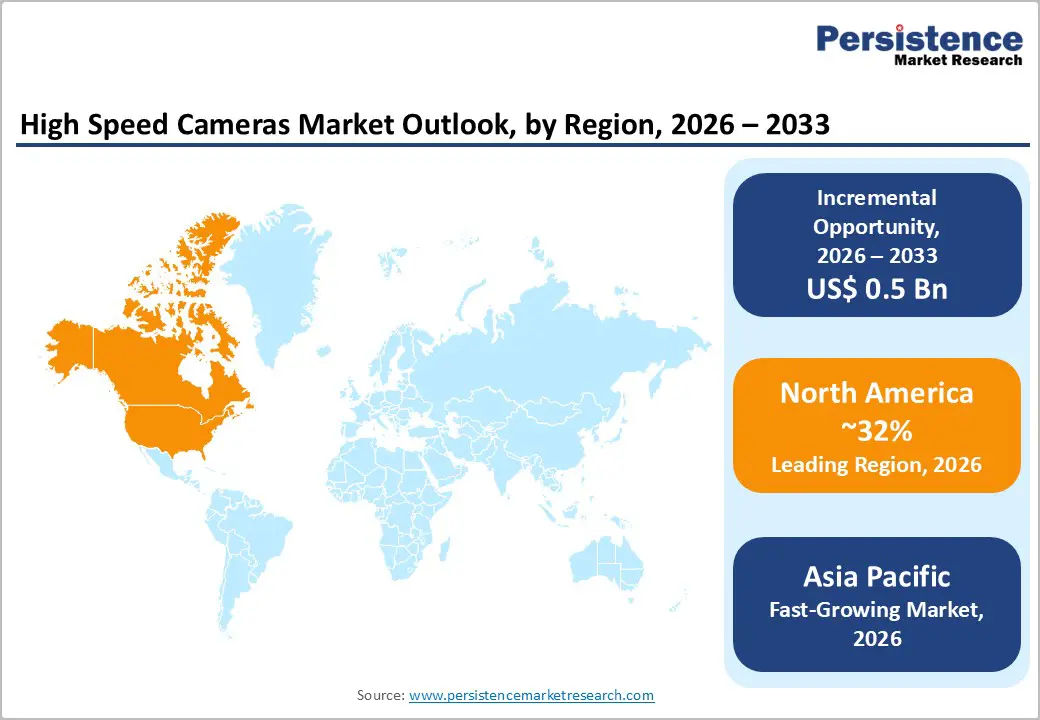
North America is set to command a significant portion of the high-speed cameras market share at approximately 32% in 2026, supported by strong contributions from the United States and Canada. The region is benefiting from a well-established industrial base and a mature technology ecosystem that is encouraging continuous innovation. Companies are actively investing in R&D to improve imaging performance and expand application capabilities. The presence of leading manufacturers and technology providers is strengthening the region’s competitive advantage. In addition, industries such as automotive and aerospace are consistently demanding high-speed imaging solutions for testing, validation, and quality assurance processes.
The United States is playing a central role in driving regional growth due to its strong focus on technological advancement and innovation. Organizations are collaborating with academic institutions and research centers to develop next-generation imaging solutions. Government agencies are also supporting innovation through funding initiatives and regulatory frameworks that encourage technological development. At the same time, companies are integrating high-speed cameras with AI and machine vision systems to enhance automation and data analysis capabilities. Canada is also contributing through advancements in industrial automation and scientific research. As industries are continuing to prioritize efficiency, safety, and precision, North America is expected to sustain its leadership position by fostering innovation and supporting the adoption of advanced imaging technologies.
Europe High Speed Cameras Market Trends
Europe is holding a strong position in the global high-speed cameras market, following North America in overall market presence. Countries such as Germany, the United Kingdom, and France are playing a central role in supporting regional demand. The region is benefiting from a well-established industrial base that is emphasizing precision engineering, product quality, and continuous innovation. Manufacturers are actively adopting advanced imaging solutions to enhance production efficiency and maintain strict quality standards. In addition, companies are investing in R&D to improve imaging technologies and expand their application across different sectors.
The automotive industry is acting as a key driver, as manufacturers are continuously improving vehicle safety and performance through advanced testing methods. High-speed cameras are being used to analyze crash tests, component behavior, and material performance under extreme conditions. At the same time, investments in aerospace and defense are supporting the adoption of high-speed imaging systems for research, simulation, and testing applications. Governments and regulatory bodies are encouraging innovation through policies that promote safety and technological development. Collaboration between industry players, research institutions, and technology providers is further strengthening the regional ecosystem.
Asia Pacific High Speed Cameras Market Trends
Asia Pacific is anticipated to emerge as the fastest-growing market for high-speed cameras through 2033, reinforced by rapid industrialization and continuous technological advancements. Countries such as China, Japan, and South Korea are leading the adoption of these systems across multiple sectors, including automotive, electronics, and general manufacturing. Companies are increasingly integrating high-speed imaging solutions to monitor production lines, improve precision, and ensure consistent product quality. At the same time, governments in the region are supporting technological innovation through policies that encourage automation, R&D, and digital transformation initiatives. As industries are focusing on improving efficiency and reducing operational costs, high-speed cameras are becoming essential tools for monitoring, inspection, and process optimization.
The demand for high-speed imaging is being driven by scientific research and advanced engineering applications. Universities, research institutions, and industrial laboratories are deploying these cameras to study fast-moving phenomena, analyze material behavior, and support experimental simulations. High-speed cameras are also being integrated with machine vision and data analytics platforms to enable real-time insights and predictive maintenance. Furthermore, Asia Pacific offers cost advantages in manufacturing and skilled labor, which is attracting global companies to establish local production and R&D facilities.
Competitive Landscape
The global high speed cameras market structure is moderately fragmented, dominated by leading players such as Photron Limited, Vision Research, NAC Image Technology, and Mikrotron GmbH. These players collectively capture 35-40% of the market share. The competitive landscape of the high-speed cameras market is being shaped by ongoing technological advancements, innovative product development, and strategic collaborations.
Leading companies are continuously expanding their product offerings, strengthening their global presence, and increasing investments in R&D to stay ahead of competitors. At the same time, new entrants are joining the market, intensifying competition and driving further innovation. Success in this market is increasingly dependent on the ability to deliver high-performance, reliable, and cost-effective imaging solutions that meet the evolving demands of diverse industries.
Key Industry Developments
- In March 2026, e-con Systems launched the STURDeCAM57, a 5MP RGB-IR global shutter camera designed for in-cabin monitoring, enabling continuous day-to-night vision using a single device. The camera combines RGB and infrared imaging with an onboard image processor and IR illumination, improving AI-based driver and occupant monitoring.
- In March 2026, Network Rail approved Ninehundred’s Incident Watch camera, a 4G-enabled system that enables real-time remote monitoring of trackside assets and incidents, reducing the need for on-site watch personnel. The solution enhances safety, speeds up decision-making, and improves operational efficiency following successful field trials across critical rail infrastructure locations.
- In November 2025, the National Highways Authority of India (NHAI) deployed a camera-based automatic tolling system on key Chennai–Bengaluru highway and GST Road stretches, replacing toll booths with ANPR-enabled, FASTag-integrated systems. The Multi-Lane Free Flow system allows vehicles to pass at high speeds without stopping, reducing congestion, travel time, and fuel consumption while enabling seamless toll deduction.
Companies Covered in High Speed Cameras Market
- Photron Limited
- Vision Research
- NAC Image Technology
- Mikrotron GmbH
- AOS Technologies AG
- Fastec Imaging Corporation
- iX Cameras
- Optronis GmbH
- DEL Imaging Systems
- Weisscam GmbH
- Motion Engineering Company
- Olympus Corporation
- Sony Corporation
- Canon Inc.
- FLIR Systems
Frequently Asked Questions
The global high speed cameras market is projected to reach US$ 0.8 billion in 2026.
Rising demand for motion analysis in automotive crash testing, aerospace, sports broadcasting, and industrial automation is boosting market growth.
The market is poised to witness a CAGR of 8.0% from 2026 to 2033.
Expansion in AI-driven analytics for quality control and emerging applications in healthcare/biomedical and consumer electronics are offering significant growth potential.
Photron Limited, Vision Research, NAC Image Technology, and Mikrotron GmbH are some of the key players in the market.


