




- Renewable Energy
- Green Technology and Sustainability Market
Green Technology and Sustainability Market Size, Share, and Growth Forecast 2026 - 2033
Green Technology and Sustainability Market by Component (Solutions, Services), by Technology (Internet of Things (IoT), Artificial Intelligence (AI) & Analytics, Cloud Computing, Digital Twin, Blockchain, Edge Computing, Cybersecurity), Industry (Energy & Utilities, Manufacturing, Automotive & Transportation, Agriculture, Retail & Consumer Goods, Healthcare & Life Sciences, BFSI, Chemicals & Materials), and Regional Analysis, 2026 - 2033

Green Technology and Sustainability Market Size and Trend Analysis
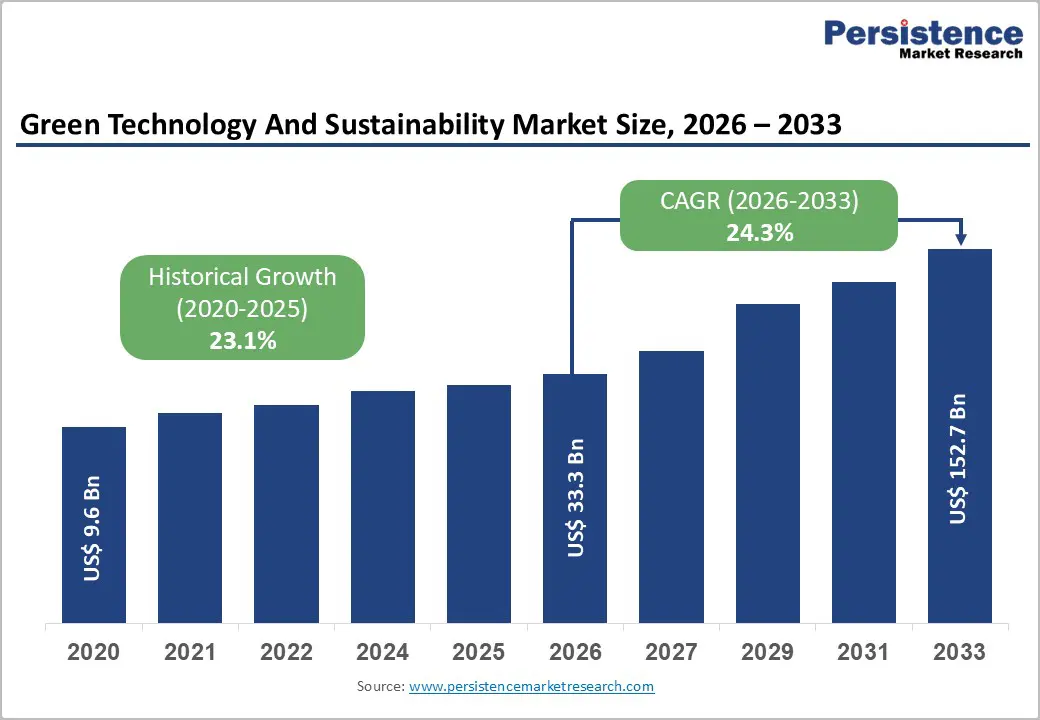
The global green technology and sustainability market size is expected to be valued at US$ 33.3 billion in 2026 and projected to reach US$ 152.7 billion by 2033, growing at a CAGR of 21.4% between 2026 and 2033.
Growth is being driven by tightening global environmental regulations, rising energy cost pressures, and a surge in corporate environmental, social, and governance (ESG) commitments. Governments are aligning climate policies with global agreements to reduce emissions and expand renewable energy adoption. Increasing corporate focus on carbon neutrality and science-based targets is boosting demand for smart grids, energy-efficient systems, and digital monitoring solutions. Meanwhile, falling solar costs and advancements in energy storage are further accelerating the adoption of sustainable technologies worldwide.
Key Industry Highlights:
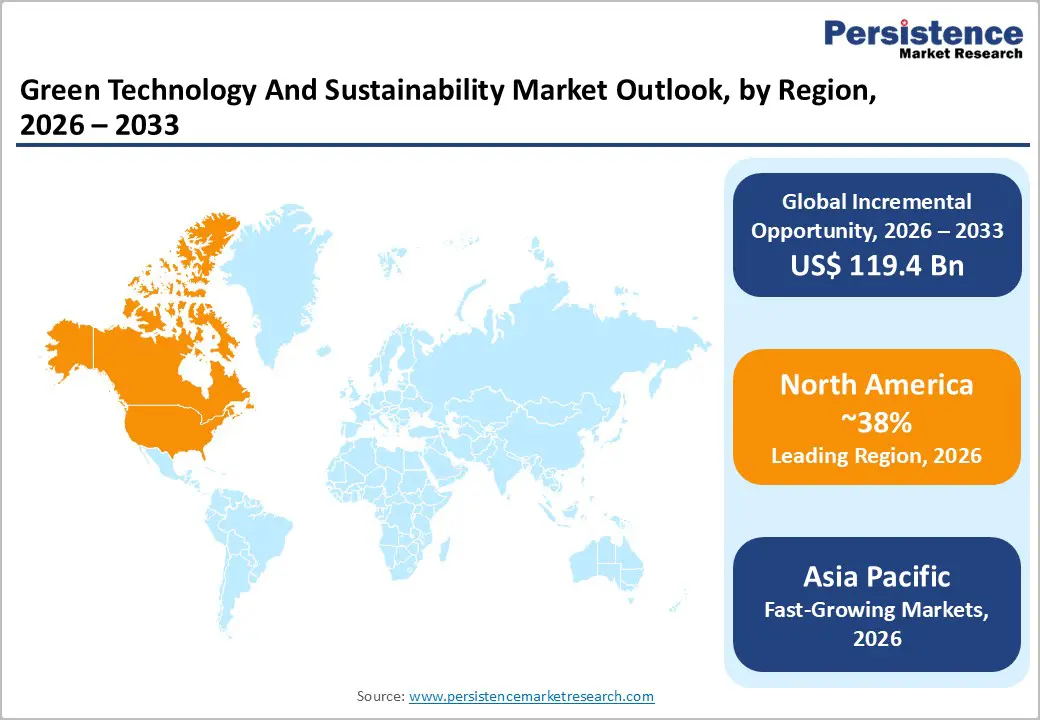
- Leading Region: North America leads with 38% share in 2025, driven by strong policy support and advanced infrastructure.
- Fastest Growing Region: Asia Pacific holds 32.3% share in 2025 and is expanding rapidly due to industrial growth and renewable investments.
- Leading Component: Solutions dominate with 62% share in 2025 due to high demand for integrated sustainability systems.
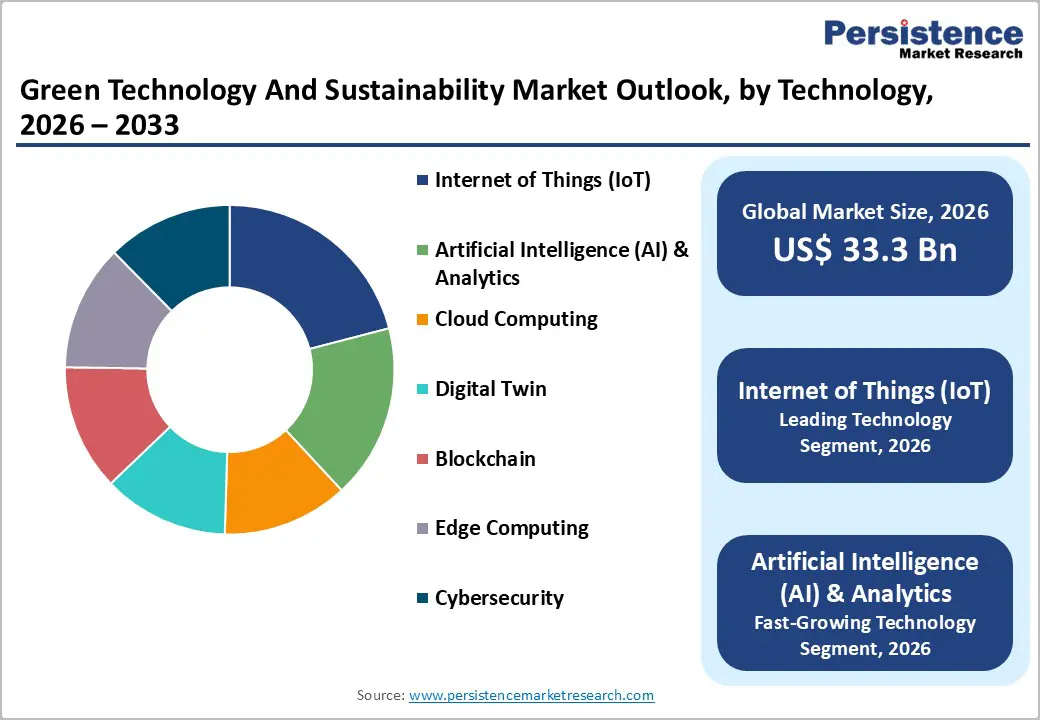
- Leading Technology: IoT leads with 28% share in 2025, enabling real-time monitoring and smart operations.
- Key Opportunity: AI-driven optimization offers major growth potential by improving efficiency and renewable integration.
| Key Insights | Details |
|---|---|
| Green Technology and Sustainability Market Size (2026E) | US$ 33.3 Billion |
| Market Value Forecast (2033F) | US$ 152.7 Billion |
| Projected Growth CAGR (2026 - 2033) | 21.4% |
| Historical Market Growth (2020 - 2025) | 23.1% |
Market Dynamics
Drivers - Regulatory Frameworks and Government-Driven Decarbonization Policies Accelerating Market Growth
Regulatory frameworks and government-led climate policies are key drivers of the Green Technology and Sustainability Market. Initiatives such as the European Union’s Green Deal and Fit for 55 package, along with the United States’ Inflation Reduction Act, are pushing large-scale adoption of renewable energy, smart grids, and energy efficiency technologies. These policies create strong compliance requirements, encouraging industries to invest in low-carbon infrastructure and digital sustainability solutions.
In Asia, programs like China’s 14th Five-Year Plan and India’s National Green Hydrogen Mission further support clean energy development and green infrastructure expansion. Such long-term, policy-driven commitments provide market stability and drive demand across Energy & Utilities, Manufacturing, and Automotive sectors, significantly accelerating the adoption of advanced green technologies worldwide.
Rising ESG Commitments and Investor Pressure Driving Sustainable Technology Adoption
The growing importance of environmental, social, and governance (ESG) criteria is another major driver of market growth. Institutional investors and financial institutions are increasingly prioritizing sustainability performance, compelling companies to adopt carbon tracking systems, IoT-enabled monitoring tools, and AI-driven analytics platforms. This shift ensures better transparency, risk management, and compliance with evolving global reporting standards.
Regulations aligned with frameworks such as the Task Force on Climate-Related Financial Disclosures are further reinforcing the need for companies to disclose environmental impact and sustainability strategies. As a result, industries including BFSI, Healthcare & Life Sciences, and Retail are rapidly investing in green technologies to meet stakeholder expectations and strengthen their long-term sustainability positioning.
Restraints - High Initial Capital Requirements and Financing Constraints Limiting Adoption Pace
High upfront investment requirements remain a significant restraint in the Green Technology and Sustainability Market. Many renewable energy systems, energy storage solutions, and advanced sustainability platforms demand substantially higher initial capital compared to conventional alternatives. This cost barrier is particularly evident in large-scale solar and wind projects, carbon capture technologies, and digital monitoring infrastructure, where capital intensity can deter rapid deployment.
Small and medium-sized enterprises (SMEs), especially in developing economies, face limited access to green financing, further slowing adoption. In sectors such as Chemicals & Materials and heavy Manufacturing, long payback periods and the presence of legacy infrastructure discourage immediate transition to green solutions. Additionally, existing energy subsidies in some regions reduce the economic urgency to shift toward sustainable technologies.
Lack of Standardization, Interoperability, and Rising Cybersecurity Challenges
The absence of standardized frameworks and interoperability across green technologies poses another major restraint to market growth. Many IoT devices, edge systems, and legacy industrial equipment operate on different protocols, creating integration challenges when building unified sustainability platforms. This fragmentation increases implementation complexity, extends deployment timelines, and raises overall system costs for enterprises.
At the same time, the growing reliance on connected infrastructure such as smart grids, EV charging networks, and cloud-based sustainability platforms introduces heightened cybersecurity risks. Data breaches and cyberattacks can disrupt operations, compromise emissions tracking, and affect critical energy systems. These risks create hesitation among industries like BFSI and Healthcare, where data security and system reliability are paramount, thereby slowing adoption of advanced green technologies.
Opportunity - AI-Driven Optimization and Smart Integration of Renewable Energy Systems
A major opportunity in the Green Technology and Sustainability Market lies in the integration of Artificial Intelligence (AI), advanced analytics, and digital twin technologies to optimize resource utilization and renewable energy management. As renewable energy is expected to form a dominant share of global electricity capacity additions, the need for intelligent forecasting, demand response, and grid balancing solutions is increasing rapidly. These technologies enable utilities and industries to improve operational efficiency while reducing energy losses.
AI-driven systems are already enhancing forecasting accuracy for wind and solar generation and enabling predictive maintenance of critical assets, reducing downtime and operational costs. Beyond energy, these solutions are being applied in water management, waste optimization, and supply chain sustainability. The convergence of AI, IoT, and blockchain creates strong opportunities across Energy & Utilities, Manufacturing, and Agriculture sectors.
Expansion into Agriculture, Healthcare, and Emerging Market Industrialization
Significant growth opportunities exist in expanding green technologies into Agriculture, Healthcare & Life Sciences, and emerging market manufacturing sectors. In agriculture, initiatives promoting solar-powered irrigation, IoT-based monitoring, and precision farming are driving efficient resource use, reducing dependency on traditional energy sources while improving crop productivity and sustainability outcomes. These solutions are especially critical in regions facing water scarcity and energy constraints.
In Healthcare, the adoption of green building standards and energy-efficient systems is reducing operational energy consumption while supporting sustainable infrastructure development. Meanwhile, emerging economies in Asia Pacific and Latin America are investing in energy-efficient manufacturing and circular economy solutions to meet global ESG requirements and export regulations. These developments create strong demand for scalable, cost-effective, and region-specific green technology solutions across industries.
Category-wise Analysis
Component Insights
The solutions category, accounted for 62% of the market share in 2025. This dominance is driven by strong demand for integrated offerings such as solar PV systems, smart metering platforms, IoT-enabled sensors, and energy management systems. These solutions enable organizations to deploy ready-to-use sustainability infrastructure with minimal customization, making them highly preferred. Large-scale investments in renewable energy and energy efficiency projects further reinforce the dominance of solutions across industries.
In contrast, the services segment is emerging as a rapidly growing category, driven by increasing demand for consulting, system integration, and managed services. Organizations are seeking expert guidance for ESG compliance, system deployment, and ongoing optimization. The growing complexity of sustainability initiatives and the need for customized implementation are accelerating service adoption across industries.
Technology Insights
In the technology segment, Internet of Things (IoT) dominates with around 28% share in 2025, driven by widespread deployment of connected sensors and smart devices. IoT enables real-time monitoring of energy consumption, emissions, and environmental parameters across industries. Its integration with smart grids, building automation systems, and precision agriculture ensures continuous data flow, making it the backbone of green technology infrastructure.
Artificial Intelligence (AI) and analytics are emerging as the fastest-growing technology segment due to their ability to process large datasets and optimize sustainability outcomes. AI is increasingly used for predictive maintenance, energy forecasting, and resource optimization. Its application across industries such as manufacturing, energy, and agriculture is expanding rapidly, supported by integration with cloud platforms and advanced analytics tools.
Industry Insights
The Energy & Utilities sector led with 35% share in 2025, owing to its critical role in global decarbonization efforts. This sector is heavily investing in renewable energy, smart grid infrastructure, and energy storage solutions to modernize aging systems and support clean energy transitions. Large-scale grid modernization programs and renewable energy integration projects further strengthen its dominance.
Manufacturing is emerging as a rapidly expanding segment as industries focus on reducing emissions and improving operational efficiency. The adoption of energy-efficient systems, IoT-based monitoring, and AI-driven process optimization is accelerating in this sector. Increasing regulatory pressure and the need to meet global sustainability standards are driving manufacturers to adopt advanced green technologies, making it one of the most dynamic growth areas.
Regional Insights
North America Green Technology and Sustainability Market Trends and Insights
North America dominates the Green Technology and Sustainability Market, holding approximately 38% of the global share in 2025. The region’s leadership is driven by aggressive climate policies, advanced digital infrastructure, and widespread adoption of ESG frameworks across industries. The United States plays a central role, with federal initiatives like the Inflation Reduction Act accelerating investments in renewable energy, smart grids, and energy storage systems. These developments are increasing demand for IoT-enabled monitoring systems, AI-driven analytics, and cloud-based sustainability platforms.
The region’s strong venture capital ecosystem and active startup landscape further support innovation in carbon tracking, digital twins, and emissions management solutions. Increasing regulatory requirements for climate risk disclosure, along with net-zero commitments from major corporations and financial institutions, are driving sustained demand. As a result, North America remains a global leader in both technological advancement and large-scale deployment of green technologies.
Europe Green Technology and Sustainability Market Trends and Insights
Europe maintains a strong position in the Green Technology and Sustainability Market, supported by its highly structured regulatory environment and long-term sustainability commitments. The region is witnessing steady growth with an estimated CAGR of around 23.2%, driven by policies such as the European Green Deal and Fit for 55 initiatives. These frameworks enforce strict emissions reduction targets and encourage large-scale investments in renewable energy, green hydrogen, and energy-efficient infrastructure. Countries like Germany, the United Kingdom, and France are leading adoption across wind, solar, and digital energy systems.
The region’s emphasis on sustainability reporting and data transparency, reinforced by regulations such as the Corporate Sustainability Reporting Directive, is boosting demand for advanced analytics and ESG platforms. Additionally, strong focus on data privacy and interoperability ensures the development of secure and scalable green technology solutions. Europe continues to be a key hub for innovation in sustainable technologies and regulatory-driven market growth.
Asia Pacific Green Technology and Sustainability Market Trends and Insights
Asia Pacific accounts for approximately 32.3% of the global Green Technology and Sustainability Market share in 2025, making it one of the largest regional contributors alongside North America. This significant share is supported by large-scale renewable energy deployments, expanding smart city projects, and strong manufacturing capabilities in countries such as China, India, Japan, and South Korea. Government initiatives promoting solar energy, green hydrogen, and digital infrastructure are further strengthening regional adoption across key industries.
The region is also witnessing the fastest growth due to rapid industrialization, urbanization, and increasing investments in clean technologies. Rising environmental concerns, supportive policy frameworks, and access to cost-effective manufacturing are accelerating the deployment of IoT-based monitoring systems, smart grids, and AI-driven optimization tools. These factors collectively position Asia Pacific as both a major revenue contributor and the fastest-evolving market for green technology solutions.
Competitive Landscape
The Green Technology and Sustainability Market is moderately consolidated, with a limited number of large multinational players holding a significant share, while the rest of the market remains fragmented among niche providers and regional system integrators. Leading companies offer integrated solutions across energy management, smart infrastructure, and industrial automation, enabling strong cross-selling opportunities.
Competition is intensifying as companies focus on mergers and acquisitions to enhance capabilities in software, AI-driven analytics, and digital sustainability platforms. At the same time, new entrants are gaining traction by offering specialized solutions such as carbon tracking, blockchain-based traceability, and edge computing applications, supported by flexible, subscription-based business models.
Key Developments:
- In June 2025, IBM launched an AI-powered sustainability-performance platform, enabling enterprises to automate carbon-footprint calculations, scenario-planning, and regulatory-reporting workflows, targeting improved grid-efficiency and cost reduction.
- In March 2024, Siemens AG acquired Uplight, a US-based energy-management software provider, to strengthen its IoT-enabled smart-grid and demand-response solutions for utilities and large-industrial customers.
- In November 2024, Schneider Electric partnered with Microsoft to integrate Azure-based cloud computing and digital-twin capabilities into its EcoStruxure platform, expanding offerings for green-building and data-center-efficiency projects.
Companies Covered in Green Technology and Sustainability Market
- Siemens AG
- Schneider Electric
- General Electric
- IBM
- Microsoft
- SAP
- Tesla
- Vestas Wind Systems
- ABB Ltd.
- Enel
- Oracle Corporation
- Engie Impact
- Xylem Inc.
- Wolters Kluwer
- Siemens Gamesa
Frequently Asked Questions
The market is projected to reach US$ 33.3 billion in 2026, driven by strong policy support, ESG adoption, and smart technology deployment.
Key drivers include strict climate regulations, rising energy costs, ESG mandates, and demand for digital tools across Energy & Utilities, Manufacturing, and BFSI.
North America leads with approximately 38% share in 2025, supported by strong policies, advanced infrastructure, and high ESG adoption.
AI-driven optimization and renewable integration present a major opportunity, enabling efficiency, smart grids, and advanced sustainability solutions.
Key players include Siemens AG, Schneider Electric SE, IBM Corporation, General Electric Company, and Honeywell International Inc.


