




- Renewable Energy
- Solar Microinverter Market
Solar Microinverter Market Size, Share, and Growth Forecast 2026 - 2033
Solar Microinverter Market by Product Type (Single Phase, Three Phase), Power Rating (Below 250 W, 250 W to 500 W), Application (Residential, Commercial), Distribution Channel (Online, Offline), and Regional Analysis, 2026 - 2033

Solar Microinverter Market Size and Trends Analysis
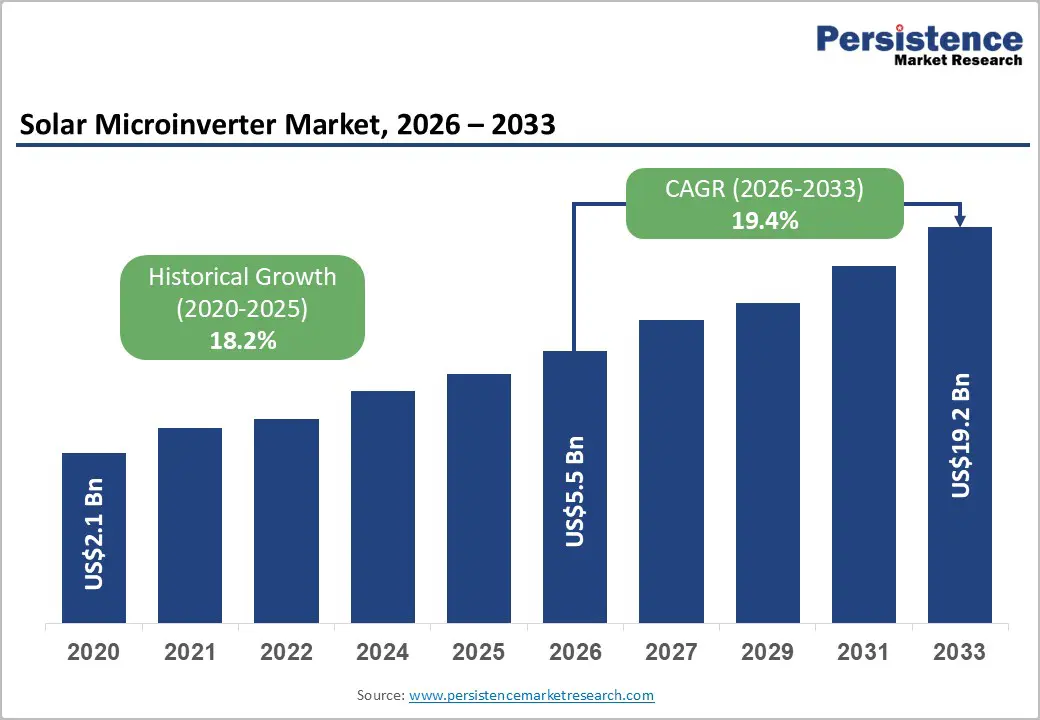
The global solar microinverter market size is likely to be valued at US$5.5 billion in 2026 and is expected to reach US$19.2 billion by 2033, growing at a CAGR of 19.4% during the forecast period from 2026 to 2033, driven by the expansion of rooftop solar installations, especially in residential and small commercial sectors, where microinverters improve energy yield through panel-level optimization. Rising focus on solar energy efficiency, real-time monitoring, and improved safety features, such as rapid shutdown compliance, is further fueling adoption.
Key Industry Highlights:
- Product Launch: In February 2025, Hoymiles introduced its MiS series microinverters at Intersolar North America 2025, positioning them as the lightest and most efficient in their class. The MiS 1-in-1 model weighs just 2.43 lbs and features a compact design that the company said reduces installation time by 70% compared to traditional systems.
- Leading Product Type: Single-phase, approximately 79.4% share in 2026, because most residential grids worldwide operate on single-phase power, making installation simple and cost-effective.
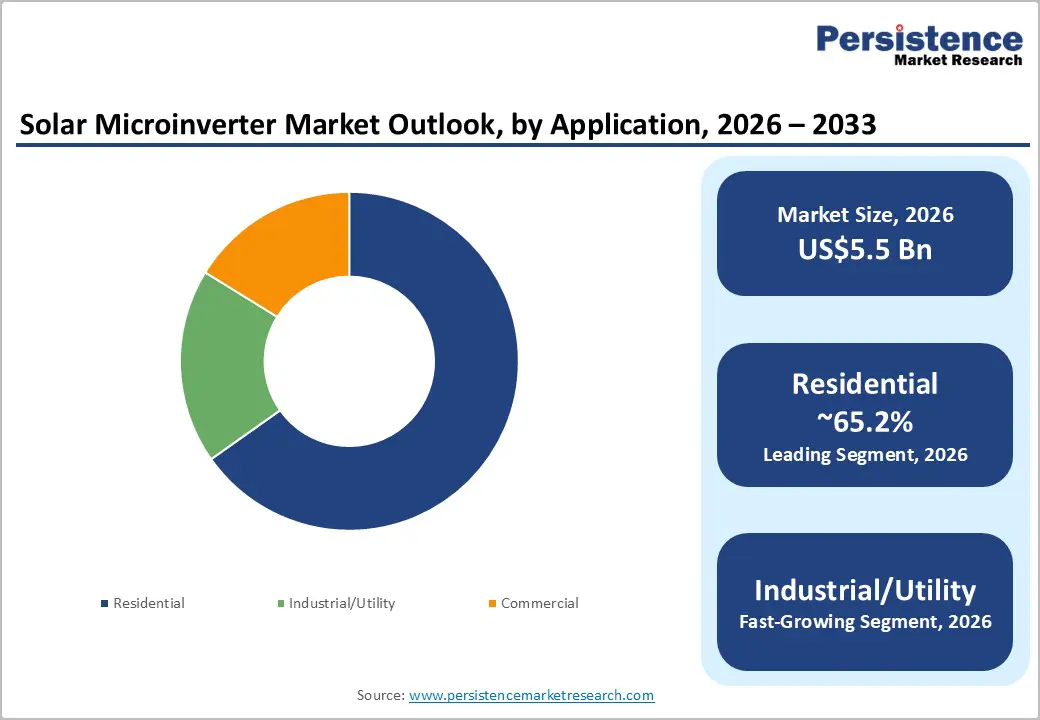
- Dominant Application: Residential, nearly 65.2% in 2026, owing to rising electricity costs pushing homeowners toward rooftop solar adoption.
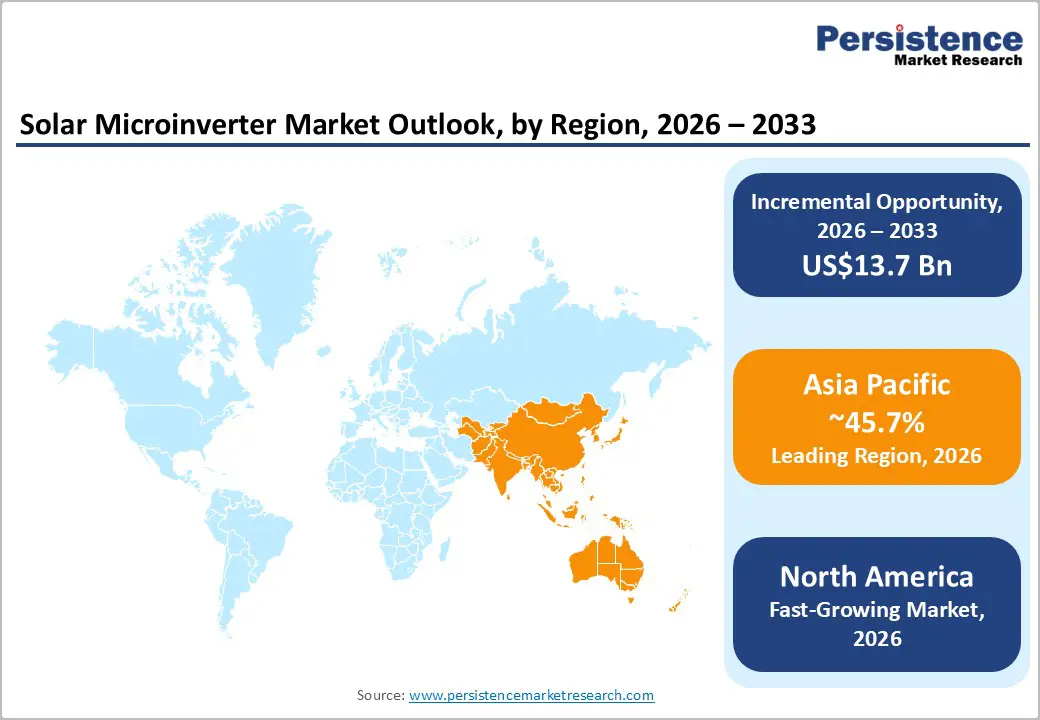
- Leading Region: Asia Pacific, with about 45.7% share in 2026, backed by large-scale rooftop solar expansion in countries such as China, India, and Australia.
- Fast-growing Region: North America, spurred by favorable policies such as tax credits under clean energy programs.
DRO Analysis
Driver - Tax Credits and Policy Support to Spur Clean Energy Adoption
Government financial support has given solar microinverters a clear structural advantage. Under the U.S. Inflation Reduction Act (IRA), microinverters are prioritized at an 11¢/W tax credit under the Advanced Manufacturing Tax Credit (Section 45X), which has motivated companies such as Enphase to shift production to the U.S. The residential solar credit was also boosted. Under the IRA, the tax credit was raised from 26% to 30% for solar installations and extended through 2032.
It directly reduces the upfront cost of installing microinverter-equipped systems, making them more accessible to homeowners. The policy also addressed coverage gaps. Battery backup systems now qualify for the credit regardless of when solar was installed, which further incentivizes full microinverter-plus-storage setups. The certainty of multi-year credit timelines gives both installers and buyers confidence to commit.
Surging Awareness of Climate Issues Worldwide
Broad awareness of climate issues has become a measurable demand signal in solar adoption. A 2025 Multidisciplinary Digital Publishing Institute (MDPI) systematic review, synthesizing 96 peer-reviewed publications from 2000 to 2024, found that solar adoption is influenced not only by environmental concern and perceived economic benefits but also by social norms, institutional trust, and demographic factors. This shows that rising environmental consciousness translates into real purchasing behavior, not just opinion.
Solar was the most prominent source of new electricity generation globally for the third consecutive year in 2024, adding 474 TWh and growing 29%, making it the fastest-growing electricity source for the 20th straight year. For microinverters specifically, this awareness-backed uptick in residential solar adoption directly extends the addressable customer base. This is because homeowners now prefer panel-level monitoring and efficiency, which microinverters uniquely provide.
Restraint - Rooftop Access to Make Servicing a Key Challenge
Microinverters are mounted directly beneath each solar panel on the roof, and this placement creates a practical maintenance problem. As Duane Wright, president of Fused Solar and Roofing, noted, most maintenance work involves replacing or repairing microinverters. In a 25-panel system, there are 25 fault points, all located underneath the panels on the roof. Identifying a failing unit first requires checking the monitoring software, then physically removing the panel above it.
Other installation-related issues include improperly torqued connections, inadequate roof flashing, and temperature-related condensation that causes corrosion of electrical components. These factors add labor time and roofing risk to what would otherwise be a simple inverter swap. Unlike a centralized string inverter installed on a wall, a faulty microinverter demands roof-level access. It raises both the service cost and the complexity for technicians.
Opportunity - Microinverters to be the Foundation for Home Energy Independence
Modern microinverters are moving well beyond simple power conversion. They are enabling homes to form self-sufficient energy islands during outages. Enphase's IQ8 Series Microinverters now support complete off-grid setups when paired with the IQ Battery 5P and a backup AC generator, providing energy resilience in remote or grid-unstable areas. A standout feature is grid-forming capability.
IQ8 microinverters can create a self-sustaining microgrid to power a home during grid failures, with the Sunlight JumpStart function delivering limited backup power directly from solar panels even without a battery. This matters because extreme weather events in the U.S. caused over US$182 billion in damages in 2024, with wildfires, hurricanes, and winter storms propelling widespread outages. As grid fragility rises, the ability to island a home safely becomes a compelling selling point. This positions microinverters as a resilience tool, not just a solar component.
GaN Semiconductors to Boost Microinverter Performance
The shift from silicon to gallium nitride (GaN) semiconductors is unlocking a new performance tier for microinverters. In September 2025, Enphase opened U.S. pre-orders for its IQ9N-3P Commercial Microinverter, its first GaN-powered microinverter. It is designed for three-phase 480 V commercial projects. The GaN technology enables quick switching, cool operation, and an industry-leading efficiency of 97.5%. The hardware partnership behind this is also significant. Infineon Technologies confirmed that its CoolGaN bi-directional switch technology enables improvements in power output, energy efficiency, and system reliability for Enphase's IQ9 Series.
GaN handles higher switching frequencies than silicon without generating excess heat, which reduces the requirement for bulky cooling hardware and allows more compact designs. The IQ9N-3P began production shipments in December 2025 and is manufactured in the U.S. to meet domestic content and Foreign Entity of Concern (FEOC) compliance requirements. This transition shows that GaN is moving from experimental to commercial standard in microinverter design.
Category-wise Analysis
Product Type Insights
Single-phase microinverters are predicted to lead with a share of approximately 79.4% in 2026, as they fit perfectly with residential electricity systems. Most homes worldwide use single-phase power, so installers prefer this setup. It reduces complexity and avoids the requirement for extra conversion equipment. Another factor is safety compliance. Microinverters support module-level shutdown, which is required under the U.S. National Electrical Code (NEC). This has pushed the adoption of single-phase systems in homes, especially in North America and Europe.
Three-phase microinverters are estimated to be the fastest-growing over the forecast period. These are widely used in commercial buildings, schools, and small industries. These setups require high load balancing and stable power output, which three-phase systems provide. However, adoption is lower as installation costs are high. Several commercial users still prefer string inverters for cost efficiency. That said, demand is rising in Europe. According to International Energy Agency reports, commercial rooftop solar installations are expanding in the EU, especially in logistics hubs and warehouses, where three-phase systems are required.
Application Insights
The residential segment is anticipated to dominate with a share of nearly 65.2% in 2026, as microinverters improve panel-level efficiency. They work well even when shading or dust affects a few panels. Government incentives are a key push. For instance, India’s rooftop solar program under the Ministry of New and Renewable Energy provides subsidies for residential users. The U.S. federal solar tax credit also covers rooftop installations, encouraging homeowners to adopt novel inverter systems.
The industrial/utility segment is expected to remain in the second position in 2026. Industrial users are now shifting to microinverters for reliability and modularity. Factories and warehouses prefer systems where one panel failure does not impact the full system. Government-backed solar projects, for example, are promoting distributed generation for disaster resilience in Japan. Microinverters allow sections of a plant to remain operational even during partial failures. Large retail chains and logistics companies are also adopting rooftop solar.
Regional Insights
Asia Pacific Solar Microinverter Market Trends
In 2026, Asia Pacific is predicted to dominate with a share of nearly 45.7%, backed by large-scale solar deployment and superior policy support. Countries such as China, India, Japan, and Australia are broadening rooftop solar at a fast pace. The region benefits from high solar irradiance and rising electricity demand. According to the International Energy Agency, Asia Pacific accounted for the majority of new solar capacity additions globally in recent years.
China Solar Microinverter Market Trends
China leads due to its massive solar manufacturing networks and domestic installations. It produces most of the world’s solar modules and inverter components. The National Energy Administration has pushed distributed solar through county-level rooftop programs. These programs aim to install solar across residential and commercial buildings at scale. Between 2023 and 2024, distributed solar made up a large share of China’s new installations, boosting demand for microinverters, especially in urban rooftops.
India Solar Microinverter Market Trends
India is growing steadily due to policy support and rising electricity costs. The government’s rooftop solar scheme targets millions of homes. The Ministry of New and Renewable Energy launched the PM Surya Ghar initiative in 2024. It aims to provide free electricity to households through rooftop solar. This is increasing the adoption of microinverters in urban homes. Net metering policies in states such as Maharashtra and Gujarat are also supporting installations. Growth is steady rather than explosive due to cost sensitivity in the market.
North America Solar Microinverter Market Trends
North America is estimated to witness the fastest growth in 2026, spurred by strict safety rules and advanced solar adoption. Microinverters are preferred because they meet rapid shutdown requirements. The U.S. Department of Energy supports distributed solar and grid resilience programs. These programs promote technologies such as microinverters. Canada is also expanding residential solar, especially in provinces such as Ontario and Alberta, where energy prices are rising.
U.S. Solar Microinverter Market Trends
The U.S. is a key growth market due to policy incentives and technology adoption. The Inflation Reduction Act (IRA) has increased tax credits for solar systems. This law supports domestic manufacturing and installation of solar equipment. Companies are also localizing production to qualify for incentives. Safety compliance under NEC further makes microinverters more attractive than traditional systems. Residential installers widely prefer them for ease of installation and monitoring.
Europe Solar Microinverter Market Trends
Europe shows decent growth, fueled by energy security concerns and high electricity prices. Countries are focusing on rooftop solar to reduce dependence on imports. The European Commission’s REPowerEU plan aims to bolster solar deployment across homes and businesses. This is pushing demand for microinverters, especially in small-scale systems. There is also rising demand for balcony solar systems in Germany and the Netherlands. These systems often use compact microinverters.
Germany Solar Microinverter Market Trends
Germany leads due to its mature solar ecosystem and rising rooftop adoption. The country has long supported feed-in tariffs and distributed solar. According to the Fraunhofer Institute for Solar Energy Systems, the country continues to add significant rooftop capacity each year. Balcony solar systems are also growing fast. These plug-and-play systems use microinverters and are popular among apartment residents.
Italy Solar Microinverter Market Trends
Italy is becoming a lucrative market due to increasing incentives and rising energy costs. The government has offered tax benefits for home solar installations under programs such as Superbonus. Southern Italy has high solar potential, which improves system efficiency. This makes microinverters attractive for maximizing output at the panel level. The Gestore dei Servizi Energetici supports distributed solar projects, including residential and small commercial systems, further boosting demand.
Competitive Landscape
The global solar microinverter market is moderately consolidated, with a few dominant players controlling a large share of installations. The competitive environment is currently led by Enphase Energy. It continues to dominate premium residential solar installations due to its expansive installer network, integrated energy ecosystem, and software-backed monitoring platform. APsystems and Hoymiles have emerged as key challengers by providing low-cost multi-module microinverters targeted at Europe and Asia Pacific.
Competition is now shifting away from pure hardware efficiency toward complete energy ecosystems. Companies are competing through AI-enabled monitoring software, battery compatibility, EV charger integration, smart grid support, and installer-friendly commissioning tools. SolarEdge Technologies, for example, has strengthened its position through acquisitions and domestic manufacturing expansion in the U.S. SMA Solar Technology, GoodWe, and Sungrow are expanding their distributed solar portfolios to capture residential and small commercial demand.
Key Industry Developments
- In February 2026, Enphase Energy introduced Power Control software for IQ9 and IQ8 Microinverter-based small commercial solar systems. The solution was designed to help installers cut costs, simplify interconnection, and unlock projects that would otherwise stall due to unfavorable project economics.
- In November 2025, Infineon Technologies announced that it was providing its gallium nitride (GaN) technology, specifically the CoolGaN bi-directional switch, for Enphase Energy's next-generation IQ9 Series Microinverters. The CoolGaN technology enables significant improvements in power output, energy efficiency, and system reliability for the IQ9N-3P Commercial Microinverter.
- In March 2025, Infineon Technologies announced a collaboration with Enphase Energy to integrate its 600 V CoolMOS 8 superjunction MOSFET technology into Enphase's microinverter systems. By adopting this component, Enphase was able to reduce MOSFET resistance in its solar inverter systems, resulting in low conduction losses, improved device efficiency, and high power density.
Companies Covered in Solar Microinverter Market
- SMA Solar Technology AG
- Canadian Solar
- SolarEdge Technologies Inc.
- Complete Solaria
- Enphase Energy
- Delta Electronics, Inc.
- Yaskawa - Solectria Solar
- Sineng Electric Co., Ltd.
- Hitachi Hi-Rel Power Electronics Private Limited
- Sungrow
- Sensata Technologies, Inc.
- Others
Frequently Asked Questions
The global solar microinverter market is projected to be valued at US$5.5 billion in 2026.
The market is expected to reach US$19.2 billion by 2033.
Key trends include a shift toward smart microinverters with real-time monitoring and rising adoption of balcony solar systems.
Single-phase is expected to be the leading product type with a share of nearly 79.4% in 2026, as the systems comply with rooftop solar demand.
The solar microinverter market is expected to grow at a CAGR of 19.4% from 2026 to 2033.
SMA Solar Technology AG, Canadian Solar, SolarEdge Technologies Inc., Solaria, and Delta Electronics, Inc. are a few key market players.


