




- Biotechnology
- Gas Chromatography Market
Gas Chromatography Market Size, Share, and Growth Forecast 2026 - 2033
Gas Chromatography Market by Product Type (Accessories & Consumables, Instruments, Services), Application (Pharmaceutical, Drug Development, Food & Beverage Testing, Chemical Analysis, Other), End-use Industry (Pharmaceutical, Chemical, Environmental Labs, Food and Beverage, Institutes, Other), and Regional Analysis, 2026 - 2033

Gas Chromatography Market Size and Trends Analysis
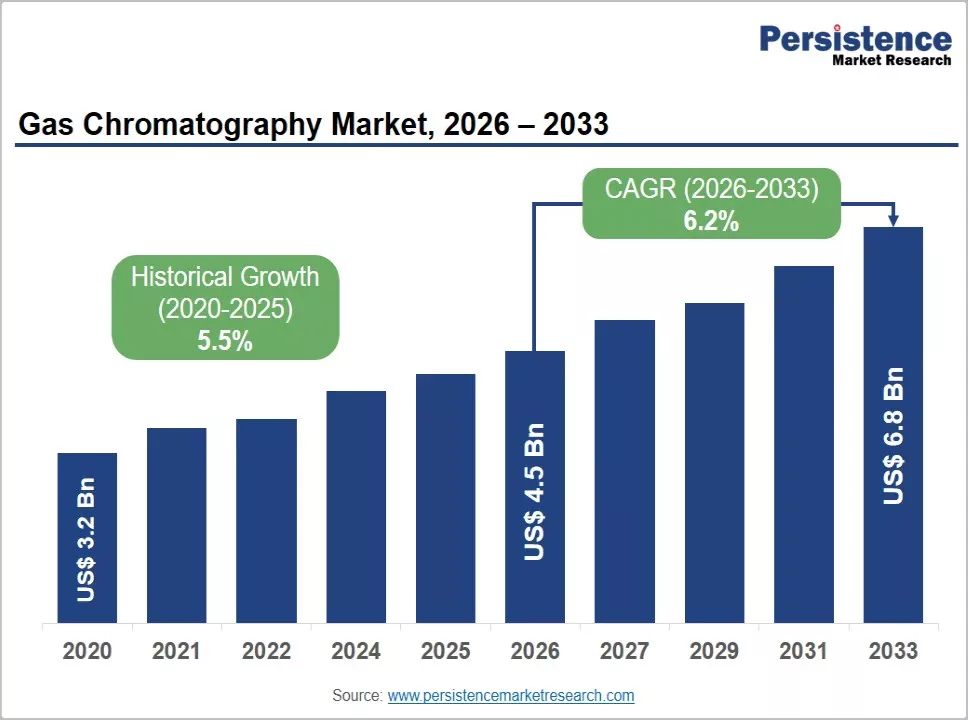
The global gas chromatography market size is expected to be valued at US$4.50 billion in 2026 and is projected to reach US$6.86 billion by 2033, growing at a CAGR of 6.2% during the forecast period from 2026 to 2033, driven by increasing regulatory requirements for analytical testing across pharmaceutical, food, and environmental applications.
Stricter pharmaceutical quality control mandates, evolving food safety standards, and expanding environmental monitoring requirements are strengthening demand for gas chromatography (GC) systems, columns, detectors, and consumables across major markets.
The market is supported by sustained investments in analytical testing infrastructure and laboratory workflows. Updates to residual solvent testing requirements under ICH Q3C, reinforced through regulatory guidance, continue to support the use of GC in pharmaceutical quality control. At the same time, expanding generic drug manufacturing in Asia and increased investment in environmental laboratory infrastructure are contributing to broader adoption of GC technologies.
Key Industry Highlights:
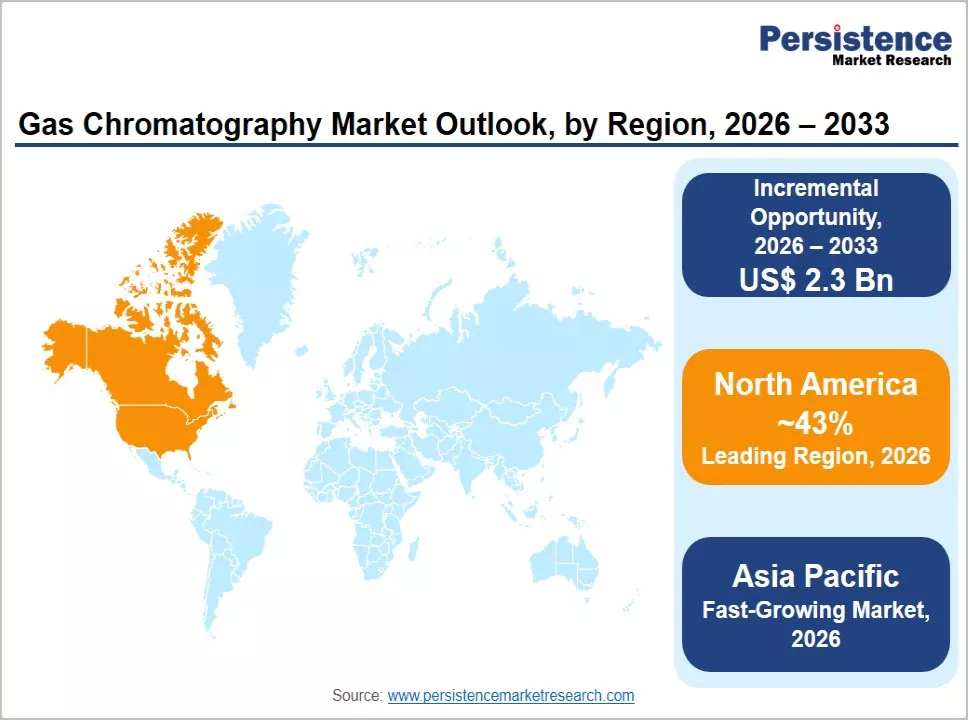
- Regional Leader: North America is expected to account for 43.0% of global gas chromatography revenues in 2026, valued at US$1.94 billion. Strong demand from pharmaceutical quality control and environmental testing, supported by stringent EPA and FDA analytical requirements, is anticipated to reinforce the region’s leading market position through 2033.
- Fastest-Growing Region: Asia Pacific is anticipated to register the fastest growth, expanding at a CAGR of 7.2% through 2033. Increasing pharmaceutical manufacturing, API production, and quality-control requirements across China and India are expected to drive adoption, while expanding domestic CDMO capabilities are set to further support demand for gas chromatography systems.
- Leading Segment: Instruments are expected to account for 45.0% of the market in 2026, reaching US$2.02 billion. Demand is anticipated to remain strong as pharmaceutical, environmental, and other regulated laboratories continue to replace aging equipment and upgrade systems to maintain compatibility with established analytical methods.
- Fastest-Growing Segment: Accessories & consumables are anticipated to remain the fastest-growing product category, supported by the expanding global installed base of gas chromatography instruments and recurring demand for columns, vials, liners, seals, and other consumables. Increasing applications across pharmaceutical, environmental, food safety, and cannabis testing are expected to further strengthen the demand for consumables.
- Key Market Opportunity: The opportunity for instrument manufacturers lies in embedding validated ICH Q3C residual solvent methods and 21 CFR Part 11-compliant data systems directly into platform configurations, effectively locking in recurring consumable and service revenues across multi-year drug development programs at CDMOs and CROs.
Market Dynamics
Drivers - Expanding Pharmaceutical Quality Control Requirements Under Global Pharmacopoeia Standards
Pharmaceutical manufacturers worldwide rely on gas chromatography for residual solvent analysis, headspace GC testing, and purity profiling, applications directly mandated by the United States Pharmacopeia (USP), the European Pharmacopoeia (Ph. Eur.), and the Japanese Pharmacopoeia (JP). Production volumes of active pharmaceutical ingredients (APIs) have expanded significantly since 2022, particularly in India and China, where contract development and manufacturing organizations (CDMOs) are scaling capacity to serve global innovator pipelines.
Each new GC-compliant production line requires validated instruments, certified reference standards, and ongoing consumable replenishment, creating a recurring revenue base that sustains instrument demand well beyond initial capital expenditure cycles. The International Council for Harmonisation of Technical Requirements for Pharmaceuticals for Human Use (ICH) continues to tighten analytical method expectations, effectively mandating instrument refresh programs across regulated facilities.
Strengthening Food Safety Regulation Driving GC Adoption in Testing Laboratories
Pesticide residue testing, flavor and fragrance profiling, and contaminant detection in food matrices represent a structurally growing application set for gas chromatography. The European Food Safety Authority (EFSA) revised maximum residue levels for over 150 pesticide-food combinations between 2022 and 2024, compelling accredited laboratories across the EU to upgrade GC-MS and GC-FID capabilities to meet lower detection thresholds.
In parallel, the U.S. Department of Agriculture (USDA) Pesticide Data Program expanded its commodity coverage, adding volume requirements to contract laboratories that depend on high-throughput GC platforms. These regulatory mandates are not discretionary; they bind testing laboratories contractually to method performance specifications that entry-level instruments cannot satisfy, favoring investment in current-generation split/splitless injectors and high-resolution capillary column technology.
Restraints - High Capital Cost and Total Cost of Ownership Limiting Adoption in Emerging Markets
Benchtop gas chromatograph systems from leading suppliers carry list prices ranging from approximately US$15,000 for single-detector configurations to well above US$80,000 for hyphenated GC-MS platforms. When validation costs, carrier gas infrastructure, certified reference materials, and trained operator time are incorporated, the total cost of ownership creates a meaningful barrier for public-sector laboratories in lower-middle-income countries. The World Bank classifies laboratory infrastructure investment as a recurring financing gap in its 2023 Health System Strengthening assessments, and this constraint directly limits the pace at which environmental and food safety laboratories in sub-Saharan Africa and Southeast Asia can modernize to current analytical standards.
Complexity of Method Development and Skilled Operator Dependency
Gas chromatography requires specialized expertise in stationary phase selection, carrier gas optimization, temperature program design, and detector calibration. The gas chromatography industry faces a compounding skills shortage as experienced analytical chemists retire and academic programs struggle to produce graduates with hands-on GC method development experience. The American Chemical Society (ACS) has documented declining enrolment in analytical chemistry tracks at the undergraduate level across U.S. institutions since 2020, a structural talent constraint that slows laboratory throughput and increases reliance on vendor application support, adding to operational costs.
Opportunities - Miniaturization and Portable GC for Field-Based Environmental and Defense Applications
The development of micro-fabricated gas chromatography systems, devices that integrate the separation column, detector, and control electronics onto compact, field-deployable platforms, is opening an entirely new deployment category. The U.S. Department of Defense (DoD) has funded portable chemical agent detection programs using miniaturized GC-MS technology since 2022, recognizing the capability gap between laboratory-grade identification and field-rapid screening. Beyond defense, environmental regulators monitoring volatile organic compound (VOC) emissions at industrial fence lines are increasingly specifying real-time, on-site GC monitoring over periodic laboratory sampling. Inficon and Ellutia have both launched portable or process GC platforms targeting this segment, signaling that incumbent instrument manufacturers face competitive pressure from specialist innovators in this emerging channel.
Hyphenated Techniques and Multi-Detector GC Platforms in Untargeted Metabolomics
The life sciences research community is accelerating its adoption of GC-MS and two-dimensional gas chromatography (GC×GC) for untargeted metabolomics, exposomics, and lipidomics workflows. The National Institutes of Health (NIH) Common Fund's All of Us Research Program and related precision medicine initiatives are generating demand for high-resolution metabolite profiling that requires the separation power and spectral libraries of advanced GC platforms. This is a research-to-clinical translation opportunity: as metabolomic biomarkers validated in academic settings migrate toward clinical diagnostic applications, the instruments that enabled that discovery become specification standards for the next generation of regulated laboratory deployments. Instrument manufacturers that build proprietary spectral libraries and software integration tools are now positioning for outsized adoption when clinical reimbursement pathways formalize.
Category-wise Insights
Which Product Type Leads the Gas Chromatography Market?
The instruments segment is expected to account for 45.0% of the global gas chromatography market in 2026, equivalent to US$2.02 billion. This dominance reflects the capital-intensive nature of laboratory build-outs and instrument replacement cycles in regulated pharmaceutical and environmental testing environments. Pharmaceutical quality assurance laboratories purchase dedicated GC systems, typically flame ionization detector (FID) or mass spectrometer-coupled configurations, for residual solvent testing under validated, compendial methods that require periodic instrument qualification and re-validation. Environmental testing laboratories similarly specify standalone benchtop instruments for EPA Method 8260 volatile organic compound analysis, where instrument traceability and audit trails are non-negotiable procurement criteria.
The accessories & consumables segment is likely to be the fastest-growing category, driven by the expanding installed base of GC instruments globally. Capillary columns, septa, liners, carrier gas purifiers, and autosampler vials require regular replacement on defined maintenance schedules. Restek Corporation launched an expanded line of SilTite ferrule-based connections and premium inlet liners in 2023, responding specifically to rising demand from high-throughput cannabis testing laboratories, a new end-user group that rapidly scaled GC-FID and GC-MS infrastructure following legalization in multiple U.S. states and Canadian provinces.
Which Application Is Driving Gas Chromatography Demand?
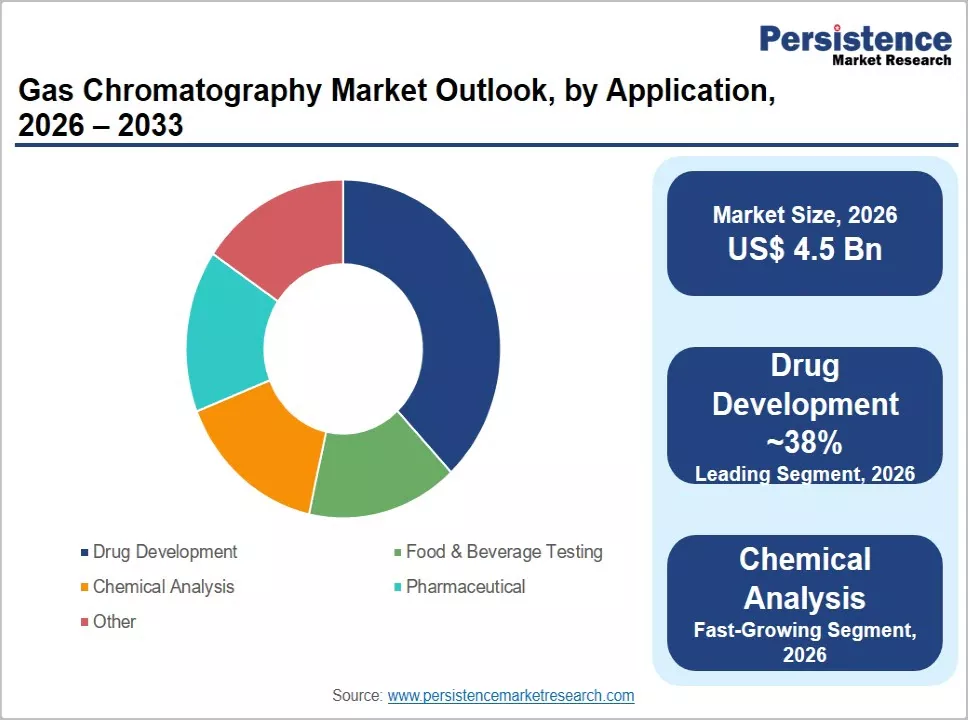
The drug development segment is expected to account for 38.0% of the global gas chromatography market in 2026, equivalent to US$1.71 billion. Demand is supported by the use of GC for API synthesis monitoring, impurity profiling of volatile and semi-volatile compounds, and residual solvent analysis in drug substances and drug products. Contract research organizations (CROs), including Labcorp Drug Development, use GC systems to support solvent testing aligned with ICH Q3C requirements across multiple client programs. Regulatory analytical requirements incorporated into drug development and submission processes continue to support the use of GC, particularly for the analysis of low-molecular-weight volatile impurities.
Chemical Analysis is set to be the fastest-growing application segment. Growth is supported by the expanding use of GC in petrochemical and polymer characterization, industrial gas analysis, and chemical purity testing. Increasing regulatory scrutiny of chemical composition and product quality is also encouraging laboratories and manufacturers to strengthen analytical testing capabilities. Shimadzu Corporation's Nexis GC-2030 series, which offers enhanced thermal conductivity detector (TCD) sensitivity, addresses applications including industrial gas analysis and chemical purity testing, supporting broader adoption of GC across chemical and related industrial workflows.
Which End-Use Industry Is Fueling Gas Chromatography Adoption?
The pharmaceutical end-use industry is forecast to account for 36.0% of the global gas chromatography market in 2026, equivalent to US$1.62 billion. Pharmaceutical manufacturers, from large integrated innovators to mid-tier generics producers, embed GC instruments across quality control laboratories, process analytical technology (PAT) platforms, and stability testing programs. GC headspace systems are specifically deployed for container closure integrity testing and residual moisture analysis in lyophilized drug products, applications where the technique's selectivity for volatile species is unmatched. Major contract manufacturers including Samsung Biologics and Lonza Group have expanded analytical laboratory capacity since 2023, incorporating GC qualification as a baseline capability across new production sites.
The chemical end-use industry is likely to be the fastest-growing segment. Specialty chemical producers and petrochemical refiners are accelerating GC deployment as European Union sustainability reporting frameworks, specifically the Corporate Sustainability Reporting Directive (CSRD), require detailed chemical composition and emissions data that process GC systems are uniquely positioned to generate continuously. Yokogawa Electric Corporation expanded its SiliconStar process gas chromatograph portfolio in 2024, targeting refinery stream analysis applications where real-time compositional data feeds directly into process optimisation and regulatory compliance reporting workflows.
Regional Insights
What Is Powering Growth in the North America Gas Chromatography Market?
North America is expected to account for 43.0% of the global gas chromatography market in 2026, representing US$1.94 billion. The region's dominance reflects a deeply institutionalized analytical testing infrastructure across pharmaceutical manufacturing, environmental compliance monitoring, and forensic science. U.S. Environmental Protection Agency (EPA) method requirements continue to mandate GC across soil, water, and air quality testing programs, sustaining baseline instrument and consumable demand independent of discretionary R&D cycles. Forward momentum is reinforced by biopharmaceutical manufacturing expansion under the BIOSECURE Act framework, which is redirecting API production investment back into domestic facilities.
U.S. Gas Chromatography Market Size
The U.S. gas chromatography market is likely to represent 90.0% of the North America regional market in 2026, equivalent to US$1.74 billion. Demand is anchored by the world's largest concentration of FDA-regulated pharmaceutical manufacturing sites and EPA-licensed environmental testing laboratories, both of which carry non-discretionary GC instrument qualification obligations. The reauthorization of the Superfund programme and continued remediation activity at legacy industrial sites will sustain environmental laboratory instrument procurement through the forecast period.
Germany Gas Chromatography Market Size
The Germany gas chromatography market is set to represent 28.0% of the Europe regional market in 2026, equivalent to US$0.32 billion. Germany's chemical and pharmaceutical industrial base, anchored by BASF SE, Bayer AG, and a dense network of specialty chemical producers, generates systematic demand for process and laboratory GC instrumentation. Continued investment in green chemistry and sustainable process development is expected to expand GC deployment in reaction monitoring and by-product characterization applications through 2033.
U.K. Gas Chromatography Market Size
The U.K. gas chromatography market is anticipated to account for 19.0% of the Europe regional market in 2026, equivalent to US$0.21 billion. Post-Brexit realignment of food safety and medicines regulation under the Medicines and Healthcare products Regulatory Agency (MHRA) and the Food Standards Agency (FSA) has prompted laboratories to revalidate analytical methods against updated domestic standards, a process that is driving targeted GC instrument upgrades. Life sciences manufacturing investment enabled by the U.K.'s 2023 Life Sciences Vision programme positions the sector for continued analytical infrastructure growth.
France Gas Chromatography Market Size
The France gas chromatography market is expected to represent 13.0% of the Europe regional market in 2026, equivalent to US$0.15 billion. Demand is concentrated in the cosmetics and fragrance industry; France hosts the global headquarters of L'Oréal and LVMH's Parfums Christian Dior, where GC-MS is the primary technique for flavor and fragrance characterization and quality assurance. Expanding clinical research activity at French academic medical centers is expected to broaden the GC instrument base into metabolomics and toxicology applications by 2028.
Asia Pacific Gas Chromatography Market Trends and Insights
Asia Pacific is likely to account for 22.0% of the global gas chromatography market in 2026, representing US$0.99 billion, and is the fastest-growing region at an estimated CAGR of 7.2% through 2033. Pharmaceutical manufacturing scale-up across India and China, combined with accelerating food safety enforcement in ASEAN markets, is driving instrument procurement at rates that outpace global averages. China's National Medical Products Administration (NMPA) adoption of ICH technical guidelines since 2017 has progressively aligned domestic pharmaceutical quality requirements with international GC method standards, creating a sustained domestic instrument demand cycle.
China Gas Chromatography Market Size
The China gas chromatography market is likely to represent 46.0% of the Asia Pacific regional market in 2026, equivalent to US$0.46 billion. Domestic pharmaceutical production growth under China's 14th Five-Year Plan for Health, which targets self-sufficiency in critical API manufacturing, is the primary GC demand driver. Domestic instrument manufacturers, including Tianmei (Techcomp), are gaining share in entry-tier laboratory segments, while multinational suppliers retain dominance in regulated pharmaceutical and petrochemical applications requiring internationally certified performance standards.
Japan Gas Chromatography Market Size
The Japan gas chromatography market is predicted to represent 23.0% of the Asia Pacific regional market in 2026, equivalent to US$0.23 billion. Japan's advanced semiconductor and electronics manufacturing sector deploys high-purity gas analysis GC systems for process gas monitoring, a technically demanding application where Shimadzu Corporation and GL Sciences hold strong domestic positions. Aging instrument installed bases across Japan's university research sector represent a meaningful near-term replacement opportunity as next-generation GC-MS platforms offer substantially improved mass spectral sensitivity.
India Gas Chromatography Market Size
The India gas chromatography market is poised to represent 15.0% of the Asia Pacific regional market in 2026, equivalent to US$0.15 billion. India's position as the world's largest supplier of generic pharmaceuticals by volume, supplying approximately 20% of global generic medicines by count per the Indian Pharmaceutical Alliance, creates structural, recurring demand for GC quality control instruments across the country's extensive CDMO and API manufacturing base. Capacity expansion by major exporters targeting WHO prequalification status is accelerating laboratory GC investment in tier-2 pharmaceutical manufacturing hubs including Hyderabad and Ahmedabad.
Competitive Landscape
The global gas chromatography industry is characterized by a competitive landscape led by established instrument manufacturers, including Agilent Technologies, Inc., Thermo Fisher Scientific Inc., and Shimadzu Corporation. Agilent and Thermo Fisher maintain significant positions in the global GC instrument market, while Shimadzu has a strong presence across Asia Pacific supported by its established distribution network and regional manufacturing capabilities. Danaher Corporation, through its Phenomenex and other analytical science businesses, maintains a significant presence in the GC consumables market. Competition is shaped by software integration capabilities, particularly those supporting data integrity requirements under FDA 21 CFR Part 11, application-specific detector configurations, and validated method libraries that can help reduce method development requirements for customers.
Key Industry Developments:
- In May 2026, Agilent launched the 8890B and 8860B gas chromatographs with GC Assist, integrating predictive maintenance, guided troubleshooting, and remote monitoring while improving throughput and oven-cooling performance for high-productivity analytical laboratories.
- In July 2026, Shimadzu released the GCMS-TQ RX Series of triple-quadrupole GC-MS systems, combining high-sensitivity detection, AI-based peak processing, automated method development, and flexible workflows for environmental, food, pharmaceutical, and chemical analysis.
- In March 2026, Shimadzu released the Nexis GC-2060 gas chromatograph, featuring newly developed detection technology and enhanced separation performance, marking a major product update as the company builds on seven decades of GC development.
Companies Covered in Gas Chromatography Market
- Agilent Technologies, Inc.
- Thermo Fisher Scientific Inc.
- Shimadzu Corporation
- Danaher Corporation
- PerkinElmer, Inc.
- Merck KGaA
- Waters Corporation
- Bruker Corporation
- LECO Corporation
- Restek Corporation
- Teledyne Technologies
- Scion Instruments
- Chromatotec
- DANI Instruments S.p.A.
- Markes International
Frequently Asked Questions
The global gas chromatography market is valued at US$4.50 billion in 2026 and is projected to reach US$6.86 billion by 2033, expanding at a CAGR of 6.2%. The primary growth catalyst is rising pharmaceutical quality control requirements under international pharmacopoeia standards, which mandate GC-based residual solvent and impurity testing across regulated drug manufacturing facilities globally.
The mandatory pesticide residue testing programs, including those administered by the European Food Safety Authority (EFSA), require laboratories to upgrade GC-MS detection capabilities, and expanding generic pharmaceutical production in Asia requires validated GC quality control workflows compliant with ICH Q3C residual solvent guidelines. Both drivers are regulatory in origin and therefore largely non-cyclical.
The Instruments segment holds the largest share at 45.0% of the global gas chromatography market, valued at approximately US$2.02 billion in 2026. Dominance reflects capital equipment replacement cycles in pharmaceutical and environmental laboratories, where validated GC methods are embedded in long-term regulatory submissions, creating durable, recurring instrument procurement demand that competitors cannot easily displace once methods are validated.
North America leads the global gas chromatography market with a 43.0% share, equivalent to US$1.94 billion in 2026. The world's highest concentration of FDA-regulated pharmaceutical manufacturing sites, and mandatory U.S. Environmental Protection Agency (EPA) GC method requirements applied across environmental compliance testing programs. Continued domestic biopharmaceutical manufacturing investment will reinforce this position through 2033.
A key near-term opportunity lies in miniaturized and portable gas chromatography systems for field-based environmental monitoring and chemical agent screening, supported by ongoing investment in portable analytical technologies by the U.S. Department of Defense. Growing demand for rapid, on-site VOC detection is also creating opportunities for manufacturers developing compact GC platforms with integrated software and simplified field operation. As environmental monitoring requirements expand, portable GC systems are expected to gain wider adoption across environmental, industrial, and defense applications.
The gas chromatography market is dominated by Agilent Technologies, Inc. and Thermo Fisher Scientific Inc., which collectively lead in GC instrument revenues globally, with Shimadzu Corporation holding a strong position across Asia Pacific. Competition is intense and centers on software-driven data integrity compliance, validated application-specific detector configurations, and proprietary spectral libraries, barriers that give established players durable advantages over new entrants in regulated pharmaceutical and environmental testing channels.


