




- Beverages
- Chocolate Powder Drink Mix Market
Chocolate Powder Drink Mix Market Size, Share, and Growth Forecast 2026 - 2033
Chocolate Powder Drink Mix Market by Product Type (Sweetened, Low-sugar, Unsweetened), Distribution Channel (Supermarkets and Hypermarkets, Online Retail, Convenience and Specialty Stores), and Regional Analysis, 2026 - 2033

Chocolate Powder Drink Mix Market Size and Trends Analysis
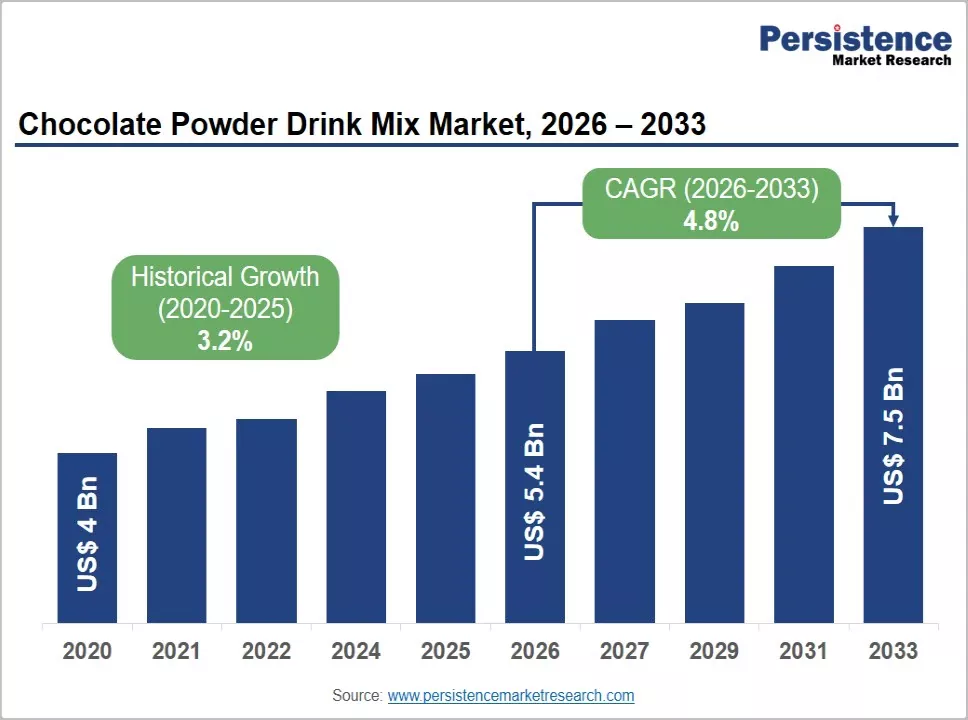
The global chocolate powder drink mix market size is likely to be valued at US$ 5.4 billion in 2026 and is estimated to reach US$ 7.5 billion by 2033, growing at a CAGR of 4.8% during the forecast period 2026 to 2033, driven by easing cocoa costs, strong demand in emerging markets, and a shift to lower-sugar recipes.
Drink mixes are also a low-cost treat for families. Brands are adding protein and fortified recipes to widen appeal.
Key Industry Highlights
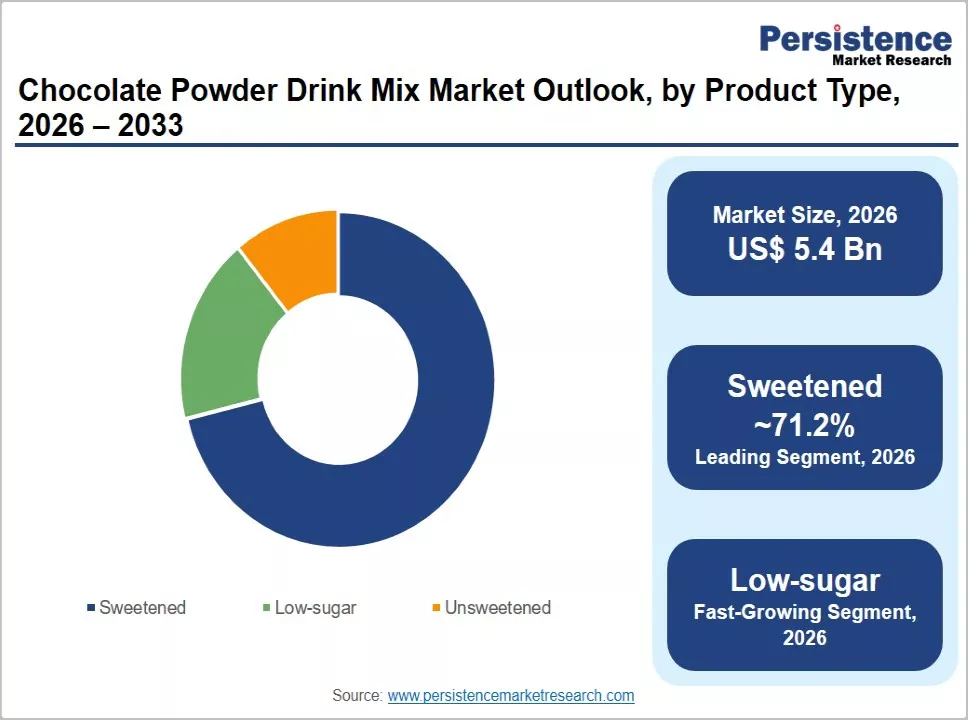
- Leading Product Type: Sweetened mixes, about 71.2% share in 2026, because classic recipes remain popular with families and are priced for everyday use. Large tubs and value packs support steady sales.
- Dominant Distribution Channel: Supermarkets and hypermarkets, around 52.4% share in 2026, as buyers prefer to stock up on pantry staples during weekly shops. Promotions and bulk packs also drive repeat buying.
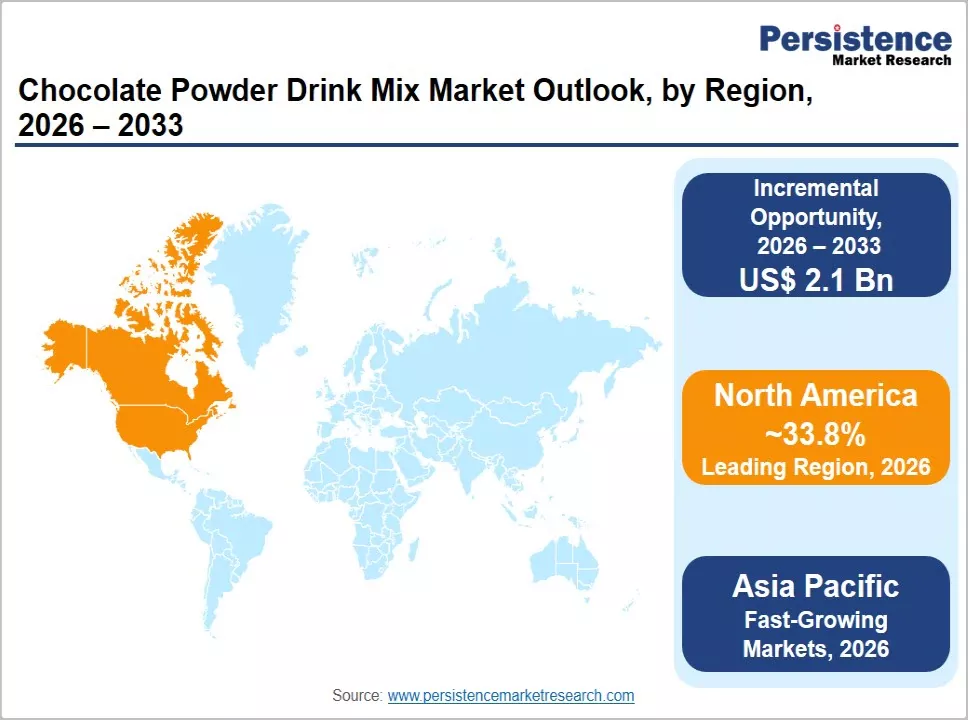
- Leading Region: North America, with about 33.8% share in 2026, owing to high household use of drink mixes and strong brand loyalty. Hot and cold milk drinks are both common.
- Fast-growing Region: Asia Pacific, backed by a large young population, rising incomes, and strong malt and chocolate beverage brands. Local flavors and malt blends also help brands win share.
- Latest Product: In June 2026, Nestlé Professional launched Chocolate Quente Cremoso in Brazil, a powdered hot-chocolate product developed for cafés, bakeries, restaurants, and other foodservice operators. Supplied in a 2.01 kg pack, the product is designed to deliver a consistent, creamy texture while simplifying preparation for professional kitchens. Nestlé cited consumer research indicating that hot-chocolate quality, flavor, and creaminess are important purchasing considerations, positioning the launch as a way for foodservice businesses to standardize preparation and expand their hot-drink menus.
DRO Analysis
Driver- Easing Cocoa Prices to Improve Margins and Promotions
Cocoa supply has improved after a long period of high prices. The International Cocoa Organization (ICCO) estimates that world cocoa production in 2024/25 rose 8.5% to 4.733 million tons. Grindings fell 3.3% to 4.649 million tons. End-of-season stocks reached 1.309 million tons. Better crops in key growing areas also support steady supply. Buyers can plan contracts with more confidence.
Lower bean prices are now reaching the supply chain. Barry Callebaut reported that average terminal cocoa prices in the first half of its 2025/26 fiscal year were 42% lower than a year earlier. Prices closed the period 61% below the start of the fiscal year. This helps drink mix makers protect margins. Stable input costs let brands invest in advertising and new flavors. Retail promotions can also return.
Exponential Emerging Market Demand to Widen the Consumer Base
Emerging markets are growing faster than mature ones. Nestlé reported nine-month organic growth of 5% in Asia, Oceania and Africa, against 2.2% in Europe. Mondelez International reported second quarter 2026 organic growth of 8.4% in Latin America and 7.1% in Asia, the Middle East and Africa. These regions have young populations and growing middle classes. Chocolate drinks are an affordable daily treat.
Europe was weaker. Mondelez reported organic growth of negative 3.5% in Europe in the same quarter. Brands that focus on high-growth regions can offset slow demand in mature markets. Price rises have also hurt volumes in mature markets. Value packs and private label brands attract cost-aware shoppers.
Restraint- Added Sugar Guidance May Pressure Sweetened Mixes
Health guidance is getting stricter. The U.S. Department of Health and Human Services (HHS) and the U.S. Department of Agriculture (USDA) released the Dietary Guidelines for Americans, 2025-2030 on January 7, 2026. They cap added sugars at 10% of daily calories. They urge people to avoid sugar-sweetened beverages. Retailers and schools may respond by removing high-sugar drinks. Brands must plan for tighter rules and closer scrutiny.
Child intake is also under watch. The Centers for Disease Control and Prevention (CDC) reported that 20% of U.S. children aged 1 to 5 years had sugar-sweetened beverages four or more times a week in 2023. Parents may cut back on sweetened mixes as awareness grows. Many chocolate mixes are made with milk, which adds nutrition. Even so, added sugar remains the main concern.
Opportunity- Low-sugar Recipes to Open New Buyer Groups
Reformulation can turn guidance into growth. Low-sugar and unsweetened mixes let brands serve health-focused families without dropping the chocolate taste. Cocoa powder, milk solids, and natural sweeteners can be blended into cleaner labels. Clear front-of-pack claims can also support premium pricing. Taste testing is key to keeping loyal buyers.
Labeling rules also reward clear claims. In April 2024, India's Ministry of Commerce and Industry advised e-commerce firms to remove drinks, including Bournvita, from the health drinks category. It noted that the term is not defined under the Food Safety and Standards Act, 2006. Honest claims build trust. Brands that avoid vague health claims face fewer risks. Simple labels also help parents compare products.
Volume Recovery and New Occasions to Broaden Product Scope
Volumes are recovering as prices ease. Nestlé reported nine-month real internal growth of 1.9%, with third-quarter growth of 2.8%. Barry Callebaut expects its 2025/26 volume to decline by 1% to 3%. It expects a return to growth in the second half. Retail partners are also restoring promotions as costs fall. Better supply gives brands room to plan launches.
Brands are also reaching new age groups and occasions. Nestlé said that Milo has product extensions for new age groups and consumption occasions. Ready-to-mix sachets, protein blends, and cold-brew style mixes can lift usage beyond breakfast. Single-serve packs suit on-the-go use and gym users. Seasonal flavors can add excitement through the year.
Category-wise Analysis
Product Type Insights
Sweetened mixes are predicted to lead with a share of about 71.2% in 2026, because classic chocolate recipes are familiar and priced for daily use. Mondelez reported 1.5 percentage points of pricing in its second quarter 2026 organic growth. Sugar content may face more scrutiny. Large tubs and refill pouches give good value to families. Brand trust supports steady repeat purchase.
Low-sugar and unsweetened mixes are estimated to grow fastest in the forecast period, as dietary guidance pushes brands to cut added sugars. The 2025-2030 Dietary Guidelines set a 10% calorie cap on added sugars. Better sweeteners and cocoa blends are improving taste. Plant-based and reduced-sugar recipes are also entering this group. Clean labels help win skeptical buyers.
Distribution Channel Insights
Supermarkets and hypermarkets are anticipated to dominate with a share of around 52.4% in 2026, because drink mixes are pantry staples bought in bulk. Wide shelf space and promotions help brands win trial. Private label mixes also compete here on price. Shoppers can compare brands side by side. In-store displays also lift impulse purchases during holidays.
Online retail is expected to be the fastest-growing channel in the forecast period, as buyers seek convenience and bundle deals. Subscription packs and larger sizes suit repeat purchase. Direct sales also help brands reach niche low-sugar buyers. Mobile shopping apps also make reordering simple. Reviews help new brands build trust quickly.
Regional Insights
North America Chocolate Powder Drink Mix Market Trends
North America is anticipated to lead globally in 2026 with a share of approximately 33.8%, supported by the established consumption of chocolate-flavored beverages, strong brand recognition, and the widespread availability of instant drink mixes through supermarkets, convenience stores, and e-commerce platforms. Manufacturers are focusing on convenient preparation, improved flavor profiles, and products with reduced sugar or added nutritional benefits to appeal to health-conscious consumers while retaining the indulgent appeal of chocolate beverages.
U.S. Chocolate Powder Drink Mix Market Trends
A share of nearly 77.4% is expected to be held by the U.S. in 2026 in North America, driven by the popularity of chocolate milk, breakfast beverages, and at-home drink preparations among children and adults. Established brands benefit from extensive retail distribution and consumer familiarity, while online grocery platforms are improving access to different flavors, pack sizes, and specialty formulations. Opportunities are also emerging for products featuring higher protein content, reduced sugar, and added vitamins and minerals, particularly among consumers seeking convenient beverage options.
Asia Pacific Chocolate Powder Drink Mix Market Trends
Asia Pacific is predicted to be the fastest-growing region globally in 2026 with a share of around 28.6%, backed by urbanization, expanding modern retail networks, rising disposable incomes, and increasing demand for convenient, affordable beverages. Chocolate-flavored drinks are gaining traction among younger consumers and families, while manufacturers are adapting sweetness levels, pack sizes, and pricing to suit local preferences. The expansion of e-commerce and the availability of single-serve sachets are further improving product accessibility across both established urban markets and developing consumer markets.
China Chocolate Powder Drink Mix Market Trends
China will likely lead in Asia Pacific in 2026 with a share of about 34.5%, supported by the growth of packaged food and beverage consumption, the popularity of flavored drinks among younger consumers, and the expansion of online retail channels. Manufacturers can target this market through premium chocolate flavors, convenient home-preparation formats, and products designed for younger consumers and families. Digital marketing and online product discovery also provide opportunities for brands to introduce new formulations and build consumer awareness in a competitive beverage market.
India Chocolate Powder Drink Mix Market Trends
In 2026, India is projected to account for a share of just about 21.6% in Asia Pacific, fueled by a large population of children and young consumers, growing urban consumption, and the use of chocolate-flavored milk and beverage mixes as breakfast or between-meal options. Affordable sachets and small packs help brands reach price-sensitive households, while supermarkets, neighborhood grocery stores, and e-commerce platforms expand product availability. Manufacturers are also positioned to benefit from demand for fortified beverage mixes and products offering convenient preparation, varied chocolate flavors, and family-sized packaging.
Europe Chocolate Powder Drink Mix Market Trends
Europe will likely see steady growth in the forecast period with a share of roughly 14.1% in 2026 globally, supported by established chocolate consumption habits, the availability of branded beverage powders, and continued interest in convenient drinks for home consumption. Product development is increasingly focused on ingredient transparency, reduced sugar content, responsibly sourced cocoa, and packaging improvements. Competition from ready-to-drink chocolate beverages and other breakfast drinks is encouraging manufacturers to differentiate powdered products through taste, convenience, nutritional positioning, and value for money.
Germany Chocolate Powder Drink Mix Market Trends
Germany is predicted to register a substantial share of approximately 21.5% in 2026 in Europe. Demand benefits from established retail infrastructure, strong availability of packaged food products, and consumer familiarity with cocoa-based beverages. Supermarkets, discount retailers, and online grocery channels provide manufacturers with broad distribution opportunities. Interest in products with clear ingredient information, reduced sugar, and sustainably sourced cocoa may influence purchasing decisions, while affordable everyday options remain important for household consumption. Brands that combine familiar chocolate flavors with convenient preparation and competitive pricing can strengthen their market presence.
U.K. Chocolate Powder Drink Mix Market Trends
A share of nearly 18.2% is predicted to be held by the U.K. in 2026 in Europe, supported by the popularity of chocolate-flavored milk and warm cocoa beverages, alongside the convenience of preparing drinks at home. Established brands benefit from supermarket distribution and strong consumer familiarity, while online grocery channels offer additional opportunities to reach households. Growing attention to sugar consumption is encouraging manufacturers to explore reduced-sugar formulations, portion-controlled packaging, and products with added nutritional value. Premium cocoa blends and differentiated flavors also offer opportunities to attract consumers seeking variety and indulgence.
Competitive Landscape
The global chocolate powder drink mix market is moderately consolidated, with supply led by global food companies and cocoa processors. Leading participants include Nestlé, Mondelez International, The Hershey Company, Barry Callebaut, and Cargill, along with regional brands. Cocoa processors and food makers often partner on supply. Regional brands compete strongly on price and local taste.
Makers blend cocoa powder with sugar, milk solids, malt, and flavors, then pack the mix in tubs and sachets. Brand strength and cocoa sourcing are central. Companies compete mainly through taste, price, nutrition claims, innovation, and shelf access. Reliable cocoa supply is a key edge, since cocoa is the main input. Packaging and tub design also shape buyer choice.
Key Industry Developments
- In September 2026, Hindustan Unilever expanded Horlicks into the protein-powder category in India, launching a formula providing 24 grams of fermented yeast protein and 4 grams of prebiotic fiber per serving. The range includes Chocolate, Coffee, and Unflavored variants in single-serve sachets, with 28 sachets packaged in a 1 kg pack. Although it is primarily a protein supplement rather than a traditional chocolate drink mix, the Chocolate variant demonstrates how established malted-drink brands are moving into protein-enriched powdered beverages.
- In May 2026, Mars Drinks & Treats launched Galaxy Hot Chocolate dual-sachet products in the U.K., introducing Galaxy Caramel Duo and Galaxy Hot Chocolate with separate hot-chocolate and topping sachets. The products combine instant chocolate drink powder with toppings such as caramel pieces or marshmallows to recreate café-style beverages at home. The launch was planned for Asda, with a recommended retail price of £1.49 (approx. US$ 1.99), and aimed to differentiate the hot-chocolate category through a more indulgent, customizable preparation format.
- In January 2026, Gardenia launched its Chocolate Malt Drink in Singapore, offering a powdered beverage in individual sachets. Made with real cocoa, the product contains 25% less sugar than most malted drinks and is enriched with calcium, prebiotics, and essential vitamins. Its launch extended Gardenia’s consumer food portfolio beyond bakery products into convenient powdered beverages, with the sachet format designed for easy preparation at home.
Companies Covered in Chocolate Powder Drink Mix Market
- Nestlé S.A.
- Mondelez International Inc.
- The Hershey Company
- Barry Callebaut AG
- Cargill Incorporated
- Mars, Incorporated
- Associated British Foods plc (Ovaltine)
- The Kraft Heinz Company (Swiss Miss)
- Chocoladefabriken Lindt & Sprüngli AG
- Ghirardelli Chocolate Company
- Ferrero International S.A.
- Idilia Foods, S.L. (ColaCao)
- PepsiCo, Inc. (Toddy)
- Lotte Wellfood Co., Ltd.
- Dr. August Oetker Nahrungsmittel KG
- The J. M. Smucker Company (Carnation)
- Others
Frequently Asked Questions
The global chocolate powder drink mix market is projected to be valued at US$ 5.4 billion in 2026.
The market is expected to reach US$ 7.5 billion by 2033.
Key market trends include a shift to low-sugar recipes and faster growth in emerging markets.
Sweetened mixes are expected to be the leading product type with a share of around 71.2% in 2026, as classic chocolate recipes are familiar and priced for daily use.
The market is expected to grow at a CAGR of 4.8% from 2026 to 2033.
Nestlé S.A., Mondelez International Inc., and The Hershey Company are a few key market players.


