




- Advanced Materials
- Faux Suede Market
Faux Suede Market Size, Share, and Growth Forecast 2026 - 2033
Faux Suede Market by Material Type (Polyester, Polyurethane, Microfiber, Recycled/Bio-based), Product Type (Woven Faux Suede, Non-woven Faux Suede, Knitted Faux Suede), Finish Type (Smooth, Brushed, Embossed, Stretch), Application (Apparel, Upholstery, Automotive Interiors, Home Furnishings, Others), Industry (Fashion & Apparel Industry, Automotive Industry, Furniture & Interior Design, Home Textiles Industry, Footwear Industry), and Regional Analysis, 2026 - 2033

Faux Suede Market Size and Trend Analysis
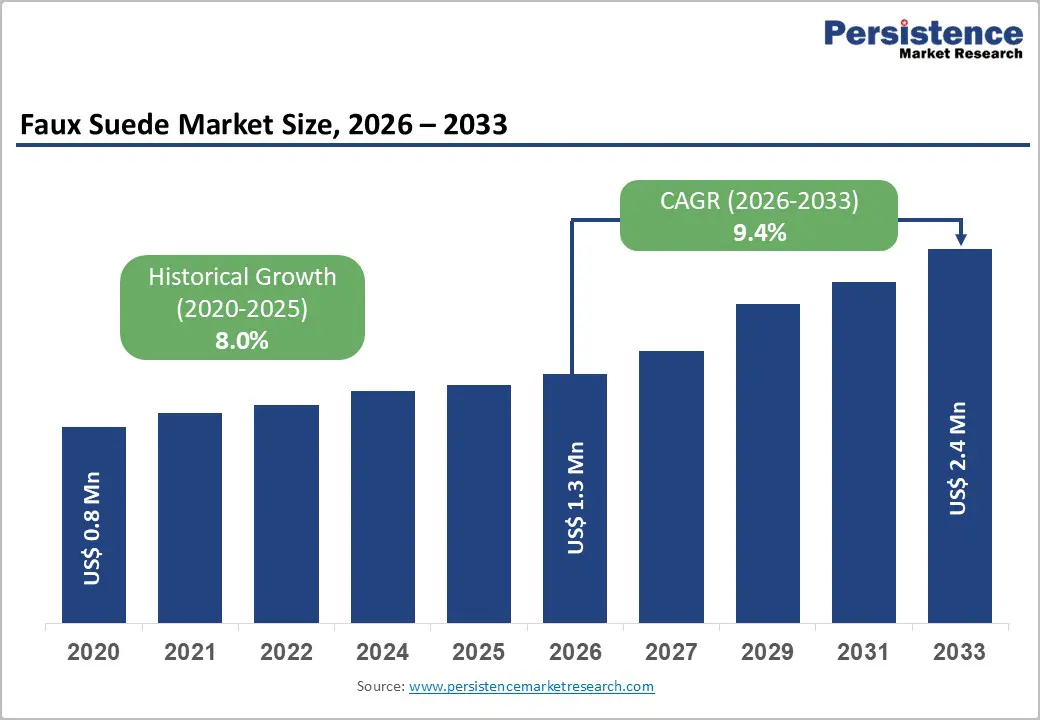
The global faux suede market size is expected to be valued at US$ 1.3 billion in 2026 and projected to reach US$ 2.4 billion by 2033, growing at a CAGR of 9.4% between 2026 and 2033.
The market’s robust growth is primarily driven by accelerating consumer and industry-wide rejection of animal-derived leather, surging demand for high-performance synthetic textiles across automotive and fashion end-use sectors, and expanding regulatory frameworks discouraging the use of conventional animal leather in key global markets. Faux suede, engineered to closely replicate the tactile and aesthetic properties of genuine suede while offering superior durability, washability, and lower environmental impact, is witnessing widespread adoption across fashion & apparel, automotive interiors, home furnishings, and footwear segments. The proliferation of microfiber-based and bio-based faux suede innovations, combined with growing brand commitments to cruelty-free and sustainable material sourcing under frameworks such as the Textile Exchange’s Preferred Fiber & Materials Market Report, is reinforcing the material’s market penetration across both premium and mass-market product tiers globally.
Key Industry Highlights
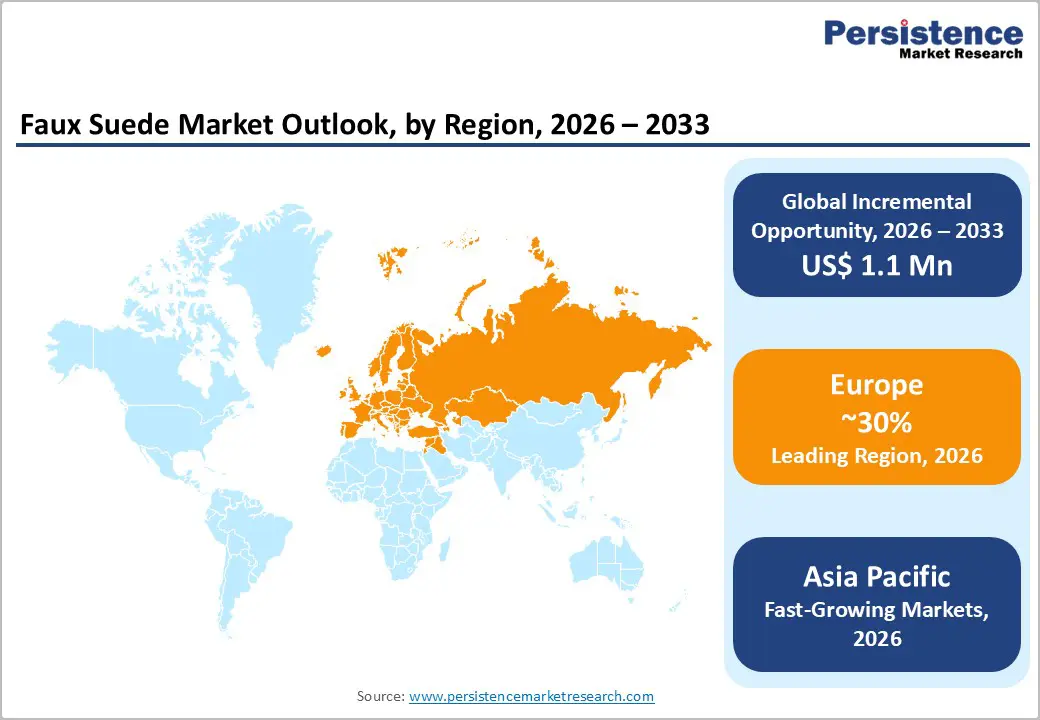
- Leading Region: Europe leads the global faux suede market with approximately 30% revenue share in 2025, driven by stringent EU sustainability regulations, advanced automotive OEM demand from Germany, and strong fashion industry preference for cruelty-free premium synthetic textile materials across luxury and mass-market segments.
- Fastest Growing Region: Asia Pacific is the fastest growing regional market, projected to expand at approximately 11% CAGR through 2033, propelled by large-scale manufacturing infrastructure in China and Japan, India’s expanding domestic apparel sector supported by the PLI Textiles Scheme, and surging footwear production demand across Vietnam and Indonesia.
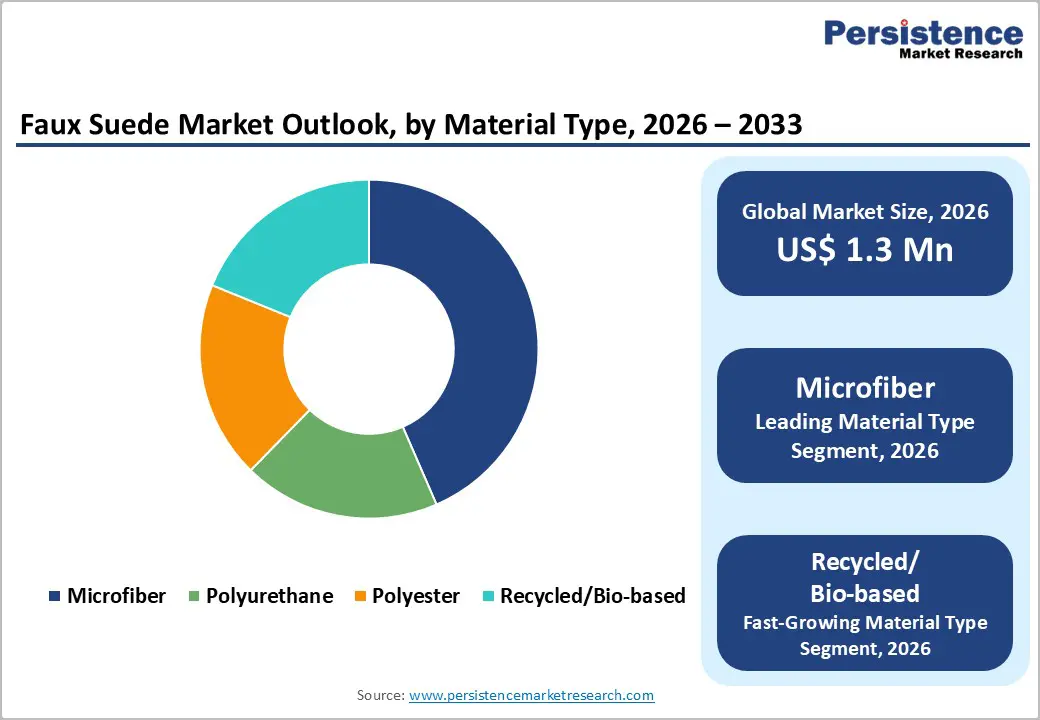
- Dominant Segment: Microfiber-based faux suede dominates the material type segment, accounting for approximately 42% of revenue in 2025, prized for its closest replication of genuine suede aesthetics, superior durability, and broad acceptance across automotive, fashion, and premium upholstery OEM and brand specification programs worldwide.
- Fastest Growing Segment: Bio-based and recycled-content faux suede is the fastest growing material sub-segment, driven by EU Circular Textile Strategy mandates, brand sustainability commitments under SBTi frameworks, and growing Textile Exchange Preferred Fiber sourcing programs creating strong pull demand for environmentally compliant synthetic suede alternatives.
- Key Opportunity: The automotive industry’s accelerating transition to Battery Electric Vehicles (BEVs), where faux suede’s weight advantage over genuine leather directly extends driving range, represents a transformative multi-year growth opportunity for advanced microfiber faux suede manufacturers supplying premium OEM interior specifications.
| Key Insights | Details |
|---|---|
| Faux Suede Market Size (2026E) | US$ 1.3 Billion |
| Market Value Forecast (2033F) | US$ 2.4 Billion |
| Projected Growth CAGR (2026 - 2033) | 9.4% |
| Historical Market Growth (2020 - 2025) | 8.0% |
DRO Analysis
Drivers - Rising Demand for Animal-Free and Vegan Materials Across Fashion and Lifestyle Industries
The global shift toward vegan and cruelty-free materials is a structural and accelerating driver for the faux suede market. Consumer advocacy organizations, including PETA (People for the Ethical Treatment of Animals) report that the global vegan fashion market has grown significantly, with searches for “vegan leather” increasing by over 69% globally between 2020 and 2023 per Google Trends data. Major fashion brands, including Stella McCartney, Adidas, and H&M, have published explicit commitments to eliminate animal-derived materials from core product lines by 2025-2030, creating sustained pull demand for technically advanced faux suede alternatives. Regulatory support is also expanding: California’s AB 44 banning the sale of new animal fur products and the European Commission’s proposed ban on products made with forced labor further tilt brand procurement decisions toward synthetic suede solutions. These converging brand, consumer, and regulatory forces collectively generate a powerful and durable demand runway for faux suede across global fashion supply chains.
Automotive Sector’s Preference for Premium Synthetic Textiles in Vehicle Interiors
The global automotive industry’s transition toward premium, lightweight, and sustainable interior materials is creating substantial incremental demand for faux suede fabrics. According to the International Organization of Motor Vehicle Manufacturers (OICA), global vehicle production reached approximately 93.5 million units in 2023, with the premium and electric vehicle segments, where interior material quality is a central differentiator, growing disproportionately. Automakers, including BMW, Tesla, Volkswagen Group, and Hyundai, have increasingly specified microfiber-based faux suede headliners, door panels, and seating inserts as standard or optional interior elements, citing the material’s weight advantage over genuine leather (contributing to improved EV range), superior UV resistance, and hypoallergenic properties. Alcantara S.p.A., a leading microfiber suede specialist, supplies over 50 premium automotive OEMs worldwide, underscoring the material’s well-established and expanding role in automotive interior specifications.
Restraints - Performance and Perception Gap Versus Genuine Suede in the Luxury Segment
Despite significant technological advances, faux suede continues to face perception challenges in the ultra-luxury segment, where discerning consumers and high-end brands maintain strong preferences for genuine leather and suede. Research published in the Journal of Consumer Psychology confirms that material authenticity remains a key driver of luxury purchases, with premium leather commanding strong brand equity associations. This perception gap constrains faux suede’s penetration into the highest-margin tiers of the fashion, accessories, and automotive interior markets, limiting average selling price potential and creating a persistent ceiling on revenue density in premium applications.
Environmental and Regulatory Scrutiny of Petroleum-Derived Synthetic Fabrics
Conventional faux suede made from polyester and polyurethane feedstocks faces increasing environmental scrutiny due to microplastic shedding during laundering and its reliance on fossil-fuel-derived raw materials. The European Environment Agency (EEA) has flagged synthetic textiles as a significant source of microplastic pollution in European waterways, with an estimated 35% of microplastics entering the ocean originating from synthetic textile washing per IUCN data. Forthcoming EU textile labeling regulations and extended producer responsibility (EPR) frameworks under the EU Strategy for Sustainable and Circular Textiles are expected to impose additional compliance costs on manufacturers of petroleum-derived synthetic fabrics, potentially disadvantaging conventional faux suede versus bio-based or recycled-content alternatives.
Opportunities - Bio-based and Recycled-Content Faux Suede: Meeting Circular Economy Mandates
The development and commercialization of bio-based and recycled-content faux suede presents a transformative growth opportunity, aligning market expansion with tightening global sustainability regulations. The EU Strategy for Sustainable and Circular Textiles (2022) mandates that by 2030, all textile products placed on the EU market must be durable, repairable, and made from recycled fibers where technically feasible. Brands sourcing bio-based faux suede, derived from feedstocks such as pineapple leaf fiber (Pinatex), mushroom mycelium, or sugarcane-based polyurethane, gain access to growing pools of sustainability-conscious consumers and corporate procurement programs aligned with the Science-Based Targets initiative (SBTi) emission reduction commitments. Ecolorica and several Asian microfiber manufacturers are actively developing bio-based faux suede products using partially renewable polyurethane systems. The Textile Exchange reports that demand for preferred synthetic materials grew by 17% year-on-year in 2022, confirming strong market pull for environmentally preferred faux suede innovations across fashion, footwear, and upholstery applications.
Expansion into Emerging Footwear and Home Furnishings Markets in Asia Pacific
Asia Pacific’s rapidly expanding footwear manufacturing sector, the world’s largest, producing over 87% of global footwear per the World Footwear Yearbook 2023, represents a large and largely underpenetrated opportunity for faux suede material suppliers. Countries including Vietnam, Indonesia, China, and Bangladesh collectively host thousands of footwear factories actively substituting genuine suede with cost-competitive synthetic alternatives. Similarly, the home furnishings market across India, China, and ASEAN is experiencing a design premiumization trend driven by the growing urban middle class, with faux suede increasingly specified for decorative cushions, upholstered furniture, and curtain applications. India’s domestic home textiles industry, supported by the government’s Production-Linked Incentive (PLI) scheme for textiles offering incentives totaling INR10,683 crore, is generating new domestic demand for sophisticated synthetic fabric alternatives, including faux suede, creating fresh downstream opportunities for material manufacturers and regional distributors.
Category-wise Analysis
Material Type Insights
Microfiber-based faux suede dominates the material type segment, commanding approximately 42% of total market revenue in 2025. Microfiber faux suede, typically composed of ultra-fine polyester or polyamide filaments of less than 1 denier in diameter, most closely replicates the soft hand-feel, drape, and surface texture of genuine suede, making it the preferred material specification across automotive interiors, premium fashion, and upholstery applications. Leading Japanese manufacturers including TORAY, Kuraray (producer of CLARINO), and Asahi Kasei (producer of Lamous) have established global benchmarks for microfiber faux suede quality, with their products specified by BMW, Porsche, and luxury fashion houses. The International Textile Manufacturers Federation (ITMF) notes sustained investment in microfiber production capacity across East Asia, further reinforcing the segment’s supply-side strength and cost-competitiveness relative to genuine suede and other synthetic alternatives.
Product Type Insights
Non-woven faux suede leads the product type category, representing approximately 48% of total market share in 2025. Non-woven faux suede fabrics are manufactured through needle-punching or water-jet entanglement of synthetic staple fibers, producing a structurally isotropic material with consistent thickness, excellent dimensional stability, and superior abrasion resistance compared to woven or knitted alternatives. These properties make non-woven faux suede the preferred choice for high-wear applications, including automotive door panels, headliners, and seat bolsters, where dimensional consistency under repetitive mechanical loading is a critical specification criterion. Major automotive Tier-1 suppliers, including Lear Corporation and Faurecia (now FORVIA) specify non-woven microfiber faux suede for OEM interiors globally. The segment’s manufacturing scalability and cost efficiency relative to woven alternatives further consolidate its market dominance.
Finish Type Insights
The brushed finish segment leads the faux suede market’s finish type category with approximately 45% revenue share in 2025. Brushed faux suede, produced through mechanical or chemical napping processes that raise individual filament ends to the fabric surface, most authentically replicates the characteristic nap and velvet-like tactile quality of genuine suede, making it the industry standard for premium application segments. In the fashion & apparel industry, brushed faux suede is widely used for jackets, skirts, boots, and accessories, where the material’s softness and visual warmth are key consumer appeal attributes. The Council of Fashion Designers of America (CFDA) sustainability guidelines’ endorsement of high-quality synthetic alternatives to animal suede has accelerated designer adoption of brushed faux suede in ready-to-wear and accessory collections. The finish type’s broad application compatibility, spanning fashion, footwear, furniture, and automotive interiors, underpins its commanding market position.
Application Insights
The automotive interiors application segment leads the faux suede market with approximately 34% of total revenue share in 2025, driven by the material’s unique combination of aesthetic premiumness, light weight, ease of maintenance, and superior durability compared to genuine leather suede in demanding interior environments. Faux suede headliners, instrument panel coverings, steering wheel wraps, and seat upholstery inserts have become standard specifications in upper-mid and premium vehicle segments globally. The accelerating transition toward Battery Electric Vehicles (BEVs), where every kilogram of weight reduction meaningfully extends driving range, provides a structural engineering justification for faux suede’s displacement of heavier genuine leather in OEM specifications. Tesla’s standard specification of synthetic suede headliners across its vehicle lineup and BMW iX’s use of Alcantara microfiber suede in its sustainability-positioned interior packages exemplify this application leadership.
Industry Insights
The automotive industry leads the industry category with approximately 36% of total market revenue in 2025, consistent with the application-level leadership of automotive interiors identified above. Beyond direct material specification, the automotive end use industry drives upstream R&D investment in faux suede performance properties, including flame retardancy per FMVSS 302 and ECE R118 international standards, UV resistance per ISO 105-B06 colorfastness protocols, and VOC emission compliance per VDA 278 automotive interior air quality standards, that elevate overall product quality and ultimately benefit adjacent end-use industries including furniture and fashion. The Society of Automotive Engineers (SAE) standard J1854 governing automotive interior soft trim fabrics references microfiber suede-type materials, confirming the segment’s technical regulatory maturity and long-term specification security for faux suede suppliers serving the automotive industry.
Regional Insights
North America Faux Suede Market Trends and Insights
North America holds a significant position in the global faux suede market, accounting for approximately 22% of global revenue share in 2025, anchored by the United States’ well-developed automotive, fashion, and home furnishings industries. Regulatory momentum is a key demand catalyst: California’s AB 44, the first U.S. state-level ban on the sale of animal fur products, has prompted downstream brand reformulation toward synthetic suede alternatives, while the U.S. Green Building Council’s LEED v4.1 framework’s material credit structure incentivizes specifiers of commercial interiors to prioritize recycled-content and low-emission synthetic textiles, including faux suede.
The U.S. automotive industry’s strong commitment to premium interior specifications, supported by the largest premium vehicle market outside China, generates consistent OEM demand for high-performance faux suede fabrics. The Sustainable Apparel Coalition’s Higg Materials Sustainability Index (MSI), widely adopted by leading U.S. apparel brands, scores synthetic microfiber suede competitively against animal-derived leather on environmental impact metrics, reinforcing specification decisions in favor of faux suede in brand supply chains. Growing investments in bio-based textile R&D through programs funded by the U.S. Department of Agriculture’s (USDA) BioPreferred Program further position North America as a key innovation hub for next-generation sustainable faux suede materials.
Europe Faux Suede Market Trends and Insights
Europe is the leading regional market for faux suede, commanding approximately 30% of global revenue in 2025, driven by stringent sustainability regulations, advanced automotive manufacturing, and a deeply embedded premium fashion and upholstery industry. Germany, as the epicenter of European automotive manufacturing with brands including BMW, Mercedes-Benz, Porsche, and Volkswagen, represents the single largest national demand center for automotive-grade microfiber faux suede. The EU Strategy for Sustainable and Circular Textiles and the forthcoming EU Ecodesign for Sustainable Products Regulation (ESPR) are compelling European fashion brands and interior designers to systematically replace animal-derived materials with high-performance synthetic suede alternatives that comply with evolving recyclability and chemical safety requirements under REACH.
Italy’s Alcantara S.p.A., globally recognized as a benchmark microfiber suede manufacturer, exemplifies Europe’s technical leadership in premium faux suede innovation, holding ISO 14001 environmental certification and carbon neutrality status since 2009, making it a preferred material supplier for luxury automotive OEMs and fashion houses simultaneously. France and the UK represent important fashion and luxury goods demand centers, where growing cruelty-free procurement policies among leading houses are systematically increasing faux suede specification rates. Spain’s well-developed footwear industry, exporting over 100 million pairs annually per Fice (Federación de Industrias del Calzado Español), increasingly utilizes premium faux suede uppers as a technically and commercially competitive alternative to genuine suede.
Asia Pacific Faux Suede Market Trends and Insights
Asia Pacific is both the dominant production hub and the fastest growing consumption region for faux suede, projected to expand at a CAGR of approximately 11% through 2033, supported by unparalleled manufacturing scale, rapidly rising middle-class spending on fashion and automotive products, and aggressive government support for advanced textile manufacturing. China hosts the world’s largest concentration of microfiber faux suede manufacturers, including Huafon Group, Hexin Group, Sanfang, Wanhua Micro Fiber, Meisheng Group, and Tongda Island, supported by vertically integrated synthetic fiber feedstock supply chains and significant government investment in advanced textile equipment through the Made in China 2025 initiative’s advanced materials sub-plan.
Japan remains a global quality leader in faux suede technology, with TORAY’s Ultrasuede®, Kuraray’s CLARINO®, and Asahi Kasei’s Lamous® representing the highest-performing microfiber suede products globally, specified in premium automotive and luxury fashion applications worldwide. India’s faux suede market is growing rapidly, stimulated by the PLI Scheme for Textiles and robust domestic apparel and footwear manufacturing sector expansion, with the Confederation of Indian Textile Industry (CITI) projecting the domestic textile sector to reach US$ 190 billion by 2025-26. Vietnam and Indonesia are emerging as high-growth footwear manufacturing centers actively substituting genuine suede with faux suede alternatives to improve cost competitiveness and comply with international brand sustainability sourcing requirements.
Competitive Landscape
The global faux suede market exhibits a dual-structured competitive landscape, with moderate consolidation in the premium technology segment and high fragmentation among volume-oriented producers. A limited number of technologically advanced players dominate the high-end segment through proprietary microfiber production capabilities, strong brand positioning, and long-term supply agreements with automotive and fashion OEMs. In contrast, numerous manufacturers, particularly in Asia, compete on cost efficiency, large-scale production, and pricing strategies.
Competition is increasingly shaped by sustainability and innovation. Premium-tier participants emphasize eco-friendly credentials, including certified production processes, recycled material integration, and verified environmental disclosures to strengthen positioning in high-value applications. Strategic approaches such as technology licensing, co-development with OEMs, and customized product offerings are gaining traction. Meanwhile, mass-market players prioritize capacity expansion, operational efficiency, and regional distribution networks to capture volume-driven demand, creating a clear divide between value-driven and performance-driven market segments.
Key Developments
- January 2026: Toray Industries opened an Ultrasuede™ showroom and stock sales hub in Portugal to strengthen its presence in Europe, targeting the interior and furniture segments while enhancing local distribution and customer engagement capabilities.
- August 2025: Hyundai partnered with startup Uncaged Innovations to co-develop plant-based, grain-derived leather alternatives for vehicle interiors, aiming to reduce environmental impact while delivering high-performance, customizable materials that replicate the look, feel, and even scent of traditional leather.
- May 2025: Tesla introduced a faux suede dashboard upgrade for Model 3 and Model Y, offering a vegan suede trim option via its online store to enhance interior aesthetics and provide a more premium cabin experience.
Companies Covered in Faux Suede Market
- TORAY Industries, Inc.
- Huafon Group
- Kuraray Co., Ltd.
- Asahi Kasei Corporation
- Hexin Group
- Teijin Cordley
- Kolon Industries, Inc.
- Sanfang
- Wanhua Micro Fiber
- Meisheng Group
- FILWEL Co., Ltd.
- Sanling Micro Fiber
- SISA
- Ecolorica
- Tongda Island
- Alcantara S.p.A.
- Majilite Corporation
- Dinamica Srl (Miko S.p.A.)
Frequently Asked Questions
The faux suede market is projected to reach US$ 1.3 billion in 2026.
Demand is driven by vegan material adoption and rising use in automotive interiors.
Europe leads the market with the highest revenue share.
Opportunities lie in bio-based materials and expanding demand from Asia Pacific industries.
Leading companies in the global Faux Suede market include TORAY Industries, Inc., Kuraray Co., Ltd., Asahi Kasei Corporation, Huafon Group, Hexin Group, Teijin Cordley, Kolon Industries, Alcantara S.p.A., etc.


