




- Industrial Machinery
- Electric Rice Cooker Market
Electric Rice Cooker Market Size, Share, and Growth Forecast, 2026 - 2033
Electric Rice Cooker Market by Product Type (Standard / Conventional, Microcomputer (Micom), Induction Heating (IH), Pressure), Capacity (Below 2 Liters, 2 - 4 Liters, Above 4 Liters), Distribution Channel (Online, Offline), End User, and Regional Analysis for 2026 - 2033

Electric Rice Cooker Market Size and Trends
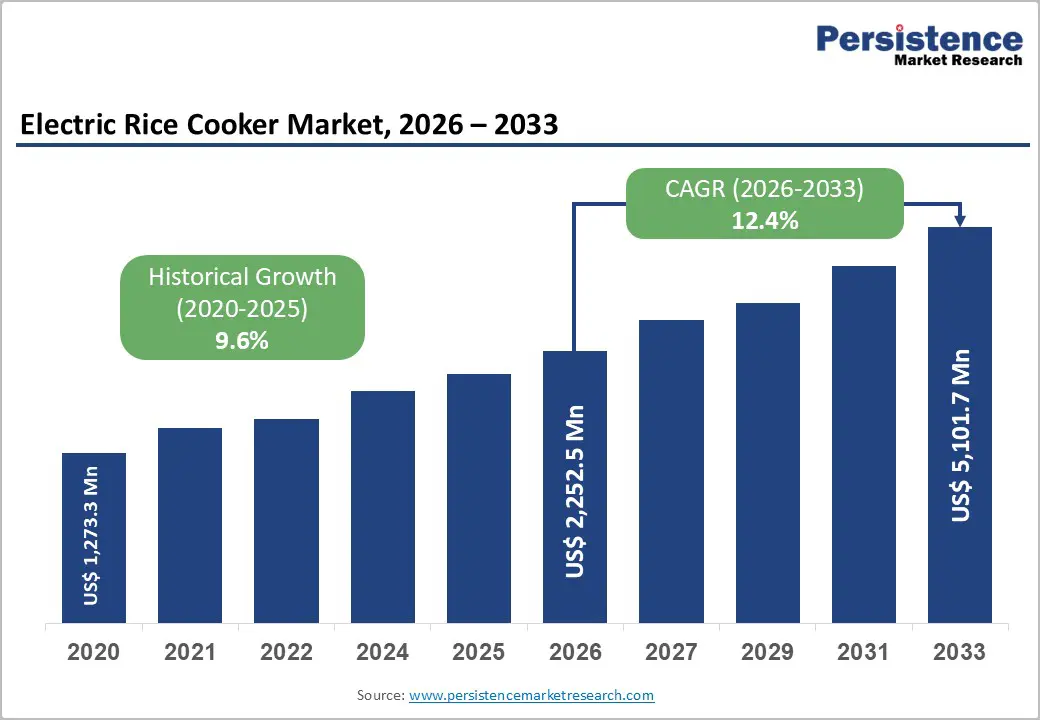
The global electric rice cooker market size is projected to rise from US$ 2,252.5 million in 2026 to US$ 5,101.7 million by 2033. It is anticipated to witness a CAGR of 12.4% during the forecast period from 2026 to 2033, driven by rising urbanization, increasing disposable income, and the shift toward convenient kitchen appliances globally.
The rapid adoption of smart home technologies and energy-efficient cooking solutions is further accelerating demand. Growing consumption of rice as a staple food across the Asia-Pacific and emerging economies, combined with innovations such as induction heating and AI-enabled cooking, is strengthening product adoption across sectors.
Key Industry Highlights:
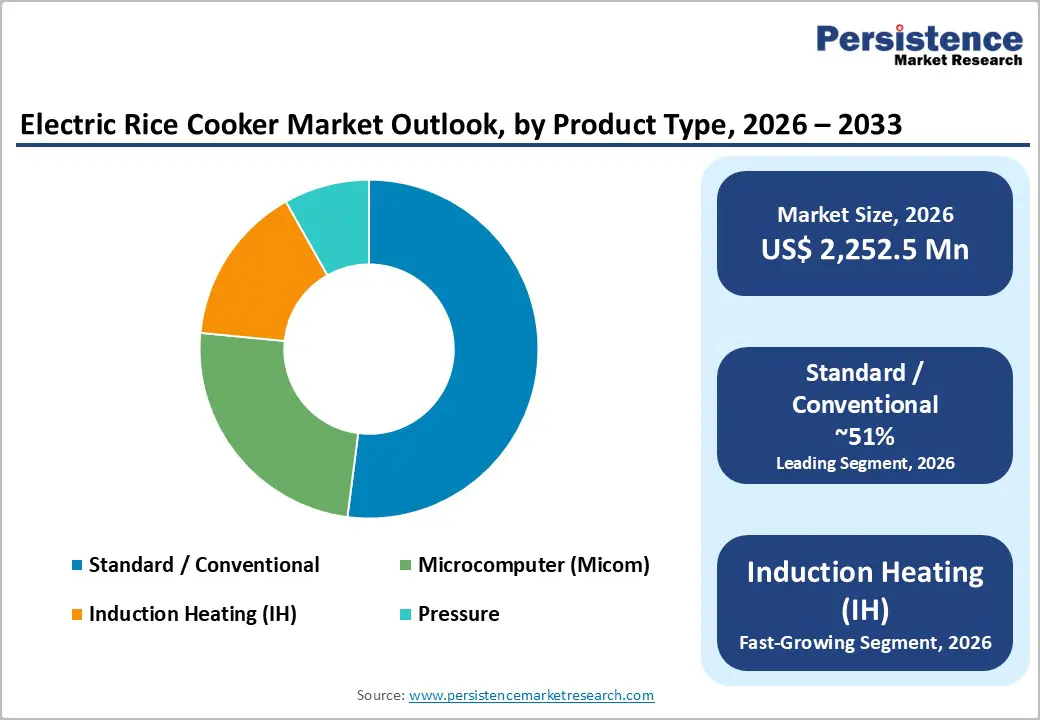
- Leading Product Type: Standard / Conventional rice cookers dominate with over 51% market share in 2026, valued at more than US$ 1,148.8 Mn, driven by affordability, ease of use, and strong adoption across price-sensitive households. Induction Heating (IH) models are the fastest-growing segment, supported by rising demand for precision cooking, premium features, and superior food quality.
- Leading Capacity: 2-4 Liters segment holds over 45% share in 2026, valued at more than US$ 1,013.6 Mn, due to its suitability for nuclear families and everyday household consumption. Above 4 Liters capacity is the fastest-growing, driven by increasing demand from commercial kitchens, catering services, and large households requiring bulk cooking efficiency.
- Leading Distribution Channel: Offline channels command the largest share at over 67% in 2026, valued at more than US$ 1,509.2 Mn, as consumers prefer physical inspection, immediate availability, and trusted retail assistance. Online channels are expanding at a CAGR of 17.5%, fueled by growing e-commerce penetration, competitive pricing, and convenience among urban consumers.
- Leading End-user: Residential / Household segment dominates with over 70% market share in 2026, valued at more than US$ 1,576.8 Mn, supported by the staple nature of rice and rising demand for convenient cooking solutions. The commercial segment is the fastest-growing, driven by expansion in foodservice, cloud kitchens, and quick-service restaurants.
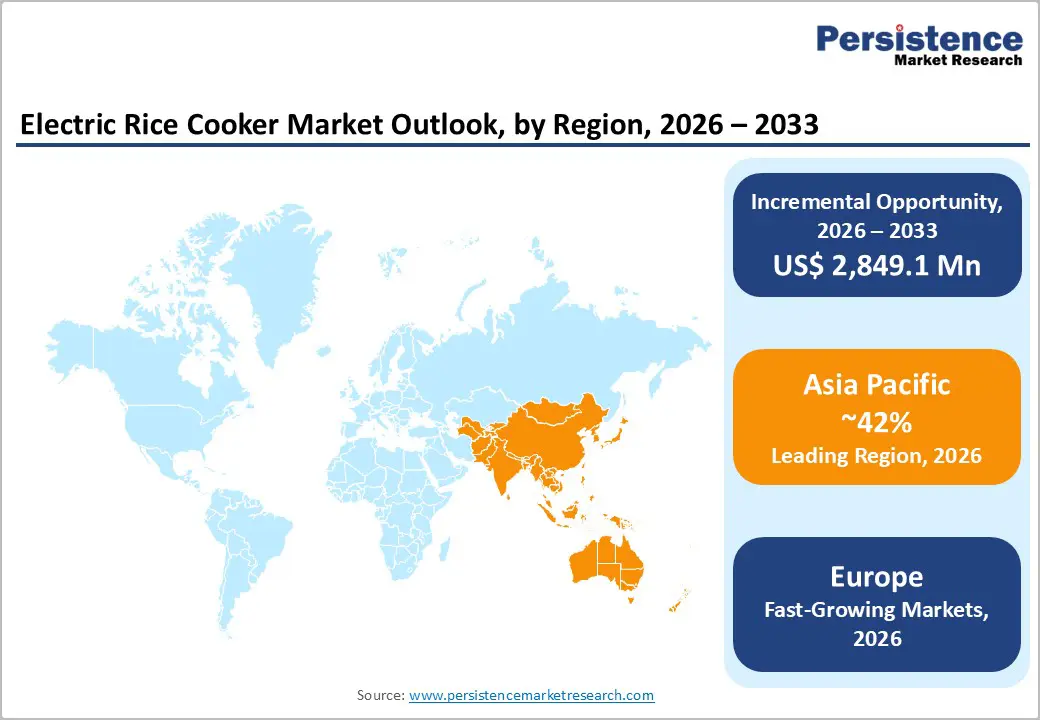
- Leading Region: Asia Pacific leads with over 42% share in 2026, valued at US$ 946.1 Mn, driven by high rice consumption, strong manufacturing base, and increasing urbanization. North America holds over 23% share, supported by multicultural demographics and premium product adoption, while Asia Pacific remains the fastest-growing region due to rising incomes and expanding middle-class population.
| Key Insights | Details |
|---|---|
| Electric Rice Cooker Market Size (2026E) | US$ 2,252.5 Mn |
| Market Value Forecast (2033F) | US$ 5,101.7 Mn |
| Projected Growth (CAGR 2026 to 2033) | 12.4% |
| Historical Market Growth (CAGR 2020 to 2025) | 9.6% |
Market Dynamics
Driver - Rising Demand for Convenience Cooking Appliances
The strongest factor is the consumer shift toward time-saving, automated kitchen appliances that reduce cooking effort and improve consistency. Electric rice cookers appeal to busy households because they simplify a staple food process and support functions such as keep-warm, steaming, and multi-grain cooking. In markets with expanding urban populations and more dual-income households, this convenience becomes a purchase trigger rather than a nice-to-have feature. The category also benefits from premiumization, as buyers increasingly upgrade from basic units to Micom and IH models for better texture control and multifunctionality.
Rising Urbanization and Expanding Middle-Class Population in Emerging Economies
Urbanization remains a principal driver of electric rice cooker demand, particularly across the Asia Pacific and Sub-Saharan Africa. According to the United Nations Department of Economic and Social Affairs (UN DESA), approximately 68% of the world's population is projected to live in urban areas by 2050. Urban households increasingly gravitate toward convenient, time-saving appliances to accommodate fast-paced lifestyles. In countries like India, the National Sample Survey Office (NSSO) data indicates a consistent upswing in household appliance expenditure among middle-class consumers. This expanding consumer base directly translates into higher demand for automated kitchen appliances such as electric rice cookers, propelling market growth across developing regions.
Restraint - Price Sensitivity Limits Premium Model Penetration
A key factor is the gap between consumer willingness to pay and the higher pricing of advanced models. While IH and pressure rice cookers deliver superior results, many buyers still choose standard units because they are materially cheaper and adequate for basic use. This makes the market more fragmented at the entry level and slows the conversion of volume users into premium users. In cost-conscious markets, especially where rice cookers compete against microwave ovens, pressure cookers, and multipurpose appliances, the upgrade cycle remains slow.
Energy Consumption Concerns and Increasing Competition from Alternative Cooking Appliances
Growing consumer awareness of energy costs and sustainability is prompting scrutiny of the power consumption patterns of traditional electric rice cookers. The proliferation of multi-functional appliances such as electric pressure cookers, instant pots, and air fryers is creating competitive substitution pressure. The International Energy Agency (IEA) highlights that household appliances account for a substantial portion of residential electricity consumption globally, amplifying cost concerns among budget-conscious consumers. This dynamic constrains the market's growth potential, particularly in mature markets where product substitution rates are comparatively higher.
Opportunity
Surging Demand for Smart and Connected Kitchen Appliances
The accelerating global adoption of smart home ecosystems presents a significant opportunity for electric rice cooker manufacturers. Smart home device ownership in the U.S. surpassed 65% of households. Integration of rice cookers with platforms such as Amazon Alexa, Google Home, and Apple HomeKit positions these products as integral components of modern connected kitchens. Manufacturers that invest in IoT-enabled product development and interoperable ecosystems stand to capture premium market share, particularly in North America and Western Europe, where smart appliance adoption rates are demonstrably high, and consumer willingness to pay for connected features is well-established.
Expanding Commercial Foodservice Sector Driving Industrial-Grade Demand
The rapid expansion of the global foodservice industry offers substantial growth potential for commercial-grade electric rice cookers. Across the Asia Pacific, the proliferation of quick-service restaurants (QSRs), hotel chains, and catering services is generating sustained demand for high-capacity, durable rice cooking equipment. Manufacturers offering above 4-liter commercial cookers with advanced automation, hygiene compliance, and energy efficiency certifications effectively capitalize on this trend, particularly as institutional foodservice operators seek consistent quality and operational efficiency in their kitchen workflows.
Category-wise Analysis
Product Type Analysis
Standard / Conventional dominates the market, capturing more than 51% market share in 2026 with a value exceeding US$ 1,148.8 Mn, due to their affordability and simplicity, making them highly accessible to mass households, especially in price-sensitive regions. Consumers prefer these models for daily use as they fulfill the core need of basic rice cooking without complex features. Their durability and low maintenance requirements further strengthen adoption. Widespread availability across rural and urban retail networks supports their dominance. For many households, especially in developing economies, functionality outweighs advanced technology.
Induction Heating (IH) is expected to grow rapidly as consumers increasingly prioritize precision cooking and improved food quality. These models address the need for uniform heat distribution, resulting in better texture and taste of rice. Rising disposable incomes and growing interest in premium kitchen appliances are driving adoption. Urban consumers are also attracted to multifunctionality, smart features, and energy efficiency. As lifestyles modernize, demand is shifting toward convenience combined with superior cooking performance.
Capacity Analysis
2 - 4 Liters holds over 45% market share in 2026, with a value exceeding US$ 1,013.6 Mn, as it aligns well with the needs of average household sizes, particularly nuclear families. This capacity offers the right balance between portion size and energy efficiency for daily consumption. Consumers prefer this range for its versatility, suitable for both regular meals and small gatherings. It also fits well within standard kitchen spaces, making it practical for urban living.
The demand for above 4 liters rice cookers is expected to grow rapidly from commercial establishments and joint families. Restaurants, catering services, and institutional kitchens require high-capacity appliances to meet bulk cooking needs efficiently. Growing trends of home gatherings and joint family structures in certain regions contribute to demand. These models address the need for time-saving and operational efficiency in large-scale cooking. Their adoption is also supported by durability and higher output capabilities.
Distribution Channel Analysis
Offline commands the largest market share at over 67% in 2026, with a value exceeding US$ 1,509.2 Mn, due to consumers preferring to physically evaluate appliances before purchase, especially for durability and build quality. Retail stores provide immediate product availability, personalized assistance, and trust, key factors for first-time buyers. In many regions, especially semi-urban and rural areas, offline stores remain the primary purchasing channel due to limited digital penetration. Promotional offers, bundled deals, and after-sales support further strengthen offline sales.
Online is expected to grow at a positive CAGR as consumers increasingly seek convenience, competitive pricing, and a wider product selection. E-commerce platforms cater to the need for easy comparison of features, reviews, and prices, enabling informed decision-making. Urban, tech-savvy consumers are driving this shift, supported by improved logistics and faster delivery services. Discounts, EMI options, and festive sales further accelerate online adoption. The growth is also fueled by increasing smartphone usage and digital payment penetration globally.
End User Insights
Residential/household commands the largest market share at over 70% in 2026, due to rice being a staple food across a large portion of the global population. Electric rice cookers fulfill the everyday need for convenient, consistent, and time-saving meal preparation in households. Increasing urbanization and busy lifestyles are driving demand for automated cooking solutions that reduce manual effort. Affordability and availability of a wide range of models make them accessible to diverse income groups. The growing trend of modular kitchens and small appliances further supports household adoption.
The commercial is expected to grow significantly as foodservice establishments increasingly prioritize efficiency and consistency in large-scale cooking. These appliances address the need for standardized cooking quality while reducing labor dependency. Growth in the hospitality sector, cloud kitchens, and quick-service restaurants is further accelerating demand. Rising food delivery trends are pushing commercial kitchens to adopt reliable, high-performance cooking equipment.
Regional Insights
North America Electric Rice Cooker Market Trends
North America holds over 23% share in 2026, reaching US$ 518.1 Mn value, driven by increasing multiculturalism and rising adoption of Asian cuisines. Data from the U.S. Census Bureau indicates that the Asian-American population has grown by over 35% in the past decade, contributing significantly to demand for rice-based appliances. Health-conscious consumers are also shifting toward grain-based diets, boosting the adoption of premium Micom and IH rice cookers. Regulatory frameworks led by the U.S. Department of Energy and ENERGY STAR are encouraging energy-efficient product innovation. Strong retail and e-commerce presence through major players such as Walmart and Amazon is enhancing consumer accessibility across the region.
Asia Pacific Electric Rice Cooker Market Trends
Asia Pacific holds over 42% share in 2026, reaching US$ 946.1 Mn value, supported by high rice consumption and strong manufacturing capabilities. Countries like China and Japan serve as key hubs, with leading players driving innovation. According to the China Household Electrical Appliances Association, urban penetration in China exceeds 90%, indicating a mature market driven by replacement and premiumization demand. India represents the fastest-growing market, supported by rising electrification and income growth as per the Ministry of Statistics and Programme Implementation, along with increasing urbanization and nuclear households.
Europe Electric Rice Cooker Market Trends
Europe is expected to hold more than 17% share by 2026, led by dietary diversification and the rising popularity of Asian-fusion cuisines across key countries. Regulatory policies such as the Ecodesign Directive enforced by the European Commission and EU Energy Labelling Regulation (EU) 2017/1369 are driving the development of energy-efficient appliances. Markets like the UK, Germany, and France benefit from multicultural populations and growing health awareness, although adoption remains moderate due to a preference for multifunctional kitchen devices. Harmonized regulations across the EU are easing market entry for Asian manufacturers, improving product availability and pricing. Consumer protection initiatives by the European Consumer Organisation further strengthen quality standards and brand trust.
Competitive Landscape
The global electric rice cooker market exhibits a moderately consolidated competitive structure, with Asia Pacific-headquartered firms commanding a significant collective market share. Market leaders differentiate through advanced proprietary technologies, strong brand recognition, and expansive distribution networks. Strategic product launches, regional portfolio customization, and e-commerce channel investments are prevailing expansion strategies, while selective mergers and acquisitions and OEM partnerships characterize the evolving competitive dynamics.
Key Developments:
- In March 2026, CUCKOO Electronics is expanding into smart kitchen technology with an AI-enabled induction range developed alongside Renesas Electronics. The new product features smart listening technology to prevent boil-overs, reinforcing CUCKOO’s shift from a rice-cooker specialist to a global, precision-driven appliance innovator.
- In March 2026, Tiger launches Pressure IH Rice Cooker JPV-H10W/H18W, featuring 1.25 atm pressure cooking and induction heating to enhance rice texture, sweetness, and overall taste. The model includes advanced inner pot technology and specialized modes like Premium and Brown GABA, offering improved flavor retention and convenient, health-focused cooking options.
Companies Covered in Electric Rice Cooker Market
- Zojirushi Corporation
- Tiger Corporation
- Panasonic Corporation
- Midea Group
- Cuckoo Electronics Co., Ltd.
- Koninklijke Philips N.V.
- Bajaj Electricals Ltd.
- Hamilton Beach Brands Holding Company
- Mitsubishi Electric Corporation
- Electrolux AB
- Breville Group Limited
- Black+Decker
- Others
Frequently Asked Questions
The global electric rice cooker market is projected to be valued at US$ 2,252.5 Mn in 2026.
Rising urbanization and increasing demand for convenient, time-saving cooking appliances, especially among working households, are key drivers of the market.
The electric rice cooker market is expected to witness a CAGR of 12.4% from 2026 to 2033.
The growing popularity of Asian cuisines and advancements in smart, energy-efficient kitchen appliances are creating strong growth opportunities.
Zojirushi Corporation, Tiger Corporation, Panasonic Corporation, Midea Group, Cuckoo Electronics Co., Ltd., Koninklijke Philips N.V., Bajaj Electricals Ltd., Hamilton Beach Brands Holding Company are among the leading key players.


