Connected Mining Market Size, Share, and Growth Forecast 2026 - 2033

Connected Mining Market by Component (Asset Tracking & Optimization, Fleet Management, Industrial Safety & Security, Workforce Management, Analytics & Reporting, Process Control), Deployment Mode (On-Premise, Cloud), Mining Type (Surface Mining, Underground Mining), End-User (Coal Mining, Metal Mining, Mineral Mining), and Regional Analysis, 2026 - 2033

ID: PMRREP36532
Calendar

April 2026

214 Pages

Author : Rajat Zope

Connected Mining Market Size and Trend Analysis

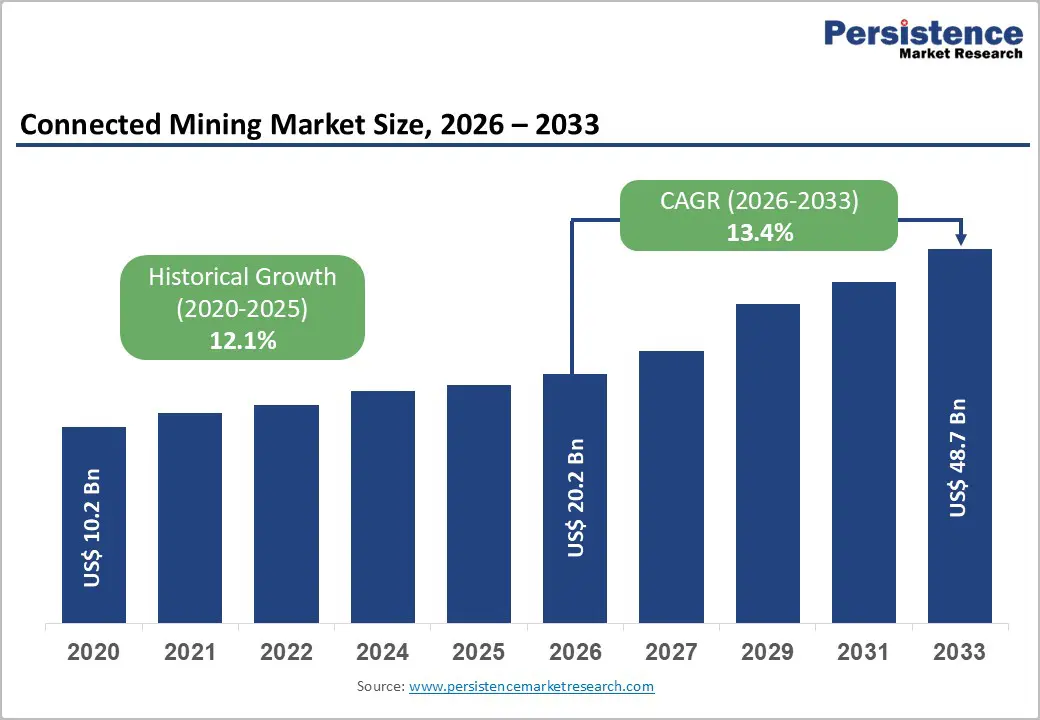
The global connected mining market size is expected to be valued at US$ 20.2 billion in 2026 and projected to reach US$ 48.7 billion by 2033, growing at a CAGR of 13.4% between 2026 and 2033.

Digital transformation powered by IoT and AI is accelerating adoption, enabling predictive maintenance, real-time monitoring, and enhanced worker safety across mining operations. The International Council on Mining and Metals highlights mining’s contribution of 6-7% to global GDP, while sensor-based technologies reduce incidents significantly. Rising mineral demand for clean energy technologies, supported by the International Energy Agency and policy frameworks like the European Green Deal, further drives market expansion.

Key Industry Highlights:

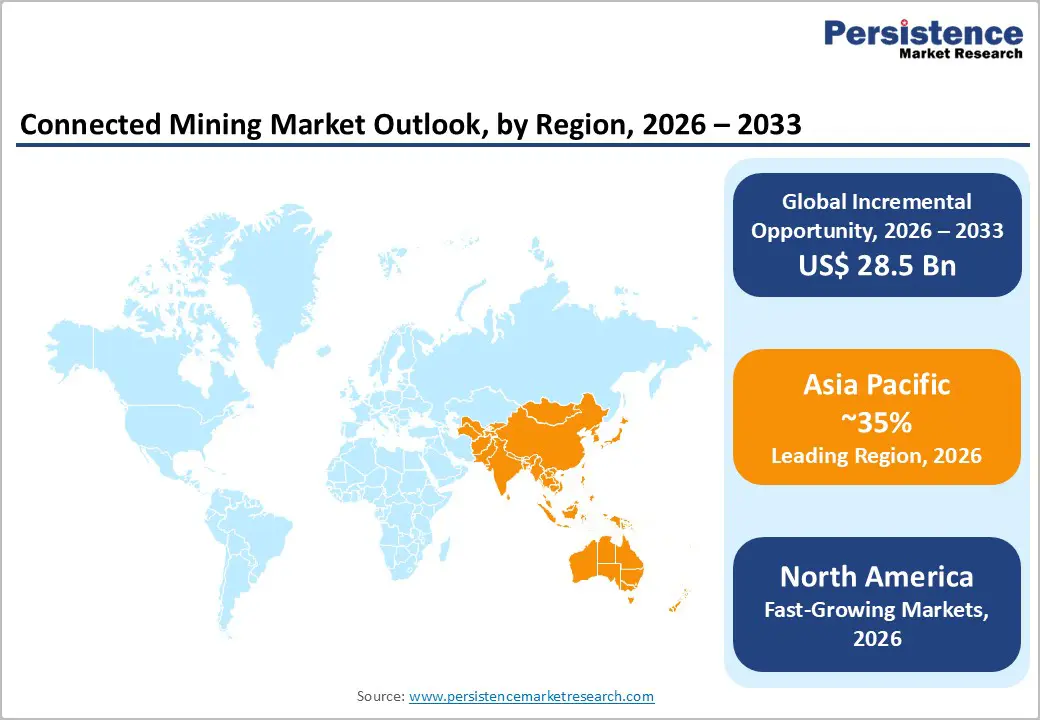
  • Leading Region: Asia Pacific leads the connected mining market with a 35% share, driven by strong mining activity and advanced technological adoption, particularly in China.
  • Fastest Growing Region: North America is the fastest growing region, supported by rapid adoption of advanced technologies, strong regulatory frameworks, and increasing digital transformation in mining operations.
  • Leading Component: Solutions dominate the market with a 68% share, driven by demand for fleet management, asset tracking, and real-time monitoring systems.
  • Fastest Growing Deployment Mode: Cloud deployment is the fastest growing segment, enabling scalable, cost-effective, and flexible mining operations with enhanced data accessibility.
  • Key Opportunity: Surface mining automation offers strong growth potential, improving productivity by enabling efficient operations and delivering significant gains in mineral extraction.
Key Insights Details
Connected Mining Size (2026E) US$ 20.2 billion
Market Value Forecast (2033F) US$ 48.7 billion
Projected Growth CAGR(2026 - 2033) 13.4%
Historical Market Growth (2020 - 2025) 12.1%

connected-mining-market-size-2026-2033

Market Dynamics

Drivers - Rising Sustainability Regulations Driving Adoption of Connected Mining Technologies

Sustainability mandates are accelerating the adoption of connected mining technologies for emission monitoring, resource optimization, and regulatory compliance. According to the World Bank, mining contributes around 4-7% of global greenhouse gas emissions, pushing operators to deploy IoT-enabled systems. These solutions enable real-time tracking of energy, water, and emissions, improving operational transparency and environmental performance. Connected technologies also help reduce water consumption by nearly 20% through intelligent monitoring and automation. Policy frameworks such as the European Green Deal further enforce sustainability standards, while insights from the International Energy Agency indicate efficiency improvements of 15-25%, encouraging investments in ESG-focused mining operations.

Advancements in Autonomous Equipment Enhancing Mining Productivity and Safety

Advancements in AI-driven autonomous equipment are transforming mining operations by significantly improving productivity and safety. Companies like Komatsu Ltd. have deployed autonomous haulage systems capable of transporting massive volumes with minimal human intervention. Integration of 5G connectivity reduces latency, enabling real-time decision-making and addressing labor shortages in remote mining environments.

Automation technologies are delivering substantial efficiency gains, with estimates from McKinsey & Company suggesting productivity improvements of 20-30%. Leading operators such as Rio Tinto are scaling autonomous fleets to enhance operational safety, reduce costs, and optimize resource extraction across large-scale mining sites.

Restraints - High Initial Capital Requirements Limiting Connected Mining Technology Adoption

High upfront capital investment remains a significant barrier to the adoption of connected mining technologies, particularly for small and mid-sized operators. Deployment of sensors, communication networks, and automation systems requires substantial expenditure, while integration with legacy infrastructure further increases costs. Insights from Deloitte indicate that nearly 40% of mining companies view capital requirements as a key adoption challenge.

Additionally, integration and implementation costs can account for 20-30% of total project spending, creating financial strain, especially in developing regions. Limited access to financing and budget constraints slow the pace of digital transformation, restricting widespread deployment of advanced connected mining solutions across emerging mining economies.

Rising Cybersecurity Risks Threatening Connected Mining Infrastructure Stability

Increasing cybersecurity vulnerabilities pose a critical restraint for connected mining operations as digital systems become more interconnected. According to IBM, cyberattacks on industrial sectors have surged significantly, exposing mining networks to risks such as ransomware and data breaches. These threats can disrupt operations, compromise sensitive data, and lead to substantial financial losses.

Guidelines from the National Institute of Standards and Technology emphasize the growing complexity of securing industrial IoT environments. Compliance requirements and the need for advanced security infrastructure place additional pressure on smaller firms, limiting their ability to fully adopt connected mining technologies.

Opportunities - Expansion of Surface Mining Automation Creating Scalable Growth Opportunities

Surface mining continues to dominate global operations, accounting for approximately 60% of mining activities, making it highly suitable for automation and connected technologies. Integration of drones, GPS-enabled systems, and remote monitoring solutions enhances efficiency, safety, and precision in large-scale open-pit operations. Insights from the United States Geological Survey highlight the scalability of digital tools in surface mining environments.

Leading companies are already demonstrating strong gains, with firms like BHP Group reporting productivity improvements of up to 25% through automation initiatives. Government-backed initiatives, including Australia’s mining modernization strategies, further support adoption amid rising mineral demand driven by energy transition trends. This creates substantial opportunities for connected mining solutions across surface operations.

Growing Cloud-Based Deployment Unlocking Opportunities for SMEs

Cloud-based deployment is emerging as a key opportunity in the connected mining market, particularly for small and medium enterprises (SMEs). Cloud solutions reduce upfront infrastructure costs and enable scalable, flexible data management, making digital transformation more accessible. According to Amazon Web Services, cloud adoption can reduce operational and IT costs by nearly 50% while improving efficiency and data accessibility.

This trend is especially prominent in the Asia Pacific region, where mineral demand is increasing and SMEs are seeking cost-effective digital solutions. Cloud platforms support remote monitoring, predictive analytics, and real-time collaboration, enabling smaller mining operators to adopt advanced technologies without heavy capital investment, thereby driving significant market expansion opportunities.

Category-wise Analysis

Component Insights

Solutions dominate the connected mining market, accounting for nearly 68% share in 2025, driven by strong adoption of fleet management, asset tracking, and advanced analytics solutions. These systems enable real-time monitoring, predictive maintenance, and improved operational visibility, with companies leveraging technologies that can achieve up to 95% equipment visibility across mining operations. Enhanced safety compliance, supported by regulations similar to those enforced by Occupational Safety and Health Administration, has further strengthened demand for connected solutions, reducing workplace incidents by up to 40%.

The services segment is emerging as the fastest growing category, supported by increasing demand for managed services, system integration, and ongoing maintenance of connected mining infrastructure. Mining companies are increasingly outsourcing digital operations to ensure seamless implementation, cybersecurity, and optimization of connected platforms. Growing complexity in mining environments, along with the need for continuous system upgrades and data analytics support, is accelerating service adoption across both large and small mining operators.

Deployment Mode Insights

On-premise deployment holds a dominant share of around 55% in the connected mining market, primarily due to concerns over data security, operational control, and the need for reliable connectivity in remote mining environments. Many mining companies prefer localized systems to ensure uninterrupted operations and safeguard sensitive data. Industry insights from Gartner indicate that while cloud adoption is rising, a significant portion of enterprises still rely on on-premise systems for critical mining functions.

Cloud deployment is the fastest growing segment, driven by its scalability, cost efficiency, and ability to support remote and distributed mining operations. Cloud platforms enable real-time data access, advanced analytics, and seamless collaboration across locations, making them highly attractive for digital transformation initiatives. Increasing integration of IoT and AI solutions, along with reduced infrastructure costs, is accelerating the shift toward cloud-based connected mining solutions.

Mining Type Insights

Surface mining accounts for approximately 60% of the connected mining market share, as it offers easier deployment of connected technologies such as GPS-enabled haulage systems, drones, and autonomous trucks. Large-scale open-pit operations benefit from enhanced visibility and accessibility, enabling efficient implementation of digital monitoring and automation solutions. Leading equipment providers like Caterpillar Inc. are actively supporting surface mining automation with advanced connected solutions.

Underground mining is the fastest growing segment due to rising safety concerns, increasing regulatory pressure, and the need for improved operational efficiency in complex environments. Connected technologies such as real-time monitoring, environmental sensors, and communication systems are being rapidly deployed to enhance worker safety and optimize underground operations. Growing investments in deep mining projects and mineral extraction are further accelerating the adoption of connected solutions in underground mining.

End-user Insights

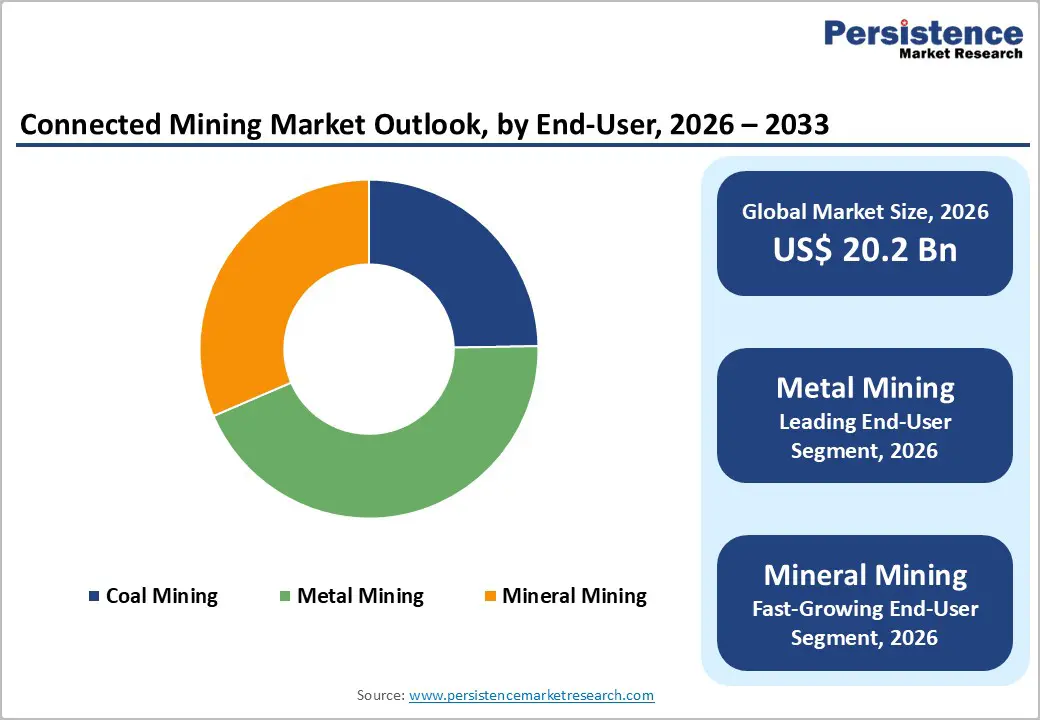
Metal mining dominates the connected mining market with around 55% share, driven by strong demand for critical minerals such as lithium, copper, and cobalt, which are essential for electric vehicles and renewable energy technologies. Companies like Glencore plc are leveraging connected technologies to improve operational efficiency and resource optimization. The increasing focus on energy transition and electrification is further boosting demand from the metal mining segment.

The mineral mining segment is the fastest growing end-user category, supported by rising demand for industrial and construction minerals across developing economies. Increasing infrastructure development, urbanization, and technological advancements are driving the need for efficient resource extraction. The push for sustainable mining practices and the integration of digital technologies are further accelerating the adoption of connected mining solutions in this segment.
connected-mining-market-outlook-by-end-user-2026-2033

Regional Insights

North America Connected Mining Market Trends and Insights

North America holds a strong position in the connected mining market with a significant share of around 30%, driven by advanced infrastructure, early technology adoption, and strong regulatory frameworks. The United States leads the region, particularly mining hubs such as Nevada, where advanced connected mining systems are widely implemented. Companies like Newmont Corporation have reported improvements of up to 25% in downtime reduction through the use of connected technologies.

Government agencies such as the Mine Safety and Health Administration and the U.S. Department of Energy are actively supporting mining safety and digital infrastructure through funding initiatives, including investments in safety grids and smart mining systems. This strong regulatory and technological ecosystem continues to drive innovation and adoption across the region.

Europe Connected Mining Market Trends and Insights

Europe is a mature yet rapidly evolving market, supported by a strong focus on digitalization and sustainability. The region is expected to grow at a steady CAGR of around 10-11%, driven by regulatory initiatives and the push for efficient resource utilization. Germany leads the region with its advanced industrial ecosystem and strong adoption of Industry 4.0 practices, with companies like Siemens AG playing a key role in enabling smart mining solutions.

The implementation of policies such as the European Critical Raw Materials Act is fostering collaboration across countries including the UK, France, and Spain. According to the Eurostat, mining output in the region is improving by approximately 15%, driven by digital technologies and sustainability-focused mining practices.

Asia Pacific Connected Mining Market Trends and Insights

Asia Pacific leads the connected mining market with a dominant share of around 35% in 2025, driven by large-scale mining activities, rapid industrialization, and strong government support for digital transformation. The region is also the fastest growing, supported by a CAGR of nearly 15%, as countries continue to invest in advanced mining technologies. China plays a pivotal role through initiatives like the Belt and Road program, with companies such as Zijin Mining Group deploying sensor-based solutions for improved efficiency.

India is also witnessing significant growth, with major investments from Coal India Limited toward digitalization, while ASEAN countries benefit from initiatives supported by organizations like the Asian Development Bank, enabling up to 20% operational efficiency improvements through connected mining technologies.
connected-mining-market-outlook-by-region-2026-2033

Competitive Landscape

The competitive landscape of the connected mining market is moderately consolidated, with a mix of global technology providers and specialized mining solution vendors. Leading players focus on strengthening their positions through strategic collaborations, innovation, and integration of advanced technologies such as AI, IoT, and real-time data analytics. The market is characterized by continuous investments in digital transformation, enabling companies to offer end-to-end connected solutions across mining operations. Increasing demand for automation, predictive maintenance, and remote monitoring is further intensifying competition, pushing companies to enhance operational efficiency, safety, and overall productivity.

Emerging players and established firms are increasingly adopting strategies centered on edge computing, cloud integration, and 5G-enabled connectivity to gain a competitive edge. Partnerships and joint ventures are becoming crucial for expanding technological capabilities and geographic reach. The focus on scalable, interoperable solutions is driving innovation, while rising demand for sustainable and efficient mining practices continues to shape competitive dynamics in the market.

Key Developments:

  • In June 2025, Caterpillar Inc. launched MineStar Edge, an advanced fleet optimization solution designed to enhance operational efficiency, real-time decision-making, and equipment utilization in mining operations, leveraging connected technologies to improve productivity and reduce operational downtime.
  • In March 2024, Komatsu Ltd. partnered with Nippon Telegraph and Telephone Corporation to deploy 5G-enabled connectivity in Australia, enabling ultra-low latency communication, improved remote operations, and enhanced safety across large-scale mining sites.
  • In November 2024, Hexagon AB introduced an AI-powered safety solution for BHP Group, aimed at improving worker safety, monitoring risks in real time, and leveraging predictive analytics to reduce incidents and enhance operational safety standards.

Companies Covered in Connected Mining Market

  • Caterpillar Inc.
  • Komatsu Ltd.
  • Cisco Systems Inc.
  • Hexagon AB
  • Siemens AG
  • Rockwell Automation
  • ABB Ltd.
  • Epiroc AB
  • Sandvik AB
  • Trimble Inc.
Frequently Asked Questions

The connected mining market is valued at US$ 20.2 billion in 2026, driven by the increasing adoption of IoT and AI technologies across mining operations.

The connected mining market is driven by sustainability mandates and growing automation, enabling 20-30% productivity improvements through advanced connected mining technologies.

Asia Pacific leads with a 35% share in 2025, supported by large-scale mining activities and strong technological capabilities, particularly in China.

Surface mining automation presents a major opportunity, with around 60% share and potential productivity gains of up to 25%.

Key players include leading OEMs and technology providers such as major equipment manufacturers and digital solution providers focusing on AI, IoT, and 5G integration.

Connected Mining Market Report Scope
Report Attribute Details
Historical Data/Actuals 2020 - 2025
Forecast Period 2026 - 2033
Market Analysis Units Value: US$ Bn, Volume: As Applicable
Geographical Coverage
  • North America
  • Europe
  • Asia Pacific
  • Latin America
  • Middle East & Africa
Segmental Coverage
  • Component
  • Deployment Mode
  • Mining Type
  • End-user
  • Region
Competitive Analysis
  • Caterpillar Inc.
  • Komatsu Ltd.
  • Cisco Systems Inc.
  • Hexagon AB
  • Siemens AG
  • Rockwell Automation
  • ABB Ltd.
  • Epiroc AB
  • Sandvik AB
  • Trimble Inc.
Report Highlights
  • Market Forecast and Trends
  • Competitive Intelligence & Share Analysis
  • Growth Factors and Challenges
  • Strategic Growth Initiatives
  • Pricing Analysis
  • Future Opportunities and Revenue Pockets
  • Market Analysis Tools
Market Segmentation

By Component

  • Asset Tracking & Optimization
  • Fleet Management
  • Industrial Safety & Security
  • Workforce Management
  • Analytics & Reporting
  • Process Control

By Deployment Mode

  • On-Premise
  • Cloud

By Mining Type

  • Surface Mining
  • Underground Mining

By End-user

  • Coal Mining
  • Metal Mining
  • Mineral Mining

By Region

  • North America
  • Europe
  • Asia Pacific
  • Latin America
  • Middle East & Africa

Related Reports

  1. Executive Summary
    1. Global Connected Mining Market Snapshot 2026 and 2033
    2. Market Opportunity Assessment, 2026-2033, US$ Bn
    3. Key Market Trends
    4. Industry Developments and Key Market Events
    5. Demand Side and Supply Side Analysis
    6. PMR Analysis and Recommendations
  2. Market Overview
    1. Market Scope and Definitions
    2. Market Dynamics
      1. Driver
      2. Restraint
      3. Opportunities
      4. Trends
    3. Macro-Economic Factors
      1. Global GDP Outlook
      2. Global Prison Growth Outlook
      3. Global Crime Rates by Country
      4. Global Prison Population by Country
      5. Global Private Prison Market Growth Outlook
      6. Other Macro-economic Factors
    4. Forecast Factors - Relevance and Impact
    5. COVID-19 Impact Assessment
  3. Value Added Insights
    1. Value Chain analysis
    2. Key Market Players
    3. Product Adoption Analysis
    4. Key Promotional Strategies by key players
    5. PESTLE Analysis
    6. Porter's Five Forces Analysis
    7. Regulatory and Technology Landscape
  4. Price Trend Analysis, 2025
    1. Region-wise Price Analysis
    2. Price by Segments
    3. Price Impact Factors
  5. Global Connected Mining Market Outlook: Historical (2020 - 2025) and Forecast (2026 - 2033)
    1. Key Highlights
    2. Global Connected Mining Market Outlook: Component
      1. Introduction/Key Findings
      2. Historical Market Size (US$ Bn) and Volume (Units) Analysis by Component, 2020-2025
      3. Current Market Size (US$ Bn) and Volume (Units) Forecast, by Component, 2026-2033
        1. Solutions
          1. Asset Tracking & Optimization
          2. Fleet Management
          3. Industrial Safety & Security
          4. Workforce Management
          5. Analytics & Reporting
          6. Process Control
        2. Services
          1. Professional Services
          2. Managed Services
      4. Market Attractiveness Analysis: Component
    3. Global Connected Mining Market Outlook: Deployment Mode
      1. Introduction/Key Findings
      2. Historical Market Size (US$ Bn) and Volume (Units) Analysis by Deployment Mode, 2020-2025
      3. Current Market Size (US$ Bn) and Volume (Units) Forecast, by Deployment Mode, 2026-2033
        1. On-Premise
        2. Cloud
      4. Market Attractiveness Analysis: Deployment Mode
    4. Global Connected Mining Market Outlook: Mining Type
      1. Introduction/Key Findings
      2. Historical Market Size (US$ Bn) and Volume (Units) Analysis by Mining Type, 2020-2025
      3. Current Market Size (US$ Bn) and Volume (Units) Forecast, by Mining Type, 2026-2033
        1. Surface Mining
        2. Underground Mining
      4. Market Attractiveness Analysis: Mining Type
    5. Global Connected Mining Market Outlook: End-User
      1. Introduction/Key Findings
      2. Historical Market Size (US$ Bn) and Volume (Units) Analysis by End-User, 2020-2025
      3. Current Market Size (US$ Bn) and Volume (Units) Forecast, by End-User, 2026-2033
        1. Coal Mining
        2. Metal Mining
        3. Mineral Mining
      4. Market Attractiveness Analysis: End-User
  6. Global Connected Mining Market Outlook: Region
    1. Key Highlights
    2. Historical Market Size (US$ Bn) and Volume (Units) Analysis by Region, 2020-2025
    3. Current Market Size (US$ Bn) and Volume (Units) Forecast, by Region, 2026-2033
      1. North America
      2. Europe
      3. East Asia
      4. South Asia & Oceania
      5. Latin America
      6. Middle East & Africa
    4. Market Attractiveness Analysis: Region
  7. North America Connected Mining Market Outlook: Historical (2020 - 2025) and Forecast (2026 - 2033)
    1. Key Highlights
    2. Pricing Analysis
    3. North America Market Size (US$ Bn) and Volume (Units) Forecast, by Country, 2026-2033
      1. U.S.
      2. Canada
    4. North America Market Size (US$ Bn) and Volume (Units) Forecast, by Component, 2026-2033
      1. Solutions
        1. Asset Tracking & Optimization
        2. Fleet Management
        3. Industrial Safety & Security
        4. Workforce Management
        5. Analytics & Reporting
        6. Process Control
      2. Services
        1. Professional Services
        2. Managed Services
    5. North America Market Size (US$ Bn) and Volume (Units) Forecast, by Deployment Mode, 2026-2033
      1. On-Premise
      2. Cloud
    6. North America Market Size (US$ Bn) and Volume (Units) Forecast, by Mining Type, 2026-2033
      1. Surface Mining
      2. Underground Mining
    7. North America Market Size (US$ Bn) and Volume (Units) Forecast, by End-User, 2026-2033
      1. Coal Mining
      2. Metal Mining
      3. Mineral Mining
  8. Europe Connected Mining Market Outlook: Historical (2020 - 2025) and Forecast (2026 - 2033)
    1. Key Highlights
    2. Pricing Analysis
    3. Europe Market Size (US$ Bn) and Volume (Units) Forecast, by Country, 2026-2033
      1. Germany
      2. Italy
      3. France
      4. U.K.
      5. Spain
      6. Russia
      7. Rest of Europe
    4. Europe Market Size (US$ Bn) and Volume (Units) Forecast, by Component, 2026-2033
      1. Solutions
        1. Asset Tracking & Optimization
        2. Fleet Management
        3. Industrial Safety & Security
        4. Workforce Management
        5. Analytics & Reporting
        6. Process Control
      2. Services
        1. Professional Services
        2. Managed Services
    5. Europe Market Size (US$ Bn) and Volume (Units) Forecast, by Deployment Mode, 2026-2033
      1. On-Premise
      2. Cloud
    6. Europe Market Size (US$ Bn) and Volume (Units) Forecast, by Mining Type, 2026-2033
      1. Surface Mining
      2. Underground Mining
    7. Europe Market Size (US$ Bn) and Volume (Units) Forecast, by End-User, 2026-2033
      1. Coal Mining
      2. Metal Mining
      3. Mineral Mining
  9. East Asia Connected Mining Market Outlook: Historical (2020 - 2025) and Forecast (2026 - 2033)
    1. Key Highlights
    2. Pricing Analysis
    3. East Asia Market Size (US$ Bn) and Volume (Units) Forecast, by Country, 2026-2033
      1. China
      2. Japan
      3. South Korea
    4. East Asia Market Size (US$ Bn) and Volume (Units) Forecast, by Component, 2026-2033
      1. Solutions
        1. Asset Tracking & Optimization
        2. Fleet Management
        3. Industrial Safety & Security
        4. Workforce Management
        5. Analytics & Reporting
        6. Process Control
      2. Services
        1. Professional Services
        2. Managed Services
    5. East Asia Market Size (US$ Bn) and Volume (Units) Forecast, by Deployment Mode, 2026-2033
      1. On-Premise
      2. Cloud
    6. East Asia Market Size (US$ Bn) and Volume (Units) Forecast, by Mining Type, 2026-2033
      1. Surface Mining
      2. Underground Mining
    7. East Asia Market Size (US$ Bn) and Volume (Units) Forecast, by End-User, 2026-2033
      1. Coal Mining
      2. Metal Mining
      3. Mineral Mining
  10. South Asia & Oceania Connected Mining Market Outlook: Historical (2020 - 2025) and Forecast (2026 - 2033)
    1. Key Highlights
    2. Pricing Analysis
    3. South Asia & Oceania Market Size (US$ Bn) and Volume (Units) Forecast, by Country, 2026-2033
      1. India
      2. Southeast Asia
      3. ANZ
      4. Rest of SAO
    4. South Asia & Oceania Market Size (US$ Bn) and Volume (Units) Forecast, by Component, 2026-2033
      1. Solutions
        1. Asset Tracking & Optimization
        2. Fleet Management
        3. Industrial Safety & Security
        4. Workforce Management
        5. Analytics & Reporting
        6. Process Control
      2. Services
        1. Professional Services
        2. Managed Services
    5. South Asia & Oceania Market Size (US$ Bn) and Volume (Units) Forecast, by Deployment Mode, 2026-2033
      1. On-Premise
      2. Cloud
    6. South Asia & Oceania Market Size (US$ Bn) and Volume (Units) Forecast, by Mining Type, 2026-2033
      1. Surface Mining
      2. Underground Mining
    7. South Asia & Oceania Market Size (US$ Bn) and Volume (Units) Forecast, by End-User, 2026-2033
      1. Coal Mining
      2. Metal Mining
      3. Mineral Mining
  11. Latin America Connected Mining Market Outlook: Historical (2020 - 2025) and Forecast (2026 - 2033)
    1. Key Highlights
    2. Pricing Analysis
    3. Latin America Market Size (US$ Bn) and Volume (Units) Forecast, by Country, 2026-2033
      1. Brazil
      2. Mexico
      3. Rest of LATAM
    4. Latin America Market Size (US$ Bn) and Volume (Units) Forecast, by Component, 2026-2033
      1. Solutions
        1. Asset Tracking & Optimization
        2. Fleet Management
        3. Industrial Safety & Security
        4. Workforce Management
        5. Analytics & Reporting
        6. Process Control
      2. Services
        1. Professional Services
        2. Managed Services
    5. Latin America Market Size (US$ Bn) and Volume (Units) Forecast, by Deployment Mode, 2026-2033
      1. On-Premise
      2. Cloud
    6. Latin America Market Size (US$ Bn) and Volume (Units) Forecast, by Mining Type, 2026-2033
      1. Surface Mining
      2. Underground Mining
    7. Latin America Market Size (US$ Bn) and Volume (Units) Forecast, by End-User, 2026-2033
      1. Coal Mining
      2. Metal Mining
      3. Mineral Mining
  12. Middle East & Africa Connected Mining Market Outlook: Historical (2020 - 2025) and Forecast (2026 - 2033)
    1. Key Highlights
    2. Pricing Analysis
    3. Middle East & Africa Market Size (US$ Bn) and Volume (Units) Forecast, by Country, 2026-2033
      1. GCC Countries
      2. South Africa
      3. Northern Africa
      4. Rest of MEA
    4. Middle East & Africa Market Size (US$ Bn) and Volume (Units) Forecast, by Component, 2026-2033
      1. Solutions
        1. Asset Tracking & Optimization
        2. Fleet Management
        3. Industrial Safety & Security
        4. Workforce Management
        5. Analytics & Reporting
        6. Process Control
      2. Services
        1. Professional Services
        2. Managed Services
    5. Middle East & Africa Market Size (US$ Bn) and Volume (Units) Forecast, by Deployment Mode, 2026-2033
      1. On-Premise
      2. Cloud
    6. Middle East & Africa Market Size (US$ Bn) and Volume (Units) Forecast, by Mining Type, 2026-2033
      1. Surface Mining
      2. Underground Mining
    7. Middle East & Africa Market Size (US$ Bn) and Volume (Units) Forecast, by End-User, 2026-2033
      1. Coal Mining
      2. Metal Mining
      3. Mineral Mining
  13. Competition Landscape
    1. Market Share Analysis, 2025
    2. Market Structure
      1. Competition Intensity Mapping
      2. Competition Dashboard
    3. Company Profiles
      1. Caterpillar Inc.
        1. Company Overview
        2. Product Portfolio/Offerings
        3. Key Financials
        4. SWOT Analysis
        5. Company Strategy and Key Developments
      2. Komatsu Ltd.
      3. ABB Ltd.
      4. Cisco Systems Inc.
      5. International Business Machines Corporation (IBM)
      6. Siemens AG
      7. Rockwell Automation Inc.
      8. Hexagon AB
      9. Schneider Electric SE
      10. Trimble Inc.
      11. Sandvik AB
      12. Hitachi Construction Machinery Co., Ltd.
      13. Epiroc AB
      14. Accenture plc
      15. SAP SE
  14. Appendix
    1. Research Methodology
    2. Research Assumptions
    3. Acronyms and Abbreviations

Research Methodology Framework for Market Research Excellence

At Persistence Market Research, we implement a comprehensive, validated, and multi-dimensional approachto market analysis that delivers actionable insights across complex market landscapes. Our methodology combines the analytical rigor of leading consulting firms with innovative research techniques, ensuring robust market assessments that guide strategic decision-making with confidence.

Core Research Philosophy

Our methodology is built on four foundational pillars:

Research Philosophy Image

At Persistence Market Research, our methodology is designed to transcend conventional market studies by combining analytical rigor, multi-source validation, and future-focused insights.

We integrate advanced research frameworks, robust data collection strategies, cutting-edge analytics, and innovative technologies to deliver a 360-degree view of complex markets.

We integrate advanced research frameworks, robust data collection strategies, cutting-edge analytics, and innovative technologies to deliver a 360-degree view of complex markets.

Each stage spanning from strategic scoping and hypothesis-building to competitive intelligence, quality validation, and actionable recommendations is engineered to provide clients with unmatched clarity, precision, and confidence in decision-making.

By embedding innovation and technology at the core, our approach ensures that insights are not only comprehensive but also predictive, empowering businesses to seize opportunities, mitigate risks, and achieve sustainable growth

Research Philosophy Image

Capturing Key Information and Events

During this phase, key research objectives focus on essential information and data points for assessing the market, including:

Research Philosophy Image

TAM-SAM-SOM Framework Implementation

We employ both top-down and bottom-up approaches to ensure accurate market sizing.

Top-Down Market SizingBottom-Up Market Sizing
Universe Definition: Total global/regional market identificationUnit Economics: Average transaction values, purchase frequencies, customer lifecycle
Segmentation Filters: Geographic, demographic, and behavioral constraintsCustomer Segmentation: Detailed buyer persona development and sizing
Market Share Analysis: Competitive landscape assessment and share allocationPenetration Analysis: Market penetration rates by segment and geography
Growth Rate Application: Historical trends and forward-looking growth assumptionsScaling Methodology: Extrapolation techniques with confidence intervals

Validation & Cross-Verification

  • Triangulation: Comparing top-down and bottom-up results for consistency
  • Sensitivity Analysis: Testing key assumptions and parameter variations
  • Peer Benchmarking: Comparison with analogous markets and industry benchmarks
  • Expert Review: External validation through industry specialist consultation

Research Philosophy Image

Forecasting & Projection Modeling

Our proprietary forecasting models incorporate multiple variables and scenarios.

Forecasting Components

  • Historical Trend Analysis: 10-year historical growth patterns and cyclical variations
  • Driver-Based Modeling: Economic indicators, demographic shifts, technology adoption
  • Scenario Planning: Base case, optimistic, and conservative projections
  • Monte Carlo Simulations: Probability-weighted outcomes and risk assessments

Model Validation

  • Back-Testing: Historical accuracy assessment over 3–5-year periods
  • Cross-Validation: Multiple modeling approaches for result comparison
  • External Benchmarking: Comparison with established market forecasts
  • Continuous Calibration: Quarterly model updates based on new data

Comprehensive Data Collection Strategy

Our secondary research phase establishes a robust knowledge base utilizing diverse, credible sources.

Secondary Data Sourcess

  • Industry Publications & Reports
  • Government & Regulatory Data
  • Financial Intelligence (filings & reports)
  • Academic Research & Digital Intelligence

Quality Assurance Protocol

  • Source credibility assessment and publication date validation
  • Data consistency checks across multiple sources
  • Bias identification and neutralization techniques
  • Information gap tracking for primary research prioritization

Research Philosophy Image

Primary Research Excellence

Our primary research methodology employs best-in-class techniques to capture unique market insights.

Quantitative Research Methods

  • Large-Scale Surveys: Statistically representative samples with 95% confidence intervals
  • Survey Methodology: Multi-channel deployment (online, telephone, in-person)
  • Question Architecture and Response Optimization

Qualitative Research Methods

  • Executive Interviews
  • Focus Groups
  • Expert Consultations

Quality Assurance & Validation Framework

Multi-Stage Validation Process

  • Source Verification and Consistency Testing
  • Outlier Detection and Bias Assessment
  • Peer Review Process and External Validation
  • Sensitivity Analysis and Confidence Intervals

Research Philosophy Image

Methodology Validation & Credibility

Our research methodology has been extensively validated through:

  • Academic Partnerships: Collaborations with top-tier business schools and research institutions
  • Client Success Stories: Documented case studies demonstrating research impact and ROI
  • Continuous Benchmarking: Performance comparison with leading global research firms

This comprehensive methodology framework positions Persistence Market Research at the forefront of market intelligence, combining the analytical sophistication of top-tier consulting firms with innovative research techniques. Our approach ensures that every market assessment delivers precise, actionable, and strategically valuable insights that drive business success in competitive market environments.

Ready to unlock your market potential? Contact our research experts to discuss how our validated methodology can transform your strategic decision-making with data-driven market intelligence.

Copyright © 2026 Persistence Market Research. All Rights Reserved

Connect With Us -