




- Construction & Engineering
- Joint Compound Market
Joint Compound Market Size, Share, and Growth Forecast 2026 - 2033
Joint Compound Market by Product Type (Ready-Mix Joint Compound, Setting-Type Joint Compound, Drying-Type Joint Compound), Distribution Channel (Offline Retail, Online Retail), by Packaging Type (Buckets / Tubs, Bags, Boxes / Cartons), by Application (Residential, Commercial, Industrial), and Regional Analysis, 2026 - 2033

Joint Compound Market Size and Trend Analysis
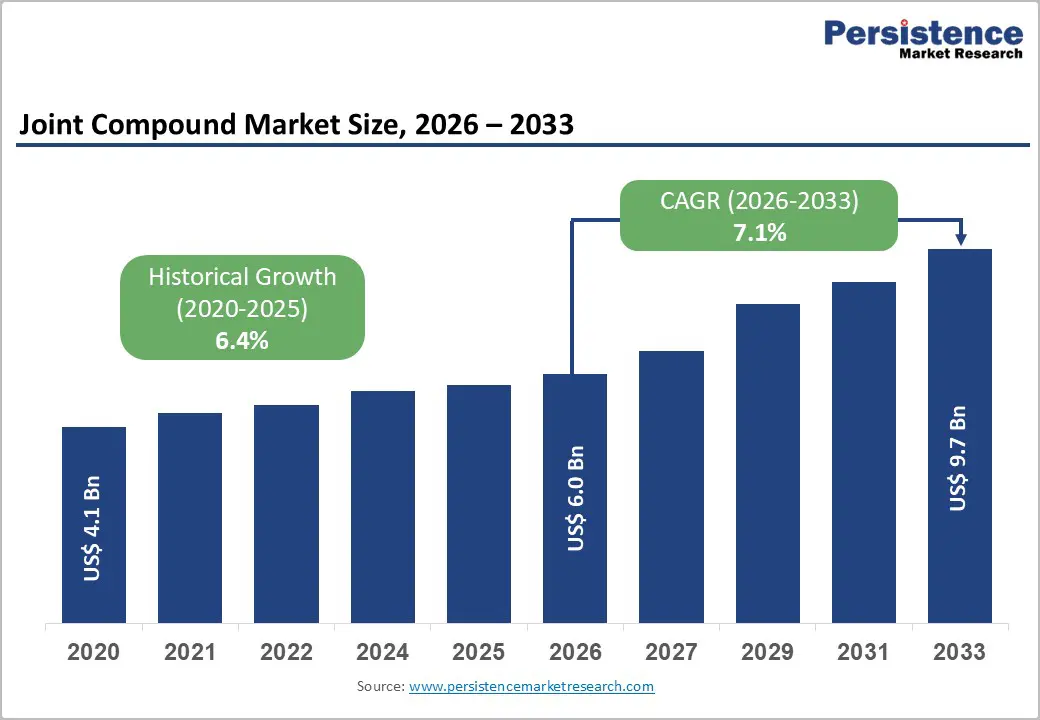
The global joint compound market size is expected to be valued at US$ 6.0 billion in 2026 and projected to reach US$ 9.7 billion by 2033, growing at a CAGR of 7.2% between 2026 and 2033. Growth is driven by robust expansion in global construction activities, particularly in residential and commercial sectors.
Rapid urbanization, rising housing demand, and infrastructure development are accelerating the use of drywall finishing materials. Further increases in renovation and remodeling projects support demand. Government initiatives such as affordable housing programs and urban redevelopment schemes, along with steady growth in building permits, continue to strengthen the market outlook globally.
Key Industry Highlights:
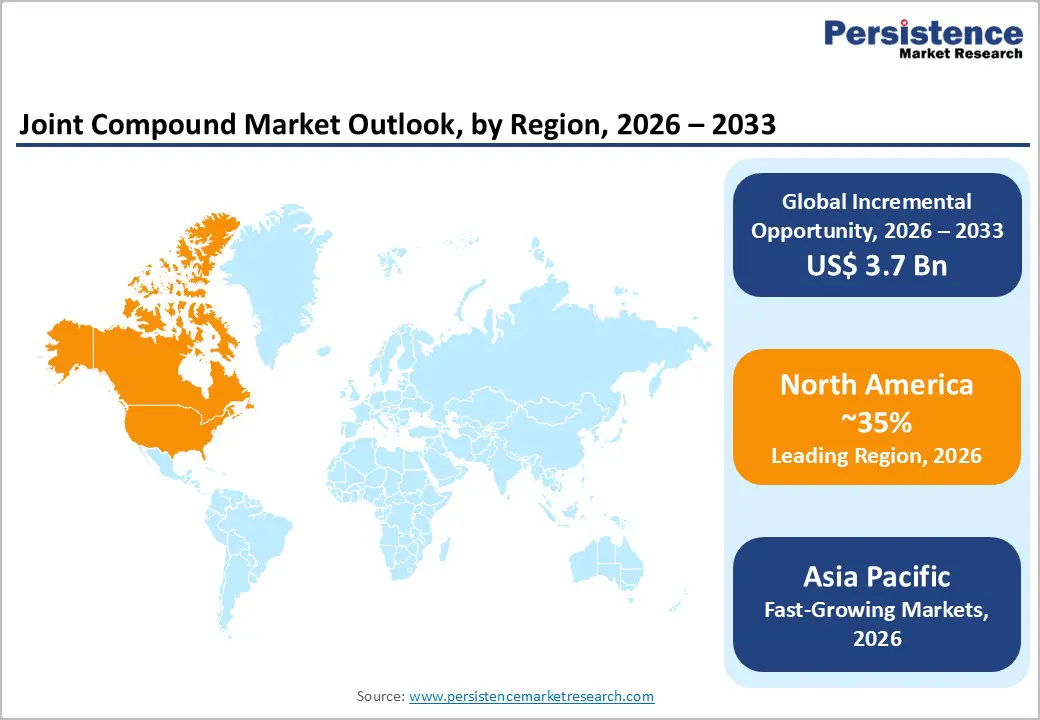
- Leading Region: North America dominates with 35% share in 2025, supported by strong renovation activity, advanced drywall adoption, and strict indoor air quality regulations.
- Fastest Growing Region: Asia Pacific holds 30% share and remains the fastest-growing region, driven by rapid urbanization, infrastructure expansion, and increasing adoption of modern wall systems.
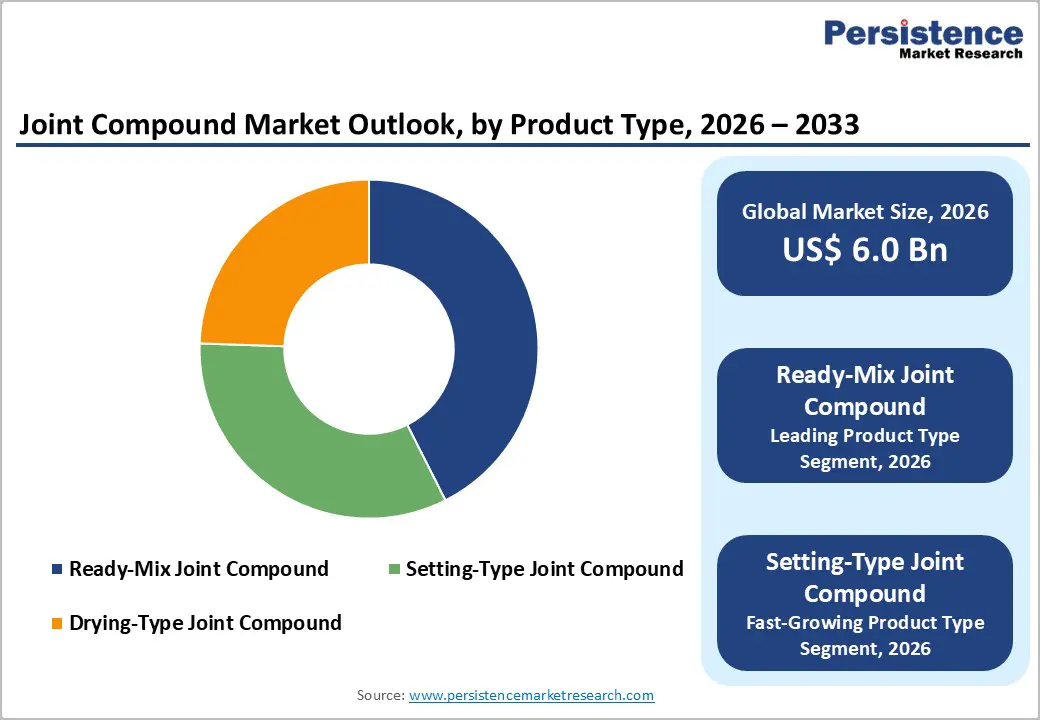
- Leading Product Type: Ready-Mix Joint Compound leads with 52% share, driven by ease of use, consistent quality, and strong preference among contractors and DIY users.
- Leading Application: The residential segment dominates with 55% share, fueled by rising housing construction, renovation demand, and preference for high-quality interior finishes.
- Key Opportunity: Expansion of e-commerce and digital distribution channels is enabling direct access to contractors and DIY users, improving reach, efficiency, and customer engagement.
| Global Market Attributes | Key Insights |
|---|---|
| Joint Compound Size (2026E) | US$ 6.0 Billion |
| Market Value Forecast (2033F) | US$ 9.7 Billion |
| Projected Growth CAGR (2026 - 2033) | 7.2% |
| Historical Market Growth (2020 - 2025) | 6.4% |
Market Dynamics
Drivers - Rapid Expansion of Construction, Urbanization, and Renovation Activities Globally
The expansion of residential, commercial, and industrial construction projects worldwide continues to be a primary driver for the joint compound market. Increasing urbanization is driving higher demand for housing, office space, and infrastructure, thereby accelerating drywall installation and finishing. This trend significantly boosts the consumption of joint compounds across both developed and developing economies.
In addition, aging infrastructure in developed regions is driving renovation and remodeling activities, further supporting market demand. Government-backed housing schemes and large-scale infrastructure projects in emerging economies are also creating sustained construction pipelines. This ensures consistent usage of joint compounds among contractors and DIY users for repair, finishing, and maintenance applications.
Growing Adoption of Eco-Friendly and High-Performance Joint Compounds
The increasing shift toward eco-friendly construction materials is another key growth driver for the joint compound market. Rising awareness regarding indoor air quality and environmental sustainability has led to greater adoption of low-VOC, low-dust, and lightweight joint compounds, making them suitable for green building practices and regulatory compliance across various regions.
At the same time, advancements in high-performance formulations are gaining strong traction among professional users. Features such as quick drying, crack resistance, minimal shrinkage, and easy sanding enhance application efficiency and reduce labor time. These benefits support faster project completion, making such products increasingly preferred in both large-scale construction and renovation projects.
Restraints - Volatility in Raw Material Prices and Rising Production Costs
The joint compound market is significantly affected by fluctuations in the prices of key raw materials, including gypsum, calcium carbonate, vinyl polymers, and specialty additives. Variations in global supply chains and rising energy costs increase manufacturing expenses, particularly in regions with energy-intensive production processes, directly affecting overall cost structures and pricing strategies across the value chain.
These input costs often lead manufacturers to increase product prices, making joint compounds less affordable for cost-sensitive contractors and small-scale builders. This is especially evident in developing regions where traditional plastering methods or lower-cost substitutes are still widely used, thereby limiting adoption and creating margin pressure across the industry.
Stringent Environmental Compliance and Fire Safety Regulations
Strict environmental and chemical safety regulations are creating challenges for joint compound manufacturers. Compliance with emission standards and safety frameworks requires reformulating products, adopting sustainable raw materials and investing in certification and quality control systems, increasing both operational complexity and production costs for manufacturers.
Additionally, fire safety requirements for commercial and high-rise buildings demand specific performance characteristics such as reduced combustibility and smoke emissions. These regulations can restrict product formulation flexibility and delay approvals for new products. While enhancing safety and sustainability, such compliance requirements also increase barriers to entry and slow innovation, particularly for smaller market participants.
Opportunities - Expanding Construction Activities Across High-Growth Emerging Economies
Rapid growth in construction activities across emerging economies presents a significant opportunity for the joint compound market. Countries in the Asia Pacific, including China, India, and ASEAN nations, are witnessing strong infrastructure development, urbanization, and housing expansion, which are increasing the adoption of drywall systems and related finishing materials, such as joint compounds.
Government-backed initiatives such as affordable housing programs, smart city developments, and large-scale infrastructure pipelines are further strengthening demand. Manufacturers can capitalize on this opportunity by establishing local production facilities, optimizing pricing strategies, and offering region-specific product solutions, thereby gaining a competitive edge in fast-growing construction markets.
Rising Adoption of E-Commerce and Direct Distribution Channels
The increasing penetration of e-commerce and digital platforms in the building materials sector is creating new growth avenues for joint compound manufacturers. Contractors and DIY consumers are increasingly turning to online channels to purchase construction materials for convenience, product variety, and competitive pricing, driving a shift away from traditional retail distribution models.
This transition enables manufacturers to adopt direct-to-consumer and direct-to-contractor strategies, supported by digital tools and targeted marketing. By leveraging online platforms, companies can offer value-added services such as product guidance, tutorials, and bulk purchasing options, enhancing customer engagement, improving margins, and strengthening brand positioning in a competitive market.
Category-wise Analysis
Product Type Insights
Ready-Mix Joint Compound dominates the product type segment, accounting for approximately 52% of the global joint compound market in 2025. Its leadership is driven by ease of application, consistent quality, and reduced preparation time, making it highly preferred among contractors and DIY users. The elimination of on-site mixing minimizes errors and material waste, further strengthening its widespread adoption across residential and commercial construction projects.
Setting-Type Joint Compound is the fastest-growing segment due to its quick drying and high durability properties. These compounds are increasingly used in projects that require faster turnaround times and greater strength. Their ability to perform well in varied environmental conditions and reduce project delays makes them highly attractive for professional applications and large-scale construction activities.
Distribution Channel Insights
Offline retail holds the leading position in the distribution channel segment, capturing around 65% of the market in 2025. This is supported by strong contractor reliance on physical stores, availability of bulk purchasing options, and access to technical guidance. Hardware stores, specialty building suppliers, and contractor outlets ensure immediate access to products, which is critical for time-sensitive construction and renovation projects.
Online retail is emerging as the fastest-growing distribution channel, driven by increasing digital adoption and greater procurement convenience. Contractors and DIY consumers are gradually shifting toward e-commerce platforms for better pricing, product variety, and doorstep delivery. Enhanced digital tools, product comparisons, and direct-to-contractor models are further accelerating the growth of online sales channels
Packaging Type Insights
Buckets/tubs lead the packaging type segment, accounting for approximately 48% of the joint compound market in 2025. Their dominance is attributed to ease of handling, reusability, and reduced risk of spillage or contamination. These packaging formats are widely used for premixed compounds, offering convenience and efficiency for both storage and on-site application in construction environments.
Bags are the fastest-growing packaging segment due to increasing demand for powder-based and setting-type compounds. They offer advantages such as lower transportation costs, reduced packaging weight, and suitability for bulk applications. As large-scale construction projects expand, the demand for cost-effective and space-efficient packaging solutions continues to rise.
Application Insights
The residential segment dominates the application category, representing approximately 55% of the joint compound market in 2025. Growth in housing construction, renovation, and remodeling activities is the primary factor supporting this leadership. The increasing demand for modern interiors and smooth wall finishes continues to drive the widespread use of joint compounds in residential settings worldwide.
The commercial segment is the fastest-growing application area, driven by expanding office spaces, retail infrastructure, and hospitality projects. Rapid urban development and increasing investments in commercial real estate are boosting demand for efficient interior finishing materials. Joint compounds play a crucial role in achieving high-quality finishes in large-scale commercial construction projects.
Regional Insights
North America Joint Compound Market Trends and Insights
North America dominates the joint compound market, accounting for approximately 35% of global demand in 2025, led by the United States. The region benefits from widespread adoption of drywall construction systems, a strong contractor base, and a well-established home improvement culture. High renovation activity and strict building codes further support the consistent demand for high-quality joint compound products.
Additionally, environmental regulations and indoor air quality standards are encouraging the adoption of low-VOC and sustainable formulations. The presence of advanced construction practices and continuous product innovation strengthens market maturity. Ongoing residential upgrades and commercial space renovations ensure that North America remains a stable and leading market for joint compounds.
Europe Joint Compound Market Trends and Insights
Europe represents a steadily growing joint compound market, supported by strong construction activity in countries such as Germany, France, and the United Kingdom. The region benefits from regulatory harmonization and a high focus on quality and performance, driving the adoption of advanced joint compound formulations across residential and commercial applications.
The market is projected to grow at a CAGR of around 5.5%-6.5% during the forecast period, driven by the renovation of aging infrastructure and green building initiatives. Increasing emphasis on fire safety, sustainability, and energy-efficient construction materials continues to shape product innovation, supporting long-term growth across the region.
Asia Pacific Joint Compound Market Trends and Insights
Asia Pacific is the fastest-growing region in the joint compound market, accounting for approximately 30% of the global share and expanding rapidly due to urbanization and infrastructure development. Countries such as China and India are leading demand, supported by large-scale housing projects and increasing adoption of modern drywall systems in construction.
Rising investments in infrastructure, smart cities, and transportation projects are further accelerating market growth. Additionally, the shift toward lightweight and efficient construction materials, along with expanding local manufacturing capabilities, is improving product accessibility. These factors position the Asia Pacific as the key growth engine for the joint compound market over the coming years.
Competitive Landscape
The global joint compound market is moderately consolidated, with a group of large multinational players dominating through strong brand presence, extensive distribution networks, and integrated supply chains. These companies focus on capacity expansion in high-growth regions and leverage established contractor relationships to maintain market leadership. Their scale enables consistent product quality, wide availability, and efficient logistics across major construction markets.
Competition is further shaped by product innovation and differentiation, including eco-friendly formulations, fast-setting compounds, and specialized solutions for advanced construction needs. While large players emphasize performance and innovation, smaller regional manufacturers compete through cost-effective offerings and localized strategies. The market also sees growing adoption of digital sales channels, private label partnerships, and bundled construction solutions.
Key Developments:
- In March 2025, USG Corporation launched an eco-friendly ready-mix joint compound aligned with stringent VOC standards, strengthening its sustainable product portfolio while supporting expansion into environmentally regulated European construction and renovation markets.
- In July 2024, Saint-Gobain acquired a gypsum production facility in North America, enhancing its manufacturing capabilities and increasing setting-type joint compound output capacity by approximately 20% to meet rising regional construction demand.
- In January 2024, Henkel introduced innovative recyclable bucket packaging solutions across Asia Pacific, reducing plastic usage by nearly 30% while improving sustainability credentials and aligning with growing environmental regulations in construction materials packaging.
Companies Covered in Joint Compound Market
- USG Corporation
- Compagnie de Saint-Gobain
- Knauf Gips KG
- National Gypsum Company
- Georgia-Pacific LLC
- DAP Products Inc.
- Sika AG
- Etex Group
- ParexGroup
- Pidilite Industries Limited
- MAPEI S.p.A.
- Wacker Chemie AG
- Fosroc International Ltd.
- LafargeHolcim Ltd.
- Yoshino Gypsum Co., Ltd.
Frequently Asked Questions
The global Joint Compound Market is expected to reach US$ 6.0 Billion in 2026, driven by growth in construction, renovation, and infrastructure development activities.
Key drivers include urbanization, rising housing demand, increased renovation projects, and growing preference for low-VOC, high-performance interior finishing materials.
North America leads with 35% share in 2025, supported by strong construction activity, mature drywall systems, and well-established distribution networks.
A major opportunity lies in expanding e-commerce and digital distribution channels to reach contractors and DIY users more efficiently.
Key players include USG Corporation, Saint-Gobain, Henkel, Knauf Gips KG, and National Gypsum Company.


