




- Food Ingredients & Additives
- Coconut Flour Market
Coconut Flour Market Size, Share, Growth, and Regional Forecast, 2026 - 2033
Coconut Flour Market by Product Type (Whole Full Fat Coconut Flour, Medium Fat Coconut Flour, and Low Fat Coconut Flour), Application (Bakery & Confectionery, Frozen Desserts & Functional Foods, Breakfast Cereals & Granola, Dietary Supplements, Animal Feed & Pet Food, and Others) Distribution Channel (Hypermarkets, Specialty Stores, Online Retail, and Others), and Regional Analysis from 2026 - 2033

Coconut Flour Market Share and Trend Analysis
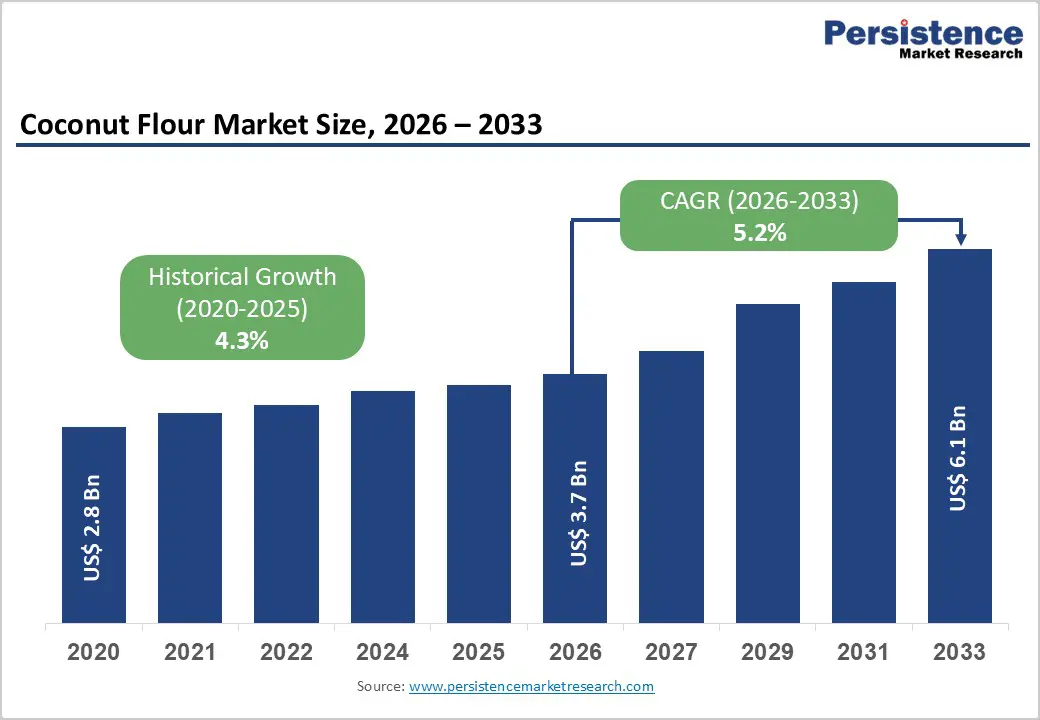
The global coconut flour market size is estimated to grow from US$ 3.7 Bn in 2026 to US$ 6.1 Bn by 2033. The market is projected to record a CAGR of 5.2% during the forecast period from 2026 to 2033. The rise in global interest in healthier eating habits and alternative grain solutions is steadily strengthening demand for coconut flour across the food and nutrition industries. Consumers are increasingly selecting naturally gluten-free ingredients that support digestive wellness, balanced carbohydrate intake, and improved dietary fiber consumption. Coconut flour is widely incorporated into bakery products, snacks, meal mixes, and nutritional formulations owing to its plant-based origin and clean-label appeal.
The rise in prevalence of metabolic disorders, combined with growing emphasis on preventive nutrition, is encouraging manufacturers to introduce fiber-enriched and low-carbohydrate food options. Broader adoption across packaged food brands, specialty wellness companies, and household cooking applications continues to support consistent category expansion. Enhanced product visibility in modern retail formats and digital marketplaces is further improving accessibility. Technological improvements in drying, milling precision, and texture optimization are enabling better functional performance in diverse formulations. Additionally, sustainability initiatives and responsible sourcing practices are strengthening consumer confidence, while ongoing innovation in functional food development and plant-forward diets continues to accelerate market momentum worldwide.
Key Industry Highlights:
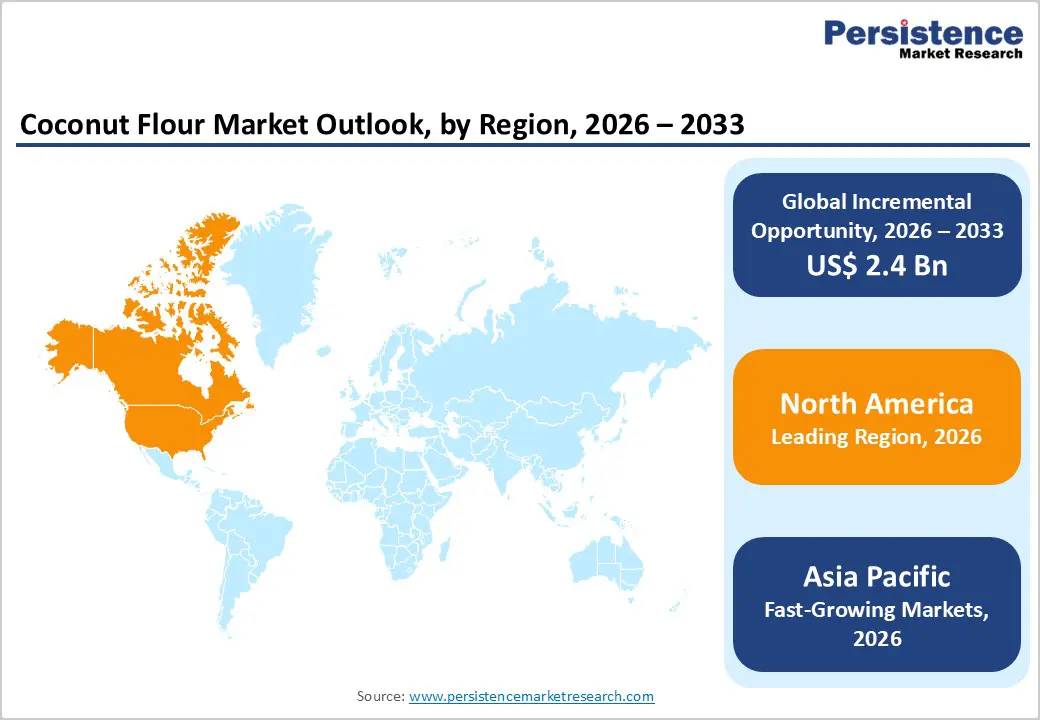
- Leading Region: North America accounts for the largest share at 46.7%, supported by strong adoption of gluten-free diets, mature food processing capabilities, high consumer awareness regarding functional nutrition, and well-established organized retail ecosystems.
- Fastest-Growing Region: Asia Pacific is emerging as the fastest-expanding region due to urban population growth, rising purchasing power, improving health awareness, strong coconut cultivation base, and increasing investments in food processing infrastructure.
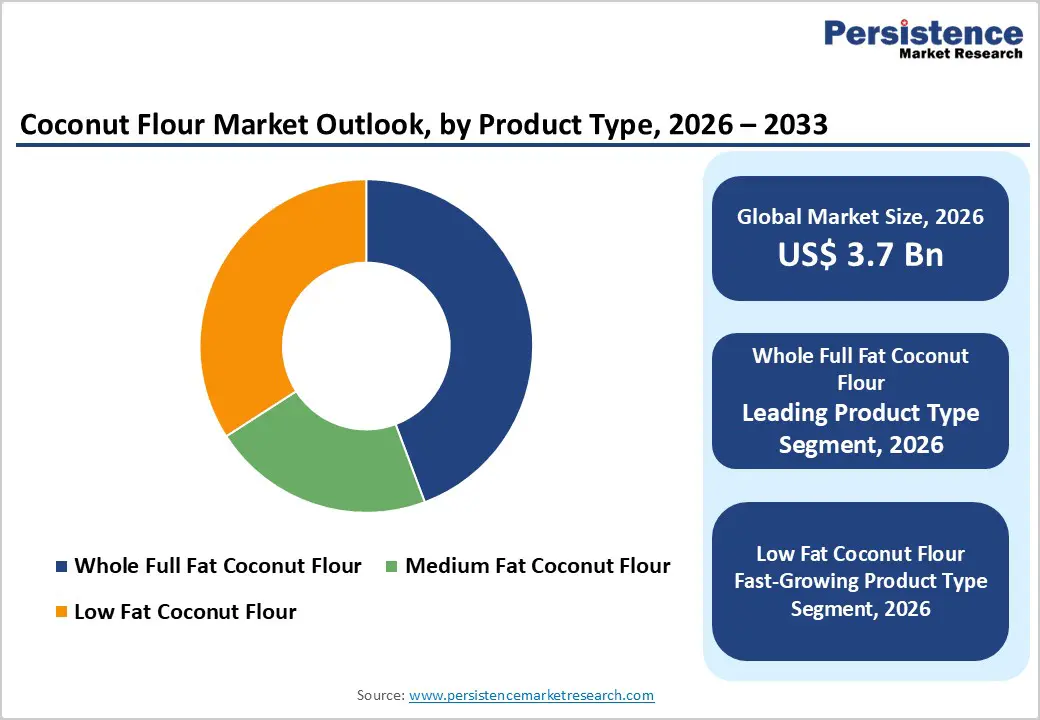
- Leading Product Type Segment: Whole full-fat coconut flour leads the market owing to broad industrial usage, stable raw material availability, favorable processing economics, and strong integration into mainstream bakery and snack manufacturing.
- Fastest-Growing Product Type Segment: Low fat coconut flour is witnessing rapid expansion as demand rises for clean-label, nutritionally balanced, and sustainably sourced ingredient options among premium health-focused consumers.
- Leading Application Segment: Bakery & confectionery remains the dominant application, supported by widespread adoption in gluten-free baking, strong consumer acceptance, and compatibility with large-scale food production.
- Fastest-Growing Process Segment: Dietary supplements are expanding quickly due to increasing utilization of coconut flour in fiber-rich nutrition blends, functional powders, and value-added wellness formulations targeting specialized health needs.
| Key Insights | Details |
|---|---|
|
Coconut Flour Market Size (2026E) |
US$ 3.7 Bn |
|
Market Value Forecast (2033F) |
US$ 6.1 Bn |
|
Projected Growth (CAGR 2026 to 2033) |
4.3% |
|
Historical Market Growth (CAGR 2020 to 2025) |
5.2% |
Market Dynamics
Driver - Expanding Preference for Gluten-Free Nutrition and Fiber-Rich Plant Ingredients
The global transition toward healthier dietary patterns centered on allergen-free and nutrient-dense ingredients has accelerated the demand. Consumers are increasingly prioritizing digestive wellness, weight management, and balanced blood sugar levels, encouraging the adoption of alternative flours with naturally high fiber content. Coconut flour, produced from dried coconut meat after oil extraction, offers a unique nutritional profile combining dietary fiber, plant-based nutrients, and low carbohydrate density, making it suitable for gluten-free and keto-aligned formulations. Rising incidences of lifestyle disorders, including diabetes and obesity, are prompting food manufacturers to reformulate products using ingredients that support metabolic health claims.
Food companies are actively incorporating coconut flour into baked goods, snack products, functional mixes, and nutrition supplements to improve fiber enrichment and clean-label positioning. Growth of plant-forward eating habits and demand for minimally refined foods further strengthen adoption across retail and foodservice sectors. Urban consumers, supported by higher purchasing power and exposure to wellness trends through digital platforms, are increasingly experimenting with alternative baking ingredients. The expansion of organized retail and online grocery ecosystems has improved product accessibility globally. As manufacturers seek wheat substitutes that deliver both functionality and nutritional differentiation, coconut flour continues to transition from a specialty ingredient toward mainstream food innovation.
Restraints - Raw Material Dependency, Processing Challenges, and Pricing Sensitivity
Market expansion faces constraints linked primarily to agricultural dependency and cost structure variability. Coconut flour production relies heavily on coconut harvest cycles concentrated in tropical regions, making supply vulnerable to climatic fluctuations, pest outbreaks, and changing agricultural yields. Variations in copra availability and transportation logistics can influence production consistency and create periodic price instability for processors and end users. Additionally, maintaining standardized particle size, moisture levels, and baking performance requires advanced drying and milling infrastructure, which is not uniformly available across producing countries.
Smaller manufacturers often operate with limited technological capabilities, resulting in inconsistent product quality that may restrict adoption among large food processors demanding uniform specifications. Certification requirements related to organic sourcing, export regulations, and food safety compliance further increase operational expenses. In price-sensitive markets, consumers frequently favor traditional wheat-based flours due to affordability and familiarity, slowing the penetration of premium alternatives. Awareness regarding coconut flour’s functional advantages also remains uneven outside mature health-food markets. Furthermore, competition from other gluten-free substitutes, such as almond, rice, and cassava flours, intensifies competitive pricing pressure, creating additional barriers for new entrants and moderating rapid category expansion in developing regions.
Opportunity - Functional Food Innovation, Premium Product Positioning, and Emerging Market Expansion
Shifting consumer expectations toward nutrition-focused food products are unlocking significant growth avenues across multiple application segments. Coconut flour’s compatibility with high-protein, low-carbohydrate, and fiber-enriched formulations makes it highly attractive for next-generation functional foods. Manufacturers are developing innovative applications, including ready-to-mix baking blends, fortified snacks, dairy alternatives, and specialized nutrition products targeting diabetic, sports nutrition, and weight-management consumers. Continuous experimentation with blended flour systems is improving texture performance and widening usage beyond traditional bakery categories.
Rapid growth of digital retail platforms and direct-to-consumer wellness brands is enabling smaller producers to access niche audiences without heavy dependence on conventional distribution networks. Emerging economies present long-term potential as rising middle-income populations increasingly adopt packaged health foods and premium grocery products. Investments in modern processing facilities across coconut-producing nations are improving value addition at source while strengthening export competitiveness. Sustainability initiatives, including responsible sourcing and environmentally friendly packaging, are also enhancing brand differentiation in premium markets. Collaboration between ingredient suppliers and packaged food companies is accelerating integration into mainstream formulations. As demand shifts toward natural, multifunctional ingredients delivering both nutritional and functional benefits, coconut flour is positioned to capture value growth across evolving global food ecosystems.
Category-wise Analysis
By Product Type, Whole Full-Fat Coconut Flour Dominates Owing to Functional Versatility and Large-Scale Commercial Usage
Whole full-fat coconut flour is anticipated to remain the leading product category in 2026, securing a 44.3% revenue share of the global coconut flour market. Its dominance stems from superior functionality in food formulations, balanced fat and fiber composition, and strong acceptance among commercial food processors. The product delivers enhanced moisture retention, improved texture, and natural flavor enhancement, making it highly suitable for bakery, snack, and ready-mix applications. Manufacturers favor this variant due to reliable raw material utilization during coconut processing and reduced production waste, improving overall cost efficiency. Additionally, whole full-fat coconut flour integrates easily into gluten-free and low-carbohydrate formulations without requiring complex processing adjustments. Growing demand from packaged food manufacturers and private-label brands further strengthens its adoption. Continuous improvements in milling technologies and standardized quality parameters also enable consistent large-volume supply, reinforcing segment leadership across both retail and industrial channels globally.
By Application, Bakery & Confectionery Segment Leads Driven by Strong Gluten-Free Baking Demand and Ingredient Compatibility
The bakery & confectionery application segment is projected to account for a 48.7% revenue share in 2026, positioning it as the largest consumer of coconut flour worldwide. Coconut flour’s natural sweetness, high fiber concentration, and excellent binding capability make it particularly effective in bread, cookies, cakes, muffins, and dessert formulations. Food manufacturers increasingly incorporate coconut flour to meet rising consumer demand for gluten-free, grain-free, and low-glycemic baked products. Its compatibility with alternative diet trends such as keto and paleo further accelerates usage in premium bakery innovations. Compared to traditional flour substitutes, coconut flour enhances nutritional labeling by increasing fiber content while supporting clean-label positioning. Expansion of artisanal bakeries and functional snack producers has also widened the application scope. Additionally, product innovation in ready-to-bake mixes and fortified baked goods continues to expand commercial adoption, ensuring sustained leadership of this application segment across developed and emerging markets.
By Distribution Channel, Hypermarkets Maintain Leadership Due to Wide Product Accessibility and Organized Retail Expansion
Hypermarkets are expected to lead distribution in 2026 with a 34.8% share of the global coconut flour market. Their dominance is supported by extensive shelf visibility, diversified product assortments, and consumer preference for purchasing health ingredients through organized retail environments. Large retail chains enable manufacturers to reach mass consumers while offering competitive pricing, promotional bundles, and private-label alternatives. Coconut flour increasingly appears within health food aisles alongside gluten-free and plant-based products, improving product discovery among mainstream shoppers. Hypermarkets also benefit from established supply chain infrastructure, enabling consistent stock availability and efficient inventory turnover. Rising urbanization and expansion of modern retail formats in developing economies further strengthen this channel. While digital sales continue to grow, physical retail outlets remain critical for first-time product trials and bulk purchases, reinforcing hypermarkets as the primary distribution platform for coconut flour globally.
Region-wise Insights
North America Coconut Flour Market Trends
North America is projected to hold the largest regional share of the coconut flour market in 2026, representing 46.7% of global value consumption, with the United States serving as the primary growth contributor. Demand is strongly influenced by widespread consumer awareness surrounding gluten intolerance, digestive health, and metabolic wellness, encouraging the adoption of alternative flour solutions rich in dietary fiber. The region has witnessed the rapid expansion of gluten-free bakery products, protein snacks, meal replacements, and functional beverage mixes incorporating coconut flour as a nutrient-dense ingredient. Health-focused consumers actively prioritize clean-label, non-GMO, and minimally processed food components, supporting premium product positioning. Advanced food manufacturing capabilities and highly efficient retail logistics networks enable large-scale commercialization.
E-commerce platforms and direct-to-consumer brands further accelerate accessibility, particularly for organic and specialty variants. Continuous innovation in fortified baking blends, keto-friendly mixes, and high-fiber formulations enhances product diversification. Strong collaboration between ingredient suppliers and packaged food companies continues to reinforce North America’s sustained leadership in both consumption volume and product innovation.
Europe Coconut Flour Market Trends
Europe’s coconut flour market is forecast to experience consistent expansion in 2026, supported by strong consumer inclination toward organic, allergen-free, and responsibly sourced food ingredients. Countries such as Germany, the United Kingdom, France, Italy, Spain, and the Netherlands represent key consumption centers due to their mature health food ecosystems and strict regulatory standards governing ingredient transparency. European buyers demonstrate heightened sensitivity toward sustainability credentials, prompting manufacturers to emphasize traceable sourcing, environmentally responsible processing, and certified organic production. Coconut flour is increasingly used in gluten-free artisan bakery products, specialty breads, and functional snack innovations aimed at improving fiber intake and glycemic balance.
Growth of vegan and flexitarian dietary lifestyles further drives the adoption of plant-based flour alternatives. Distribution is strongly supported by organic retail chains, specialty food outlets, and rapidly expanding online grocery channels. Additionally, reformulation initiatives by food manufacturers seeking to enhance nutritional profiles and reduce refined carbohydrates continue to create steady long-term demand across the European market landscape.
Asia Pacific Coconut Flour Market Trends
The Asia Pacific coconut flour market is forecast to achieve a CAGR of approximately 7.0% between 2026 and 2033, making it the fastest-expanding regional landscape. Growth is supported by rapid urbanization, rising disposable incomes, and increasing exposure to global health and wellness trends. Countries including China, India, Japan, South Korea, and Australia are witnessing greater adoption of alternative flours within bakery, nutrition, and packaged food segments. The region benefits from abundant coconut cultivation in nations such as India, Indonesia, the Philippines, and Thailand, enabling cost-efficient sourcing and localized processing. Government initiatives promoting agro-processing, food exports, and rural value addition are strengthening manufacturing capacity.
Expansion of modern retail formats and online grocery platforms enhances product visibility among urban consumers. Regional and multinational players are investing in advanced milling facilities and export-grade processing standards. Growing use in nutraceutical blends, diabetic-friendly foods, and infant nutrition formulations further accelerates demand, positioning the Asia Pacific as the primary future growth engine of the global coconut flour market.
Competitive Landscape
The global coconut flour market is highly competitive, with strong participation from NAVIK Mills (PVT) LTD., Groovy Food Company Ltd, BATA FOOD, Delphi Organic GmbH, JAINDI EXPORTS PVT LTD., and Royce Food Corporation. These companies leverage diversified coconut sourcing networks, integrated processing capabilities, and strong partnerships with food manufacturers and health-focused retailers while advancing gluten-free formulations, high-fiber optimization, clean-label positioning, and functional ingredient innovation across bakery, snack, dietary supplement, and nutrition applications.
Rising demand for gluten-free and plant-based foods, growing health awareness, and functional nutrition trends are encouraging investments in organic certifications, sustainable sourcing, improved texture performance, private-label expansion, e-commerce penetration, and application-specific product development.
Key Developments:
- In January 2022, Tamil Nadu Chief Minister inaugurated a INR16-crore coconut value-addition center at Shenbhagaramanpudur, Tamil Nadu, via videoconference to strengthen the farm economy. The facility includes units for producing desiccated coconut powder, dry coconut, virgin coconut oil, coconut charcoal, and packaged coconut-based products, along with refrigeration and processing infrastructure.
Companies Covered in Coconut Flour Market
- NAVIK Mills (PVT) LTD
- Groovy Food Company Ltd
- BATA FOOD
- Delphi Organic GmbH
- JAINDI EXPORTS PVT LTD
- Royce Food Corporation
- Briofeed Private Limited
- Pure & Sure
- KAIRA ORGANIC WORLD
- Laurico
- anirink.com
- Urban Platter
- Dhatu Organics & Naturals Private Limited
- INDOMITRA FARM PRODUCTS PRIVATE LIMITED
- LUONG QUOI COCONUT CO., LTD.
- Olam Group
- Wildly Organic
- Bob’s Red Mill Natural Foods
- ROYAL NUT COMPANY
- Others
Frequently Asked Questions
The global coconut flour market is projected to be valued at US$ 3.7 Bn in 2026.
Rising consumer shift toward gluten-free, plant-based, and high-fiber functional foods, supported by growing health awareness and demand for clean-label ingredients, is the primary driver of coconut flour adoption globally.
The global coconut flour market is poised to witness a CAGR of 5.2% between 2026 and 2033.
Expansion into functional foods, dietary supplements, ready-to-mix bakery products, and e-commerce distribution channels is creating strong growth opportunities for coconut flour manufacturers worldwide.
NAVIK Mills (PVT) LTD., Groovy Food Company Ltd, BATA FOOD, Delphi Organic GmbH, JAINDI EXPORTS PVT LTD., and Royce Food Corporation are some of the key players in the coconut flour market.


