




- Beverages
- Mushroom Coffee Market
Mushroom Coffee Market Size, Share, and Growth Forecast 2026–2033
Mushroom Coffee Market by Form (Instant Mushroom Coffee, Ground Mushroom Coffee, Others), Mushroom Extract (Lion's Mane, Chaga, Cordyceps, Reishi), Distribution Channel (Supermarkets/Hypermarkets, Specialty Stores), and Regional Analysis, 2026–2033

Mushroom Coffee Market Size and Trend Analysis
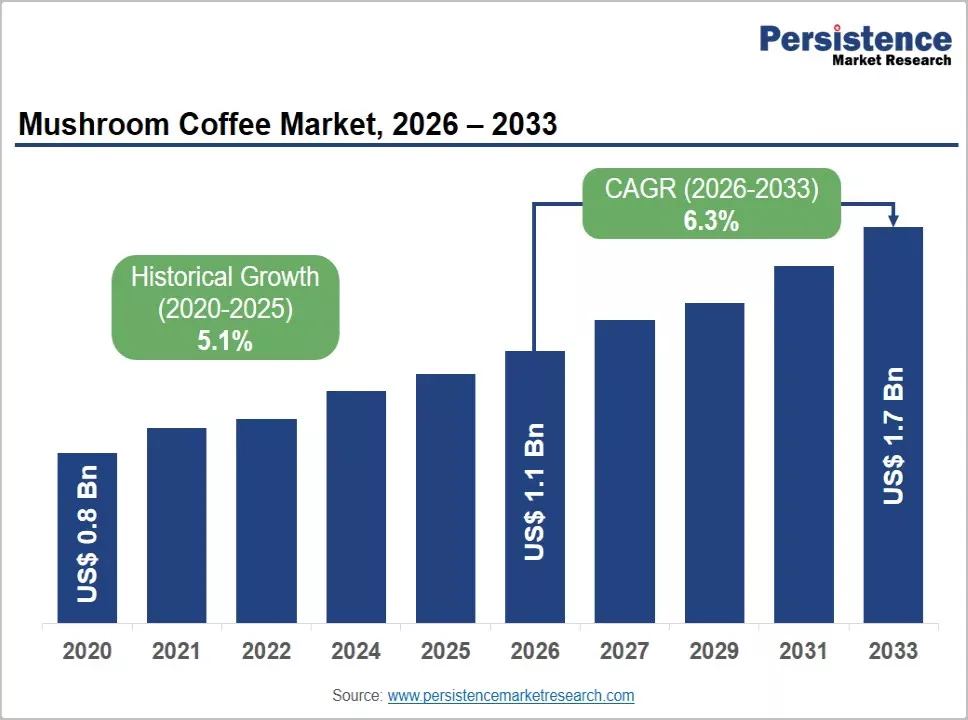
The global mushroom coffee market size is likely to be valued at US$ 1.1 billion in 2026, and is estimated to reach US$ 1.7 billion by 2033, growing at a CAGR of 6.3% during the forecast period 2026−2033. Growth is underpinned by the rapid mainstreaming of functional beverages, rising consumer interest in cognitive and immune wellness, and the appeal of lower-caffeine alternatives that deliver a smoother energy profile.
The market has been experiencing steady expansion, largely driven by direct-to-consumer brands and early adopters in North America. However, the forecast period anticipates broader acceleration as national grocery chains, ready-to-drink formats, and international launches extend category reach, while ingredient innovation improves taste, solubility, and the retention of bioactive compounds during brewing.
Key Industry Highlights
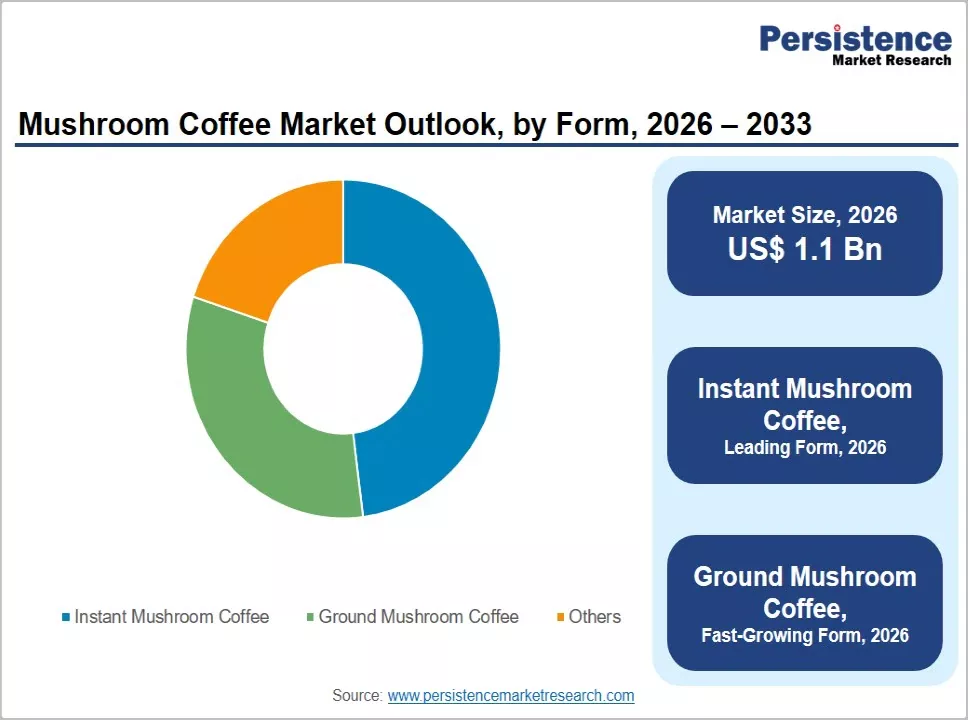
- Dominant Form: Instant mushroom coffee is set to command around 54% of the revenue share in 2026, while other formats, including pods, capsules, and ready-to-drink products, are likely to grow the fastest at about 8.4% CAGR through 2033, as convenience-led consumption expands.
- Leading Mushroom Extracts: Lion's Mane is expected to lead with about 36% in 2026, while Cordyceps is likely to be the fastest-growing extract at about 7.6% CAGR during 2026–2033, reflecting rising interest in energy and endurance positioning.
- Dominant Distribution Channel: Supermarkets and hypermarkets are anticipated to lead with an estimated 38% share in 2026, while online retail is slated to represent the fastest-growing channel at around 9.2% CAGR from 2026 to 2033.
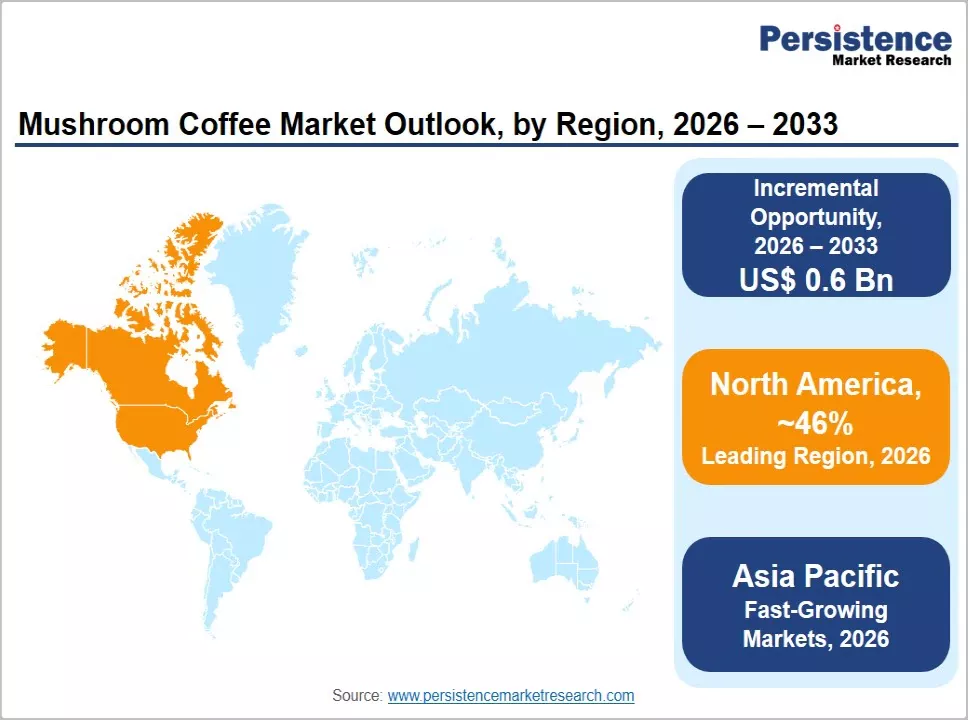
- Regional Leadership: North America is poised to dominate with an estimated 46% share in 2026, while Asia Pacific is expected to register the fastest growth at an 8.3% CAGR through 2033, supported by established mushroom consumption traditions.
- Competitive Environment: Competitive dynamics include new entrants from established coffee and wellness brands, venture-backed international expansion, and ingredient suppliers developing extracts engineered for brewed coffee applications.
DRO Analysis
Drivers: Functional Beverage Mainstreaming and Cognitive Wellness Demand as Primary Growth Catalysts
Consumer migration toward functional beverages is the leading force driving the mushroom coffee market growth, as shoppers increasingly expect everyday drinks to deliver benefits beyond hydration and caffeine. Mushroom coffee blends combine coffee with extracts such as Lion's Mane, Chaga, Cordyceps, and Reishi, positioned around focus, stress balance, immune support, and sustained energy.
Many products are formulated so that caffeine content per serving is lower than a conventional cup, appealing to consumers who experience jitters or afternoon crashes. Social media, wellness communities, and influencer-led marketing have accelerated awareness, while retail expansion has moved the category from niche online brands to mainstream grocery shelves, widening the consumer base beyond early adopters.
Retail Expansion and Everyday Ritual Integration
Retail partnerships are converting digital popularity into scale. Laird Superfood added two mushroom coffee products to Target stores nationwide in June 2026, while established coffee and wellness names are launching their own lines to capture demand.
The shift also reflects a change in consumption occasion, as mushroom coffee moves from a supplement-like routine to a daily ritual replacing standard morning coffee. This transition supports repeat purchase, subscription models, and cross-selling of complementary functional products such as creamers, lattes, and boosters, creating durable revenue growth and improving brand loyalty across the category.
Restraints: Limited Clinical Evidence and Regulatory Scrutiny of Health Claims
A principal challenge for the mushroom coffee market is the gap between consumer expectations and the strength of clinical evidence supporting specific cognitive and immune benefits. Many studies on Lion's Mane, Reishi, and Cordyceps are small, preclinical, or conducted using concentrated extracts at doses higher than those found in a single serving of coffee.
Regulators in major markets restrict disease-related and unsubstantiated claims, and authorities such as the U.S. Federal Trade Commission expect competent and reliable scientific evidence for health-related advertising. In the European Union and the U.K., nutrition and health claims rules limit permissible wording, constraining how brands can communicate functional benefits.
Quality Variability, Premium Pricing, and Taste Barriers
Ingredient quality is another restraint, as products vary widely in whether they use fruiting bodies or mycelium grown on grain, in extraction methods, and in the standardization of beta-glucans and other markers. This variability complicates comparison and can erode consumer trust when labelling is unclear.
Mushroom coffee is also priced at a premium to conventional coffee, which limits household penetration among price-sensitive consumers, and some formulations are criticized for earthy or bitter notes. Brands must therefore invest in sourcing transparency, third-party testing, and taste optimization, which raises costs and favors well-capitalized players over smaller entrants.
Opportunities: Ready-to-Drink Formats, Ingredient Innovation, and International Expansion
Format and ingredient innovation represent major growth avenues. Ready-to-drink cans and bottles, single-serve pods, and coffee boosters allow consumers to add functional mushrooms to existing routines. In June 2026, Spacegoods entered the ready-to-drink category in the U.K. with an oat mushroom latte, while M2 Ingredients introduced M2Brew in March 2026 to help bioactive compounds withstand the brewing
process. Co-branded and limited-edition launches, such as Four Sigmatic's creatine coffee released in April 2026, also demonstrate how brands are layering additional functional food ingredients, including creatine, collagen, and nootropics, to broaden appeal.
Venture Funding and Geographic Whitespace
Investment activity is supporting international expansion and category development. Reformed raised a US$ 22 million Series A round in July 2026 ahead of a planned U.S. launch, and Organic Traditions closed a US$ 10.5 million Series A round in the same month to scale its functional superfood portfolio. Markets such as the U.K., Germany, Australia, Japan, and the Gulf region remain under-penetrated, offering opportunities for localized flavors, certifications, and retail partnerships. Companies that combine credible sourcing, clear labelling, and strong taste are well positioned to capture this emerging demand through 2033.
Category-wise Insights
Form Analysis
Why Does Instant Mushroom Coffee Lead the Mushroom Coffee Market?
Instant mushroom coffee is the leading form segment, expected to hold about 54% of the mushroom coffee market revenue share in 2026. Its dominance stems from convenience, easy dissolution in hot or cold water, and suitability for office, travel, and on-the-go consumption. Instant formats also allow manufacturers to blend dual-extracted mushroom powders uniformly, deliver consistent dosing per sachet, and support subscription-based direct-to-consumer models. Scalable manufacturing and favorable shelf life contribute to attractive margins for brands. Although purists may prefer brewed coffee, the combination of low preparation effort and clear functional positioning continues to attract mainstream consumers entering the category.
Other formats, including capsules, pods, and ready-to-drink beverages, are likely to grow the fastest through 2033, at an estimated 8.4% CAGR. Single-serve pods address households with existing brewing equipment, while ready-to-drink products capture the large coffee-to-go occasion without any preparation. Ground mushroom coffee appeals to consumers who prefer traditional brewing methods, and brands such as Laird Superfood have expanded into whole bean and decaf variants to reach that audience. The challenge for ground formats is ensuring that mushroom bioactives survive heat and extraction during brewing, which is encouraging ingredient suppliers to develop specialized solutions.
Mushroom Extract Analysis
Which Mushroom Extract Dominates Mushroom Coffee?
Lion's Mane dominates the mushroom extract segment, projected to capture about 36% of the revenue share in 2026. The ingredient is strongly associated with focus, memory, and mental clarity, which aligns closely with the reasons consumers drink coffee. Strong brand storytelling, wide availability of extract powders, and a mild flavor profile compared with some other mushrooms support its use in blends. Lion's Mane is often paired with Chaga, which is valued for its antioxidant positioning and rich, slightly earthy taste, and the combination features across many leading product lines. Consumer familiarity and recurring purchases keep this extract the cornerstone of most formulations.
Cordyceps represents the fastest-growing extract segment, anticipated to achieve about 7.6% CAGR during the 2026–2033 period. It is positioned around energy, stamina, and exercise performance, making it attractive to active consumers seeking an alternative to high-caffeine pre-workout drinks. Reishi, associated with relaxation and evening routines, and Maitake, increasingly used in immune-focused blends, are also broadening the extract palette. Producers are investing in organic, traceable cultivation, particularly in Asia and North America, and in standardized extracts with verified beta-glucan content. Multi-mushroom blends containing three to four species are becoming a common way to deliver comprehensive functional claims.
Distribution Channel Analysis
Why Do Supermarkets and Hypermarkets Lead Mushroom Coffee Distribution?
Supermarkets and hypermarkets are poised to lead with an estimated 38% share in 2026, as national and regional grocery chains allocate dedicated functional beverage and wellness shelf space. Large-format retail provides consumer trust, trial opportunities, and exposure to shoppers who have not yet purchased through brand websites. Retail listings at mass merchants strengthen brand credibility and enable promotional activity, bundling, and in-store sampling. The channel is expected to grow steadily, driven mainly by broader category adoption and the migration of digitally native brands into physical retail rather than by any shift away from established grocery formats.
Online retail is the fastest-growing distribution channel, expected to showcase an approximate 9.2% CAGR through 2033. Direct-to-consumer websites, marketplaces, and subscription programmes remain central to brand building, enabling detailed education, bundling, and data-driven retention strategies. Specialty stores, including natural food retailers, cafes, and wellness shops, serve engaged consumers seeking premium and organic options and often act as proving grounds for new brands. Convenience stores are gaining relevance for single-serve and ready-to-drink formats, while foodservice partnerships with cafes and workplaces are anticipated to introduce mushroom coffee to broader audiences.
Regional Insights
North America Mushroom Coffee Market Trends and Insights
North America is anticipated to account for an estimated 46% of the global mushroom coffee market in 2026. The region's market is likely to benefit from a mature functional beverage culture, an influential direct-to-consumer ecosystem, and strong retail partnerships with mass merchants and natural food chains. Established brands such as Four Sigmatic, RYZE, Laird Superfood, and Bulletproof are expanding product lines and retail footprints, with new entrants adding differentiated positioning around focus, gut health, and sleep. Competition is expected to intensify through 2033 as coffee companies, supplement makers, and private-label suppliers enter the category.
U.S. Mushroom Coffee Market Size
The U.S. is estimated to account for approximately 86% of the North America mushroom coffee market in 2026. Market growth is likely to be supported by wellness-oriented consumers, strong e-commerce adoption, and rapid retail rollouts across national chains. Bulletproof's entry into mushroom coffee in May 2026 and Laird Superfood's expanded Target availability in June 2026 illustrate the pace of competitive activity. Brands are also layering ingredients such as collagen, creatine, and nootropics into mushroom blends. Regulatory attention to health claims and ingredient labelling is anticipated to shape marketing practices and encourage investment in clinical substantiation through 2033.
Canada Mushroom Coffee Market Size
Canada is projected to represent approximately 14% of the North America mushroom coffee market in 2026. Market expansion is expected to be driven by consumer interest in functional foods, natural health product positioning, and growing availability across grocery and online channels. Domestic brands such as Organic Traditions, which closed a US$ 10.5 million Series A round in July 2026, are scaling mushroom coffee alongside lattes, greens, and superfood staples. Cross-border e-commerce, strong health food retail, and a receptive wellness culture are anticipated to support steady demand growth across Canadian provinces through 2033.
Europe Mushroom Coffee Market Trends and Insights
Europe is estimated to account for approximately 14% of the global mushroom coffee market in 2026. The region's market is expected to benefit from a strong specialty coffee culture, growing interest in adaptogens and plant-based wellness, and the expansion of functional beverage start-ups. The European Union's nutrition and health claims framework and novel food rules require careful ingredient selection and claim wording, which favors brands with robust documentation. Retail listings in supermarkets, health food chains, and online platforms are widening access, while venture-backed brands from the U.K. are expanding across continental markets.
U.K. Mushroom Coffee Market Size
The U.K. is anticipated to account for approximately 31% of the Europe mushroom coffee market in 2026. Demand is expected to be supported by a large coffee-to-go market, an active functional wellness start-up scene, and rapid adoption of instant and ready-to-drink formats. Spacegoods launched an oat mushroom latte in June 2026, while Reformed raised US$ 22 million in a Series A round in July 2026 to scale its functional coffee and matcha subscription business internationally. Retailers are expanding wellness aisles and chilled functional beverage ranges, which is projected to support market growth through 2033.
Why Is Asia Pacific Expected to Grow the Fastest in the Mushroom Coffee Market?
Asia Pacific is projected to account for approximately 17% of the global mushroom coffee market in 2026, but is anticipated to register the fastest growth, expanding at an estimated CAGR of 8.3% through 2033. The region has deep cultural familiarity with medicinal and edible mushrooms, including Reishi, Cordyceps, and Chaga, which lowers consumer education barriers. Rising disposable incomes, a growing coffee-drinking population, and expanding e-commerce are expected to drive adoption. China, Japan, South Korea, Australia, and Southeast Asian markets are likely to emerge as important growth centers as local brands and international entrants introduce adapted flavors and formats.
China Mushroom Coffee Market Size
China is estimated to represent approximately 28% of the Asia Pacific mushroom coffee market in 2026. The country's market is expected to benefit from long-standing consumer familiarity with Ganoderma and Cordyceps, a fast-growing domestic coffee culture, and powerful social commerce platforms. Local brands are combining traditional herbal positioning with instant coffee sachets, while multinational entrants test premium imported products. Online marketplaces and livestream retail are anticipated to accelerate trial, and the large base of health-conscious urban consumers is projected to sustain China's regional leadership through 2033.
Japan Mushroom Coffee Market Size
Japan is projected to account for approximately 24% of the Asia Pacific mushroom coffee market in 2026. The market is expected to witness steady expansion, supported by an aging, health-focused population, a sophisticated functional food regulatory framework, and a strong convenience store and vending culture. Japan's Foods with Function Claims system offers a pathway for evidence-backed communication, encouraging product development around cognitive health and fatigue management. Canned and bottled coffee formats are likely to provide a natural route for ready-to-drink mushroom products through 2033.
Competitive Landscape
The global mushroom coffee market structure is fragmented, with a mix of venture-backed direct-to-consumer brands and established functional food companies. Leading players, including Four Sigmatic, RYZE Superfoods, Laird Superfood, and Bulletproof, have built awareness through digital marketing, community engagement, and growing retail presence. These companies invest in product development, flavor optimization, and ingredient sourcing, and increasingly emphasize third-party testing and clinical substantiation to strengthen consumer trust.
Emerging and niche competitors such as Reformed, Spacegoods, Om Mushroom Superfood, Organic Traditions, and Clevr Blends are targeting specific occasions, formats, and geographies. Barriers to entry remain moderate, as contract manufacturing and white-label extracts are readily available, yet brand credibility, retail relationships, and ingredient quality increasingly differentiate winners. Market consolidation is expected to increase gradually as larger food, beverage, and coffee companies acquire or partner with high-growth brands, while ingredient suppliers collaborate with brewers to optimize extraction and taste.
Key Market Developments
- In May 2026, Bulletproof entered the mushroom coffee category with "The Mood Booster," expanding its functional coffee portfolio and targeting taste and function in a rapidly growing segment.
- In June 2026, Laird Superfood added its Organic Perform and Defend functional mushroom coffees to Target stores nationwide and launched Perform Whole Bean and Perform Decaf coffee, extending its mushroom coffee range across formats.
- In July 2026, UK-based Reformed raised a US$ 22 million Series A round led by Iris Ventures to scale its functional coffee and matcha business, with a U.S. launch planned for the third quarter.
Companies Covered in Mushroom Coffee Market
- Four Sigmatic (Funguys Inc.)
- RYZE Superfoods, Inc.
- Laird Superfood, Inc.
- Bulletproof 360, Inc.
- Everyday Dose
- Om Mushroom Superfood
- Clevr Blends
- MUD\WTR
- Organic Traditions
- Reformed
- Fungi Perfecti, LLC (Host Defense)
Frequently Asked Questions
The global mushroom coffee market is valued at US$ 1.1 billion in 2026 and is projected to reach US$ 1.7 billion by 2033, expanding at a CAGR of 6.3% during 2026–2033.
Mainstreaming of functional beverages, rising cognitive and immune wellness demand, preference for lower-caffeine energy, and retail expansion by direct-to-consumer brands are driving the market.
Instant mushroom coffee leads forms with about 54% share, Lion's Mane leads mushroom extracts with about 36%, and supermarkets and hypermarkets lead distribution channels with an estimated 38% in 2026.
North America dominates the market with an estimated 46% share in 2026, supported by a mature functional beverage culture and strong retail partnerships, while Asia Pacific is projected to grow fastest at an 8.3% CAGR through 2033.
Ready-to-drink and pod formats, ingredient innovation for brewed coffee, venture-funded international expansion, and under-penetrated markets in Europe and Asia Pacific are key market opportunities.
The market is fragmented, with Four Sigmatic, RYZE Superfoods, Laird Superfood, and Bulletproof leading, alongside fast-growing entrants such as Reformed and Spacegoods.


