




- Bulk Chemicals
- Butadiene Extraction Market
Butadiene Extraction Market Size, Share, and Growth Forecast 2026 - 2033
Butadiene Extraction Market by Product Type (Liquid Butadiene, Gas Butadiene) Extraction Method, Steam Cracking, Catalytic Cracking), Source Material (Natural Gas, Naphtha), End Use Industry (Automotive, Plastics, Chemicals), and Regional Analysis, 2026 - 2033

Butadiene Extraction Market Size and Trend Analysis
The global butadiene extraction market size is likely to be valued at US$ 13.20 billion in 2026 and is projected to reach US$ 19.07 billion by 2033, growing at a CAGR of 5.4% during forecast period between 2026 and 2033.
Tire manufacturers, synthetic rubber compounders, and specialty chemical producers collectively anchor this demand, with the automotive supply chain alone absorbing the majority of output. Asia Pacific's naphtha-cracking expansion led by state-backed integrated refinery complexes across China and India is the primary structural engine behind this trajectory. The International Energy Agency (IEA) projects continued growth in petrochemical feedstock consumption through 2030, reinforcing the investment case for extraction capacity upgrades across the region.
Key Industry Highlights
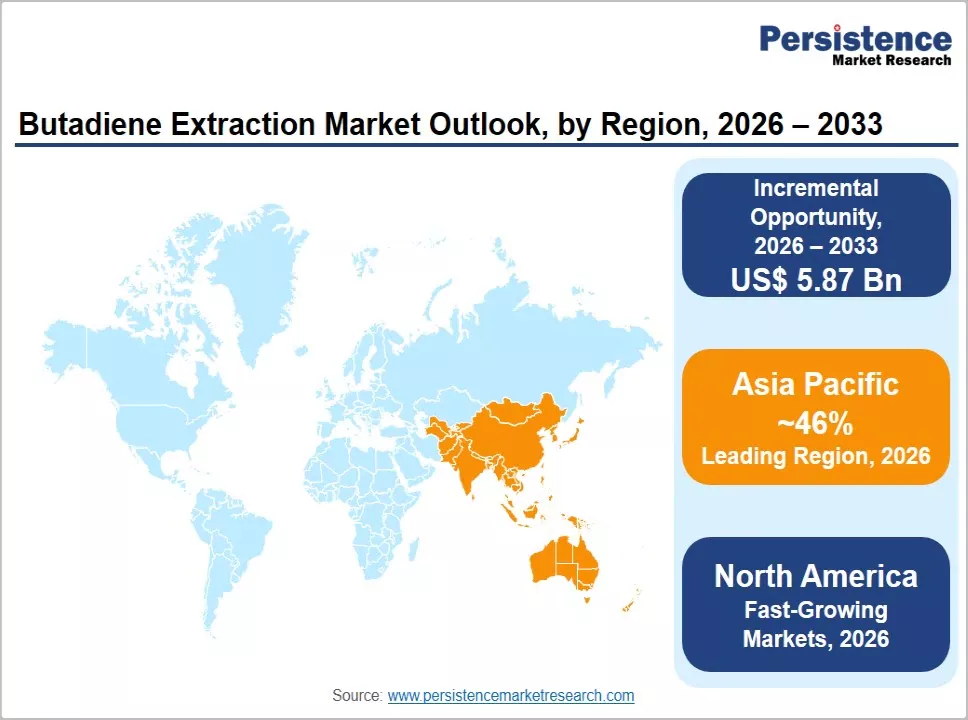
- Dominant Region: Asia Pacific is expected to dominate the regional market hold 46% of market share in 2026, propelled by naphtha-cracking complexes across China and India.
- Leading Product Type: Liquid butadiene 78% product share reflects the physical and logistical requirements of industrial-scale synthetic rubber polymerization. Extractive distillation operators supplying continuous SBR and PBR production lines at facilities run by LANXESS AG and JSR Corporation face minimal pressure on this configuration, as downstream reactor infrastructure is specifically engineered around pressurized liquid monomer feed systems.
- Dominant Source Material: Naphtha's 54% source material share is structurally reinforced by existing cracker infrastructure across European and Asian integrated complexes but butane-based extraction is accelerating fastest, driven by North American shale NGL surplus and TPC Group's expanded Gulf Coast C4 processing footprint, signaling a gradual feedstock diversification trend through 2033.
- Leading End Use Industry: Electronics, though the smallest end-use segment today, is the fastest-growing application in the butadiene extraction landscape. ABS and NBR demand from consumer electronics manufacturers led by procurement specification upgrades at Apple Inc. and Samsung Electronics is creating a quality-defined sub-market for polymer-grade butadiene at 99.5%+ purity, commanding extraction premiums unavailable in commodity synthetic rubber supply chains.
- Key Market Opportunity: Bio-based butadiene represents the most strategically consequential long-term opportunity in the extraction industry. Advances validated by Global Bioenergies and Synthos S.A. are bringing renewable butadiene closer to commercial viability, and OEM sustainability commitments from Toyota Motor Corporation and others are establishing early off-take demand signals that forward-looking extraction investors should factor into capacity planning through 2033.
DRO Analysis
Driver- Naphtha Cracker Capacity Expansion Across Integrated Petrochemical Complexes
Ethylene and propylene production through steam cracking generates mixed C4 streams as a co-product, making butadiene extraction an economically embedded step in naphtha-based refinery operations. Saudi Aramco's downstream integration strategy and Sinopec's ongoing refinery-petrochemical integration program which added over 12 million tons per annum of combined olefin capacity between 2022 and 2024 directly expand the available C4 raffinate feedstock pool.
As crackers scale up to serve polyolefin markets, butadiene extraction economics improve through higher throughput and better solvent recovery efficiency. This co-production dynamic means capacity growth is partly self-funding, reinforcing investment appetite across the extraction segment.
Restraint- Crude Oil and Naphtha Price Volatility Compressing Extraction Margins
Butadiene extraction profitability is closely tied to the spread between naphtha feedstock costs and downstream butadiene contract pricing. When crude benchmarks spike as occurred during the 2022 energy crisis following Russia's invasion of Ukraine naphtha costs surge while long-term butadiene supply contracts limit the ability to pass through cost increases immediately.
Extraction operators running solvent-based separation units, such as those employing N-methylpyrrolidone (NMP) or dimethylformamide (DMF) extraction solvent systems, face compounded cost pressure when both feedstock and energy prices rise simultaneously. This margin sensitivity deters incremental capacity investment among mid-tier operators.
Opportunity- Bio-Based Butadiene Pathways Opening a Premium Market Tier
Renewable butadiene production derived from bioethanol via catalytic dehydration is transitioning from laboratory demonstration to early commercial scale. Synthos S.A., in partnership with Global Bioenergies, advanced bio-butadiene synthesis process validation through 2023, targeting tire manufacturers with sustainability procurement mandates.
Major automotive OEMs including Toyota Motor Corporation have committed to incorporating bio-based synthetic rubber in tire supply chains by the late 2020s, creating a nascent but high-margin extraction segment. Investors with positions in integrated biorefinery platforms are best placed to capture this transition as bio-butadiene achieves cost parity with petrochemical routes.
Category-wise Analysis
Why Does Liquid Butadiene Command Nearly Four-Fifths of the Global Market?
Liquid butadiene is projected to dominate the segment hold around 78% of market share in 2026, due to its physical state makes it the preferred form for large-volume storage, pipeline transfer, and downstream polymerization reactor feed. Synthetic rubber producers operating continuous-feed SBR and PBR production lines including facilities operated by LANXESS AG and JSR Corporation require butadiene in liquefied pressurized form to maintain precise monomer feed ratios. Tank farm infrastructure at integrated petrochemical complexes is engineered around liquid butadiene handling, reinforcing incumbent supply chain configurations. Switching to gaseous handling at comparable scale would require substantial capital reinvestment, sustaining liquid form's structural dominance across nearly all major end-use applications.
Gas butadiene is likely to be the fastest-growing product segment, accelerating as small-scale specialty chemical synthesis and pilot-scale bio-butadiene production units adopt gaseous feed systems. LyondellBasell Industries commissioned a modular gas-phase extraction pilot unit in 2024, targeting specialty polymer applications where lower throughput and flexible feed composition favor gaseous handling over pressurized liquid logistics.
Source Material Insights
Naphtha is expected to lead the source material segment command nearly 54% of market share in 2026, fueled by its established position as the primary feedstock for steam cracking complexes across Asia and Europe. Integrated refinery-petrochemical operators including Reliance Industries Limited at its Jamnagar complex process naphtha through ethylene crackers that yield C4 mixed streams as a co-product, making butadiene extraction a value-recovery step embedded within existing asset configurations. European naphtha crackers, concentrated in the Rotterdam and Antwerp chemical clusters, also depend on this feedstock pathway, sustaining its dominant share across both mature and growth markets.
Butane is likely to be the fastest-growing source material, driven by the U.S. shale gas boom generating abundant natural gas liquids (NGL) streams with high butane content. TPC Group's Port Neches facility has expanded butane-based C4 processing capacity since 2023, capitalizing on low-cost butane feedstock from Permian Basin NGL production to improve extraction economics relative to naphtha-cracker routes.
What Is Driving Automotive's Dominant Share of Butadiene Extraction Demand?
Automotive is estimated to dominate the end use industry segment capture nearly 36% of market share in 2026, driven by the sector's near-total dependence on polybutadiene rubber (PBR) and styrene-butadiene rubber (SBR) for tire manufacturing and anti-vibration components. Every passenger tire requires approximately 1–2 kilograms of synthetic rubber, and global light vehicle production which the International Organization of Motor Vehicle Manufacturers (OICA) placed at over 90 million units in 2023 generates an enormous recurring demand pool. Beyond tires, butadiene-derived rubber compounds are integral to suspension bushings, engine mounts, and sealing systems, all of which require replacement over vehicle lifecycles, supporting aftermarket demand independent of new vehicle output.
Electronics are likely to be the fastest-growing end-use segment, propelled by expanding ABS polymer consumption in device manufacturing. Apple Inc.'s supplier quality frameworks now specify high-purity ABS grades for internal structural components in MacBook and iPad product lines, indirectly driving polymer-grade butadiene procurement standards across the Taiwanese and South Korean petrochemical supply base since 2023.
Regional Insights
North America Butadiene Extraction Market Trends and Insights
North America is projected to command around 19% of market share in 2026. The region's extraction activity is anchored by Gulf Coast cracker infrastructure, where abundant ethane and butane feedstock from shale production provide cost-competitive C4 stream yields. The U.S. Infrastructure Investment and Jobs Act (2021) has sustained downstream chemical manufacturing investment, indirectly supporting extraction capacity retention through 2026 and beyond.
U.S. Butadiene Extraction Market Size
The U.S. is anticipated to capture nearly 88% of the North America regional market in 2026. Gulf Coast integrated cracker complexes operated by ExxonMobil Chemical and Chevron Phillips Chemical drive the majority of domestic extraction output, underpinned by shale-derived feedstock cost advantages. Continued NGL production growth from the Permian and Marcellus basins positions U.S. operators favorably for export-oriented butadiene supply through 2033.
Canada Butadiene Extraction Market Size
Canada is estimated to account for 12% of the North America regional market in 2026. Alberta's petrochemical diversification strategy supported by the provincial government's Petrochemicals Diversification Program is directing investment toward upgrading NGL streams, including C4 fractions, into higher-value chemical outputs. Incremental extraction capacity additions are projected as new propane and butane upgrading facilities come online through 2028.
Europe Butadiene Extraction Market Trends and Insights
Europe is projected to hold about 12% of market share in 2026. The region's extraction industry faces a structural tension between strong downstream synthetic rubber demand and tightening REACH-driven solvent regulations. BASF SE's Verbund integration model at Ludwigshafen coupling cracker operations directly with extraction and downstream polymer units represents the most capital-efficient European configuration and sets the benchmark for regional competitive positioning.
Germany Butadiene Extraction Market Size
Germany is anticipated to command around 24% of the Europe regional market in 2026. BASF SE and Evonik Industries AG anchor domestic extraction capacity, with their integrated chemical complexes enabling recovery efficiencies that standalone extraction facilities cannot match. Germany's automotive OEM base including Volkswagen AG and BMW AG sustains structurally high synthetic rubber procurement, underpinning a stable long-term demand signal for extracted butadiene.
France Butadiene Extraction Market Size
France is expected to hold nearly 18% of the Europe regional market in 2026. TotalEnergies SE's integrated refining and petrochemical operations at Gonfreville provide the primary domestic C4 stream, feeding extractive distillation units that supply French synthetic rubber compounders. France's commitment to industrial decarbonization under the France 2030 investment plan is directing funding toward cleaner solvent recovery systems, potentially improving extraction economics at existing facilities through 2030.
Asia Pacific Butadiene Extraction Market Trends and Insights
Asia Pacific is forecast to dominate and the fastest growing regional market capture around 46% of market revenue during the forecast period between 2026 to 2033. China's integrated naphtha cracking expansion and India's petrochemical capacity build-out under the Production Linked Incentive (PLI) scheme for chemicals are the twin engines accelerating regional output. Rising domestic tire production, synthetic rubber compounding, and ABS polymer demand across Southeast Asia collectively reinforce Asia Pacific's dominant and widening market position.
China Butadiene Extraction Market Size
China is estimated to capture nearly 36% of the Asia Pacific regional market in 2026. Sinopec (China Petroleum & Chemical Corporation) operates the largest network of domestic cracker-linked extraction facilities, benefiting from integrated C4 stream processing across its refinery-petrochemical complexes in Zhenhai, Maoming, and Tianjin. Continued government support for domestic synthetic rubber self-sufficiency articulated in China's 14th Five-Year Plan for the Petrochemical Industry signals sustained extraction capacity investment through 2025 and beyond.
India Butadiene Extraction Market Size
India is projected to hold nearly 18% of the Asia Pacific regional market in 2026. Reliance Industries Limited and Indian Oil Corporation Limited (IOCL) lead domestic extraction output, with capacity tied to their respective cracker complexes. India's rapidly expanding tire manufacturing base anchored by MRF Limited and Apollo Tyres Limited is driving SBR and PBR procurement growth that incentivizes further upstream extraction investment through the forecast period.
Competitive Landscape
The global butadiene extraction market is moderately consolidated at the top, with integrated petrochemical majors commanding structural advantages through co-located cracker and extraction assets. BASF SE, Royal Dutch Shell plc, Evonik Industries AG, TPC Group, Reliance Industries Limited, Indian Oil Corporation Limited, ZEON Corporation, and Qatar Petroleum represent the principal competitive field. The primary basis of competition is feedstock access and integration depth operators with captive C4 streams from owned crackers consistently outcompete standalone extraction facilities on margin. Technology differentiation through extractive distillation solvent selection particularly the shift from DMF to NMP to newer ionic liquid systems represents a secondary competitive axis. Mid-tier players are increasingly vulnerable to margin compression as integrated majors scale extraction throughput on the back of cracker expansions.
Key Industry Developments
- In March 2023, Lummus Technology announced that Butadiene LLP had selected its iC4 CATOFIN®, CATADIENE® and CDMtbe technologies, along with BASF butadiene extraction technology, for a new petrochemical plant in Atyrau, Kazakhstan. The agreement covered technology licensing and basic engineering for four process units designed to upgrade mixed butanes into 85,000 metric tons per year (MTA) of isobutylene, 120,000 MTA of butadiene and 40,000 MTA of methyl tert-butyl ether (MTBE). The products were intended to supply Butadiene LLP new synthetic rubber manufacturing facility and meet demand from the local transportation fuels market. Lummus also committed to providing lifecycle services, including operator training simulators, technical support and digitalization solutions during project implementation and operations.
Companies Covered in Butadiene Extraction Market
- BASF
- Qatar Petroleum
- Reliance Industries
- ZEON CORPORATION
- TPC Group
- Indian Oil Corporation
- Evonik Industries
- Royal Dutch Shell
Frequently Asked Questions
The global butadiene extraction market is valued at US$ 13.20 billion in 2026.
Growth in the butadiene extraction market is driven by expanding polybutadiene rubber and styrene-butadiene rubber demand from tire manufacturers, alongside co-production economics embedded in naphtha steam cracking operations.
Liquid butadiene holds 78% of market share in 2026, dominating because pressurized liquid monomer is the required feed form for continuous-flow SBR and PBR polymerization reactors.
Asia Pacific dominates the market with a 46% share in 2026, driven by China's integrated naphtha cracker network operated by Sinopec and India's expanding tire manufacturing base served by producers including MRF Limited.
The most significant opportunities in the butadiene extraction market lie in bio-based butadiene commercialization and the emerging electronics-grade extraction segment. Companies with integrated biorefinery capabilities and those able to achieve 99.5%+ purity polymer-grade specifications are best positioned, with enabling conditions including OEM sustainability mandates and rising ABS demand from consumer electronics supply chains.
Leading companies include BASF SE, Royal Dutch Shell plc, Evonik Industries AG, Reliance Industries Limited, TPC Group, ZEON Corporation, Indian Oil Corporation Limited, and Qatar Petroleum.


