




- Healthcare Services
- Breast-conserving Surgery Market
Breast-conserving Surgery Market Size, Share, and Growth Forecast 2026 - 2033
Breast-conserving Surgery Market by Product Type (Tumor Localization Devices, Surgical Excision Devices), Procedure (Lumpectomy, Quadrantectomy), End-user (Hospitals, Ambulatory Surgery Centers), and Regional Analysis, 2026 - 2033

Breast-conserving Surgery Market Size and Trends Analysis
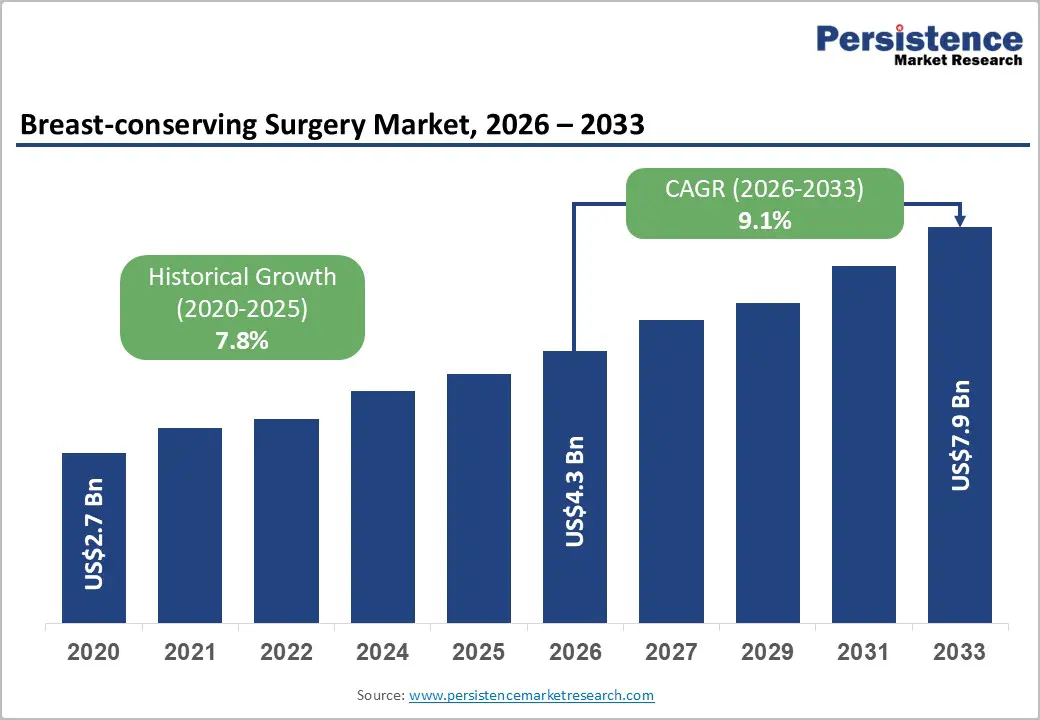
The global breast-conserving surgery market size is likely to be valued at US$4.3 billion in 2026 and is expected to reach US$7.9 billion by 2033, growing at a CAGR of 9.1% during the forecast period from 2026 to 2033, driven by a rising global breast cancer burden and expanding screening programs that catch more tumors at early stages. Developments in intraoperative imaging and wireless localization are also spurring demand.
Key Industry Highlights:
- Leading Product Type: Surgical excision devices, approximately 62.1% share in 2026, as these are present in every single BCS procedure without exception.
- Dominant Procedure: Lumpectomy, nearly 48.3% in 2026, as it provides equivalent survival rates to mastectomy for early-stage breast cancer.
- Leading Region: North America, with about 38.7% share in 2026, due to mature screening infrastructure and favorable reimbursement for unique procedures.
- Fast-growing Region: Europe, backed by increasing specialized oncoplastic surgery training programs.
- FDA Approval: In March 2026, Perimeter Medical Imaging AI received the U.S. Food and Drug Administration (FDA) premarket approval for Claire, making it the first AI-enabled imaging device approved in the U.S. for intraoperative breast cancer margin assessment.
DRO Analysis
Driver - Surging Global Breast Cancer Burden to Fuel Surgical Demand
The sheer scale of breast cancer's spread worldwide is directly expanding the pool of patients eligible for Breast-Conserving Surgery (BCS). A February 2025 study published in Nature Medicine by the International Agency for Research on Cancer (IARC) found that on average, 1 in 20 women across the globe will be diagnosed with breast cancer in their lifetime. It further stated that if current rates continue, by 2050, there will be 3.2 million new breast cancer cases and 1.1 million related deaths per year.
Global breast cancer incidence is projected to rise by 38% and related deaths by 68% by 2050. Critically, the disease is no longer concentrated in high-income nations. In 2022, Asia Pacific alone recorded 985,817 new cases, the highest of any continent. By 2050, the region is projected to see the most significant rise, reaching 2.0 million cases annually. As detection improves across these markets and more patients are diagnosed at early and operable stages, the proportion eligible for lumpectomy rather than full mastectomy rises directly in step.
Psychological and Quality-of-Life Advantages to Propel Patient Preference
The decision to undergo breast-conserving surgery is increasingly being influenced by its measurable advantages for emotional and psychosocial well-being, not just clinical outcomes. A prospective study conducted on 392 women at Hangzhou Cancer Hospital found that breast conservation has significant advantages over mastectomy in terms of breast satisfaction, psychosocial well-being, and sexual well-being, with mastectomy independently associated with decreased scores across all three dimensions. This is corroborated by broad evidence: patients who undergo breast-conserving surgery report higher levels of body image satisfaction and lower rates of depression compared to those who undergo mastectomy.
In a recent multicenter prospective cohort study, when offered oncoplastic BCS as an alternative to mastectomy, most women opted for BCS, with breast conservation successfully achieved in over 90% of cases and lower major complication rates. A meta-analysis using the EORTC QLQ-BR23 scale found BCS delivered statistically significantly better outcomes than mastectomy, specifically in body image, future perspective, and systemic therapy side effects. These outcomes are informing shared clinical decision-making, making patient preference itself a structural driver of BCS adoption.
Restraint - High Risk of Local Recurrence May Hinder Growth
The fact that breast-conserving surgery retains breast tissue is precisely what introduces its most persistent clinical concern, i.e., the possibility of cancer returning in the same breast. While large-scale comparisons have narrowed the gap considerably, the underlying risk remains a real barrier to wide adoption, mainly in young patients and those with aggressive tumor subtypes. A study of young women (aged ≤40) published in Cancers found a 10-year local recurrence rate of 11.1% among those who underwent BCS compared to 4.1% for mastectomy alone.
A 2024 meta-analysis of 389,465 patients across 22 studies found a local recurrence odds ratio of 1.65 for BCS versus mastectomy, meaning the risk, while statistically inconclusive due to heterogeneity, trends meaningfully higher. For patients with BRCA mutations, dense breast tissue, or multifocal tumors, surgeons often remain reluctant to recommend BCS. This limits its addressable patient base and creates a ceiling on adoption that is difficult to overcome through technology or awareness alone.
Opportunity - Next-Generation Tumor Localization to Create New Avenues
The shift away from wire-guided localization toward wireless alternatives is extending BCS eligibility and improving outcomes for the surging segment of patients whose tumors are detected through screening before they become palpable. Magnetic seed localization, exemplified by Endomag's Magseed, now part of Hologic's portfolio, is leading this transition. A retrospective analysis of 37 patients who underwent Magseed-guided BCS between 2022 and 2024 at a dedicated Breast Unit reported 100% successful seed retrieval with no migration or dislodgment. It also showed successful breast conservation in 97.9% of patients with no significant complications.
Beyond accuracy, the logistical advantage is significant. Unlike wires, magnetic and radioactive seeds can be placed days before surgery, decoupling radiology scheduling from operating room timelines. A 2024 evaluation of over 25,000 radioactive seed localization cases at a high-volume cancer center over 10 years confirmed that the technique provides a precise and efficient method for removing non-palpable lesions while improving perioperative logistics and patient satisfaction. As more breast cancers are detected at non-palpable stages through expanded screening, these localization technologies translate to more patients becoming viable candidates for conservation over mastectomy.
Cosmetically Refined Alternatives to Broaden the Spectrum of Preserving Options
When full conservation is clinically not viable, new surgical techniques are preserving body architecture in ways that were not previously possible. Nipple-Sparing Mastectomy (NSM) and Endoscopic Nipple-Sparing Mastectomy (E-NSM) help remove glandular breast tissue while keeping the skin envelope and nipple-areola complex intact. A 2025 meta-analysis published in BJS Open evaluated endoscopic NSM against conventional NSM. It found that the endoscopic approach delivers superior cosmetic outcomes while maintaining oncological safety.
The technique's adoption is also accelerating geographically. E-NSM, practiced in Europe and Asia Pacific for several years, was introduced to the U.S. only in 2025. Surgeons at NewYork-Presbyterian and Weill Cornell Medicine were among the first to perform the procedure in the U.S. in June 2025, reducing incisions to as small as 3 centimeters. Hence, patients who previously faced a binary choice between standard BCS and full mastectomy now have intermediate options that deliver comparable oncological control with better aesthetic and psychological outcomes.
Category-wise Analysis
Product Type Insights
Surgical excision devices are estimated to lead with nearly 62.1% of the share in 2026. These include electrosurgical units, scalpels, radiofrequency ablation tools, and ultrasonic dissectors, which are fundamental to tumor removal and used in almost all breast-conserving surgeries. Their dominance is structural. Unlike localization or margin assessment tools, which are used at specific points in the workflow, excision devices are in the surgeon's hands throughout the entire operation. They are also non-negotiable, as a lumpectomy or quadrantectomy simply cannot happen without them.
Tumor localization devices are projected to be in the second position in 2026, owing to the ongoing shift away from traditional wire-guided localization. Wire placement requires the procedure to happen on the same day as surgery, which often creates scheduling bottlenecks. Wireless alternatives such as magnetic seeds, RFID tags, and radar systems remove this dependency entirely. As mammography and screening programs improve, more patients are diagnosed with tumors that cannot be felt. Each of those patients requires a localization device before surgery can happen.
Procedure Insights
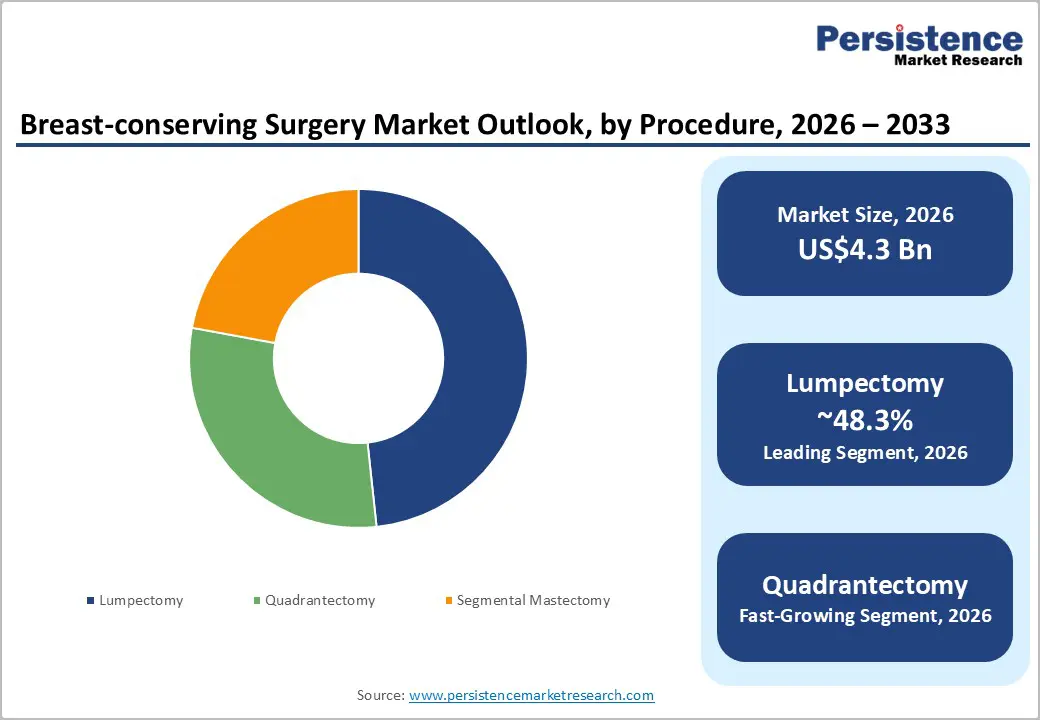
The lumpectomy segment is predicted to dominate with approximately 48.3% of the share in 2026, backed by its association with how breast cancer is being detected today. Widespread screening is catching tumors at early stages, and the majority of early-stage tumors do not necessitate a quadrantectomy. Lumpectomy removes only the tumor mass with a 1 cm margin of healthy tissue, a far smaller excision that preserves breast appearance more effectively. The blend of proven oncological safety, minimal tissue removal, and patient preference makes it the default choice in early-stage cases.
The quadrantectomy segment is expected to remain the fastest-growing in the forecast period, spurred by the rising use of Neoadjuvant Chemotherapy (NAC). It is expanding the pool of patients who qualify for any form of conservation surgery, such as more tissue-extensive procedures. Quadrantectomy removes approximately a quarter of the breast, including the tumor, a 2 to 3 cm margin, the overlying skin, and the underlying fascia. This makes it the procedure of choice when tumors are larger relative to breast size, or when central breast involvement requires more extensive excision.
Regional Insights
North America Breast-conserving Surgery Market Trends
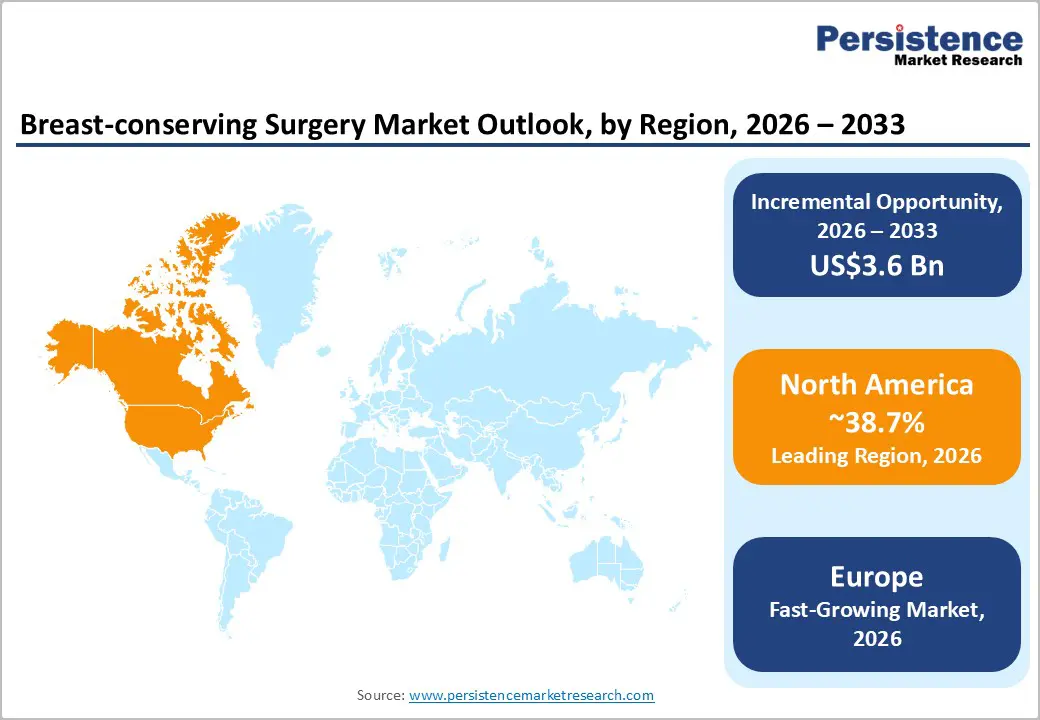
In 2026, a share of around 38.7% is expected to be registered by North America, due to the presence of a well-established breast cancer screening infrastructure. Widespread mammography programs catch more tumors at early stages, making more patients eligible for lumpectomy rather than mastectomy. The region also benefits from favorable reimbursement for BCS procedures. Insurance coverage supports both lumpectomy and the advanced localization and margin assessment tools that accompany it.
U.S. Breast-conserving Surgery Market Trends
The U.S. is the dominant market in North America. According to a 2024 report by the American Cancer Society, an estimated 310,720 new cases of invasive breast cancer and 56,500 cases of ductal carcinoma in situ (DCIS) are expected to be diagnosed among women in the U.S. This sheer volume of diagnoses keeps BCS procedure numbers consistently high. The country is also where most of the key innovations are happening.
Lumicell launched its LumiSystem, the first fluorescence-guided cavity imaging tool, commercially in January 2025. Perimeter Medical's Claire became the first FDA-approved AI-enabled imaging device for intraoperative margin assessment in March 2026. These clearances are happening first in the U.S., and hospitals are early adopters. The shift toward outpatient settings is also notable. Lumpectomy is increasingly being performed in ambulatory surgical centers, which brings costs down and broadens access.
Europe Breast-conserving Surgery Market Trends
Europe is catching up fast. Universal healthcare systems across the region provide a superior structural foundation. Governments actively fund breast cancer screening programs. Clinical guidelines are well-aligned with BCS as the preferred approach for early-stage disease. Oncoplastic surgery adoption is rising at 14 to 18% annually in developed markets across Europe. Specialized training programs for breast surgeons have increased by 40% over the last five years.
U.K. Breast-conserving Surgery Market Trends
The U.K. has a well-organized National Health Service (NHS) breast screening program. It provides the clinical pathway that funnels early-detected cases into BCS-eligible populations. The regulatory environment is also active. In January 2024, the National Institute for Health and Care Excellence (NICE) updated its recommendations for further surgery after breast-conserving surgery for invasive disease. The revised recommendations from NICE and the Association of Breast Surgery are now broadly similar, a harmonization that will help clinical teams and patients make pragmatic decisions about re-excising surgical margins.
Germany Breast-conserving Surgery Market Trends
Germany's progress in BCS is being amplified by a prominent leap in screening technology. The PRAIM study, the world's largest prospective AI mammography study, involved 463,094 women across 12 screening sites in Germany. It found that AI-supported double reading improved breast cancer detection rates by 17.6% compared to standard double reading, without increasing false positives or recall rates. This has direct implications for BCS as more cancers detected early means more patients are suitable for conservation surgery.
Asia Pacific Breast-conserving Surgery Market Trends
Asia Pacific is a high-potential but uneven market. Japan, Australia, and South Korea are leading BCS adoption, supported by novel medical infrastructure. Breast-conserving surgery in Asia Pacific is being fueled by increasing breast cancer awareness, improving healthcare access, and rising screening rates. High-income countries are adopting new BCS technologies, while emerging markets, including India and parts of Southeast Asia, still struggle with late-stage diagnoses.
Japan Breast-conserving Surgery Market Trends
Japan’s growth is steady rather than explosive, and the reasons are specific. According to the Japanese Breast Cancer Society's 2022 national registry, 40,521 patients out of 97,154 without distant metastasis underwent BCS. That figure reflects meaningful but not dominant uptake. The constraint is screening coverage. Japan's mammography mortality rate has not decreased significantly, mainly due to low screening uptake and the high prevalence of dense breast tissue among women, which reduces mammography's effectiveness.
China Breast-conserving Surgery Market Trends
China’s market is lucrative, but its BCS potential is still being unlocked. The country has one of the highest absolute numbers of breast cancer diagnoses in the world, yet BCS uptake has historically been constrained by late-stage detection. In recent years, with developments in screening technology and health awareness, the detection of early breast cancer in China has increased. However, the rate of detection is still low compared to that in developed countries, which has been an important factor limiting BCS implementation.
Competitive Landscape
The global breast-conserving surgery market sits at an interesting midpoint. It is moderately consolidated at the top, with Hologic commanding around 18% share and BD and Danaher together holding another 24%. Yet, the market is fragmented in the technology layer below, where a wave of competing margin-assessment and localization start-ups are racing to define the next standard of care.
The re-excision problem is the single most important competitive battleground. With 20 to 25% of lumpectomy cases resulting in inadequate tumor removal, every player in the market is essentially pitching a different technological solution to the same bottleneck.
The real fight, however, is happening in margin assessment, where the competing approaches are built on entirely different science. Dune Medical's MarginProbe, for example, uses radiofrequency spectroscopy to read the electrical characteristics of excised tissue to detect cancer at the margins. Lumicell is challenging this with fluorescence-guided surgery, a fundamentally different method that images the surgical cavity after the specimen is removed rather than reading the specimen itself.
Key Industry Developments:
- In March 2025, Perimeter Medical Imaging AI filed a PMA application with the FDA for its next-generation B-Series OCT system with ImgAssist AI 2.0. Its clinical trial received a grant of up to US$ 7.4 million from the Cancer Prevention and Research Institute of Texas.
- In April 2025, Innoblative Designs, Inc. announced that the FDA approved its Investigational Device Exemption (IDE) application for the SIRA RFA Electrosurgical Device. It paved the way for the company to initiate its U.S. feasibility study evaluating the safety and effectiveness of the device in patients undergoing breast-conserving surgery.
- In January 2025, Lumicell, Inc. announced the U.S. commercial availability and first commercial use of LumiSystem. It combines two recently FDA-approved products, namely, LUMISIGHT, an optical imaging agent that fluoresces at sites of suspected cancerous tissue, and the Lumicell Direct Visualization System (DVS), an imaging device that provides real-time fluorescence guidance for scanning the breast cavity during lumpectomy surgery.
Companies Covered in Breast-conserving Surgery Market
- Hologic, Inc.
- Dilon Technologies
- Argon Medical Devices
- Merit Medical Systems
- KUBTEC
- Stryker
- SamanTree Medical
- Perimeter Medical Imaging AI
- Xeos
- BD
- Mammotome (Danaher)
- CairnSurgical Inc.
- Innoblative Designs
Frequently Asked Questions
The global breast-conserving surgery market is projected to be valued at US$4.3 billion in 2026.
The breast-conserving surgery market is expected to reach US$7.9 billion by 2033.
Replacement of wire-guided localization with wireless systems and the rise of oncoplastic nipple-sparing techniques are a few key market trends.
Lumpectomy, with nearly 48.3% of share in 2026, as it is less invasive and recovery is generally faster than a mastectomy.
The breast-conserving surgery market is expected to grow at a CAGR of 9.1% from 2026 to 2033.
Hologic, Inc., Dilon Technologies, Argon Medical Devices, and Merit Medical Systems are a few key market players.


