




- Technology
- Blockchain Food Traceability Market
Blockchain Food Traceability Market Size, Share, and Growth Forecast, 2026 - 2033
Blockchain Food Traceability Market by Component (Software Platforms, Hardware & Tracking Devices, Services), Application (Food Safety & Recall Tracking, Supply Chain Transparency, Anti-Counterfeiting & Authentication, Regulatory Compliance, Sustainability & Ethical Sourcing), End-User (Food Producers, Food Processors & Manufacturers, Logistics & Cold Chain Providers, Food Retailers, Foodservice Companies, Regulatory & Certification Bodies) and Regional Analysis for 2026 - 2033

Blockchain Food Traceability Market Share and Trends Analysis
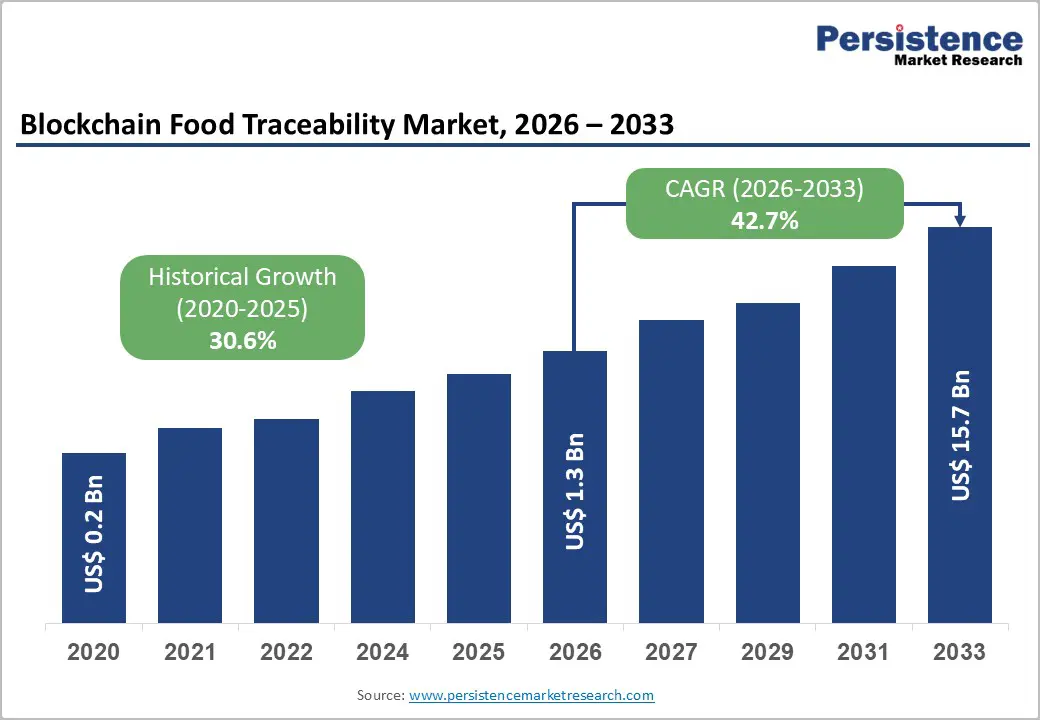
The global blockchain food traceability market size is likely to be valued at US$ 1.3 billion in 2026, and is projected to reach US$ 15.7 billion by 2033, growing at a CAGR of 42.7% during the forecast period 2026 - 2033.
The market is expanding rapidly as regulators, food manufacturers, and multinational retailers are implementing distributed ledger technologies (DLTs) to improve transparency and operational accountability across agricultural supply chains. Governments are increasingly introducing digital traceability mandates as part of broader food safety modernization strategies.
Regulatory initiatives are encouraging enterprises to adopt digital record systems that can capture supply chain events with higher accuracy and speed. Contamination incidents involving exported food products are prompting regulators and import authorities to demand more reliable traceability documentation.
Technology convergence is further strengthening the operational value of blockchain traceability platforms. Companies are integrating blockchain networks with Internet of Things sensors, smart packaging systems, and enterprise supply chain data platforms to capture detailed product lifecycle information. The Food and Agriculture Organization (FAO) estimates that nearly one-third of global food production is lost or wasted each year, highlighting major inefficiencies in agricultural supply chain monitoring. Blockchain-based traceability systems are reducing recall investigation times from several days to minutes by enabling instant access to verified supply chain data. Food retailers and processors are also adopting these platforms to verify supplier compliance, validate sustainability claims, and document ethical sourcing practices. Regulatory programs such as the Digital Product Passport initiative introduced by the European Union (EU) are pushing companies to intensify their investments in digital traceability.
Key Industry Highlights
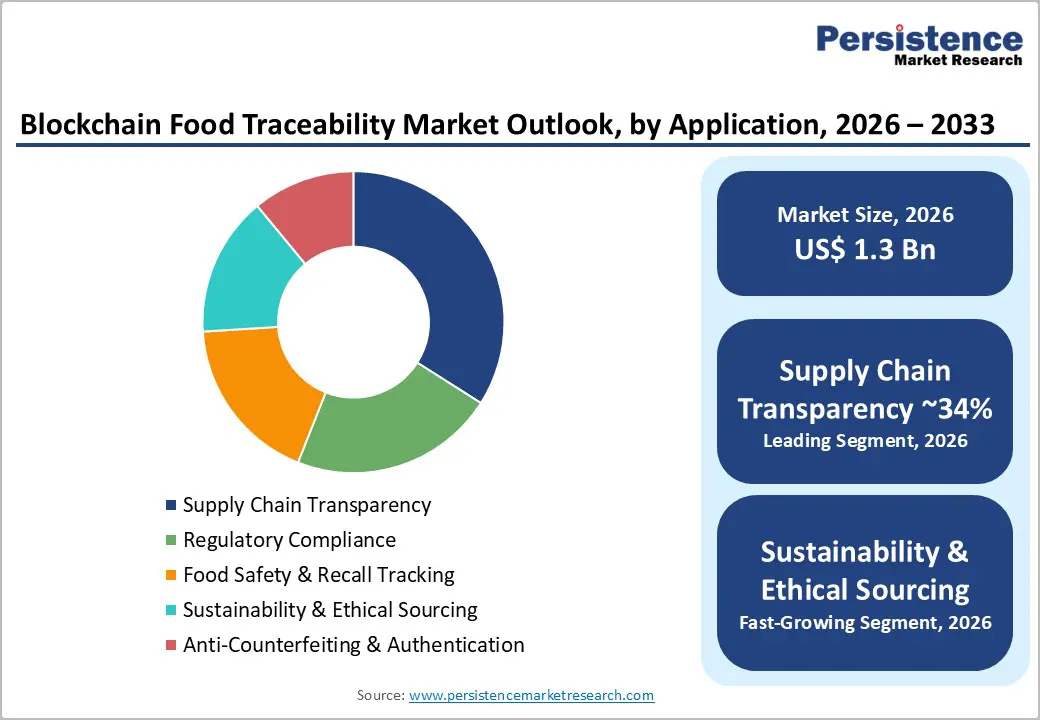
- Leading Application: Supply chain transparency solutions are expected to hold about 34% of total market revenue in 2026, as food manufacturers and retailers prioritize end-to-end product visibility.
- Fastest-growing Application: Sustainability and ethical sourcing traceability platforms are projected to grow at the highest CAGR of around 45% during 2026 - 2033, supported by carbon footprint tracking initiatives.
- Dominant End-User: Food processors and manufacturers are set to command roughly 38% of the revenue share in 2026, reflecting their central role in managing multi-tier supplier networks.
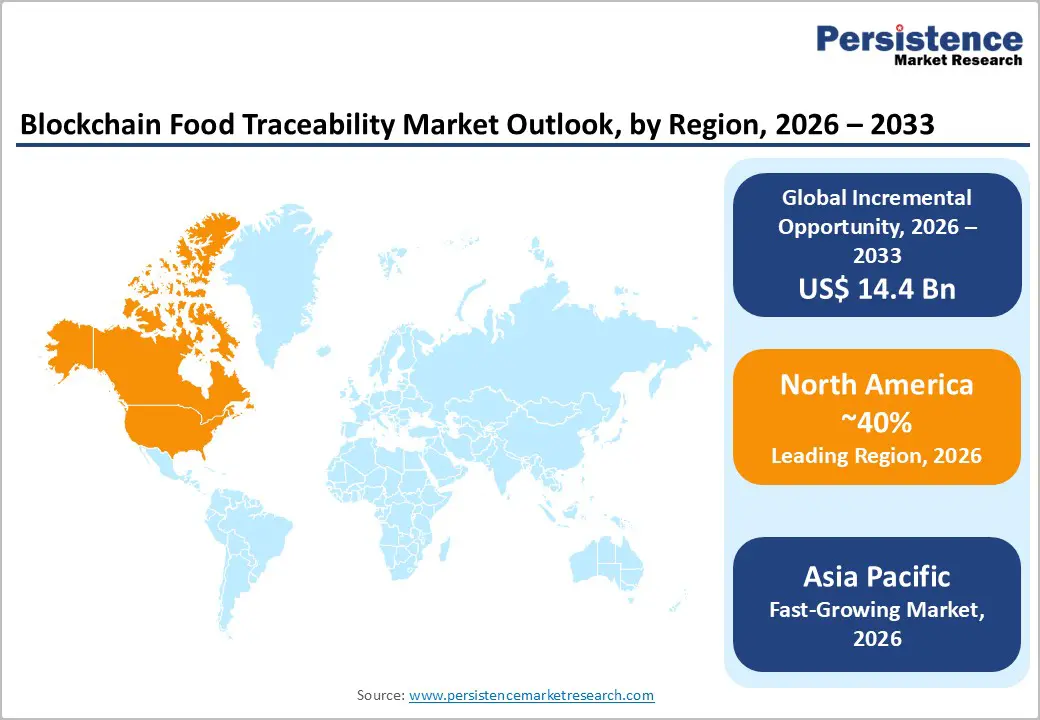
- Dominant Region: North America is likely to dominate with approximately 38% market share in 2026, boosted by the implementation of the U.S. Food Safety Modernization Act (FSMA) traceability requirements.
- Fastest-growing Market: The Asia Pacific market is slated to expand the fastest at roughly 46% CAGR through 2033, fueled by rising food export volumes and government-backed digital agriculture initiatives.
- June 2025: Australia launched a pilot program using blockchain-enabled QR codes and digital sustainability reporting to track beef production data and environmental credentials across the supply chain.
| Key Insights | Details |
|---|---|
| Blockchain Food Traceability Market Size (2026E) | US$ 1.3 Bn |
| Market Value Forecast (2033F) | US$ 15.7 Bn |
| Projected Growth (CAGR 2026 to 2033) | 42.7% |
| Historical Market Growth (CAGR 2020 to 2025) | 30.6% |
Market Factors - Growth, Barriers, and Opportunities
Regulatory Digital Traceability Mandates
Governments across major food-producing and importing economies are implementing stricter digital traceability regulations, accelerating the deployment of blockchain infrastructure in agri-food supply chains. Regulatory frameworks such as the FSMA administered by the U.S. Food and Drug Administration (FDA) require companies to maintain structured electronic traceability records for high-risk food categories such as seafood, leafy greens, dairy products, and fresh produce. Under FSMA Rule 204, organizations must provide detailed key data elements (KDEs) and critical tracking events (CTEs) within twenty-four hours of a food safety investigation.
Blockchain platforms are increasingly supporting these compliance systems because distributed ledgers create tamper-resistant records that preserve the integrity of traceability data. This capability is allowing regulators, certification bodies, and supply chain partners to access synchronized information while maintaining data security and auditability.
Global agricultural trade flows are further strengthening the strategic case for blockchain-enabled traceability systems. According to the World Trade Organization (WTO), international agricultural exports totaled close to US$ 2 trillion in 2023, reflecting the growing interdependence of cross-border food supply networks. Importing countries are implementing stricter verification requirements for product origin, sanitary standards, and sustainability certifications. Blockchain networks are enabling exporters to generate verifiable digital audit trails that support regulatory inspections and certification processes, bolstering compliance readiness and supply chain credibility.
Rising Food Fraud and Supply Chain Transparency Demands
Food fraud and product misrepresentation are increasingly affecting global agri-food markets, creating a strong commercial rationale for adopting blockchain-based traceability platforms. These practices include product substitution, counterfeit labeling, and adulteration of premium food products such as seafood, olive oil, honey, and certified organic foods. Such activities are eroding consumer trust while increasing regulatory and reputational risks for legitimate producers and retailers.
Blockchain technology provides a viable mechanism to address these challenges because distributed ledgers record each transaction and supply chain event in an immutable format. These systems are enabling regulators, certification agencies, and retailers to verify product authenticity, confirm origin claims, and identify irregularities across supply chain transactions with greater precision.
Retailers and food brands are increasingly responding to rising consumer expectations for supply chain transparency and sustainability verification. Companies are therefore implementing blockchain-enabled quick response (QR) code labeling systems that allow consumers to access verified product histories using mobile devices. These digital records provide detailed information on farm origin, harvest timelines, storage conditions, and transportation routes. Food manufacturers are also integrating blockchain traceability platforms with environmental monitoring tools to track supply chain sustainability metrics such as carbon emissions, deforestation exposure, and ethical labor compliance.
Integration Complexity across Fragmented Food Supply Chains
Food supply chains are highly fragmented, making large-scale deployment of blockchain-based traceability platforms challenging. Agricultural production systems are involving millions of small-scale farmers, cooperatives, and local suppliers that often lack the digital infrastructure necessary to participate in blockchain networks. This limited digital readiness is slowing the integration of primary producers into blockchain-enabled supply chain ecosystems. Implementing distributed ledger systems across such diverse production networks requires significant investment in digital identity frameworks, mobile-based reporting tools, and IoT-enabled monitoring technologies.
Data interoperability is presenting another critical constraint for blockchain food traceability initiatives. Food supply chains are generating vast volumes of heterogeneous data across cultivation, harvesting, processing, logistics, and retail operations. These data streams often originate from diverse enterprise systems, sensors, and documentation formats that do not adhere to consistent standards. Without standardized data structures and interoperability protocols, blockchain networks cannot effectively synchronize information across multiple stakeholders. Industry organizations such as GS1 are developing global data standards for product identification and traceability to improve cross-platform compatibility. However, the adoption of these standards is progressing unevenly across geographies, sectors, and supply chain participants.
High Implementation Costs and ROI Uncertainty
Blockchain-enabled traceability platforms entail considerable upfront investment in digital infrastructure, enterprise software integration, and operational process redesign. Organizations are deploying IoT sensors, digital product labeling technologies, and enterprise-grade data management systems before blockchain networks are capable of generating operational value. These systems are capturing product lifecycle data across production, processing, storage, and transportation activities, which must then be integrated with distributed ledger infrastructure. Companies also need to invest in cybersecurity controls, data governance frameworks, and supplier onboarding programs to ensure traceability data is consistently recorded across the entire supply chain.
Quantifying return on investment remains difficult for many organizations because the financial benefits of blockchain traceability systems are often indirect and realized over longer operational cycles. These platforms are generating value through improved recall response capabilities, stronger regulatory compliance management, and enhanced consumer trust rather than immediate revenue expansion. Food manufacturers and retail chains are therefore evaluating blockchain investments from a strategic risk-management perspective. Smaller suppliers and agricultural producers are often facing greater financial constraints, which may limit their ability to adopt new digital traceability technologies independently. Participation in blockchain-enabled supply chain ecosystems is gathering steam only when large buyers or regulatory authorities are mandating compliance.
Digital Transformation of Global Agri-Food Supply Chains
The ongoing digital transformation of agriculture and food supply chains is paving the way for high-value opportunities to deploy blockchain-based traceability infrastructure. Agricultural producers, logistics providers, and food manufacturers are increasingly adopting digital technologies to improve productivity, enhance compliance monitoring, and coordinate supply chains. These technologies are generating structured digital data across cultivation, harvesting, storage, and distribution processes. Blockchain platforms are emerging as a foundational infrastructure layer that enables secure data exchange between supply chain participants while preserving the integrity of recorded information. By creating tamper-resistant transaction histories, blockchain systems are strengthening trust among producers, processors, distributors, and retailers that operate within increasingly complex global food networks.
As the adoption of digital agriculture technologies continues expanding, blockchain-enabled traceability systems are becoming more practical because supply chain data is increasingly captured electronically at the point of origin. Sensor-based monitoring tools are collecting real-time information about crop growth conditions, livestock health indicators, and transportation environments throughout the food supply chain. Integrating this operational data into blockchain ledgers is allowing supply chain participants to verify product origin, monitor quality standards, and demonstrate regulatory compliance with greater confidence. These capabilities support more efficient product recalls, improved supplier verification, and enhanced documentation for international trade.
Premium Food Certification and Sustainability Tracking
Premium food segments such as organic products, fair-trade commodities, and sustainably sourced seafood are creating significant commercial opportunities for blockchain-enabled traceability systems. The demand for certified sustainable food products is surging as consumers, regulators, and institutional buyers are prioritizing transparency in agricultural sourcing practices. Verifying certification claims remains operationally challenging because modern food supply chains often involve multiple intermediaries across different countries. Certification bodies, exporters, processors, and retailers must maintain consistent documentation that confirms compliance with organic production standards and ethical sourcing requirements. Blockchain platforms provide the necessary digital infrastructure that allows supply chain participants to record and verify certification data throughout the product lifecycle.
DLTs are facilitating the development of digital certification systems that document key product attributes such as organic status, ethical sourcing verification, and greenhouse gas emissions associated with agricultural production. Food retailers and multinational brands are integrating blockchain traceability platforms into environmental, social, and governance (ESG) reporting frameworks to strengthen transparency across global sourcing networks. Regulatory developments are also reinforcing this shift toward digital traceability. Carbon accounting standards and climate disclosure regulations are also encouraging companies to monitor agricultural supply chain emissions with greater accuracy. Blockchain systems are enabling companies to maintain verifiable records that demonstrate compliance with sustainability commitments and regulatory requirements.
Category-wise Analysis
Application Insights
Supply chain transparency is projected to account for approximately 34% of the blockchain food traceability market revenue share in 2026. Food manufacturers, distributors, and retailers are prioritizing end-to-end visibility across increasingly complex global food supply chains. Blockchain traceability platforms are enabling organizations to document product origin, storage conditions, and transportation routes in a secure and verifiable format. These systems are helping companies detect operational inefficiencies, strengthen supplier accountability, and reduce the risk of product substitution or mislabeling. Distributed ledger networks are also supporting multi-stakeholder collaboration by allowing different participants to access synchronized supply chain information while maintaining data integrity and security.
Sustainability and ethical sourcing applications are likely to post the fastest growth at CAGR of 45% from 2026 to 2033. Companies are implementing blockchain platforms to monitor environmental indicators such as greenhouse gas emissions, deforestation exposure, and labor practice compliance within agricultural supply chains. Regulatory initiatives including the Corporate Sustainability Reporting Directive (CSRD) introduced by the EU are requiring companies to provide more detailed environmental disclosures. Blockchain traceability platforms are enabling automated verification of sustainability data while improving transparency across supplier networks. As environmental compliance frameworks continue evolving globally, blockchain-enabled sustainability tracking systems are expected to play an increasingly important role in corporate supply chain governance.
End-User Insights
Food processors and manufacturers are poised to lead with an estimated 38% revenue share in 2026. These organizations occupy a central position within agri-food supply chains because they are coordinating procurement, transformation, packaging, and distribution activities across extensive supplier networks. Processing companies are required to verify ingredient provenance, maintain detailed production records, and ensure compliance with national and international food safety regulations. Blockchain traceability platforms enable manufacturers to document the movement of raw materials from farms and fisheries to processing facilities, improving the accuracy and reliability of supply chain documentation while strengthening operational transparency across multi-facility production environments.
Food retailers are expected to record the highest 2026-2033 CAGR, powered by the expanding deployment of blockchain traceability solutions by supermarket chains, specialty food retailers, and online grocery platforms to verify product authenticity and strengthen consumer confidence in food sourcing practices. Retailers are using these platforms to monitor supplier compliance, confirm sustainability certifications, and ensure consistent product quality across global sourcing networks. Digital transparency initiatives are further accelerating adoption as retailers integrate blockchain traceability with product labeling technologies that allow consumers to access verified origin information through mobile applications. As a result, blockchain traceability platforms are becoming essential tools for strengthening supplier accountability and protecting brand reputation.
Regional Insights
North America Blockchain Food Traceability Market Trends
North America is forecasted to account for an estimated 38% of the blockchain food traceability market share in 2026, owing to strong regulatory oversight, early adoption of advanced supply chain technologies, and a highly developed food retail ecosystem. The United States is implementing major traceability reforms under the FSMA administered by the U.S. FDA. These regulations are requiring companies to maintain structured digital traceability records for high risk food products and provide detailed supply chain data during food safety investigations. With regulatory enforcement tightening, food producers, distributors, and retailers are investing in automated supply chain monitoring systems that can capture real time production and logistics data across complex distribution networks.
Enterprise investment in blockchain traceability infrastructure is also expanding across North American food supply chains as companies seek to improve operational resilience and regulatory compliance readiness. Major food retailers, processors, and logistics companies are collaborating with technology providers to build shared blockchain networks that enable secure information exchange between suppliers, distributors, and retail partners. The presence of advanced cloud computing providers, technology startups, and large enterprise software vendors is accelerating the commercialization of blockchain traceability solutions across the region. Venture capital funding for food supply chain technology companies is also increasing as investors are recognizing the potential of digital traceability systems to address food safety risks, supply chain inefficiencies, and product authentication challenges.
Europe Blockchain Food Traceability Market Trends
Europe is a major market for blockchain food traceability solutions, propelled by its comprehensive sustainability policies, strict food safety governance frameworks, and increasing investments in digital supply chain infrastructure. The EU is implementing policy initiatives such as the Farm to Fork Strategy, which is establishing greater transparency across agricultural production and food distribution networks. These policies are promoting the adoption of digital traceability systems that can monitor product origin, production methods, and environmental impacts throughout the food supply chain. Regulatory authorities are also advancing the concept of Digital Product Passports to document product lifecycle data and may incorporate blockchain technologies.
Europe’s rigorous regulatory oversight of food safety, labeling standards, and certification processes is creating favorable conditions for blockchain traceability adoption across the food industry. Food manufacturers, agricultural cooperatives, and retail chains are increasingly deploying blockchain platforms to verify organic certifications, geographical indication labels, and sustainability claims associated with agricultural products. These systems are supporting compliance with complex regulatory documentation requirements while strengthening consumer confidence in certified food products. Investment in agri-food technology innovation is also expanding across the region through collaborative research programs and public private partnerships. European governments, research institutions, and technology companies are supporting pilot projects that explore blockchain applications across agriculture, fisheries, and food processing sectors.
Asia Pacific Blockchain Food Traceability Market Trends
Asia Pacific is anticipated to emerge as the fastest-growing market for blockchain food traceability solutions through 2033, projected to display an approximate CAGR of 45%. Rapid expansion of agricultural exports, increasing regulatory attention to food safety, and large scale investments in digital agriculture infrastructure are strengthening the adoption of advanced traceability systems across the region. National and local governments in China, India, Japan, and Australia are supporting supply chain modernization initiatives that integrate digital technologies into agricultural production and food distribution networks. Several governments are also implementing blockchain pilot programs to improve monitoring of food safety incidents and reduce the circulation of counterfeit or misrepresented food products within domestic and export markets.
China has become a leading adopter of blockchain traceability technologies across both agricultural production and food retail sectors. Large electronic commerce platforms are deploying blockchain based systems to verify product authenticity, monitor supplier compliance, and document food safety data throughout complex supply chains. Similar digital traceability initiatives are expanding across Southeast Asian economies as governments seek to strengthen export competitiveness and improve alignment with international food safety standards. Increasing consumer awareness of product authenticity and food safety is further accelerating the demand for traceability technologies across regional food markets. Governments are also continuing to invest in digital agriculture infrastructure while modernizing regulatory frameworks to support transparent food supply chains.
Competitive Landscape
The global blockchain food traceability market structure is moderately fragmented, characterized by technology vendors, enterprise software providers, and specialized blockchain startups competing to secure large scale supply chain implementation contracts. Major technology firms are leveraging cloud computing infrastructure and blockchain as a service platforms to develop scalable digital traceability networks for global food supply chains. These platforms are enabling companies to record production data, logistics events, and supplier documentation in secure distributed ledgers that can be accessed across multiple supply chain participants. This integration is allowing food manufacturers, logistics providers, and retailers to adopt blockchain solutions without completely replacing their existing operational systems.
Smaller technology startups are focusing on specialized use cases that address specific traceability challenges within food supply chains. These companies are developing targeted solutions for applications such as seafood provenance verification, livestock health monitoring, and certification tracking for organic agricultural products. Strategic collaborations between technology developers and multinational food companies are becoming more common as organizations seek to build interoperable traceability ecosystems that support multi stakeholder data sharing. Market concentration is remaining relatively low as blockchain adoption across food supply chains is still at an early development stage.
Key Industry Developments
- In September 2025, Bunge collaborated with Bangkok Produce Merchandising (BKP) to deploy a blockchain platform for tracing Brazilian soy and soymeal shipments, enabling full visibility from farm origin through processing and transport to Southeast Asian markets. The system, developed with blockchain infrastructure provider Justoken, will be scaled following pilot shipments validating traceability for large soybean volumes.
- In July 2025, Domino India partnered with Jumbo Blockchain to launch TagITX, a Made-in-India blockchain traceability platform that generates secure QR codes on products, enabling real-time authentication and supply-chain tracking. The system integrates with industrial printers to create tamper-evident product identities from manufacturing to consumer verification, supporting regulatory compliance across sectors such as food, pharmaceuticals, and consumer goods.
- In June 2025, Mars teamed up with the Global Dialogue on Seafood Traceability (GDST) and blockchain platform Wholechain to implement end-to-end digital traceability across its seafood supply chain, becoming the first pet food company to commit to the GDST global traceability standard.
Companies Covered in Blockchain Food Traceability Market
- IBM Corporation
- SAP SE
- Oracle Corporation
- Microsoft Corporation
- Amazon Web Services, Inc.
- TE-FOOD International GmbH
- Provenance Ltd.
- Ripe Technology, Inc.
- Ambrosus Technologies GmbH
- VeChain Foundation
- FoodLogiQ, LLC
- OriginTrail Foundation
- Arc-Net Ltd.
- AgriDigital Pty Ltd.
Frequently Asked Questions
The global blockchain food traceability market is projected to reach US$ 1.3 billion in 2026.
Implementation of distributed ledger technologies by food manufacturers and multinational retailers to improve transparency and operational accountability across agricultural supply chains, and surging levels of food production waste worldwide are driving the market.
The market is poised to witness a CAGR of 42.7% from 2026 to 2033.
Introduction of digital traceability mandates as part of broader food safety modernization strategies by governments, and integration blockchain networks with IoT sensors, smart packaging systems, and enterprise supply chain data platforms by food companies are key market opportunities.
IBM Corporation, SAP SE, Oracle Corporation, and Microsoft Corporation are some of the key players in the market.


