




- Technology
- Cattle Handling Systems Market
Cattle Handling Systems Market Size, Share, and Growth Forecast 2026 - 2033
Cattle Handling Systems Market by Product Type (Crushes, Head Gates, Alleys & Raceways, Sorting Systems, Loading Ramps, Weighing Systems, Others), System Type (Fixed, Portable, Modular Systems), Automation Level (Manual Systems, Semi-Automated Systems, Fully Automated Systems), End-user (Dairy Farms, Beef Farms, Feedlots, Livestock Markets & Auctions, Veterinary Clinics, Slaughterhouses, Others), by Regional Analysis, 2026 - 2033

Cattle Handling Systems Market Size and Trend Analysis
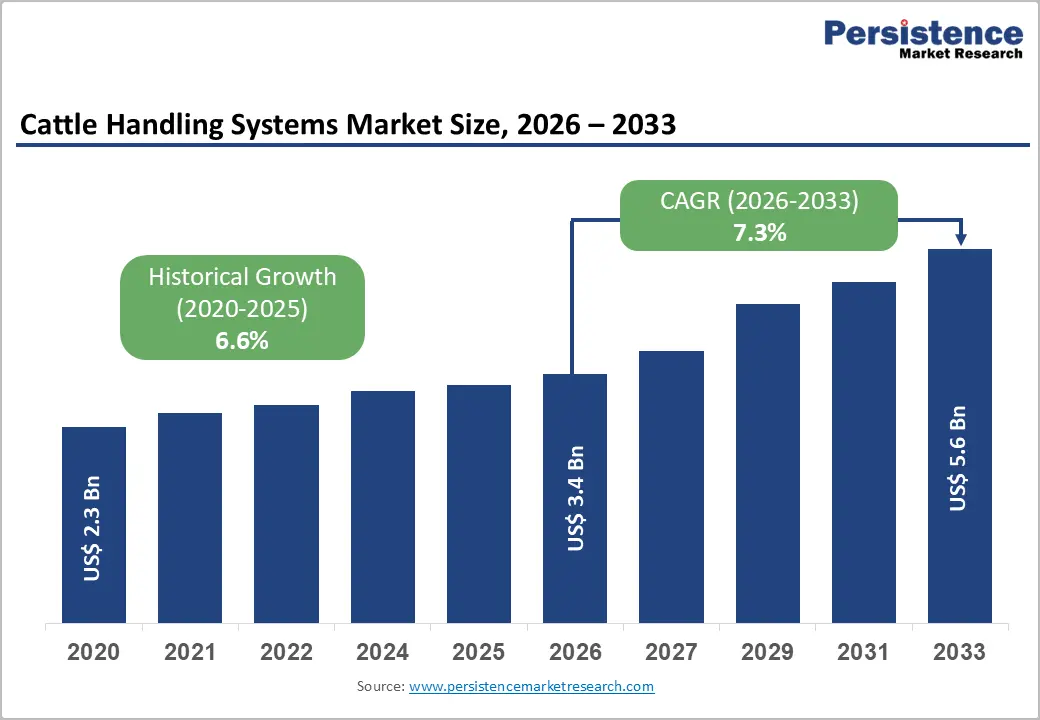
The global cattle handling systems market size is expected to reach US$ 3.4 billion in 2026 and US$ 5.6 billion by 2033, growing at a CAGR of 7.3% between 2026 and 2033. Growth is fueled by expanding global cattle populations, which surpassed 1.5 billion in 2025 per the Food and Agriculture Organization (FAO), increasing demand for efficient and low-stress handling solutions.
The rising emphasis on animal welfare and stringent regulations from authorities such as the USDA and the European Commission are accelerating adoption. Additionally, persistent labor shortages, including high vacancy rates in U.S. agriculture, are driving farms toward automation and advanced handling technologies.
Key Industry Highlights:
- Leading Region: North America dominates with 38% share, driven by strong regulatory frameworks and advanced dairy farm technologies.
- Fastest Growing Region: Asia Pacific holds 32% share and remains the fastest-growing region, supported by expanding cattle populations in India and China.
- Leading Product Type: Crushes lead with 28% share, as they are essential for safe and efficient cattle restraint during veterinary and routine operations.
- Leading Automation Level: Semi-automated systems account for 32% share, balancing efficiency and cost while reducing labor dependency.
- Key Market Opportunity: Integration of precision livestock farming (PLF) and IoT technologies is creating opportunities by improving monitoring, reducing cattle stress, and enhancing overall farm productivity.
Market Dynamics
Drivers - Stringent Animal Welfare Regulations Driving System Adoption
Global emphasis on animal welfare standards is significantly accelerating demand for advanced cattle handling systems designed to minimize stress and injury. Regulations such as the EU Council Directive 98/58/EC mandate safer livestock facilities, with EFSA audits indicating over 85% compliance, improving operational efficiency. In parallel, structured programs like Beef Quality Assurance (BQA) in the U.S. highlight measurable reductions in cattle injuries through optimized system designs.
Rising consumer preference for ethically produced meat, with nearly 70% of Europeans prioritizing welfare standards, is further influencing farm investments. Additionally, FAO findings suggest up to 20% productivity improvements from compliant systems, while global beef demand is projected to grow steadily, reinforcing the need for efficient, welfare-focused cattle handling infrastructure.
Automation Technologies Addressing Labor Shortages and Efficiency
Technological advancements in automation are transforming cattle-handling systems, primarily driven by persistent labor shortages across the agricultural sector. USDA surveys indicate that nearly 40% of farms face workforce gaps, pushing the adoption of semi-automated and automated solutions. Technologies such as RFID-enabled gates and automated sorting systems significantly reduce manual intervention while improving handling speed and operational consistency.
Automation also enhances safety and cost efficiency, with NIOSH studies showing up to 45% reduction in handling time and substantial declines in injury-related expenses. The integration of AI and IoT-based monitoring systems supports precision livestock farming, enabling better herd management. With global cattle populations exceeding 1.5 billion, scalable and technology-driven systems are becoming essential for modern livestock operations.
Restraints - High Capital Investment Limiting Adoption Among Small Farms
High initial investment costs remain a major barrier to widespread adoption of cattle handling systems, particularly among small and medium-scale farms. According to World Bank agriculture data, a standard system setup can cost around US$ 75,000, making it unaffordable for nearly 60% of farms managing fewer than 200 cattle. Additional retrofitting expenses, often increasing costs by 25-40%, further discourage modernization.
This financial burden is especially pronounced in emerging regions, where nearly 80% of farms are small-scale, as per FAO estimates. Despite offering long-term returns over 15 years, high upfront costs delay adoption, forcing continued reliance on manual handling methods. This persistence contributes to operational inefficiencies and increases risk, with studies indicating injury and loss rates up to 20% higher.
Low Awareness Hindering Adoption in Emerging Agricultural Regions
Limited awareness and technical knowledge in developing regions significantly hinder the adoption of modern cattle-handling systems. Reports from the International Labour Organization (ILO) suggest that only about 30% of farmers in parts of Asia receive formal training in livestock handling practices, limiting exposure to advanced solutions. As a result, traditional and less efficient methods continue to dominate.
This gap in awareness also impacts safety and productivity, with the World Health Organization (WHO) reporting that injury rates are around 18% higher due to outdated handling practices. Cultural dependence on conventional techniques further slows technological transition, despite pilot programs such as those by NDDB in India demonstrating efficiency improvements of up to 25% through modern system adoption
Opportunities - Integration of Precision Livestock Farming Technologies Creating Opportunities
The expansion of precision livestock farming (PLF) presents a significant opportunity for cattle-handling system providers through the integration of IoT, sensors, and data-driven technologies. EU Horizon projects indicate that advanced monitoring systems can reduce animal stress levels by 35-40%, improving overall herd productivity. With dairy operations managing nearly 900 million cattle globally, the scope for digital integration continues to expand rapidly.
Adoption of IoT-enabled livestock solutions is rising at nearly 30% annually, supported by traceability initiatives such as GS1 standards. Modular handling systems integrated with farm management software enable real-time monitoring across millions of operations. Addressing inefficiencies like the 10% milk yield loss due to poor handling, these technologies offer scalable and data-centric solutions for modern livestock farms.
Rising Demand for Sustainable and Ethical Beef Production Systems
Growing demand for sustainable beef production is creating significant opportunities for advanced cattle handling systems focused on low-stress and welfare-compliant operations. Initiatives led by organizations such as the Global Roundtable for Sustainable Beef (GRSB) show that nearly 75% of certified farms have upgraded to improved handling infrastructure, reflecting strong industry alignment with sustainability goals.
Government-backed programs are further accelerating adoption, with Australia’s Meat & Livestock Australia supporting over 12,000 facilities through subsidies. Similarly, Brazil’s initiatives covering up to 30% of system costs across thousands of farms highlight strong scalability potential. With FAO projecting a 16% increase in global beef demand, sustainable handling systems are becoming a key investment area.
Category-wise Analysis
Product Type Insights
Crushes account for approximately 28% share in 2025, making them the leading product type due to their critical role in safely restraining cattle during veterinary procedures and routine handling. Their widespread use across nearly 85% of dairy and beef operations highlights their necessity. Studies from USDA and NIOSH indicate up to 40% reduction in animal injuries and significant improvements in handler safety, reinforcing their dominance.
Advanced and smart handling systems are emerging as the fastest-growing category, driven by increasing demand for precision and efficiency. Integration of automated controls, sensor-based monitoring, and data analytics is transforming traditional setups. These systems enhance operational accuracy, reduce stress levels, and align with evolving animal welfare standards, making them highly attractive for modern livestock farms.
System Type Insights
Fixed systems hold around 35% share in 2025, primarily due to their suitability for large-scale, high-throughput operations such as feedlots and commercial ranches. Their long lifespan, often exceeding 25 years as per ASABE standards, and cost efficiency over time make them the preferred choice for nearly 70% of large farms managing extensive cattle volumes.
Portable and modular systems are witnessing the fastest growth as farms seek flexibility and scalability. These systems are particularly beneficial for small and medium-sized operations, enabling easy relocation and customization. Increasing adoption in emerging markets and remote farming regions is driving demand, as producers prioritize adaptable solutions that can evolve with changing operational requirements.
Automation Level Insights
Semi-automated systems capture approximately 32% of the market share in 2025, driven by their ability to balance efficiency and affordability for mid-sized farms. These systems significantly reduce manual labor requirements, with studies indicating up to 45% labor savings. Their adoption is further supported by improved animal welfare outcomes, including better handling consistency and reduced stress during routine operations.
Fully automated systems are emerging as the fastest-growing segment, fueled by advancements in smart farming technologies. Increasing integration of AI, IoT, and automated sorting mechanisms is enhancing precision and scalability. As farms continue to address labor shortages and seek higher productivity, demand for fully automated, technology-driven solutions is expected to accelerate rapidly.
End-user Insights
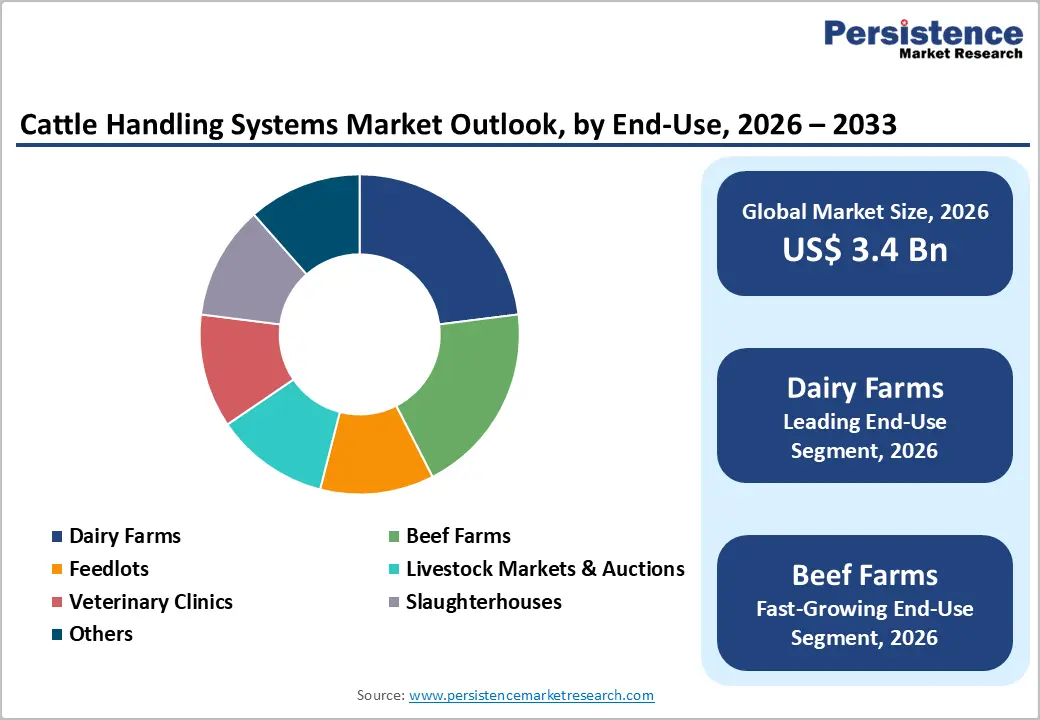
Dairy farms lead the market with around 30% share in 2025, driven by the need for frequent and consistent cattle handling across nearly 300 million dairy cows globally. Efficient systems are essential for processes such as milking, health checks, and breeding. Data from the USDA indicates that optimized handling infrastructure can improve productivity, including measurable increases in milk yield.
Beef farms and feedlots represent the fastest-growing end-use segment, supported by rising global meat consumption and expanding herd sizes. These operations require robust and scalable handling systems to manage large volumes efficiently. Growing investments in commercial beef production and export-oriented livestock industries are further accelerating demand for advanced handling solutions.
Regional Insights
North America Cattle Handling Systems Market Trends and Insights
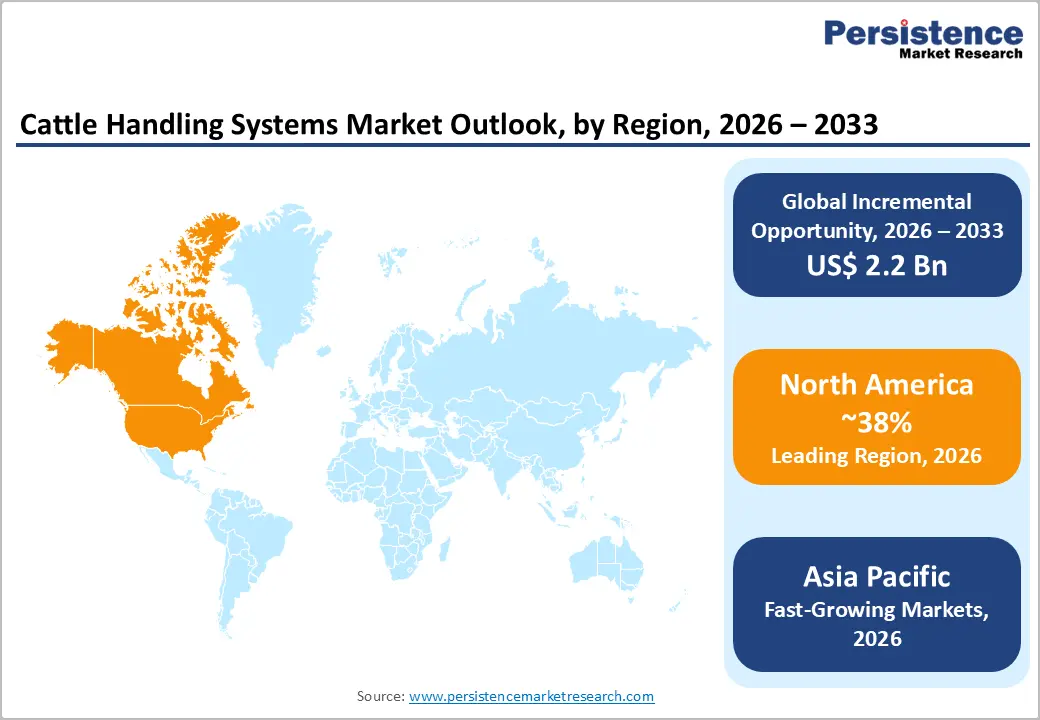
North America leads the global cattle handling systems market with approximately 38% share in 2025, translating to a market size of nearly US$ 1.3 billion in 2026. The U.S. cattle handling systems market size dominates the region, supported by USDA Farm Bill funding of over US$ 1.5 billion for infrastructure upgrades, while Canada cattle handling systems market size benefits from CFIA-driven regulatory adoption and innovation. NIOSH data highlights a 25% reduction in handling-related injuries across upgraded facilities.
Technological advancements continue to strengthen regional growth, particularly in U.S. livestock hubs adopting RFID-enabled systems for improved traceability and efficiency. Canada is witnessing steady innovation growth of around 18%, driven by compliance requirements and modernization. Large-scale cattle operations and strong policy backing ensure North America maintains its leadership, with continued investments in automation and welfare-focused systems.
Europe Cattle Handling Systems Market Trends and Insights
Europe is projected to grow at a CAGR of ~8.5% (2026-2033) and reach a market size of approximately US$ 1.4 billion by 2033. Germany's cattle handling systems market size leads due to strong engineering and accounts for a significant portion of EU exports, while the U.K. cattle handling systems market size benefits from AHDB-backed trials improving farm efficiency by nearly 20%.
The EU Strategy 2023-2030 is accelerating adoption, with nearly 28% of livestock facilities undergoing retrofits in countries such as France and Spain. EFSA-driven welfare regulations are pushing farms toward advanced systems. Combined with increasing export competitiveness and regulatory compliance, Europe is witnessing strong momentum in adopting efficient, sustainable, and technologically advanced cattle handling infrastructure.
Asia Pacific Cattle Handling Systems Market Trends and Insights
Asia Pacific accounts for around 32% of the market in 2025, representing a market size of approximately US$ 1.1 billion in 2026, and is the fastest-growing region globally. The China cattle-handling systems market is leading with strong government investment, including a ¥6 billion push toward automation. India cattle handling systems market size is expanding through NDDB initiatives covering over 12,000 dairy cooperatives, while the Japan cattle handling systems market size reflects advanced technological adoption.
Rapid industrialization and rising livestock exports are accelerating regional demand. ASEAN countries, particularly Vietnam, are witnessing strong growth with exports rising by 35%. Increasing awareness, supportive government policies, and modernization of farming practices are driving the adoption of advanced cattle handling systems, positioning Asia Pacific as a key future growth engine for the market.
Competitive Landscape
The cattle handling systems market is moderately consolidated, with leading players focusing on innovation, technology integration, and expansion strategies to strengthen their market position. Companies are increasingly investing in advanced research and development, particularly in AI-driven systems and smart livestock handling solutions. Product differentiation is centered around enhanced safety features, including non-slip designs, ergonomic structures, and improved durability to meet evolving animal welfare and operational standards.
The market remains regionally fragmented, with numerous local and regional manufacturers catering to specific farm requirements. Flexible business models such as leasing and rental solutions are gaining traction, especially among small and medium-sized farms. These approaches improve accessibility to modern systems while supporting gradual adoption across cost-sensitive agricultural markets.
Key Developments:
- In July 2025, Arrowquip introduced an AI-enabled cattle crush designed to meet EU compliance standards, significantly improving animal handling efficiency and reducing stress levels by nearly 38%, reflecting growing adoption of intelligent, welfare-focused livestock handling technologies globally.
- In April 2024, Priefert expanded its manufacturing capabilities with an investment of US$ 12 million, aimed at increasing production capacity for loading ramps and related equipment to meet rising global demand from large-scale livestock operations and infrastructure upgrades.
- In October 2023, Hi-Hog launched advanced smart weighing systems across over 600 sites in Australia, enhancing livestock monitoring accuracy and operational efficiency, while supporting precision farming practices and data-driven decision-making in modern cattle management systems.
Cattle Handling Systems Market- Key Insights & Scope
| Key Insights | Details |
|---|---|
| Historical Market Value (2020) | US$ 2.3 Bn |
| Current Market Value (2026) | US$ 3.4 Bn |
| Projected Market Value (2033) | US$ 5.6 Bn |
| CAGR (2026 - 2033) | 7.3% |
| Leading Region | North America, 38% share |
| Dominant End-user | Dairy Farms, 30% share |
| Top-ranking Product | Crushes, 28% |
| Incremental Opportunity | US$ 2.2 Bn |
Companies Covered in Cattle Handling Systems Market
- Arrowquip
- Powder River Inc.
- Te Pari Products Ltd.
- IAE (Industrial Agricultural Engineering)
- Tarter Farm & Ranch Equipment
- Priefert Manufacturing
- Hi-Hog Farm & Ranch Equipment
- D-S Livestock Equipment
- ProWay Livestock Equipment Pty Ltd.
- Sioux Steel Company
- Patura KG
- O'Donovan Engineering Ltd.
- Jourdain SA
- Behlen Country
- WW Manufacturing
Frequently Asked Questions
US$ 3.4 billion, driven by automation adoption and rising animal welfare standards.
Strict animal welfare regulations and efficiency needs, with crushes holding 28% share, supporting safer handling.
North America leads with 38% share, supported by strong regulatory frameworks and advanced livestock infrastructure.
Integration of PLF and IoT technologies, improving productivity and reducing cattle stress across dairy farms (30% share).
Arrowquip, Priefert, Bainbridge, Hi-Hog, and other global manufacturers are focusing on innovation and automation.


