




- Medical Devices
- Anxiety Treatment Devices Market
Anxiety Treatment Devices Market Size, Share, and Growth Forecast 2026 - 2033
Anxiety Treatment Devices Market by Product Type (Cranial Electrotherapy Stimulation, Transcranial Magnetic Stimulation Devices), Indication (Generalized Anxiety Disorder, Panic Disorder), End User (Hospitals and Specialty Clinics), and Regional Analysis, 2026 - 2033

Anxiety Treatment Devices Market Size and Trends Analysis
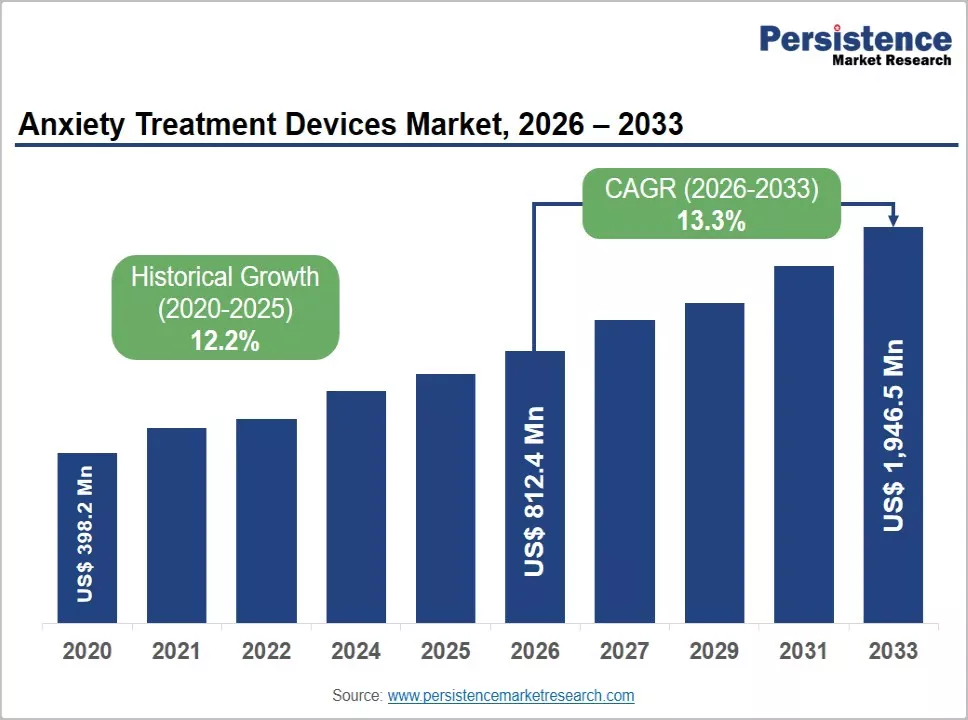
The global anxiety treatment devices market size is likely to be valued at US$812.4 million in 2026 and is estimated to reach US$1,946.5 million by 2033, growing at a CAGR of 13.3% during the forecast period from 2026 to 2033, driven by the rising global burden of anxiety disorders, surging demand for drug-free treatment options, wide regulatory clearance of non-invasive neurostimulation devices, and the ongoing shift of mental health care toward home-based and remote delivery models.
Key Industry Highlights:
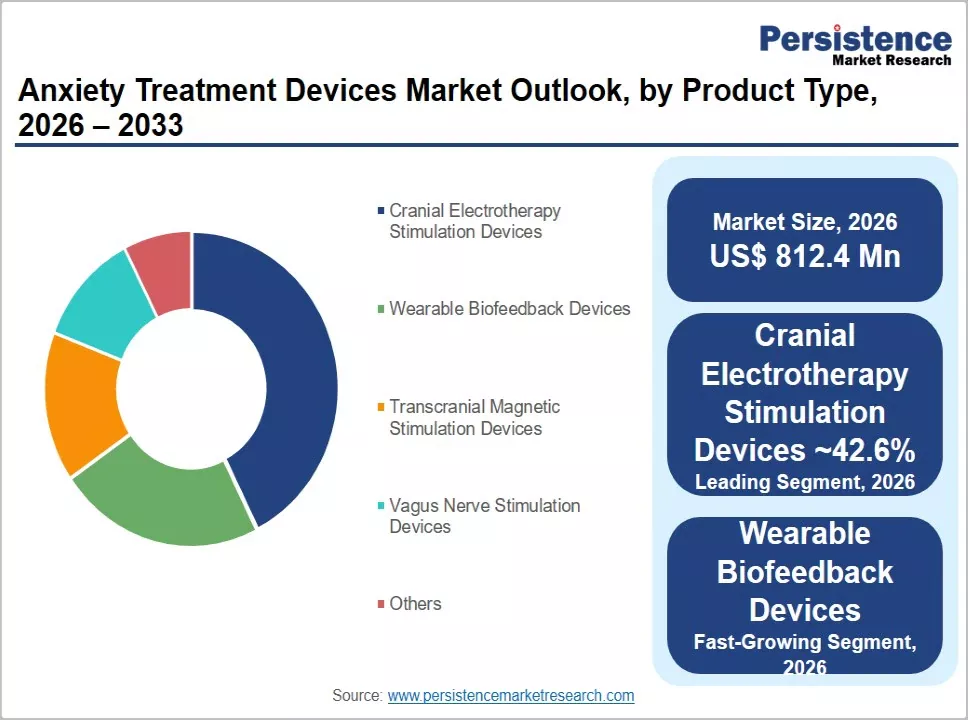
- Leading Product Type: Cranial Electrotherapy Stimulation (CES) devices, about 42.6% share in 2026, as these are compact, backed by long-standing regulatory clearance for anxiety, and suited to daily self-administered use at home.
- Dominant End-User: Homecare settings, around 38.4% share in 2026, as most anxiety devices are designed for short repeated sessions needing no clinical supervision or trained operators.
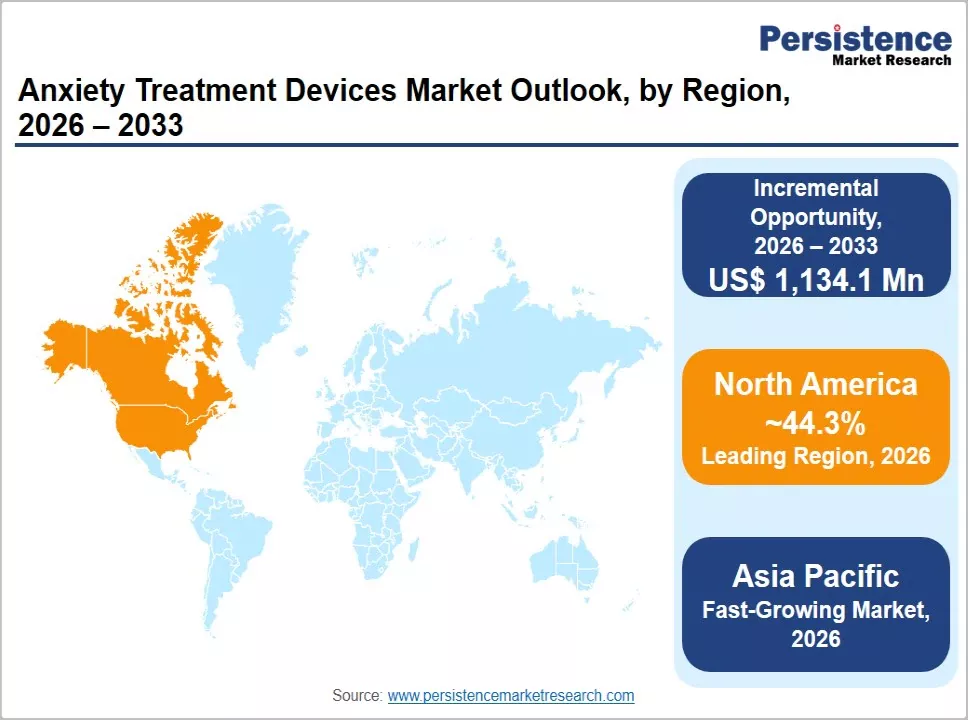
- Leading Region: North America, with about 44.3% share in 2026, owing to its large diagnosed patient pool, established reimbursement pathways for neuromodulation, and an established base of device manufacturers.
- Fast-growing Region: Asia Pacific, as governments expand tele-mental health programs, mental health awareness improves, and non-pharmacological treatment options become more widely available.
- Latest Clearance: In May 2026, Neurovalens received FDA de novo authorization for Modius Spero, the first neuromodulation device authorized to treat symptoms associated with post-traumatic stress disorder. The company said it would reach veterans through the U.S. Department of Veterans Affairs from July 2026.
DRO Analysis
Driver - Growing Anxiety Disorder Burden to Push Demand for Device-based Therapy
The scale of untreated anxiety is creating sustained demand for treatment that can be delivered outside conventional psychiatric care. The World Health Organization (WHO) estimates indicate that about 301 million people worldwide were living with anxiety disorders in 2019, making them the most prevalent class of mental health conditions. Global Burden of Disease analysis shows the affected population grew by more than 55% between 1990 and 2019, while GBD 2021 modelling places prevalence at about 359.2 million cases.
Healthcare institutions in most countries cannot expand therapist capacity at the same pace. This gap is encouraging clinicians to consider devices that can supplement scarce psychological services. Devices also appeal to patients who discontinue medication because of side effects and to those facing long waits for talking therapies, which is widening the addressable population.
Expanding Regulatory Clearance to Boost Clinical Legitimacy
Regulatory authorization is converting anxiety devices from wellness products into prescribable medical treatments. The Food and Drug Administration’s (FDA) 2019 reclassification pathway for devices targeting anxiety and insomnia has allowed several manufacturers to secure clearance on controlled trial evidence. Neurovalens obtained clearance for its Modius Stress headband for generalized anxiety disorder after two pivotal trials run by Ulster University and the Indian Center of Neurophysiology.
Clearance decisions in adjacent indications are reinforcing the trend. In December 2025, the FDA approved Flow Neuroscience's FL-100 transcranial direct current stimulation system for major depressive disorder, the first at-home prescription neuromodulation therapy authorized in the U.S. Roughly 58% of trial participants achieved remission after 10 weeks. The company has signalled interest in further conditions, suggesting at-home neurostimulation will likey broaden into anxiety-related indications.
Restraint - Uneven Evidence Quality May Slow Clinical Acceptance
Clinical evidence across the category remains inconsistent, which may limit prescriber confidence and reimbursement decisions. Several consumer vagus nerve stimulation products marketed for stress and anxiety reduction have limited independent peer-reviewed validation, and reviewers have flagged marketing claims that rely on unrelated studies. This makes it harder for clinicians and payers to separate validated devices from wellness products.
Trial design creates further difficulty. Various published studies use open-label cohorts without control groups, small samples, or short follow-up. A 2026 real-world evaluation of at-home cranial electrotherapy stimulation reported anxiety and depression remission rates of 72.3% and 71.2%, but such designs cannot fully separate device effects from expectancy effects. Blinding is hard in neurostimulation, where users may perceive the current. Until larger randomized trials accumulate, adoption will remain uneven.
Opportunity - At-home Prescription Devices to Expand Treatment Access
The shift toward prescription devices used at home is the most significant commercial opportunity in this market. Clinic-based neuromodulation such as transcranial magnetic stimulation requires repeated visits, dedicated equipment, and trained staff, restricting throughput and raising cost per patient. Home-use devices remove most of those constraints and allow daily sessions of 20 to 60 minutes without occupying clinical time.
Pricing is also becoming more accessible. Flow Neuroscience's headset is expected to retail at around US$500 to US$800 in the U.S., and the company has said it is discussing coverage with insurers. It has reported more than 55,000 users across Europe, the U.K., Switzerland, and Hong Kong. An installed base of that size builds real-world safety records and creates recurring revenue from replacement electrodes and subscriptions.
Integration with Digital Therapeutics to Create New Revenue Models
Combining hardware with software is opening a second opportunity beyond device sales. Devices that pair stimulation with a companion app can record adherence, collect GAD-7 or PHQ-9 scores, and adjust protocols over time. This converts a one-time purchase into a monitored care pathway that clinicians can review remotely, which appeals to payers evaluating outcomes rather than equipment.
Government tele-mental health infrastructure is making this integration practical. India's Tele MANAS program, launched in October 2022 under the National Mental Health Programme, had handled more than 29.82 lakh calls by November 2025 and operates 53 cells in 20 languages. Programs of this scale create a triage layer that can refer suitable patients toward device-based treatment, favoring manufacturers able to supply validated outcome data.
Category-wise Analysis
Product Type Insights
Cranial electrotherapy stimulation devices are predicted to lead with a share of about 42.6% in 2026, as they combine a long regulatory history for anxiety with a form factor suited to daily home use. Alpha-Stim, for example, is a handheld unit about the size of a mobile phone that delivers a microcurrent through ear-clip electrodes over 20 to 60 minutes. NICE has noted that people using Alpha-Stim AID have a low risk of side effects, and the device has been deployed in NHS primary care and social prescribing services.
Wearable biofeedback devices are estimated to be the fastest-growing segment over the forecast period, as they extend treatment into everyday settings and generate continuous physiological data rather than a fixed session record. These products typically track heart rate variability, respiration, or electrodermal activity and deliver haptic or breathing-guided interventions in response. Consumer familiarity with wearables and lower price points relative to prescription neurostimulation are broadening their appeal.
End User Insights
Homecare settings are anticipated to dominate with a share of around 38.4% in 2026, as treatment protocols for most anxiety devices are short, repetitive, and self-administered. A patient using a CES device or stimulation headband typically completes one daily session and needs no assistance beyond initial instruction. This suits chronic conditions such as generalized anxiety disorder, and home use also reduces barriers of travel, scheduling, and stigma.
Hospitals and specialty clinics are expected to remain in the second position in 2026, as they retain the higher-acuity segment of the market. Transcranial magnetic stimulation systems and patients with comorbid depression or treatment-resistant presentations still require supervised delivery. Clinics also serve as the diagnostic gateway, since prescription devices require clinician assessment, so clinical channels influence home-device volumes as well.
Regional Insights
North America Anxiety Treatment Devices Market Trends
North America is predicted to dominate in 2026 globally with a share of approximately 44.3%, because it combines a large diagnosed patient base with an established regulatory and commercial pathway for prescription neuromodulation. NIMH data indicate that an estimated 19.1% of U.S. adults had any anxiety disorder in the past year and about 31.1% experience one at some point in life, with higher past-year prevalence among women at 23.4% versus 14.3% among men. The region also hosts most of the category's leading manufacturers.
U.S. Anxiety Treatment Devices Market Trends
A share of nearly 63.5% is expected to be held by the U.S. in 2026 in North America, as it has the largest concentration of cleared anxiety devices, active clinical programs, and payer engagement. Generalized anxiety disorder alone affects an estimated 6.8 million American adults, more than 3% of the population. Institutional demand is also expanding. The Department of Veterans Affairs is scheduled to make Neurovalens' Modius Spero available to veterans from July 2026, showing that federal health systems are willing to procure neuromodulation devices at scale.
Asia Pacific Anxiety Treatment Devices Market Trends
Asia Pacific is anticipated to be the fastest-growing region, as mental health services are expanding rapidly from a low base while awareness improves across urban populations. GBD projections indicate that middle and low SDI countries will account for most global anxiety cases, with worldwide prevalence projected to exceed 515 million by 2040. The region's shortage of psychiatrists makes scalable, non-specialist-delivered treatment particularly relevant.
China Anxiety Treatment Devices Market Trends
China will likely lead in Asia Pacific in 2026 with a regional share of about 36.4%, supported by a large population base, expanding mental health service capacity, and a substantial domestic device manufacturing sector. Demand is also shaped by workplace stress and academic pressure among younger cohorts, who are more willing to adopt technology-based interventions. Domestic manufacturers can produce stimulation and biofeedback hardware at competitive cost, while hospital procurement and e-commerce give suppliers two parallel routes to patients.
India Anxiety Treatment Devices Market Trends
In 2026, India is projected to account for a regional share of about 24.7% in Asia Pacific, as the country has a very large affected population combined with a severe treatment gap. Global Burden of Disease estimates suggest nearly 197 million Indians, roughly one in seven, live with some form of mental disorder, while WHO has calculated economic losses of about US$1.03 trillion between 2012 and 2030. Tele MANAS handled more than 12.33 lakh calls in 2025 alone, with nearly 70% of callers aged 18 to 45. India has also hosted pivotal trial work supporting Modius Stress.
Europe Anxiety Treatment Devices Market Trends
Europe will witness steady growth over the forecast period with a global share of roughly 21.6% in 2026 globally, because publicly funded health systems are seeking cost-effective alternatives to long waiting lists for psychological therapy. Around 61.5 million people in Europe are estimated to experience anxiety disorders annually. Health technology assessment bodies also provide a structured route for devices to enter clinical pathways, giving manufacturers a clearer evidence target.
Germany Anxiety Treatment Devices Market Trends
Germany is predicted to register a substantial regional share of approximately 32.9% in 2026 in Europe, as it has a large diagnosed population and a reimbursement framework that already accommodates digital health applications. Robert Koch Institute panel data for 2024 found that about 14% of adults showed anxiety symptoms on the GAD-7 measure, while 8% had moderately severe to severe symptoms. The burden was highest among young women, 47% of whom showed depressive or anxiety symptoms.
U.K. Anxiety Treatment Devices Market Trends
A regional share of nearly 24.1% is predicted to be held by the U.K. in 2026, because cranial electrotherapy stimulation has already been trialed within NHS services rather than confined to private purchase. Alpha-Stim has been deployed through primary care and social prescribing routes, with cohort studies reporting reliable improvement and remission rates of 53.39% and 33.3% on the GAD-7 measure after six weeks. Researchers have argued the treatment cost falls well below NICE cost-effectiveness thresholds.
Competitive Landscape
The global anxiety treatment devices market is fragmented and rapidly evolving, with competition split between established neurostimulation manufacturers, venture-backed startups, and wellness brands moving toward regulated indications. Electromedical Products International, Neurovalens, Fisher Wallace Laboratories, BrainsWay, Neuronetics, electroCore, Magstim, and MagVenture compete on regulatory status, clinical evidence, and price. Clearance for a specific psychiatric indication remains the primary differentiator, since it determines whether a product can be prescribed and reimbursed.
Strategy is also shifting from single-device sales toward treatment platforms. Companies are building app-based protocol management, adherence tracking, and outcome measurement around their hardware, and several are pursuing sequential clearances across anxiety, insomnia, depression, and PTSD from a shared technology base. Neurovalens has followed this route with Modius Sleep, Modius Stress, and Modius Spero. Institutional procurement is becoming an important route to volume alongside direct-to-patient sales.
Key Industry Developments
- In July 2026, the FDA selected SonderMind's Adjunctive Care Application for its TEMPO digital-health-device pilot, evaluating a smartphone-based intervention intended to reduce depression and anxiety in adults receiving psychotherapy and/or pharmacotherapy. The pilot is designed to generate real-world evidence for digital health devices used in behavioral healthcare.
- In April 2026, Emory University initiated the Temporal Interference in Psychiatry (TIP) study, investigating temporal-interference electrical stimulation for anxiety and PTSD-related conditions. The planned study includes up to 300 participants and will examine neural, behavioral, and clinical effects using MRI, EEG, physiological measures, and clinical assessments.
- In January 2026, a systematic review of wearable devices for anxiety assessment was published in Communications Medicine, covering technologies that use physiological signals to identify anxiety-related states. The review shows growing research interest in wearable sensing as a way to capture anxiety-related physiological changes outside conventional clinical assessments.
Companies Covered in Anxiety Treatment Devices Market
- Electromedical Products International, Inc. (Alpha-Stim)
- Neurovalens Ltd.
- Fisher Wallace Laboratories
- Apollo Neuroscience, Inc.
- BrainsWay Ltd.
- Neuronetics, Inc.
- electroCore, Inc.
- Magstim Company Limited
- MagVenture A/S
- Flow Neuroscience AB
- Freespira, Inc.
- Nexalin Technology, Inc.
- Sooma Oy
- BioSelf Technology Ltd. (Sensate)
- Hoolest Inc.
- Others
Frequently Asked Questions
The global anxiety treatment devices market is projected to be valued at US$812.4 million in 2026.
The market is expected to reach US$1,946.5 million by 2033.
Key market trends include at-home prescription neurostimulation, app-integrated treatment protocols, wearable biofeedback, and sequential clearances across psychiatric indications.
Cranial electrotherapy stimulation devices are expected to be the leading product type with a share of around 42.6% in 2026, as their compact design makes daily home treatment practical.
The market is expected to grow at a CAGR of 13.3% from 2026 to 2033.
Electromedical Products International, Inc., Neurovalens Ltd., and Fisher Wallace Laboratories are a few key market players.


