




- Medical Devices
- Moist Wound Dressings Market
Moist Wound Dressings Market Size, Share, and Growth Forecast 2026 - 2033
Moist Wound Dressings Market by Product (Foam Dressings, Alginate Dressings), Application (Burn Wounds, Pressure Ulcers, Diabetic Foot Ulcers), End User (Hospitals, Homecare Settings), and Regional Analysis, 2026 - 2033

Moist Wound Dressings Market Size and Trend Analysis
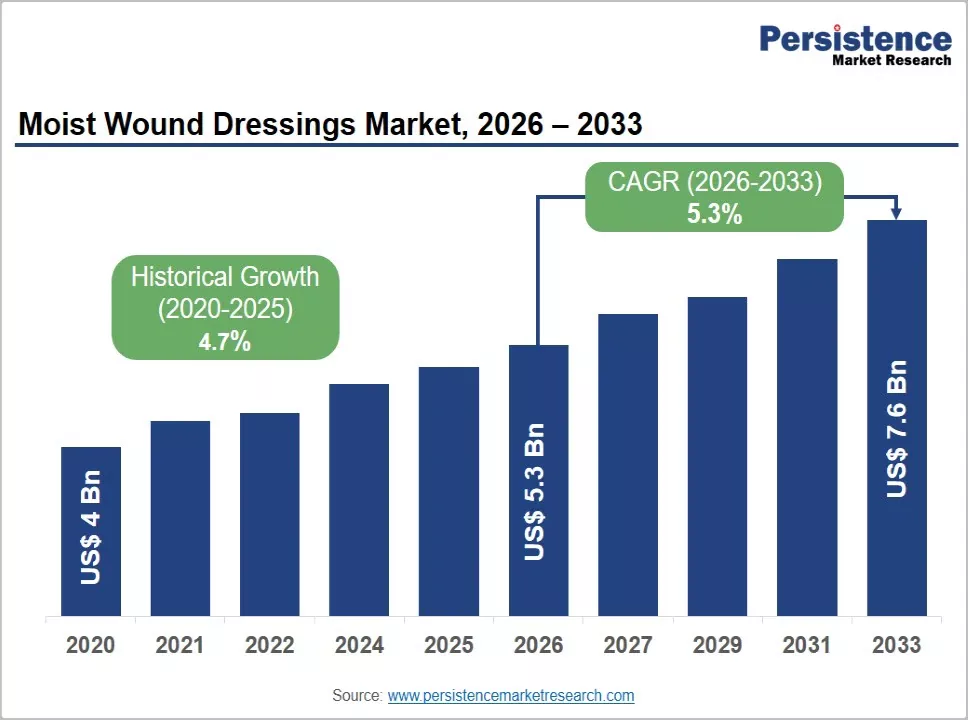
The global moist wound dressings market size is likely to be valued at US$ 5.3 billion in 2026 and is projected to reach US$ 7.6 billion by 2033, growing at a CAGR of 5.3% during the forecast period between 2026 and 2033.
Moist wound healing is now the clinical standard of care for chronic and complex wounds, and that consensus has turned advanced dressings from a discretionary purchase into a core consumable of hospital and community care. Rising diabetes, an ageing population, and pressure-injury prevention targets are enlarging the patient pool, while health systems demand products that reduce dressing-change frequency and nursing time. This is a durable, evidence-driven growth category in which differentiation rests on exudate management, skin-friendly adhesion, and proven healing outcomes rather than on price alone.
Key Industry Highlights
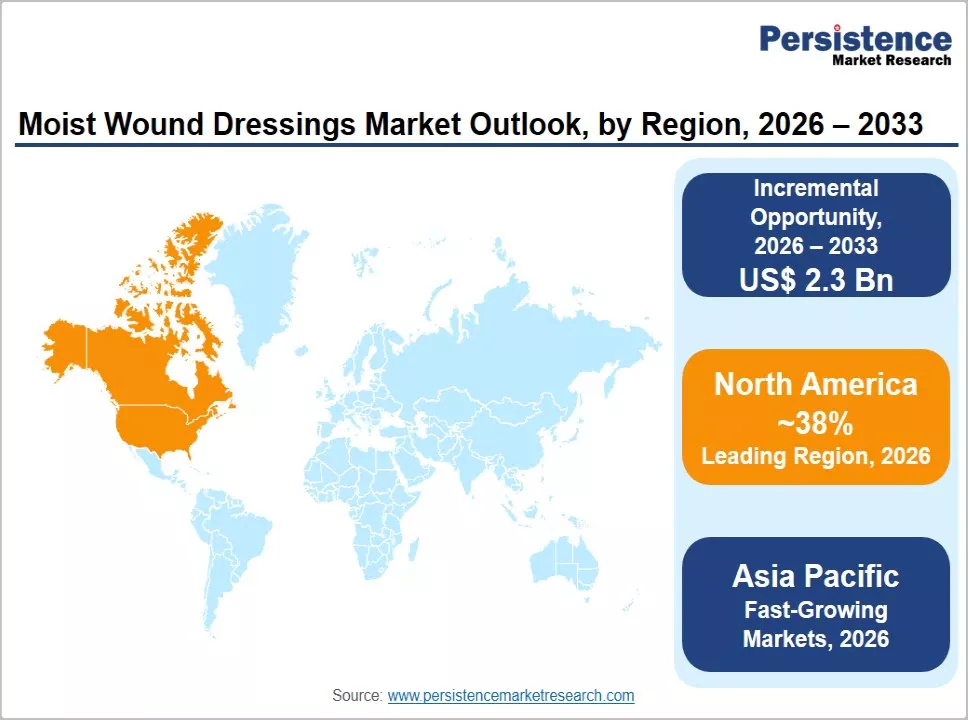
- Dominant Region: North America holds 38% of the moist wound dressings market in 2026, supported by high diabetes and pressure-injury prevalence, established reimbursement in hospitals and home health, and early adoption of premium silicone-adhesive foams and antimicrobial products. Quality metrics penalizing hospital-acquired pressure injuries sustain demand for preventive dressings.
- Fastest-growing Region: Asia Pacific is projected to expand at an estimated 7.2% CAGR through 2033, driven by rapidly growing diabetic and elderly populations in China, India, and Japan, expanding hospital capacity, and growing localization of advanced dressing manufacturing by global suppliers.
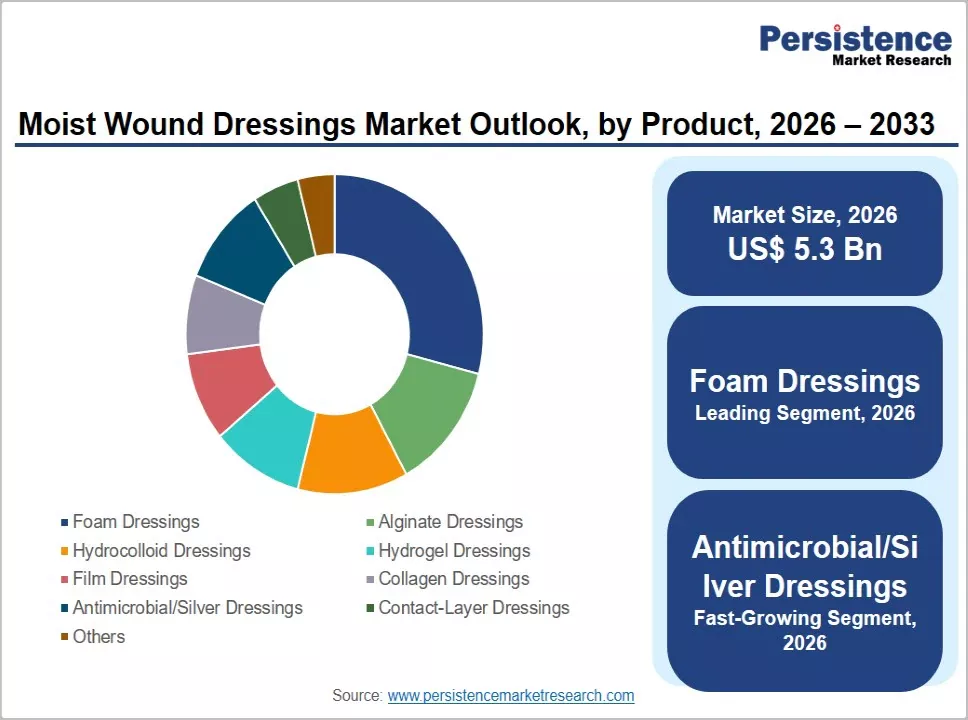
- Leading Product: Foam dressings account for roughly 29% of 2026 revenue, thanks to high absorbency, cushioning, and suitability for pressure-injury prevention and moderate-to-heavy exudate wounds. Smith+Nephew’s ALLEVYN COMPLETE CARE and Convatec’s ConvaFoam typify a new wave of multi-layer designs with longer wear time.
- Fastest-growing Product and Emerging Opportunity: Antimicrobial and silver dressings are the fastest-growing product group as clinicians focus on biofilm and antimicrobial stewardship in hard-to-heal wounds. Convatec’s nitric oxide-generating ConvaNiox dressing exemplifies a shift from broad metal-based antimicrobials towards novel mechanisms with strong clinical data.
DRO Analysis
Driver - Rising Prevalence of Diabetes, Pressure Injuries, and Chronic Wounds
Chronic wounds are increasingly common as populations age and diabetes spreads, with the International Diabetes Federation estimating well over 580 million adults living with the disease globally. Diabetic foot ulcers, venous leg ulcers, and pressure injuries require prolonged care, and moist wound environments accelerate healing, reduce pain, and lower infection risk compared with traditional dry gauze.
Health systems are also tying reimbursement to pressure-injury prevention and healing outcomes, which favors advanced dressings with clinical evidence. Suppliers with broad portfolios and strong clinician education, including Smith+Nephew, Convatec, Mölnlycke Health Care, and Coloplast, hold a defensible position as procurement shifts toward outcome-based value.
Restraint - Cost Sensitivity, Reimbursement Limits, and Product Substitution
Advanced moist dressings cost considerably more per unit than traditional gauze, and reimbursement rules in many countries limit coverage or require documentation that burdens clinicians. Hospital value-analysis committees and group purchasing organizations negotiate aggressively, driving price compression for standard foams and hydrocolloids.
Negative pressure wound therapy, skin substitutes, and cellular and tissue-based products compete for the same wound-care budgets, and evolving payment policies for skin substitutes add uncertainty. Gaps in clinician training in developing markets also slow the replacement of traditional dressings with moist healing products.
Opportunity - Home-care Migration, Antimicrobial Innovation, and Emerging-market Expansion
Care is steadily moving from hospitals to homes and outpatient clinics, creating demand for long-wear, easy-to-apply dressings that reduce visits by community nurses. Smith+Nephew and Convatec used the European Wound Management Association conference in Bremen in May 2026 to showcase products aimed at these settings, including pumps and dressings designed for lighter, simpler use. Innovation in nitric oxide, collagen, and biofilm-targeting technologies offers premium pricing opportunities, while investment in local manufacturing, such as Mölnlycke’s reported Shanghai joint venture with Zhende Medical, positions suppliers for fast-growing Asian demand.
Category-wise Analysis
Why Do Foam Dressings Command the Largest Share of the Global Moist Wound Dressings Market?
Foam dressings are projected to lead the segment, holding nearly 29% of market share in 2026. Their absorbent, cushioning structure manages moderate-to-heavy exudate while maintaining a moist environment, and silicone-bordered versions allow atraumatic removal and repositioning. Smith+Nephew’s ALLEVYN COMPLETE CARE, a five-layer foam with ExuLOCK, ExuMASK, and ShearDEFENSE technologies, launched first in the U.S. and made its global debut at the European Wound Management Association conference in May, while Convatec combines Hydrofiber, superabsorber fibers, and silicone adhesion in ConvaFoam. These innovations support higher prices through longer wear times and fewer dressing changes.
Antimicrobial and silver dressings are likely to be the fastest-growing product segment, propelled by the clinical priority on infection control in diabetic foot ulcers and venous leg ulcers. Convatec’s ConvaNiox uses nitric oxide to deliver antimicrobial and antibiofilm activity, and Urgo Medical continues to advance its TLC-NOSF matrix technology. Hydrocolloid, alginate, hydrogel, film, collagen, and contact-layer dressings maintain strong niche roles, with Mölnlycke’s Safetac-based contact layers and Coloplast’s hydrocolloid products widely used in community care.
Application Insights
What Is Driving Diabetic Foot Ulcer Dominance Across the Moist Wound Dressings Industry?
Diabetic foot ulcers are expected to lead the segment, holding about 29% of market share in 2026, because they are among the most resource-intensive chronic wounds and require prolonged, repeated dressing use. Diabetes prevalence continues to rise globally, and ulcer recurrence rates are high, which creates continuous demand. Clinical programs at ConvaTec, Smith+Nephew, and Mölnlycke emphasize moist healing combined with offloading, infection control, and negative pressure therapy, and group purchasing organizations typically include foam, alginate, and antimicrobial dressings in diabetic foot care pathways.
Pressure ulcers are likely to be the fastest-growing application segment, driven by regulatory and payer penalties for hospital-acquired pressure injuries and a strong shift towards prevention. Prophylactic multi-layer foam dressings applied to the sacrum and heels are now widely adopted in intensive care and long-term care units. Burn wounds, surgical and traumatic wounds, and venous leg ulcers remain sizable applications, supported by dressings from Hartmann Group, Lohmann & Rauscher GmbH, B. Braun, and Cardinal Health for acute and post-operative care.
Regional Insights
North America Moist Wound Dressings Market Trends and Insights
North America is expected to account for around 38% of the moist wound dressings market share in 2026. The region’s demand is anchored by a large population with diabetes, an ageing demographic, and payer programs that penalize hospital-acquired pressure injuries. Medicare reimbursement frameworks and group purchasing contracts shape product selection, and the growing home-health sector is increasing the use of long-wear dressings.
U.S. Moist Wound Dressings Market Size
The U.S. is estimated to hold around 90% of the North America regional market in 2026. Hospitals, skilled nursing facilities, and home-health agencies are the principal buyers, and suppliers such as Smith+Nephew, 3M’s health care business, Convatec, Mölnlycke, and Cardinal Health compete for contracts. Smith+Nephew launched ALLEVYN COMPLETE CARE in the U.S. before introducing it in Europe.
Canada Moist Wound Dressings Market Size
Canada is expected to account for over 10% of the North America regional market in 2026. Provincial health programs fund wound care in hospitals and community nursing, and the ageing population is increasing chronic wound caseloads. Procurement through regional purchasing groups places emphasis on cost-effectiveness and clinical evidence.
Europe Moist Wound Dressings Market Trends and Insights
Europe is anticipated to command around 19% of the moist wound dressings market in 2026. The region has a high prevalence of chronic wounds linked to ageing, strong clinical guidance from bodies such as the European Wound Management Association, and a home base for leading suppliers including Mölnlycke, Coloplast, Hartmann, Urgo, and Essity. Public health systems apply tight cost controls, but evidence-based formularies reward innovative products with documented outcomes.
Germany Moist Wound Dressings Market Size
Germany is projected to account for around 26% of the Europe regional market in 2026. Statutory health insurance covers advanced dressings under strict criteria, and domestic companies such as Hartmann Group, Lohmann & Rauscher GmbH, and B. Braun supply hospital and community channels. Specialized wound centers drive adoption of antimicrobial and foam products.
U.K. Moist Wound Dressings Market Size
The U.K. is estimated to account for nearly 17% of the Europe regional market in 2026. National Health Service community nursing is a major dressing purchaser, and national formularies and procurement frameworks emphasize value and clinical evidence. Smith+Nephew, headquartered in the country, plans to extend its newest foam line into the European market during 2026.
Which Region Will Drive the Fastest Moist Wound Dressings Growth Through 2033?
Asia Pacific is forecast to be the fastest-growing region, capturing around 22% of market share in 2026 and expanding at an estimated 7.2% CAGR through 2033. The region’s expanding diabetic and elderly populations, rising hospital capacity, and growing adoption of international wound-care guidelines are broadening the market for advanced dressings. Global suppliers are partnering with local firms and building regional production to serve price-sensitive buyers.
China Moist Wound Dressings Market Size
China is projected to hold 41% of the Asia Pacific regional market in 2026. Volume-based procurement and local manufacturing capabilities are reshaping competition, and global suppliers are responding with joint ventures, including Mölnlycke’s Shanghai-based wound care venture with Zhende Medical announced in May 2026. Rising demand for diabetic foot and pressure ulcer care underpins growth.
India Moist Wound Dressings Market Size
India is expected to account for around 14% of the Asia Pacific regional market in 2026. The country has one of the world’s largest diabetic populations, and private hospital chains are increasingly using advanced dressings, although traditional gauze remains common in public facilities. Local manufacturers and distributors are expanding foam and hydrocolloid offerings at accessible price points.
Competitive Landscape
The global moist wound dressings market is moderately consolidated, with a group of multinational medical technology companies controlling hospital contracts and a long tail of regional manufacturers in standard dressings. Smith+Nephew, Mölnlycke Health Care, Convatec, Coloplast, and 3M’s health care business lead through broad portfolios that pair foam, hydrocolloid, and antimicrobial dressings with negative pressure systems.
Essity AB, Cardinal Health, B. Braun, Johnson & Johnson, Lohmann & Rauscher GmbH, Hartmann Group, Urgo Medical, and Hollister hold strong positions in specific channels and product niches. Competition is shifting from price toward clinical evidence, wear time, and integrated solutions, and winning requires clinician education, supply reliability, and outcomes data that satisfy hospital value-analysis committees.
Key Industry Developments
- In January 2025, Beiersdorf launched Second Skin Protection, a next-generation plaster featuring advanced hydrocolloid technology under its Hansaplast, Elastoplast, and CURITAS brands. The company introduced the product to provide professional-grade wound care for everyday minor injuries while improving consumer awareness of effective wound-healing practices. The plaster absorbed wound fluid and formed a protective healing capsule that maintained a moist environment to support tissue regeneration.
Companies Covered in Moist Wound Dressings Market
- Smiths Group
- Molnlycke Health Care
- 3M (Health Care)
- Convatec
- Coloplast
- Essity AB (BSN medical)
- Cardinal Health
- B. Braun
- Medtronic plc (Acelity/KCI)
- Johnson & Johnson
- Lohmann & Rauscher GmbH
- Hartmann Group
- Urgo Medical
- Hollister
Frequently Asked Questions
The global moist wound dressings market is valued at US$ 5.3 billion in 2026.
The rising prevalence of diabetes, pressure injuries, and chronic wounds, the clinical consensus favoring moist wound healing, payer pressure to prevent hospital-acquired injuries, and innovation in long-wear and antimicrobial dressings.
Foam dressings hold around 29% of the market. Their absorbency, cushioning, and silicone-adhesive designs suit moderate-to-heavy exudate wounds and pressure-injury prevention, and newer multi-layer versions offer longer wear times.
North America leads with a 38% share in 2026, driven by high diabetes and pressure-injury prevalence, established reimbursement, and early adoption of premium dressings across hospitals and home health.
The largest opportunities are home-care and outpatient wound management, novel antimicrobial technologies such as nitric oxide, and local manufacturing and partnerships to serve fast-growing Asian markets.
Leading companies include Smith+Nephew, Mölnlycke Health Care, Convatec, Coloplast, and 3M’s health care business. The market is moderately consolidated, with competition shifting towards clinical evidence and integrated solutions.


