




- Medical Devices
- Percutaneous Surgical System Market
Percutaneous Surgical System Market Size, Share, and Growth Forecast 2026 - 2033
Percutaneous Surgical System Market by Surgery Type (Invasive Surgery, Minimally Invasive Surgery), Application (Nephrolithotomy, Coronary Intervention, Endoscopic Gastrostomy, Stenosing Tenosynovitis, Bunionectomy, Others), End-User (Hospital, Ambulatory Surgical Centers, Specialty Clinics, Others), and Regional Analysis for 2026 - 2033

Percutaneous Surgical System Market Size and Trends Analysis
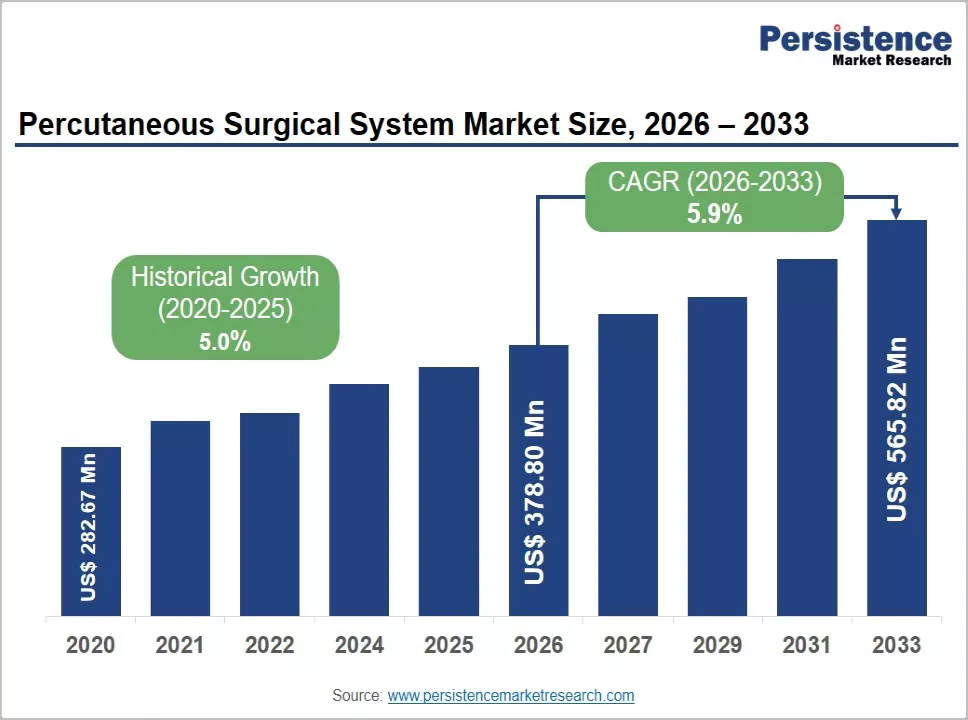
The global percutaneous surgical system market is expected to be valued at US$ 378.80 million in 2026 and is projected to reach US$ 565.82 million by 2033, growing at a CAGR of 5.9% during the forecast period from 2026 to 2033.
This growth trajectory reflects sustained clinical adoption across renal, cardiovascular, and orthopedic indications. The U.S. Centers for Medicare & Medicaid Services (CMS) has progressively expanded coverage for minimally invasive percutaneous procedures, lowering financial barriers to adoption at the health system level and supporting procedural volume growth across North American hospitals and ambulatory surgical centers.
Key Industry Highlights
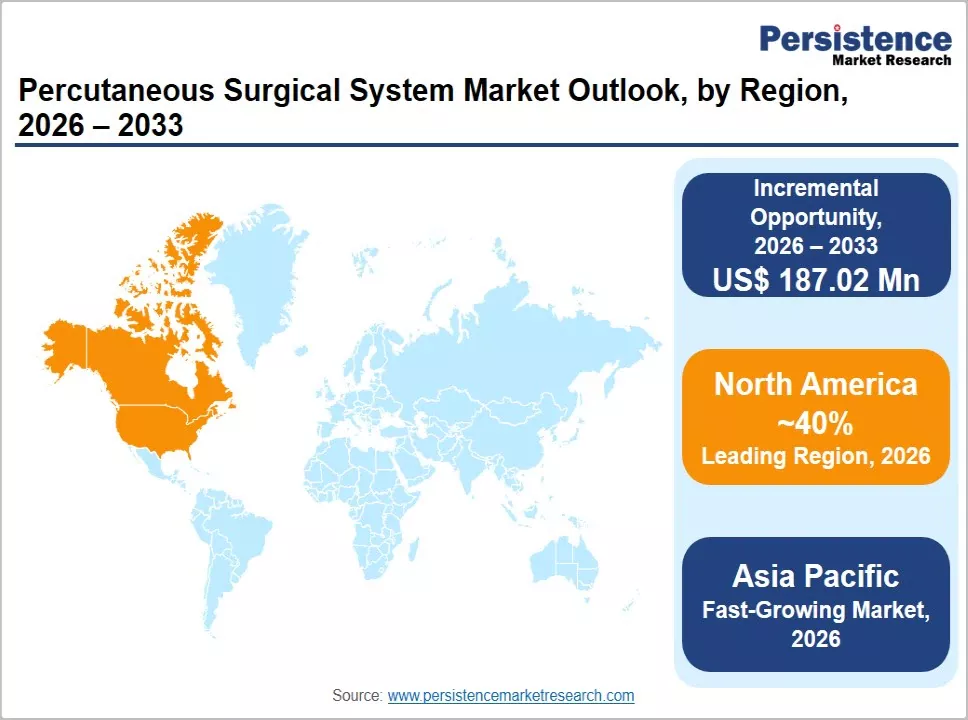
- Leading Region: North America is expected to dominate the market, accounting for 40.0% of the market share in 2026, supported by its extensive reimbursement framework for interventional medicine. CMS expansions of the Ambulatory Surgical Center (ASC) Covered Procedures List in 2023–2024 indicate growing opportunities for outpatient procedural volumes, supporting the region's market leadership through 2033, even as Asia Pacific narrows the gap in absolute market value.
- Dominant Surgery Type: Minimally invasive surgery leads the surgery type segment, holding a 40.0% share of the percutaneous surgical system market. Its leading position reflects the transition away from open surgical approaches across urology, cardiology, and orthopedics. Manufacturers offering mini-PCNL and radial-access coronary systems are well-positioned to capture incremental market share.
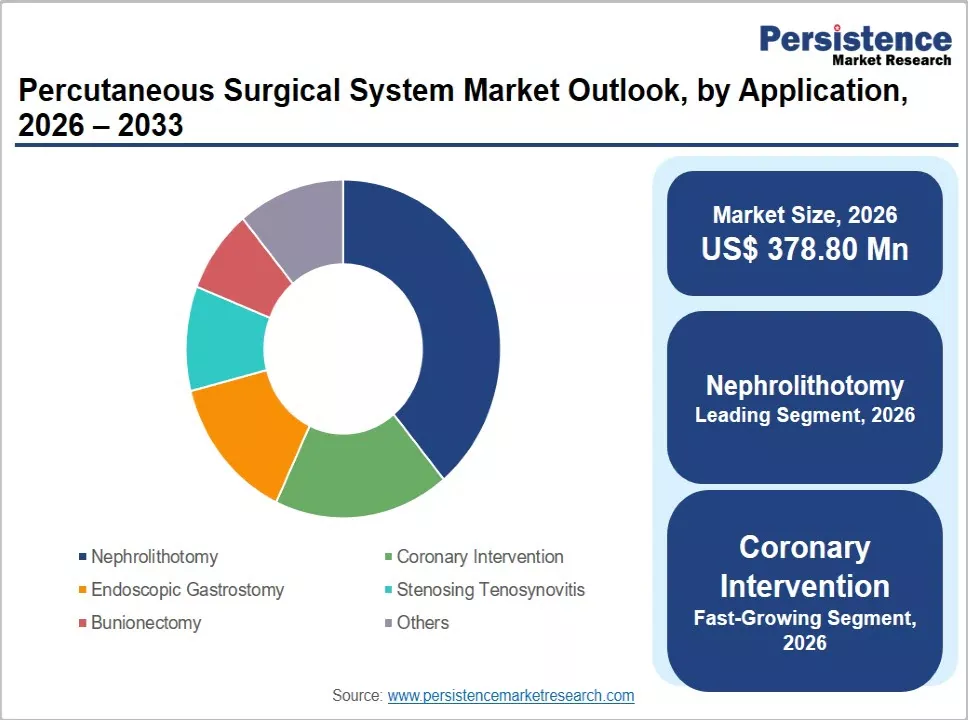
- Leading Application: Nephrolithotomy accounts for a 39.0% market share, equivalent to US$ 147.73 million in 2026, reflecting the global burden of kidney stone disease documented by the NIDDK and the clinical importance of percutaneous approaches for treating complex calculi. This application is expected to remain the largest demand contributor to the percutaneous surgical system market throughout the forecast period.
- Key Market Opportunity: Robotic-assisted percutaneous access represents a significant long-term opportunity, supported by advances in image-guided procedures and robotic-assisted navigation. Developments in image-guided nephrostomy and Intuitive Surgical's bronchoscopic platform demonstrate the broader potential of technology-assisted access systems. Manufacturers securing early regulatory clearances and clinical outcomes data in this segment are positioned to command premium pricing and establish competitive advantages over traditional access kit suppliers.
Market Dynamics
Driver - Rising Prevalence of Urolithiasis and the Clinical Case for Percutaneous Nephrolithotomy
Kidney stone disease affects an estimated 11% of men and 6% of women in the United States, according to the National Institute of Diabetes and Digestive and Kidney Diseases (NIDDK). As stone burden rises because of dietary patterns, obesity, and inadequate hydration, urologists increasingly rely on percutaneous nephrolithotomy as a preferred intervention for large or complex calculi that extracorporeal shock wave lithotripsy alone does not effectively manage.
The precision of needle-tract dilation systems, combined with single-use nephroscope platforms introduced by companies including Boston Scientific Corporation between 2022 and 2024, has supported procedural efficiency and infection control. Health systems are therefore increasingly incorporating standardized percutaneous access kits into formal stone disease treatment pathways, reinforcing sustained demand across the percutaneous surgical system market.
Restraint - Device Complexity and The Credentialing Barrier To Adoption
Percutaneous procedures require fluoroscopic or ultrasound guidance, real-time tract management, and instrument-specific tactile skills that differ considerably from open or laparoscopic techniques. Hospitals in lower-resource settings frequently face challenges in maintaining the specialist training volumes and supervised procedural experience required for safe program delivery. The Society of Interventional Radiology (SIR) provides professional guidance on training and competency requirements, while limited access to experienced specialists and adequate procedural volumes restricts adoption. These competency and infrastructure requirements limit market penetration beyond tertiary referral centers and constrain the expansion of the percutaneous surgical system market into community hospital settings.
Opportunity - Single-Use Percutaneous Access Systems Addressing Reprocessing Liability
Hospital infection control teams and risk managers are increasingly receptive to single-use percutaneous access platforms that eliminate instrument reprocessing requirements and reduce cross-contamination risks. Olympus Corporation and KARL STORZ SE & Co. KG have expanded their single-use endoscopy and access device portfolios, responding to procurement demand for sterile, ready-to-use instruments. For manufacturers in the percutaneous surgical system market, single-use designs also support value-based contracting structures and bundled episode pricing that align with hospital CFO priorities in cost-constrained healthcare systems.
Category-Wise Analysis
Why Does Minimally Invasive Surgery Command the Largest Share of the Percutaneous Surgical System Market?
Minimally invasive surgery is projected to dominate the surgery type segment, accounting for a 40.0% market share in 2026. Its dominance reflects a fundamental shift in surgical practices, as clinicians and hospital administrators increasingly prioritize approaches that reduce anesthesia exposure, shorten inpatient stays, and lower postoperative complication risks. In practice, this includes urologists performing percutaneous nephrolithotomy through mini-PCNL access sheaths with diameters of 14–20 French rather than standard 30 French tracts, and interventional cardiologists managing coronary lesions through radial artery access techniques that rely on specialized percutaneous access and delivery components.
Minimally invasive surgery is also likely to be the fastest-growing segment. A key growth catalyst is the expansion of outpatient-eligible percutaneous procedures following CMS Ambulatory Surgical Center (ASC) Covered Procedures List expansions in 2023 and 2024, which increased coverage for selected urological and orthopedic interventions. Teleflex Incorporated has expanded its access system portfolio to serve different procedural requirements, including outpatient settings, extending the addressable market beyond inpatient operating rooms.
Application Insights
Nephrolithotomy is expected to lead the application category, holding nearly 39% of the market share in 2026. Its leading position reflects the prevalence of urolithiasis and the clinical importance of percutaneous renal access in treating large and complex kidney stones. Percutaneous nephrolithotomy remains a preferred treatment option for many calculi exceeding 20 mm, particularly staghorn stones and complex collecting system anatomies. Urological departments at academic medical centers, including institutions participating in American Urological Association (AUA) quality improvement initiatives, increasingly incorporate standardized percutaneous nephrolithotomy kits into treatment pathways, supporting consistent institutional procurement.
Coronary intervention is likely to be the fastest-growing application in the percutaneous surgical system market. Growth is supported by rising volumes of complex, high-risk percutaneous coronary interventions, including chronic total occlusion (CTO) procedures that require specialized guide catheter extensions and microcatheter systems. Boston Scientific Corporation's AGENT™ Drug-Coated Balloon, which received FDA approval in February 2024 for the treatment of in-stent restenosis, exemplifies innovation in the coronary intervention segment and supports the expanding range of devices used in percutaneous procedures worldwide.
End-User Insights
Hospitals are projected to be the leading end-user, accounting for a 55.0% market share in 2026. Their leading position reflects the capital-intensive infrastructure required for percutaneous procedures, including fluoroscopy suites, catheterization laboratories, and sterile processing departments, which are concentrated primarily within hospital settings. Large academic and tertiary referral hospitals account for a substantial proportion of complex percutaneous case volumes. Institutions such as those within the Mayo Clinic Health System and Cleveland Clinic enterprise maintain specialized interventional nephrology and structural heart programs that generate consistent demand for high-value devices across multiple percutaneous system categories.
Ambulatory surgical centers (ASCs) are likely to be the fastest-growing end-user segment. The enabling factor is regulatory and reimbursement-related: CMS expansions of the ASC Covered Procedures List in 2023–2024 increased the range of eligible outpatient procedures, supporting the development of percutaneous interventions in ambulatory settings. Stryker's investment in ASC-oriented orthopedic instruments, including systems used for procedures such as trigger finger release and bunionectomy under local anesthesia, addresses growing demand in outpatient surgical settings and supports broader adoption of percutaneous surgical platforms.
Regional Analysis
North America Percutaneous Surgical System Market Trends And Insights
North America is expected to dominate the global market, capturing nearly 40% market share in 2026. This leadership reflects strong institutional infrastructure, including high hospital bed density, established interventional cardiology and urology programs, and an extensive reimbursement framework. The American College of Cardiology (ACC) and American Urological Association (AUA) clinical guidelines support the use of percutaneous procedures across appropriate indications, creating consistent procedural volumes and a well-established procurement environment for system manufacturers.
U.S. Percutaneous Surgical System Market Size
The U.S. is anticipated to dominate the North American market, capturing nearly 90% of the market share in 2026. Demand is supported by the high volume of interventional cardiology and urological procedures performed across the country's approximately 6,000 registered hospitals, according to the American Hospital Association (AHA). Growing physician preference for outpatient percutaneous care is expected to direct incremental procedural volumes toward ASC settings through 2033.
Canada Percutaneous Surgical System Market Size
Canada is expected to command around 10.0% of the North American market share in 2026. Health Canada's medical device review pathways and regulatory initiatives support the introduction of innovative surgical access devices, encouraging multinational manufacturers to expand product availability. Sustained government investment in cardiac procedure capacity across Ontario and British Columbia is expected to support steady market growth throughout the forecast period.
Europe Percutaneous Surgical System Market Trends and Insights
Europe is projected to account for a 28.0% share of the global market in 2026. Demand is shaped by the combination of broad healthcare coverage, which supports procedural access, and compliance requirements under EU MDR 2017/745, which are increasing regulatory and operational costs for medical device manufacturers. These requirements are reshaping the competitive landscape, particularly for smaller manufacturers with limited regulatory resources. Germany and the United Kingdom together represent a substantial proportion of regional market value, reflecting their established interventional specialty infrastructure.
Germany Percutaneous Surgical System Market Size
Germany is expected to account for about 39.0% of the European market share in 2026. Germany's Diagnosis-Related Group (DRG) reimbursement system incentivizes efficient inpatient care and shorter hospital stays, supporting the adoption of percutaneous approaches across urological and cardiovascular indications. Continued investment by university hospitals (Universitätskliniken) in hybrid operating room infrastructure is expected to sustain demand for advanced percutaneous surgical systems through 2033.
U.K. Percutaneous Surgical System Market Size
The U.K. is anticipated to command nearly 25.0% of the European market share in 2026. The National Health Service (NHS) England elective recovery program, designed to address surgical backlogs accumulated during 2020–2022, has supported increased procedure scheduling at NHS Trusts, driving demand for surgical devices and access systems. NHS Supply Chain framework agreements for surgical access systems are expected to strengthen supplier relationships and support stable purchasing volumes through the forecast period.
Asia Pacific Percutaneous Surgical System Market Insights
Asia Pacific is likely to be the fastest-growing regional market during the forecast period from 2026 to 2033. Infrastructure investments, rising cardiovascular and urological disease burdens, and expanding health insurance coverage are converging across China, Japan, India, and Southeast Asia. China's 14th Five-Year Plan for Health prioritizes the expansion of healthcare infrastructure and minimally invasive surgical capabilities at county-level hospitals, creating additional procurement opportunities for the percutaneous surgical system market.
China Percutaneous Surgical System Market Size
China is expected to hold nearly 40.0% share of the Asia Pacific market in 2026, equivalent to US$ 60.61 million. Domestic medical device manufacturers, supported by National Medical Products Administration (NMPA) regulatory pathways for innovative surgical instruments, are developing percutaneous access platforms tailored to domestic hospital procurement requirements, intensifying competition for multinational manufacturers. Policy-backed county hospital upgrades are expected to extend the addressable market into second- and third-tier cities through 2033.
Japan Percutaneous Surgical System Market Size
Japan is estimated to account for 31.0% of the Asia Pacific market share in 2026. Japan's aging population, with adults aged over 65 accounting for approximately 29% of the population according to the Ministry of Internal Affairs and Communications, generates sustained demand for renal and cardiovascular percutaneous procedures. The Pharmaceuticals and Medical Devices Agency (PMDA)'s Sakigake designation program supports the accelerated development and review of innovative medical technologies, including eligible minimally invasive surgical devices, facilitating the introduction of next-generation percutaneous systems.
Competitive Landscape
The global percutaneous surgical system market is moderately consolidated, with large diversified medtech companies holding portfolio breadth advantages over application-specific specialists. Medtronic, Boston Scientific Corporation, Stryker, and Cook Medical anchor the competitive field through integrated vascular, urological, and orthopaedic percutaneous portfolios, enabling cross-selling into established hospital procurement relationships.
Mid-tier specialists Teleflex Incorporated, Arthrex, Inc., and Gynex Corporation compete on procedural specificity and surgeon familiarity, particularly in orthopaedic and gynaecological percutaneous niches. The primary basis of competition is clinical evidence generation, surgeon training programme depth, and the ability to navigate MDR and FDA regulatory requirements at pace capabilities that disproportionately favour well-capitalised incumbents.
Key Industry Developments
- In August 2026, KIMS Hospital in Thane, India, introduced the VELYS Robotic System to improve precision during complex surgical procedures. The system featured a console that provided surgeons with magnified, three-dimensional high-definition views of the surgical area and translated their hand movements into precise micro-movements through robotic arms. This technology helped surgeons navigate complex anatomical spaces, minimize surgical trauma, and support smoother patient recovery.
Companies Covered in Percutaneous Surgical System Market
- Teleflex Incorporated
- Mediflex Surgical Products
- 3-Dmed
- Gynex Corporation
- Mock Medical, LLC
- Arthrex, Inc.
- Boston Scientific Corporation
- Medtronic
- Stryker
- Cook Medical
Frequently Asked Questions
The global percutaneous surgical system market is valued at US$ 378.80 million in 2026.
The global rise in urolithiasis prevalence documented by the National Institute of Diabetes and Digestive and Kidney Diseases, and expanding government health insurance coverage for cardiac intervention procedures notably under schemes such as India's Ayushman Bharat PM-JAY, which is creating new procurement capacity at public hospitals across emerging economies.
Minimally invasive surgery holds the largest market share of 40.0% in 2026, reflecting clinical and administrative preference for reduced-trauma approaches that lower inpatient length of stay and complication rates.
North America is likely to lead the global market with a 40.0% share. Its leadership is supported by two structural advantages: the most comprehensive reimbursement framework for interventional procedures among major healthcare markets, administered by the U.S. Centers for Medicare & Medicaid Services, and a dense concentration of tertiary academic medical centers that generate disproportionate percutaneous procedure volumes.
The most significant opportunity in the market lies in single-use percutaneous access system adoption by Ambulatory Surgical Centers, enabled by CMS reimbursement expansions for outpatient percutaneous procedures.
Some leading key players include Medtronic, Boston Scientific Corporation, Stryker, Teleflex Incorporated, Cook Medical, and Arthrex, Inc.


