Compounding Pharmacies Market Size, Share, and Growth Forecast for 2025 - 2032

Compounding Pharmacies Market by Type (Oral Medication,Topical Medications, Mouthwashes, Suppositories) by Application (Medication for Adults, Medication for Veterinary, Medication for Children, Medication for Geriatric) by Therapeutic Area, by Sales Channel, and by Region

ID: PMRREP5270
Calendar

February 2025

245 Pages

Author : Abhijeet Surwase

Compounding Pharmacies Market Outlook (2025-2032)

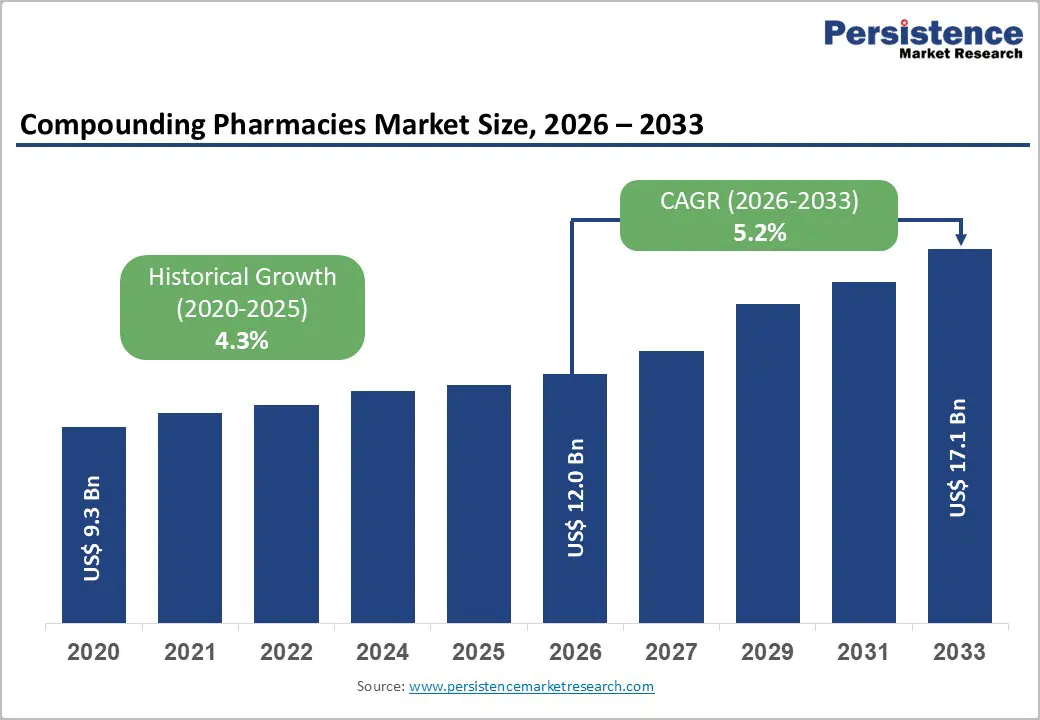
The global market for compounding pharmacies is estimated to value at US$ 16.3 Bn by the end of 2032 from US$ 11.4 Bn recorded in 2025. The market is expected to secure a CAGR of 5.2% in the forthcoming years from 2025 to 2032.

Attributes Key Insights

Compounding Pharmacies Market Size (2025)

US$ 11.4 Bn

Projected Market Value (2032)

US$ 16.3 Bn

Global Market Growth Rate (2025-2032)

5.2% CAGR

Market Share of Top 5 Countries

83.6%

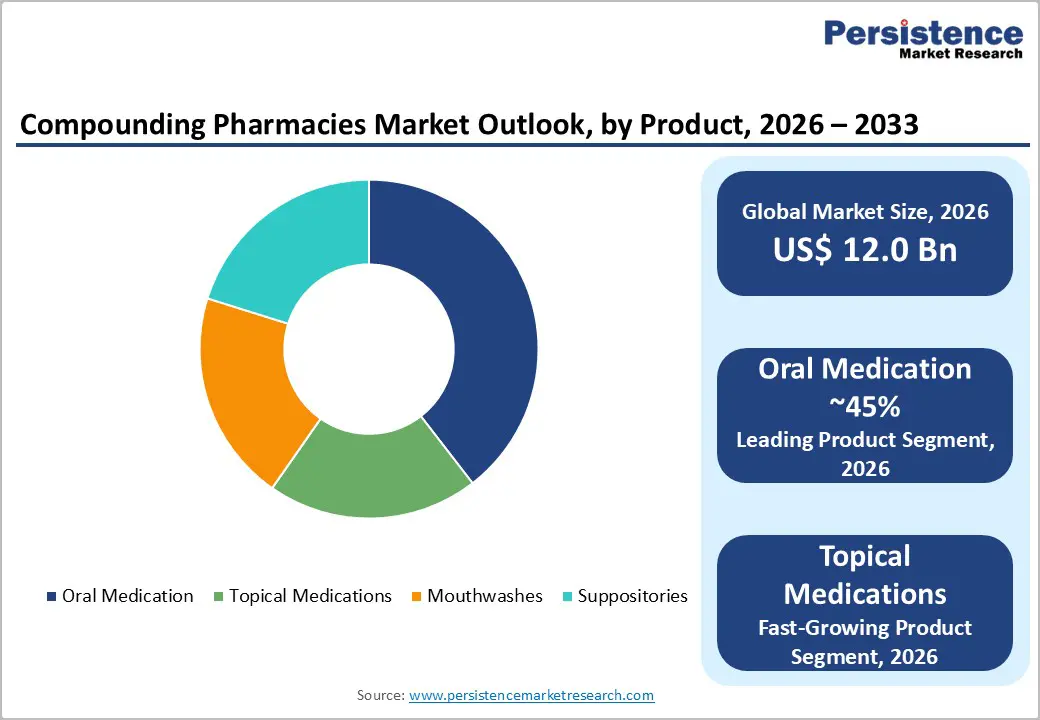
As assessed by Persistence Market Research, oral medications are expected to hold a market value of US$ 4.9 Bn by 2025. Overall, compounding pharmacies market sales account for approximately 1.9% revenue share in the global  personalized medicine market, which was valued at around US$ 535.67 Bn in 2024.

Sales Analysis of the Global Market from 2019 to 2024 Vs Market Outlook for 2025 to 2032

The global market for compounding pharmacies recorded a historic CAGR of 4.7% in the last 6 years from 2019 to 2024.

A compounding pharmacy's traditional function is to formulate drugs utilising unique doses, components, and forms in order to best serve a patient's needs. The modern compounding pharmacy has its origins in the 19th century, when doctors would prescribe and create drugs for the patients.

The practise of medicine and pharmacy has drifted apart throughout time, and now, medications are mass-produced. While the majority of patients benefit from these over-the-counter drugs, some patients require the individualised attention of a compounding pharmacy.

Additionally, patients must also use compounded medications if they need a customised dose or are allergic to a component (such a dye) in the FDA-approved, commercially accessible version of the treatment. They are particularly essential for elderly patients or children who are unable to chew pills and require a liquid version of medication that is not commonly available.

Increased palatability and adherence can be achieved by using flavouring agents, effervescent liquids, or specialised dosage forms like lollipops. Additionally, medications can be made for people adopting particular diets including those that are gluten-free, sugar-free, casein-free, vegetarian, vegan, or Kosher.

Medications for pain relief (such as gabapentin, cyclobenzaprine, baclofen, diclofenac, lidocaine, ketamine, bupivacaine, and flurbiprofen) or hormone replacement are the most often compounded pharmaceuticals (progesterone, estriol, estradiol, testosterone). Compound medications are widely used in dermatology to enhance therapeutic outcomes by the focused actions of a specific chemical combination.

Over the coming years, demand for compounded drugs is expected to rise as a result of increasing worldwide drug shortages, growing costs for branded prescription alternatives, and restricted access to medicines.

Many significant specialty pharmacies are putting their efforts into strengthening their positions through alliances with local manufacturers and the pursuit of acquisitions to boost their revenues.

Additionally, businesses are focusing on North America, Asia Pacific, and Europe through the implementation of R&D and market alliances.

The global market is thus likely to show high growth over the coming years at a CAGR of 5.2% and reach a global market size of US$ 16.3 Bn by 2032.

What Factors Will Drive the Market to Grow Over Forecast Period?

Rising Pharmaceutical R&D

Pharmaceutical R&D for the treatment of different illnesses in novel media, forms, and doses is projected to offer market participants a profitable development potential. The growing acceptance of veterinary and animal pharmaceutical compounding, particularly in Europe and North America, will benefit manufacturers.

Compounding pharmacies need to adopt hybrid retail strategies in addition to a compounding department if they want to increase their revenue. Market participants must concentrate more on pharmacies that perform non-sterile compounding in order to reduce errors brought on by sterile compounding.

To increase their market share, major market industry players are primarily concentrating on global expansion and the introduction of cutting-edge products that respond to consumer needs. For instance, In June 2016, PharMEDium collaborated with Kit Check to provide RFID tags for prefilled syringes made by PharMEDium.

Additionally, to improve their market positioning and develop sustainable positioning, large medical and pharmaceutical corporations are working with small compounding solution providers and research institutions in Asia Pacific and Europe. The target markets for significant compounding pharmacies at the moment are North America, Europe, and Asia-Pacific.

Additionally, rising FDA approvals for new medicine applications and business partnerships are promoting the use of good-quality drugs and products. Sales of compounding pharmacies might increase soon as regulatory procedures in emerging nations are likely to be improved and streamlined.

Is there Any Impact on the Growth of the Compounding Pharmacies Market?

Limitations on the Production of Complicated Formulations

Inadequate compounding practises, such as contamination during the compounding process and disregard for GMP rules, are the main factors limiting the utilization of compounded drugs. This is especially apparent in the sterile compounding of injection-ready drugs and intravenous solutions.

The sales prospects of compounded pharmaceuticals from complex drug pharmacies are expected to negatively impact the rise in the number of restricted drugs. In this regard, the U.S. FDA stated that, starting in June 2015, it would add four drugs to its register of those that are "not allowed to be compounded" in large amounts by outside facilities. These includes bromocriptine mesylate (Tylenol), cetaminophen, aprotinin (Trasylol), and ondansetron hydrochloride (Zofran).

A ruling banning the compounding of these medicines might decrease the need for mutual compounded medications like Tylenol.

When done in non-sterile surroundings, compounding sterile pharmaceuticals or medications that comprise both sterile and non-sterile constituents pose a serious risk to the safety of the drugs being used. This is yet another significant barrier to market expansion. Recalling potentially dangerous compound medications can make a scarcity issue.

Growing regulatory pressure is projected to impede the growth of compounding pharmacies worldwide. Registration with the FDA, accessibility for inspections, and adherence to GMP guidelines are required for producing bulk pharmaceuticals and ingredients as well as trans-boundary drug compounding.

Selling medications that are compounded as injectable has become more challenging due to an increase in label warnings for sterility compounding. For instance, the American Food and Drug Administration (US FDA) has increased its initial caution on Becton-Dickinson (BD) general use syringes in the sizes of 1mL, 3mL, 5mL, 10mL, 20mL, and 30mL. To prevent interactions with the rubber stoppers on some batches, the FDA encouraged consumers to use these syringes as soon as they have been filled with medication.

Additionally, because sterile medications are more susceptible to suffer chemical contamination and are not FDA-approved, they have been the subject of more recalls than other types of drugs globally.

Country-wise Insights

Why is the U.S. Market Booming?

Increased Dermatological Diseases

The U.S. accounted for around 77.4% market share in the North America compounding pharmacies market in 2024.

In North America, the prevalence of skin disorders is rising as a result of a number of causes, including poor skincare practises, unhealthy eating patterns, and a family medical history of the condition. Acute illnesses including dermatitis and melanoma are becoming more prevalent at a concerning rate.

Psoriasis is a persistent skin ailment that affects roughly 7.5 million Americans, according to the American Academy of Dermatology (AAD). The demand for online compounding pharmacies, which formulate the right medication to prevent allergic or other unfavourable medical reactions upon ingestion of the drugs, has increased as a result of these health conditions.

Will Germany Be a Lucrative Market for Compounding Pharmacies Manufacturers?

“Rise in Geriatric Population”

Germany held around 15.7% market share of the Europe compounding pharmacies market in 2024.

Increasing life expectancy and an increasing geriatric population base will both contribute to the market's rise in this region. The World Health Organization (WHO) predicts that by 2050, there will be about 40 million people in the European region who are 85 years of age or older.

The demand for customised medicine has increased as a result of the elderly population's longer lifespan. The demand for anti-aging treatments and products such as bioidentical hormone replacement therapy and human growth hormone has increased due to a higher percentage of individuals living to old age and a rising desire to look young.

Similarly, as many of these are largely developed in compounding pharmacies, rising utilisation of testosterone therapy and high-quality dermatological goods among the elderly will propel the total market expansion in Germany.

How is Australia Emerging as a Prominent Market for Compounding Pharmacies?

“New developments for patient care”

Australia is expected to hold a market share of about 8.1% of the global compounding pharmacies market in 2024. According to Australasian Menopause Society Limited, the number of women seeking hormone-related treatment has increased, and the pharmaceutical industry has responded by ramping up manufacture of pills, patches, and lotions.

The most typical application of bio-identical hormone replacement therapy (BHRT) is to treat menopause symptoms, and yet it can also be used to treat a wide variety of disorders that afflict women of all ages.

A compounding pharmacist can assist a woman in starting and maintaining a bio-identical hormone replacement prescription that balances her hormones and closely resembles what patient's body has been doing naturally for years by working closely with her and her healthcare practitioner. The pharmacist can produce hormones with a doctor's prescription in a range of dosage forms and strengths, including capsules, suppositories, topical or vaginal creams and gels, and others. This therapeutic use of compounding pharmacy is supposed to boost the regional growth.

Category-wise Insights

Which Product is Driving Growth of the Global Market?

“Various Beneficial Advantages”

The oral medication segment held around 44.0% share of the total compounding pharmacies market in 2024.

Drugs taken orally often pass through the liver and gut wall, which both have a number of inactivating enzymes. The term "pre-systemic" or "first-pass" metabolism refers to this process. This shows that only a small portion of the medication really enters the systemic circulation after being delivered.

Oral medication is the most popular method of drug administration, due to benefits like patient choice, simplicity of manufacturing oral dosage forms on a wide scale, and comfort of drug administration via the oral route.

Additionally, this medication is cost-effective because the patient imposes no additional expenses. When taking a solid medication, such as tablets and capsules, the patient just requires one or two cups of water, which is typically readily available. If the medication is in liquid form, only a measuring device, which typically comes with the medication, is required.

Furthermore, as no sterile precautions are needed even danger of acute drug reaction is minimal. These affirmatory factors have increased the consumption of oral medications than others and even patients preferably uses oral medications than others.

Which Application Offers the Global Market a Profitable Outlook?

“Rising Health Consciousness”

Medication for adults hold a market share of around 54.0% in 2024 due to rising demand spurred on by an increase in health-related situations, as well as a rise in the need for dietary supplements, topical dermatological treatments, and personalised medicine.

Rising consumer awareness for staying fit and healthy has increased which has resulted in the segment’s growth. Busy schedules and evolving lifestyles have made difficult for people to exercise daily, increasing the consumption of products such as tablets and capsules containing omega, minerals, and vitamins. The industry is anticipated to grow increasingly dependent on supplements to meet nutritional needs due to their high level of convenience.

Moreover, beauty and good looks have become prominent factors in the growing youth globally. Most of the doctors suggest creams and ointments for dermatological problems or infections. Most of the time it is not possible for everyone to apply it regularly. Therefore, most people prefer oral medications, which are easily adaptable.

Which Therapeutic Area Accounts for Highest Market Share in Compounding Pharmacies?

Growing Public Acceptance of Hormone Replacement Therapy”

In terms of therapeutic area, hormone replacement therapy accounts for 64.7% of the global market share in 2024.

The growth of compounded hormone replacement therapy (HRT) medications is being pushed by the increasing utilization of HRTs as APIs are readily available in range of doses. As individuals have become more conscious about critical health problems such as mood swings, acute depression, hot flashes, osteoporosis, erectile longevity, breast and bone health, etc., the demand for customized hormone replacement therapies has surged recently.

Additionally, the need for hormones such progesterone after hysterectomy, hormones that treat infertility, testosterone replacement, etc. has increased as a result of the dosage required for certain customized solutions.

Due to the rapid rise of lifestyle-related disorders in the younger population due to changing lifestyles and rising stress levels, these therapies are expensive and in high demand. Progesterone, estradiol, oestrogen, and testosterone are some of the active pharmaceutical chemicals that are now in high demand in the HRT industry.

Competition Landscape

Compounding pharmacies employ partnerships and acquisitions as essential tactics to set themselves apart from the competition. These strategies give participants the chance to combine the resources needed to guarantee the sustainability of their companies in the market.

Compounding pharmacies are concentrating on product launches and expansion to better position themselves in the market.

Key instances include:

  • In April 2019, California was added to Pentec Health, Inc.'s list of 43 approved states. The company offers advanced in-home clinical services and patient-specific compounded sterile pharmaceuticals.
  • In May 2019, Fagron agreed into a deal to buy Central de Drogas, S.A. de C.V., a provider of raw resources to pharmaceutical industry and compounding pharmacies in Mexico.
  • In March 2021, Osceola Capital and seasoned entrepreneur Jacob Beckel have announced the creation of Revelation Pharma Corp. to look into financing and strategic alliances in the pharmaceutical compounding market.

Similarly, the team at Persistence Market Research has tracked recent developments related to companies in the compounding pharmacies market, which are available in the full report.

Companies Covered in Compounding Pharmacies Market

  • Fagron 
  • Fresenius Kabi AG
  • PharMEDium Services, LLC,
  • Institutional Pharmacy Solutions
  • Cantrell Drug Company
  • Lorraine’s Pharmacy
  • B. Braun Melsungen AG Company
Frequently Asked Questions

The global market is projected to be valued at around US$ 11.4 Bn in 2025.

Sales of the market are expected to grow at a CAGR of 5.2% and reach around US$ 16.3 Bn by 2032.

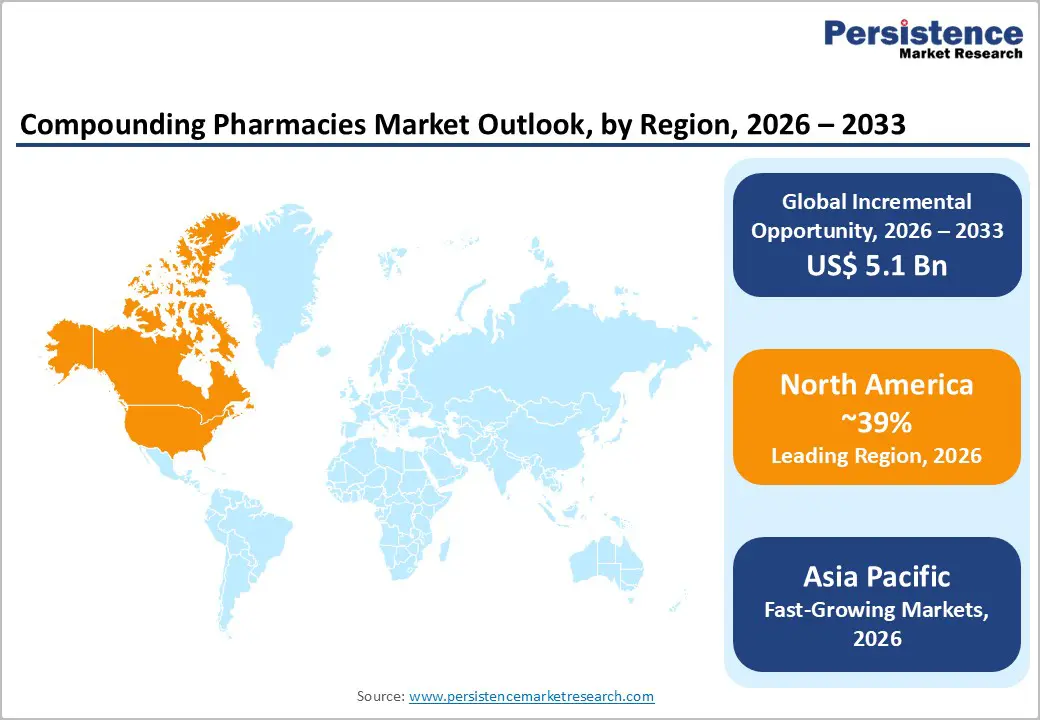
The U.S., Canada, Australia, UK and Singapore account for most demand for compounding pharmacies market, currently holding around 83.6% market share.

The U.S. is forecasted to account for around 77.4% share of the North American market in 2025.

Australia is expected to hold a market share of about 8.1% of the global compounding pharmacies market in 2025.

China is set to expand at a CAGR of close to 6.5% over the forecast period.

Germany is projected to hold around 15.7% market share of the Europe compounding pharmacies market in 2025

In terms of therapeutic area, hormone replacement therapy accounts for 64.7% of the market share in 2024.

The oral medication segment held around 44.0% share of the total compounding pharmacies market in 2024.

Compounding Pharmacies Industry Report Scope
Attribute Details

Forecast Period

2025-2032

Historical Data Available for

2019-2024

Market Analysis Units Value: US$ Bn/Mn, Volume: As applicable 

Key Countries Covered

  • U.S.
  • Canada
  • Brazil
  • Argentina
  • Mexico
  • Germany
  • France
  • U.K.
  • Italy
  • Spain
  • Russia
  • BENELUX
  • India
  • Thailand
  • Malaysia
  • Indonesia
  • China
  • Japan
  • South Korea
  • Australia
  • New Zealand
  • Turkey
  • GCC
  • North Africa
  • South Africa

Key Market Segments Covered

  • Product
  • Application
  • Therapeutic Area
  • Region

Key Companies

  • Fagron
  • Fresenius Kabi AG
  • PharMEDium Services LLC
  • Institutional Pharmacy Solutions
  • Cantrell Drug Company
  • Lorraine’s Pharmacy
  • B.Braun Melsungen AG Company
Report Highlights
  • Market Forecast and Trends
  • Competitive Intelligence & Share Analysis
  • Growth Factors and Challenges
  • Strategic Growth Initiatives
  • Pricing Analysis & Technology Roadmap
  • Future Opportunities and Revenue Pockets
  • Industry Market Analysis Tools

Customization & Pricing

Available upon Request

Key Segments Covered in Compounding Pharmacies Industry Research

Product:

  • Oral Medication
    • Capsules
    • Tablets
    • Mixtures
    • Lollipops
    • Lozenges
  • Topical Medications
    • Gels
    • Ointments
    • Cream
    • Lotions
  • Mouthwashes
  • Suppositories

Application:

  • Medication for Adults
  • Medication for Veterinary
  • Medication for Children
  • Medication for Geriatric

Therapeutic Area:

  • Pain Management
  • Hormone Replacement Therapy

Region:

  • North America
  • Latin America
  • Europe
  • South Asia
  • East Asia
  • Oceania
  • Middle East & Africa

Related Reports

1. Executive Summary

    1.1. Global Market Outlook

    1.2. Demand Side Trends

    1.3. Supply Side Trends

    1.4. Analysis and Recommendations

2. Market Overview

    2.1. Market Coverage / Taxonomy

    2.2. Market Definition / Scope / Limitations

    2.3. Inclusion and Exclusions

3. Key Market Trends

    3.1. Key Trends Impacting the Market

    3.2. Product Innovation / Development Trends

4. Key Success Factors

    4.1. Product Adoption Analysis

    4.2. Recent Product Approvals/ Launches

    4.3. Key Promotional Strategies, By Manufacturers

    4.4. Supply Chain Analysis

    4.5. Porter’s Five Forces Analysis

    4.6. PESTEL Analysis

    4.7. Regulatory Dynamics

5. Market Background

    5.1. Macro-Economic Factors

        5.1.1. Global GDP Growth Outlook

        5.1.2. Global Healthcare Expenditure Overview

        5.1.3. Global Personalized Medicine Market Outlook

    5.2. Forecast Factors - Relevance & Impact

        5.2.1. Rising geriatric population

        5.2.2. Increasing oral medications

        5.2.3. Growing public adoption of hormone replacement therapy (HRTs)

        5.2.4. Increasing medicine scarcity

        5.2.5. Rising pharmaceutical R&D

        5.2.6. Rise in pet adoption

        5.2.7. Strategic collaborations

    5.3. Market Dynamics

        5.3.1. Drivers

        5.3.2. Restraints

        5.3.3. Opportunity Analysis

6. COVID-19 Crisis Analysis

    6.1. COVID-19 and Impact Analysis

        6.1.1. Revenue By Product

        6.1.2. Revenue By Application

        6.1.3. Revenue By Therapeutic Area

        6.1.4. Revenue By Country

    6.2. 2022 Market Scenario

7. Global Compounding Pharmacies Market Demand (Size in US$ Mn) Analysis, 2019 – 2032

    7.1. Historical Market Value (US$ Mn) Analysis, 2019-2023

    7.2. Current and Future Market Value (US$ Mn) Projections, 2024-2032

        7.2.1. Y-o-Y Growth Trend Analysis

        7.2.2. Absolute $ Opportunity Analysis

8. Global Compounding Pharmacies Market Analysis 2019 - 2032, By Product

    8.1. Introduction / Key Findings

    8.2. Historical Market Size (In Value or Size in US$ Mn) Trend By Product, 2019-2023

    8.3. Current and Future Market Size (In Value or Size in US$ Mn) Analysis and Forecast By Product, 2024-2032

        8.3.1. Oral Medications

            8.3.1.1. Capsules

            8.3.1.2. Tablets

            8.3.1.3. Mixtures

            8.3.1.4. Lollipops

            8.3.1.5. Lozenges

        8.3.2. Topical Medications

            8.3.2.1. Gels

            8.3.2.2. Ointments

            8.3.2.3. Creams

            8.3.2.4. Lotions

        8.3.3. Mouthwashes

        8.3.4. Suppositories

    8.4. Market Attractiveness Analysis By Product

9. Global Compounding Pharmacies Market Analysis 2019 - 2032, By Application

    9.1. Introduction / Key Findings

    9.2. Historical Market Size (In Value or Size in US$ Mn) Trend By Application, 2019-2023

    9.3. Current and Future Market Size (In Value or Size in US$ Mn) Analysis and Forecast By Application, 2024-2032

        9.3.1. Medication for Adults

        9.3.2. Medication for Veterinary

        9.3.3. Medication for Children

        9.3.4. Medication for Geriatric

    9.4. Market Attractiveness Analysis By Application

10. Global Compounding Pharmacies Market Analysis 2019 - 2032, By Therapeutic Area

    10.1. Introduction / Key Findings

    10.2. Historical Market Size (In Value or Size in US$ Mn) Trend By Therapeutic Area, 2019-2023

    10.3. Current and Future Market Size (In Value or Size in US$ Mn) Analysis and Forecast By Therapeutic Area, 2024-2032

        10.3.1. Pain Management

        10.3.2. Hormone Replacement Therapy

    10.4. Market Attractiveness Analysis By Therapeutic Area

11. Global Compounding Pharmacies Market Analysis 2019 - 2032, by Region

    11.1. Introduction

    11.2. Historical Market Size (In Value or Size in US$ Mn) Analysis By Region, 2019 - 2023

    11.3. Current Market Size (In Value or Size in US$ Mn) Analysis and Forecast By Region, 2024 - 2032

        11.3.1. North America

        11.3.2. Latin America

        11.3.3. Europe

        11.3.4. South Asia

        11.3.5. East Asia

        11.3.6. Oceania

        11.3.7. Middle East and Africa (MEA)

    11.4. Market Attractiveness Analysis By Region

12. North America Compounding Pharmacies Market Analysis 2019 - 2032

    12.1. Introduction

    12.2. Historical Market Size (In Value or Size in US$ Mn) Trend Analysis By Market Taxonomy, 2019-2023

    12.3. Current and Future Market Size (In Value or Size in US$ Mn) Analysis and Forecast By Market Taxonomy, 2024-2032

        12.3.1. By Country

            12.3.1.1. U.S.

            12.3.1.2. Canada

        12.3.2. By Product

        12.3.3. By Application

        12.3.4. By Therapeutic Area

    12.4. Market Attractiveness Analysis

        12.4.1. By Country

        12.4.2. By Product

        12.4.3. By Application

        12.4.4. By Therapeutic Area

    12.5. Market Trends

    12.6. Key Market Participants - Intensity Mapping

    12.7. Drivers and Restraints - Impact Analysis

    12.8. Country Level Analysis & Forecast

        12.8.1. U.S. Compounding Pharmacies Market Analysis

            12.8.1.1. Introduction

            12.8.1.2. Market Analysis and Forecast by Market Taxonomy

                12.8.1.2.1. By Product

                12.8.1.2.2. By Application

                12.8.1.2.3. By Therapeutic Area

        12.8.2. Canada Compounding Pharmacies Market Analysis

            12.8.2.1. Introduction

            12.8.2.2. Market Analysis and Forecast by Market Taxonomy

                12.8.2.2.1. By Product

                12.8.2.2.2. By Application

                12.8.2.2.3. By Therapeutic Area

13. Latin America Compounding Pharmacies Market 2019 – 2032

    13.1. Introduction

    13.2. Historical Market Size (In Value or Size in US$ Mn) Trend Analysis By Market Taxonomy, 2019-2023

    13.3. Current and Future Market Size (In Value or Size in US$ Mn) Analysis and Forecast By Market Taxonomy, 2024-2032

        13.3.1. By Country

            13.3.1.1. Brazil

            13.3.1.2. Mexico

            13.3.1.3. Argentina

            13.3.1.4. Rest of Latin America

        13.3.2. By Product

        13.3.3. By Application

        13.3.4. By Therapeutic Area

    13.4. Market Attractiveness Analysis

        13.4.1. By Country

        13.4.2. By Product

        13.4.3. By Application

        13.4.4. By Therapeutic Area

    13.5. Market Trends

    13.6. Key Market Participants - Intensity Mapping

    13.7. Drivers and Restraints - Impact Analysis

    13.8. Country Level Analysis & Forecast

        13.8.1. Brazil Compounding Pharmacies Market Analysis

            13.8.1.1. Introduction

            13.8.1.2. Market Analysis and Forecast by Market Taxonomy

                13.8.1.2.1. By Product

                13.8.1.2.2. By Application

                13.8.1.2.3. By Therapeutic Area

        13.8.2. Mexico Compounding Pharmacies Market Analysis

            13.8.2.1. Introduction

            13.8.2.2. Market Analysis and Forecast by Market Taxonomy

                13.8.2.2.1. By Product

                13.8.2.2.2. By Application

                13.8.2.2.3. By Therapeutic Area

        13.8.3. Argentina Compounding Pharmacies Market Analysis

            13.8.3.1. Introduction

            13.8.3.2. Market Analysis and Forecast by Market Taxonomy

                13.8.3.2.1. By Product

                13.8.3.2.2. By Application

                13.8.3.2.3. By Therapeutic Area

14. Europe Compounding Pharmacies Market Analysis, 2019 - 2032   

    14.1. Introduction

    14.2. Historical Market Size (In Value or Size in US$ Mn) Trend Analysis By Market Taxonomy, 2019-2023

    14.3. Current and Future Market Size (In Value or Size in US$ Mn) Analysis and Forecast By Market Taxonomy, 2024-2032

        14.3.1. By Country

            14.3.1.1. Germany

            14.3.1.2. UK

            14.3.1.3. France

            14.3.1.4. Italy

            14.3.1.5. Russia

            14.3.1.6. Spain

            14.3.1.7. BENELUX

            14.3.1.8. Rest of Europe

        14.3.2. By Product

        14.3.3. By Application

        14.3.4. By Therapeutic Area

    14.4. Market Attractiveness Analysis

        14.4.1. By Country

        14.4.2. By Product

        14.4.3. By Application

        14.4.4. By Therapeutic Area

    14.5. Market Trends

    14.6. Key Market Participants - Intensity Mapping

    14.7. Drivers and Restraints - Impact Analysis

    14.8. Country Level Analysis & Forecast

        14.8.1. Germany Compounding Pharmacies Market Analysis

            14.8.1.1. Introduction

            14.8.1.2. Market Analysis and Forecast by Market Taxonomy

                14.8.1.2.1. By Product

                14.8.1.2.2. By Application

                14.8.1.2.3. By Therapeutic Area

        14.8.2. UK Compounding Pharmacies Market Analysis

            14.8.2.1. Introduction

            14.8.2.2. Market Analysis and Forecast by Market Taxonomy

                14.8.2.2.1. By Product

                14.8.2.2.2. By Application

                14.8.2.2.3. By Therapeutic Area

        14.8.3. Russia Compounding Pharmacies Market Analysis

            14.8.3.1. Introduction

            14.8.3.2. Market Analysis and Forecast by Market Taxonomy

                14.8.3.2.1. By Product

                14.8.3.2.2. By Application

                14.8.3.2.3. By Therapeutic Area

        14.8.4. Spain Compounding Pharmacies Market Analysis

            14.8.4.1. Introduction

            14.8.4.2. Market Analysis and Forecast by Market Taxonomy

                14.8.4.2.1. By Product

                14.8.4.2.2. By Application

                14.8.4.2.3. By Therapeutic Area

        14.8.5. France Compounding Pharmacies Market Analysis

            14.8.5.1. Introduction

            14.8.5.2. Market Analysis and Forecast by Market Taxonomy

                14.8.5.2.1. By Product

                14.8.5.2.2. By Application

                14.8.5.2.3. By Therapeutic Area

        14.8.6. Italy Compounding Pharmacies Market Analysis

            14.8.6.1. Introduction

            14.8.6.2. Market Analysis and Forecast by Market Taxonomy

                14.8.6.2.1. By Product

                14.8.6.2.2. By Application

                14.8.6.2.3. By Therapeutic Area

        14.8.7. BENELUX Compounding Pharmacies Market Analysis

            14.8.7.1. Introduction

            14.8.7.2. Market Analysis and Forecast by Market Taxonomy

                14.8.7.2.1. By Product

                14.8.7.2.2. By Application

                14.8.7.2.3. By Therapeutic Area

15. South Asia Compounding Pharmacies Market Analysis, 2019 - 2032

    15.1. Introduction

    15.2. Historical Market Size (In Value or Size in US$ Mn) Trend Analysis By Market Taxonomy, 2019-2023

    15.3. Current and Future Market Size (In Value or Size in US$ Mn) Analysis and Forecast By Market Taxonomy, 2024-2032

        15.3.1. By Country

            15.3.1.1. India

            15.3.1.2. Indonesia

            15.3.1.3. Malaysia

            15.3.1.4. Thailand

            15.3.1.5. Rest of South Asia

        15.3.2. By Product

        15.3.3. By Application

        15.3.4. By Therapeutic Area

    15.4. Market Attractiveness Analysis

        15.4.1. By Country

        15.4.2. By Product

        15.4.3. By Application

        15.4.4. By Therapeutic Area

    15.5. Market Trends

    15.6. Key Market Participants - Intensity Mapping

    15.7. Drivers and Restraints - Impact Analysis

    15.8. Country Level Analysis & Forecast

        15.8.1. India Compounding Pharmacies Market Analysis

            15.8.1.1. Introduction

            15.8.1.2. Market Analysis and Forecast by Market Taxonomy

                15.8.1.2.1. By Product

                15.8.1.2.2. By Application

                15.8.1.2.3. By Therapeutic Area

        15.8.2. Indonesia Compounding Pharmacies Market Analysis

            15.8.2.1. Introduction

            15.8.2.2. Market Analysis and Forecast by Market Taxonomy

                15.8.2.2.1. By Product

                15.8.2.2.2. By Application

                15.8.2.2.3. By Therapeutic Area

        15.8.3. Malaysia Compounding Pharmacies Market Analysis

            15.8.3.1. Introduction

            15.8.3.2. Market Analysis and Forecast by Market Taxonomy

                15.8.3.2.1. By Product

                15.8.3.2.2. By Application

                15.8.3.2.3. By Therapeutic Area

        15.8.4. Thailand Compounding Pharmacies Market Analysis

            15.8.4.1. Introduction

            15.8.4.2. Market Analysis and Forecast by Market Taxonomy

                15.8.4.2.1. By Product

                15.8.4.2.2. By Application

                15.8.4.2.3. By Therapeutic Area

16. East Asia Compounding Pharmacies Market Analysis, 2019 - 2032

    16.1. Introduction

    16.2. Historical Market Size (In Value or Size in US$ Mn) Trend Analysis By Market Taxonomy, 2019-2023

    16.3. Current and Future Market Size (In Value or Size in US$ Mn) Analysis and Forecast By Market Taxonomy, 2024-2032

        16.3.1. By Country

            16.3.1.1. China

            16.3.1.2. Japan

            16.3.1.3. South Korea

        16.3.2. By Product

        16.3.3. By Application

        16.3.4. By Therapeutic Area

    16.4. Market Attractiveness Analysis

        16.4.1. By Country

        16.4.2. By Product

        16.4.3. By Application

        16.4.4. By Therapeutic Area

    16.5. Market Trends

    16.6. Key Market Participants - Intensity Mapping

    16.7. Drivers and Restraints - Impact Analysis

    16.8. Country Level Analysis & Forecast

        16.8.1. China Compounding Pharmacies Market Analysis

            16.8.1.1. Introduction

            16.8.1.2. Market Analysis and Forecast by Market Taxonomy

                16.8.1.2.1. By Product

                16.8.1.2.2. By Application

                16.8.1.2.3. By Therapeutic Area

        16.8.2. Japan Compounding Pharmacies Market Analysis

            16.8.2.1. Introduction

            16.8.2.2. Market Analysis and Forecast by Market Taxonomy

                16.8.2.2.1. By Product

                16.8.2.2.2. By Application

                16.8.2.2.3. By Therapeutic Area

        16.8.3. South Korea Compounding Pharmacies Market Analysis

            16.8.3.1. Introduction

            16.8.3.2. Market Analysis and Forecast by Market Taxonomy

                16.8.3.2.1. By Product

                16.8.3.2.2. By Application

                16.8.3.2.3. By Therapeutic Area

17. Oceania Compounding Pharmacies Market Analysis, 2019 - 2032

    17.1. Introduction

    17.2. Historical Market Size (In Value or Size in US$ Mn) Trend Analysis By Market Taxonomy, 2019-2023

    17.3. Current and Future Market Size (In Value or Size in US$ Mn) Analysis and Forecast By Market Taxonomy, 2024-2032

        17.3.1. By Country

            17.3.1.1. Australia

            17.3.1.2. New Zealand

        17.3.2. By Product

        17.3.3. By Application

        17.3.4. By Therapeutic Area

    17.4. Market Attractiveness Analysis

        17.4.1. By Country

        17.4.2. By Product

        17.4.3. By Application

        17.4.4. By Therapeutic Area

    17.5. Market Trends

    17.6. Key Market Participants - Intensity Mapping

    17.7. Drivers and Restraints - Impact Analysis

    17.8. Country Level Analysis & Forecast

        17.8.1. Australia Compounding Pharmacies Market Analysis

            17.8.1.1. Introduction

            17.8.1.2. Market Analysis and Forecast by Market Taxonomy

                17.8.1.2.1. By Product

                17.8.1.2.2. By Application

                17.8.1.2.3. By Therapeutic Area

        17.8.2. New Zealand Compounding Pharmacies Market Analysis

            17.8.2.1. Introduction

            17.8.2.2. Market Analysis and Forecast by Market Taxonomy

                17.8.2.2.1. By Product

                17.8.2.2.2. By Application

                17.8.2.2.3. By Therapeutic Area

18. Middle East & Africa (MEA) Compounding Pharmacies Market Analysis, 2019 - 2032

    18.1. Introduction

    18.2. Historical Market Size (In Value or Size in US$ Mn) Trend Analysis By Market Taxonomy, 2019-2023

    18.3. Current and Future Market Size (In Value or Size in US$ Mn) Analysis and Forecast By Market Taxonomy, 2024-2032

        18.3.1. By Country

            18.3.1.1. GCC Countries

            18.3.1.2. Turkey

            18.3.1.3. South Africa

            18.3.1.4. North Africa

            18.3.1.5. Rest of MEA

        18.3.2. By Product

        18.3.3. By Application

        18.3.4. By Therapeutic Area

    18.4. Market Attractiveness Analysis

        18.4.1. By Country

        18.4.2. By Product

        18.4.3. By Application

        18.4.4. By Therapeutic Area

    18.5. Market Trends

    18.6. Key Market Participants - Intensity Mapping

    18.7. Drivers and Restraints - Impact Analysis

    18.8. Country Level Analysis & Forecast

        18.8.1. GCC Countries Compounding Pharmacies Market Analysis

            18.8.1.1. Introduction

            18.8.1.2. Market Analysis and Forecast by Market Taxonomy

                18.8.1.2.1. By Product

                18.8.1.2.2. By Application

                18.8.1.2.3. By Therapeutic Area

        18.8.2. Turkey Compounding Pharmacies Market Analysis

            18.8.2.1. Introduction

            18.8.2.2. Market Analysis and Forecast by Market Taxonomy

                18.8.2.2.1. By Product/p>

                18.8.2.2.2. By Application

                18.8.2.2.3. By Therapeutic Area

        18.8.3. South Africa Compounding Pharmacies Market Analysis

            18.8.3.1. Introduction

            18.8.3.2. Market Analysis and Forecast by Market Taxonomy

                18.8.3.2.1. By Product

                18.8.3.2.2. By Application

                18.8.3.2.3. By Therapeutic Area

        18.8.4. North Africa Compounding Pharmacies Market Analysis

            18.8.4.1. Introduction

            18.8.4.2. Market Analysis and Forecast by Market Taxonomy

                18.8.4.2.1. By Product

                18.8.4.2.2. By Application

                18.8.4.2.3. By Therapeutic Area

19. Market Structure Analysis

    19.1. Market Analysis by Tier of Companies

    19.2. Market Concentration

    19.3. Market Share Analysis of Top Players

    19.4. Market Presence Analysis

        19.4.1. Regional footprint of Players

        19.4.2. Product foot print by Players

        19.4.3. Channel Foot Print by Players

20. Competition Analysis

    20.1. Competition Dashboard

    20.2. Competition Deep Dive

        20.2.1. Fagron

            20.2.1.1. Overview

            20.2.1.2. Product Portfolio

            20.2.1.3. Key Financials

            20.2.1.4. Sales Footprint

            20.2.1.5. SWOT Analysis

            20.2.1.6. Strategy Overview

                20.2.1.6.1. Marketing Strategy

                20.2.1.6.2. Product Strategy

                20.2.1.6.3. Channel Strategy

        20.2.2. Fresenius Kabi AG

            20.2.2.1. Overview

            20.2.2.2. Product Portfolio

            20.2.2.3. Key Financials

            20.2.2.4. Sales Footprint

            20.2.2.5. SWOT Analysis

            20.2.2.6. Strategy Overview

                20.2.2.6.1. Marketing Strategy

                20.2.2.6.2. Product Strategy

                20.2.2.6.3. Channel Strategy

        20.2.3. PharMEDium Services, LLC,

            20.2.3.1. Overview

            20.2.3.2. Product Portfolio

            20.2.3.3. Key Financials

            20.2.3.4. Sales Footprint

            20.2.3.5. SWOT Analysis

            20.2.3.6. Strategy Overview

                20.2.3.6.1. Marketing Strategy

                20.2.3.6.2. Product Strategy

                20.2.3.6.3. Channel Strategy

        20.2.4. Institutional Pharmacy Solutions

            20.2.4.1. Overview

            20.2.4.2. Product Portfolio

            20.2.4.3. Key Financials

            20.2.4.4. Sales Footprint

            20.2.4.5. SWOT Analysis

            20.2.4.6. Strategy Overview

                20.2.4.6.1. Marketing Strategy

                20.2.4.6.2. Product Strategy

                20.2.4.6.3. Channel Strategy

        20.2.5. Cantrell Drug Company

            20.2.5.1. Overview

            20.2.5.2. Product Portfolio

            20.2.5.3. Key Financials

            20.2.5.4. Sales Footprint

            20.2.5.5. SWOT Analysis

            20.2.5.6. Strategy Overview

                20.2.5.6.1. Marketing Strategy

                20.2.5.6.2. Product Strategy

                20.2.5.6.3. Channel Strategy

        20.2.6. Lorraine’s Pharmacy

            20.2.6.1. Overview

            20.2.6.2. Product Portfolio

            20.2.6.3. Key Financials

            20.2.6.4. Sales Footprint

            20.2.6.5. SWOT Analysis

            20.2.6.6. Strategy Overview

                20.2.6.6.1. Marketing Strategy

                20.2.6.6.2. Product Strategy

                20.2.6.6.3. Channel Strategy

        20.2.7. B. Braun Melsungen AG Company

            20.2.7.1. Overview

            20.2.7.2. Product Portfolio

            20.2.7.3. Key Financials

            20.2.7.4. Sales Footprint

            20.2.7.5. SWOT Analysis

            20.2.7.6. Strategy Overview

                20.2.7.6.1. Marketing Strategy

                20.2.7.6.2. Product Strategy

                20.2.7.6.3. Channel Strategy

21. Assumptions and Acronyms Used

22. Research Methodolog

Research Methodology Framework for Market Research Excellence

At Persistence Market Research, we implement a comprehensive, validated, and multi-dimensional approachto market analysis that delivers actionable insights across complex market landscapes. Our methodology combines the analytical rigor of leading consulting firms with innovative research techniques, ensuring robust market assessments that guide strategic decision-making with confidence.

Core Research Philosophy

Our methodology is built on four foundational pillars:

Research Philosophy Image

At Persistence Market Research, our methodology is designed to transcend conventional market studies by combining analytical rigor, multi-source validation, and future-focused insights.

We integrate advanced research frameworks, robust data collection strategies, cutting-edge analytics, and innovative technologies to deliver a 360-degree view of complex markets.

We integrate advanced research frameworks, robust data collection strategies, cutting-edge analytics, and innovative technologies to deliver a 360-degree view of complex markets.

Each stage spanning from strategic scoping and hypothesis-building to competitive intelligence, quality validation, and actionable recommendations is engineered to provide clients with unmatched clarity, precision, and confidence in decision-making.

By embedding innovation and technology at the core, our approach ensures that insights are not only comprehensive but also predictive, empowering businesses to seize opportunities, mitigate risks, and achieve sustainable growth

Research Philosophy Image

Capturing Key Information and Events

During this phase, key research objectives focus on essential information and data points for assessing the market, including:

Research Philosophy Image

TAM-SAM-SOM Framework Implementation

We employ both top-down and bottom-up approaches to ensure accurate market sizing.

Top-Down Market SizingBottom-Up Market Sizing
Universe Definition: Total global/regional market identificationUnit Economics: Average transaction values, purchase frequencies, customer lifecycle
Segmentation Filters: Geographic, demographic, and behavioral constraintsCustomer Segmentation: Detailed buyer persona development and sizing
Market Share Analysis: Competitive landscape assessment and share allocationPenetration Analysis: Market penetration rates by segment and geography
Growth Rate Application: Historical trends and forward-looking growth assumptionsScaling Methodology: Extrapolation techniques with confidence intervals

Validation & Cross-Verification

  • Triangulation: Comparing top-down and bottom-up results for consistency
  • Sensitivity Analysis: Testing key assumptions and parameter variations
  • Peer Benchmarking: Comparison with analogous markets and industry benchmarks
  • Expert Review: External validation through industry specialist consultation

Research Philosophy Image

Forecasting & Projection Modeling

Our proprietary forecasting models incorporate multiple variables and scenarios.

Forecasting Components

  • Historical Trend Analysis: 10-year historical growth patterns and cyclical variations
  • Driver-Based Modeling: Economic indicators, demographic shifts, technology adoption
  • Scenario Planning: Base case, optimistic, and conservative projections
  • Monte Carlo Simulations: Probability-weighted outcomes and risk assessments

Model Validation

  • Back-Testing: Historical accuracy assessment over 3–5-year periods
  • Cross-Validation: Multiple modeling approaches for result comparison
  • External Benchmarking: Comparison with established market forecasts
  • Continuous Calibration: Quarterly model updates based on new data

Comprehensive Data Collection Strategy

Our secondary research phase establishes a robust knowledge base utilizing diverse, credible sources.

Secondary Data Sourcess

  • Industry Publications & Reports
  • Government & Regulatory Data
  • Financial Intelligence (filings & reports)
  • Academic Research & Digital Intelligence

Quality Assurance Protocol

  • Source credibility assessment and publication date validation
  • Data consistency checks across multiple sources
  • Bias identification and neutralization techniques
  • Information gap tracking for primary research prioritization

Research Philosophy Image

Primary Research Excellence

Our primary research methodology employs best-in-class techniques to capture unique market insights.

Quantitative Research Methods

  • Large-Scale Surveys: Statistically representative samples with 95% confidence intervals
  • Survey Methodology: Multi-channel deployment (online, telephone, in-person)
  • Question Architecture and Response Optimization

Qualitative Research Methods

  • Executive Interviews
  • Focus Groups
  • Expert Consultations

Quality Assurance & Validation Framework

Multi-Stage Validation Process

  • Source Verification and Consistency Testing
  • Outlier Detection and Bias Assessment
  • Peer Review Process and External Validation
  • Sensitivity Analysis and Confidence Intervals

Research Philosophy Image

Methodology Validation & Credibility

Our research methodology has been extensively validated through:

  • Academic Partnerships: Collaborations with top-tier business schools and research institutions
  • Client Success Stories: Documented case studies demonstrating research impact and ROI
  • Continuous Benchmarking: Performance comparison with leading global research firms

This comprehensive methodology framework positions Persistence Market Research at the forefront of market intelligence, combining the analytical sophistication of top-tier consulting firms with innovative research techniques. Our approach ensures that every market assessment delivers precise, actionable, and strategically valuable insights that drive business success in competitive market environments.

Ready to unlock your market potential? Contact our research experts to discuss how our validated methodology can transform your strategic decision-making with data-driven market intelligence.

Copyright © 2026 Persistence Market Research. All Rights Reserved

Connect With Us -