




- Pharmaceuticals
- Moisture-associated Skin Damage Management Market
Moisture-associated Skin Damage Management Market Size, Share and Growth Forecast, 2026 - 2033
Moisture-associated Skin Damage Management Market by Product Type (Silicone-based Barriers, Others), Product Form (Cream, Ointment, Others), Indication (Incontinence-associated Dermatitis (IAD), Others), and Regional Analysis for 2026 - 2033

Moisture-associated Skin Damage Management Market Share and Trends Analysis
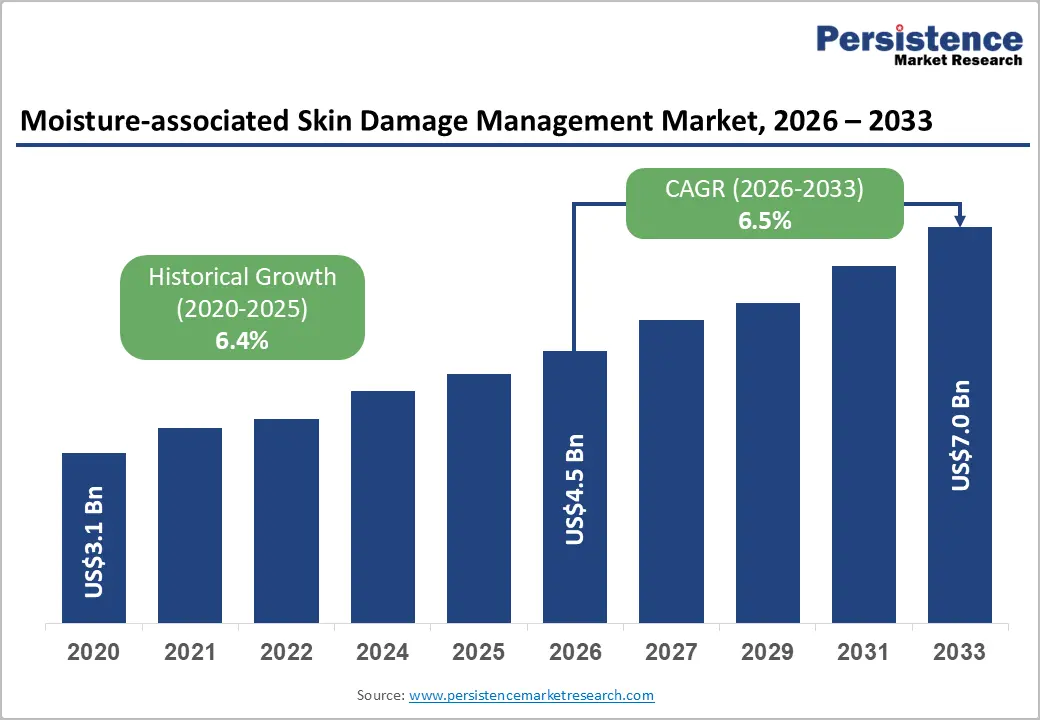
The global moisture-associated skin damage management market size is likely to be valued at US$4.5 billion in 2026 and is projected to reach US$7.0 billion by 2033, growing at a CAGR of 6.5% during the forecast period from 2026 to 2033, driven by the rising prevalence of chronic wounds, increasing elderly hospitalizations, and higher adoption of preventive hospital skin care solutions in acute and long-term care settings.
Demand for incontinence-associated dermatitis management is increasing as healthcare providers focus on reducing treatment costs and improving patient outcomes. In addition, advancements in advanced barrier film products and silicone-based skin protectants are supporting wider adoption across hospitals, nursing facilities, and home healthcare settings.
Key Industry Highlights:
- Dominant Product Type: Silicone-based barriers are expected to lead with nearly 36% share in 2026, while cyanoacrylate polymer film barriers are projected to witness the fastest growth through 2033, due to rising adoption in advanced wound protection applications.
- Leading Product Form: Cream formulations are anticipated to account for around 32% share in 2026, while foam-based products are likely to emerge as the fastest-growing segment through 2033, owing to rapid absorption and improved skin breathability.
- Dominant Indication Segment: Incontinence-associated Dermatitis (IAD) is projected to hold approximately 43% share in 2026, while peristomal moisture-associated dermatitis is expected to register the fastest growth through 2033 due to increasing ostomy care procedures.
- Key Market Driver: Rising chronic wound prevalence and growing demand for medical skin protectants are accelerating the adoption of preventive skin care solutions across hospitals and long-term care settings.
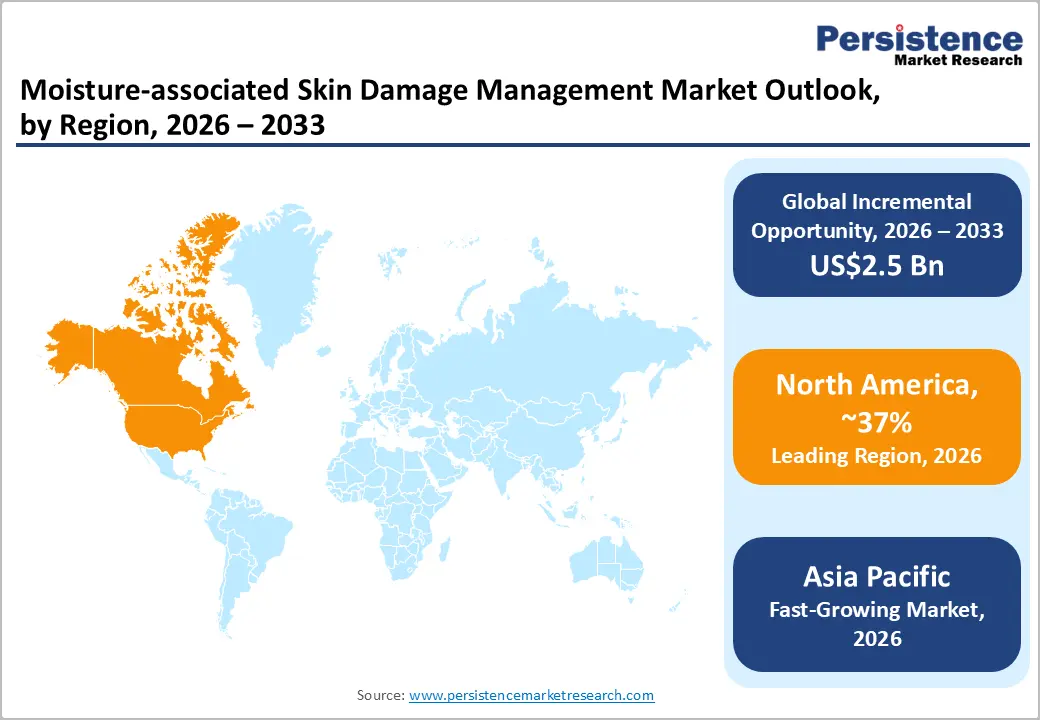
- Regional Leadership: North America is poised to dominate with nearly 37% share in 2026, while Asia Pacific is expected to register the fastest growth through 2033, driven by healthcare infrastructure expansion and rising elderly populations.
- Competitive Environment: Competitive activity is centered on silicone technology innovation, manufacturing expansion, and regional distribution growth for advanced barrier film products and chronic wound management solutions.
DRO Analysis
Driver - Rising Prevalence of Chronic Wounds and Aging Population Driving Demand for MASD Prevention
The growing burden of chronic wounds and age-related skin vulnerability continues to accelerate demand within the moisture-associated skin damage management market. According to the World Health Organization (WHO), the global population aged 60 years and above is expected to exceed 1.4 billion by 2030, significantly increasing demand for long-term care and skin protection therapies. Older adults experience reduced skin elasticity, impaired healing, and higher exposure to urinary and fecal incontinence, increasing the incidence of Incontinence-associated Dermatitis Management requirements.
Data from the U.S. Centers for Disease Control and Prevention (CDC) indicates that nearly 50% of nursing home residents experience some form of incontinence, creating sustained demand for moisture barrier creams, industry products, and skin protectants. Healthcare systems are increasingly implementing preventive skin care protocols to lower pressure injury treatment costs, thereby strengthening the adoption of wound and skin care management solutions across hospitals and rehabilitation centers.
Restraint - High Product Costs and Reimbursement Limitations Restrict Wider Adoption
Despite increasing clinical awareness, high treatment costs and inconsistent reimbursement structures remain key barriers for the moisture-associated skin damage management market. Advanced silicone barriers, polymer film technologies, and specialty formulations often carry higher procurement costs compared to conventional skin creams, limiting penetration in cost-sensitive healthcare systems. According to the U.S. Agency for Healthcare Research and Quality (AHRQ), pressure injury and skin damage management contribute billions of dollars annually to healthcare expenditure, prompting hospitals to carefully evaluate procurement efficiency.
In developing markets, many long-term care facilities continue relying on low-cost petroleum-based protectants, due to limited reimbursement support for premium advanced barrier film products. Fragmented regulatory standards across regions create approval complexities for manufacturers expanding internationally. Supply chain volatility affecting medical-grade silicone, zinc oxide, and specialty polymers also creates pricing pressure, particularly for smaller suppliers operating in emerging economies.
Opportunity - Expansion of Home Healthcare and Preventive Care Programs Creating New Revenue Potential
The rapid expansion of home healthcare services presents a major opportunity for the market. Rising healthcare costs and increasing preference for decentralized care are encouraging governments and providers to shift chronic wound management outside hospitals. The U.S. Centers for Medicare & Medicaid Services (CMS) continues to support value-based care models that prioritize preventive skin management and lower hospital readmissions. This trend is increasing demand for easy-to-apply silicone-based barrier cream market products, portable foam applications, and user-friendly skin protectants suitable for caregivers and home patients.
In Asia Pacific, aging demographics and rising chronic disease prevalence are accelerating investments in community healthcare infrastructure. Manufacturers are also introducing breathable and long-lasting formulations designed for prolonged wear, creating opportunities in long-term care skin protection and home nursing environments where continuous skin monitoring is critical.
Category-wise Analysis
Product Type Insights
Silicone-based barriers are projected to lead the moisture-associated skin damage management market with nearly 36% share in 2026, supported by superior skin adhesion, breathability, and lower risk of skin trauma during dressing removal. Their growing use in chronic wound care, pressure injury prevention, and elderly skin management continues to strengthen adoption across hospitals and long-term care facilities. Reflecting this trend, KeriCure Medical launched its Advanced Shield® Chronic Wound Barrier in 2025, designed specifically for fragile and aging skin applications.
Cyanoacrylate polymer film barriers are expected to witness the fastest growth through 2033, due to rising demand for durable, extended-wear skin protection in surgical and ostomy care. These breathable films help reduce dressing replacement frequency while improving workflow efficiency in high-acuity settings. Supporting this shift, Kerecis expanded its SurgiClose Silicone product portfolio in 2025 with additional wound care sizes targeting trauma and surgical applications, highlighting growing industry focus on advanced barrier technologies.
Product Form Insights
Cream formulations are anticipated to maintain leadership with around 32% market share in 2026, owing to their ease of application, balanced moisture retention, and suitability for frequent daily use. Their widespread adoption across hospitals, rehabilitation centers, and elderly care facilities continues to support demand for medical skin protectants and preventive skin care solutions. In 2025, Beiersdorf AG expanded its skin repair portfolio with next-generation wound and skin protection innovations focused on sensitive and compromised skin management.
Foam-based formulations are projected to register the fastest CAGR through 2033, as healthcare providers increasingly prefer lightweight, fast-absorbing, and non-greasy skin protection products. Their ability to maintain breathability while covering large anatomical areas makes them highly effective in postoperative and chronic wound care. In line with this trend, Evercare Medical introduced an advanced wound care range in 2025, featuring silicone-layered foam dressings designed to improve moisture balance and patient comfort.
Indication Insights
Incontinence-associated Dermatitis (IAD) is projected to dominate the market with nearly 43% share in 2026, driven by rising elderly populations, increasing urinary incontinence prevalence, and growing preventive skin care adoption in long-term care settings. Hospitals are increasingly implementing evidence-based skin assessment programs to reduce pressure injuries and improve patient outcomes. Growing awareness regarding IAD continues to accelerate demand for moisture barriers, skin creams, and protective films globally.
Peristomal moisture-associated dermatitis is expected to witness the fastest growth through 2033, due to increasing ostomy procedures and rising emphasis on postoperative skin integrity management. Healthcare providers are adopting advanced barrier systems and breathable films to reduce leakage-related irritation and improve patient mobility. In 2025, the U.S. Food and Drug Administration (FDA) issued updated safety communications related to ostomy skin barrier systems, reinforcing industry focus on adhesion reliability and advanced skin protection technologies.
Regional Analysis
North America Moisture-associated Skin Damage Management Market Trends
North America is projected to account for nearly 37% of the global moisture-associated skin damage management market in 2026, supported by advanced wound care infrastructure, strong reimbursement systems, and high adoption of preventive skin care protocols. The region continues to benefit from the rising prevalence of chronic wounds, expanding elderly populations, and increasing demand for medical skin protectants across hospitals and long-term care facilities. Regulatory oversight from the U.S. Food and Drug Administration (FDA) is also accelerating innovation in silicone-based barriers and advanced skin protection technologies.
U.S. Moisture-associated Skin Damage Management Market Trends
The U.S. is expected to contribute nearly 72% of the North America market, driven by strong healthcare spending, expanding home healthcare services, and growing pressure injury prevention initiatives. The country’s healthcare expenditure exceeded US$4.8 trillion according to the Centers for Medicare & Medicaid Services (CMS), supporting large-scale adoption of hospital skin care solutions. In 2025, multiple U.S. hospital networks expanded chronic wound management programs, integrating advanced barrier films and silicone protectants for elderly patient care.
Canada Moisture-associated Skin Damage Management Market Trends
Canada is estimated to account for approximately 11% of the regional market in 2026, supported by rising investments in community nursing and elderly care services. The increasing prevalence of diabetes and urinary incontinence is strengthening demand for wound and skin care management products across rehabilitation and long-term care settings. In 2025, provincial healthcare authorities expanded funding for home-based chronic wound treatment programs, improving access to preventive skin protection solutions nationwide.
Europe Moisture-associated Skin Damage Management Market Trends
Europe remains a significant market, accounting for nearly 27% of global revenue in 2026, driven by aging demographics, universal healthcare systems, and strong clinical focus on skin integrity management. Regional growth is supported by increasing chronic wound prevalence and expanding long-term care infrastructure across Western Europe. The implementation of the European Union Medical Device Regulation (MDR) continues to strengthen quality standards and encourage the adoption of advanced moisture barrier cream products.
Germany Moisture-associated Skin Damage Management Market Trends
Germany is projected to contribute around 26% of the European market, supported by its advanced wound care ecosystem and strong reimbursement framework for chronic skin management therapies. The country’s large elderly population and high healthcare expenditure continue to accelerate demand for long-term care skin protection products. In 2025, German healthcare providers increased procurement of advanced silicone dressings and protective barrier solutions as part of pressure injury reduction initiatives in rehabilitation facilities.
U.K. Moisture-associated Skin Damage Management Market Trends
The U.K. is estimated to hold nearly 19% share of the regional market, driven by rising investment in community healthcare and preventive wound management programs. The National Health Service (NHS) continues to expand pressure injury prevention protocols across hospitals and nursing homes, supporting greater adoption of medical skin protectants. In 2025, several NHS trusts introduced upgraded skin assessment pathways aimed at reducing moisture-associated skin damage among elderly and immobile patients.
Asia Pacific Moisture-associated Skin Damage Management Market Trends
Asia Pacific is anticipated to be the fastest-growing regional market, accounting for nearly 24% of global revenue in 2026, supported by rapid healthcare infrastructure expansion, rising elderly populations, and growing awareness regarding preventive wound care. Increasing healthcare expenditure and local manufacturing advantages are strengthening regional demand for advanced barrier film products and skin protection solutions. Governments across the region are also increasing investments in chronic disease management and long-term elderly care services.
China Moisture-associated Skin Damage Management Market Trends
China is expected to contribute approximately 38% of the Asia Pacific market in 2026, driven by hospital modernization programs, rising chronic disease prevalence, and expanding wound care capabilities. The country’s healthcare reforms and increasing domestic medical device production are accelerating the adoption of moisture-associated skin damage management market products. In 2025, several Chinese healthcare groups expanded geriatric care and wound management units, increasing demand for silicone-based barriers and protective skin films.
Japan Moisture-associated Skin Damage Management Market Trends
Japan is projected to account for nearly 21% of the regional market in 2026, due to its rapidly aging population and advanced elderly care infrastructure. High demand for continence care and home-based nursing services continues to support the adoption of Incontinence-associated Dermatitis Management products. In 2025, Japanese healthcare providers increased investment in smart long-term care programs integrating advanced wound and skin monitoring technologies for elderly patients, strengthening demand for preventive skin protection solutions.
Competitive Landscape
The global moisture-associated skin damage management market is moderately consolidated, with leading companies including 3M Company, Convatec Group Plc, Coloplast A/S, and Smith+Nephew accounting for a significant share of global revenue. These players benefit from strong hospital partnerships, diversified wound care portfolios, and expertise in silicone barriers and protective films. Continuous R&D investments are supporting innovation in advanced barrier film products, breathable formulations, and long-wear skin protectants. Growing demand for preventive wound care and elderly skin management continues to strengthen their market position.
Regional and niche players such as Mölnlycke Health Care and Hollister Incorporated are expanding through specialized ostomy care and postoperative skin protection solutions. Regulatory compliance and clinical validation requirements create moderate entry barriers for new participants. However, rising demand for home healthcare and preventive skin care products is enabling smaller companies to compete through targeted innovation and regional partnerships. Market consolidation is expected to increase as established companies pursue acquisitions and geographic expansion strategies.
Key Industry Developments:
- In January 2025, 3M Health Care expanded its advanced wound care manufacturing operations in the U.S. to increase production capacity for silicone-based skin protection products used in chronic wound management and intensive care settings.
- In May 2024, 3M announced a US$67 million investment to extend its Valley, Nebraska, facility by 90,000 square feet. This will help boost its manufacturing capacity and create 40 new jobs, reinforcing 3M’s commitment to supporting local economic growth and meeting increased production demands.
Moisture-associated Skin Damage Management Market Trends
| Key Insights | Details |
|---|---|
| Historical Market Value (2020) | US$3.1 Bn |
| Current Market Value (2026) | US$4.5 Bn |
| Projected Market Value (2033) | US$7.0 Bn |
| CAGR (2026 - 2033) | 6.5% |
| Leading Region | North America, 37% share |
| Dominant Product Type | Silicone-based Barriers, 36% share |
| Top-ranking Product Form | Cream Formulations , 32% |
| Incremental Opportunity | US$2.5 Bn |
Companies Covered in Moisture-associated Skin Damage Management Market
- 3M Company
- Coloplast A/S
- Convatec Group Plc
- Smith+Nephew
- Mölnlycke Health Care
- Hollister Incorporated
- Medline Industries
- Cardinal Health
- B. Braun SE
- Paul Hartmann AG
- Essity AB
- DermaRite Industries
- Medtronic plc
- Integra LifeSciences
- Advancis Medical
Frequently Asked Questions
The global moisture-associated skin damage management market is projected to reach US$4.5 billion in 2026.
Rising chronic wound cases, growing elderly populations, and increasing demand for preventive skin care solutions drive market growth.
The moisture-associated skin damage management market is expected to grow at a CAGR of 6.5% from 2026 to 2033.
Manufacturers are expanding opportunities through home healthcare, advanced barrier films, and long-term elderly care solutions.
3M Company, Convatec Group Plc, Coloplast A/S, and Smith+Nephew are the key market players.


