




- Food Ingredients & Additives
- Palm Sugar Market
Palm Sugar Market Size, Share, Growth, and Regional Forecast, 2026 - 2033
Palm Sugar Market by Nature (Organic, Conventional), Form (Powder, Liquid, Crystal) Application (Food and Beverage Industry, Foodservice Industry, Household/Retail), Distribution Channel (Business to Business, Business to Consumer), and Regional Analysis from 2026 - 2033

Palm Sugar Market Share and Trends Analysis
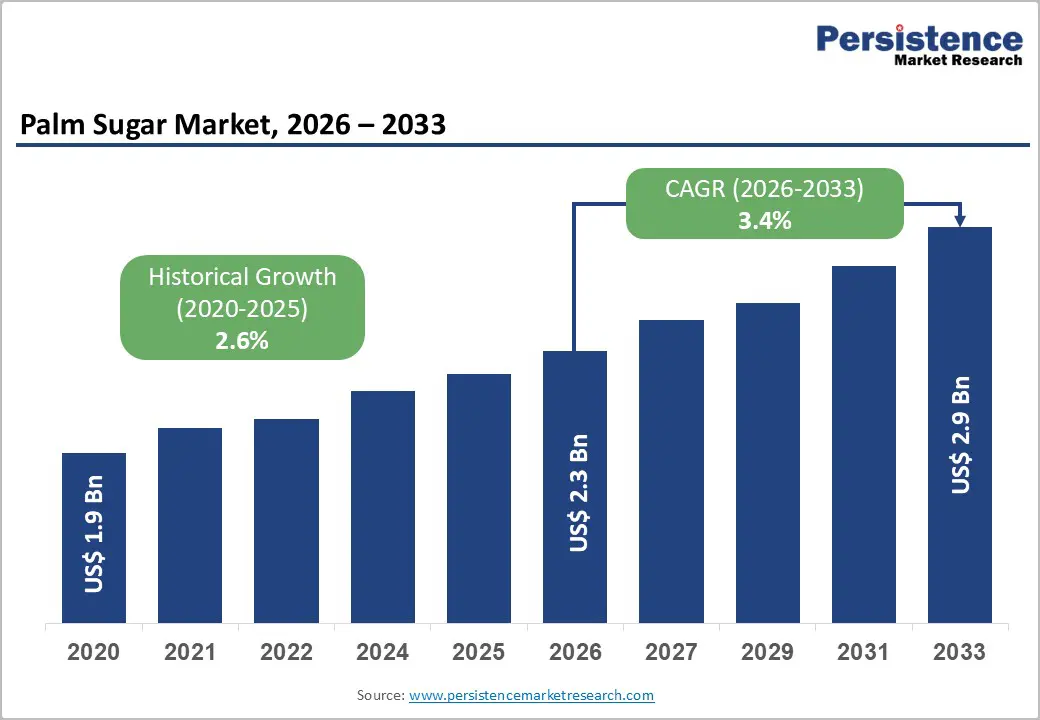
The global palm sugar market is estimated to grow from US$ 2.3 Bn in 2026 to US$ 2.9 Bn by 2033. The market is projected to record a CAGR of 3.4% during the forecast period from 2026 to 2033.
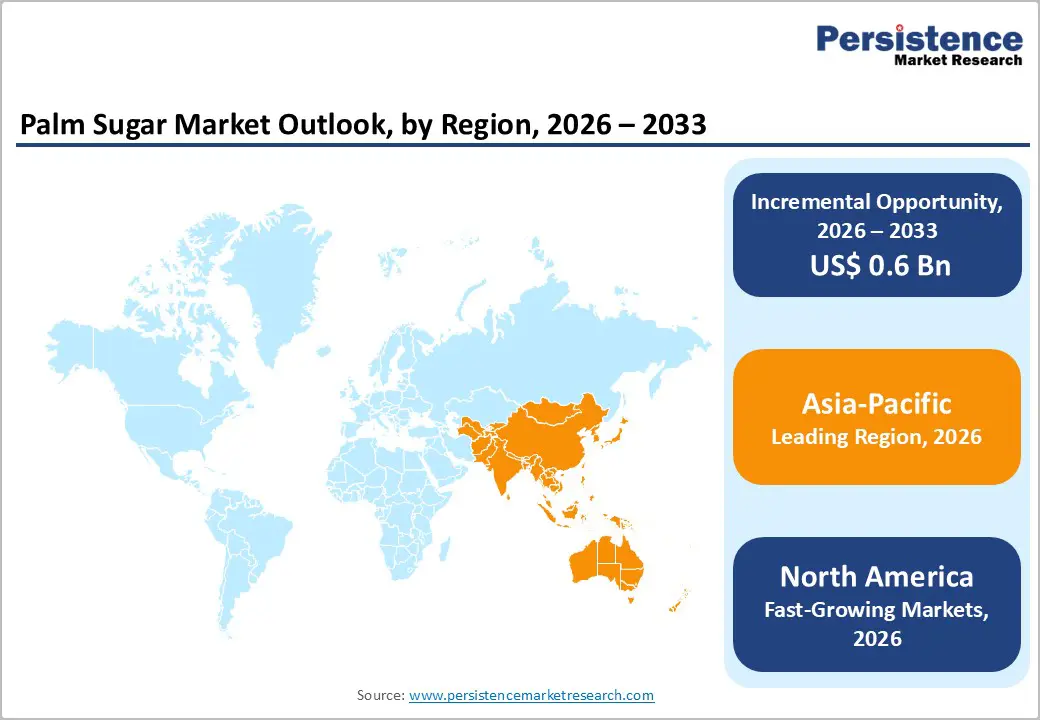
The global market is expanding steadily, driven by rising demand for natural sweeteners and clean-label food products. Asia Pacific leads due to strong production and traditional consumption, while North America is the fastest-growing region, supported by increasing health awareness, rising organic food demand, and consumer preference for low-glycemic sugar alternatives.
Key Industry Highlights
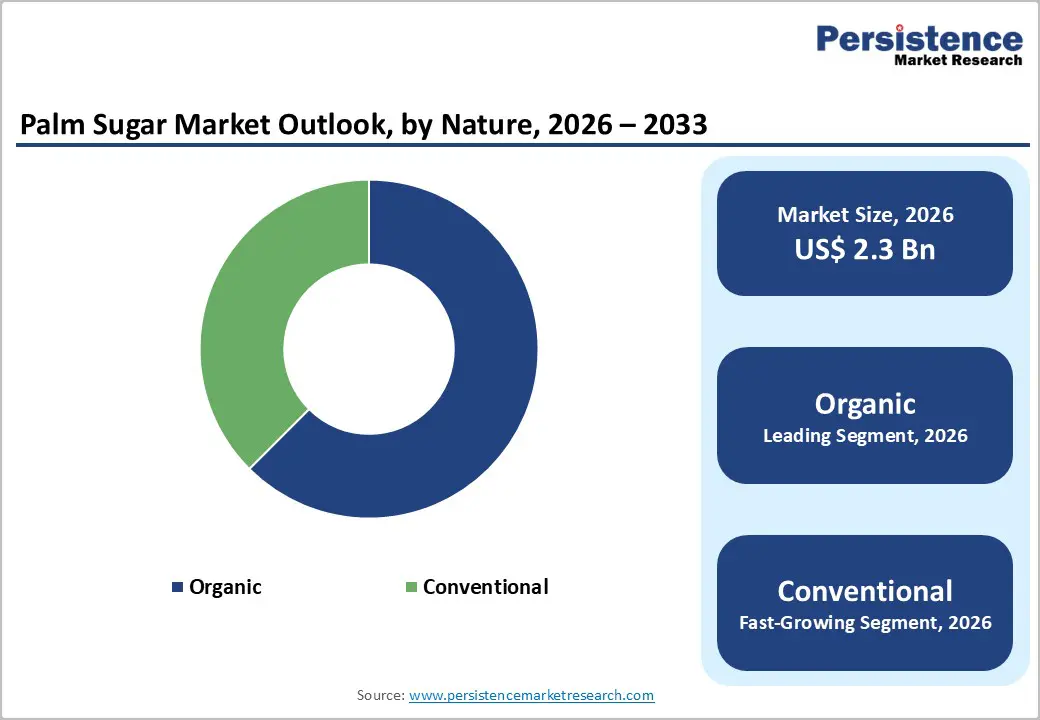
- Dominant Segment: Organic palm sugar held 62.5% share in 2025, driven by rising consumer demand for natural sweeteners, clean-label products, and chemical-free food ingredients across bakery, beverages, and packaged foods.
- Dominant Region: Asia Pacific is the leading region with the highest share in 2025 with 46.1 share, supported by large-scale palm cultivation, strong domestic consumption, and major production in Indonesia, Thailand, and the Philippines.
- Market Drivers: Growth is driven by increasing demand for natural sugar alternatives, rising health awareness, expanding organic food consumption, and growing use of palm sugar in bakery, beverages, and confectionery products.
- Market Opportunity: Opportunities include expansion in functional foods, increasing exports of organic palm sugar, product innovation in powdered and liquid forms, and growing adoption in North America and Europe.
| Key Insights | Details |
|---|---|
|
Global Palm Sugar Market Size (2026E) |
US$ 2.3 Bn |
|
Market Value Forecast (2033F) |
US$ 2.9 Bn |
|
Projected Growth (CAGR 2026 to 2033) |
3.4% |
|
Historical Market Growth (CAGR 2020 to 2025) |
2.6% |
Market Dynamics
Driver: Increasing Consumer Preference for Organic and Clean-Label Foods
The growing consumer shift toward organic and clean-label food products is a major driver of the Palm Sugar Market. Consumers increasingly prefer food ingredients that are natural, minimally processed, and free from artificial additives. Palm sugar fits this demand because it is typically produced by evaporating sap collected from palm tree flowers without chemical refining. According to research published in a food science study, palm sugar production globally is expected to reach about 958,000 metric tons by 2025, reflecting rising demand for natural sweeteners in health-focused diets. Health-conscious consumers in regions such as Europe and North America are increasingly replacing refined sugar with alternatives that contain trace minerals and antioxidants, supporting growth in natural sweetener markets.
Government and agricultural statistics also demonstrate the scale of raw material supply supporting this trend. For example, Indonesia alone produced nearly 18 million tons of coconuts in 2024, according to FAOSTAT agricultural data, making it the world’s largest coconut producer and a major source of palm sugar production. Coconut sap and other palm tree varieties are primary raw materials for palm sugar, and the widespread cultivation of these crops helps ensure raw material availability. As consumers seek organic and sustainable food options, food manufacturers increasingly incorporate palm sugar into bakery, beverage, and packaged food products, reinforcing its role as a clean-label ingredient in global food systems.
Restraint: Price Fluctuations Due to Seasonal Palm Sap Availability
Despite growing demand, the palm sugar market faces supply constraints due to its reliance on seasonal palm sap harvesting. Palm sugar production depends heavily on manual tapping of sap from palm flower stalks, which varies significantly based on climate conditions and seasonal changes. Research indicates that sap yields can decline by around 25% during dry seasons, reducing production volumes and increasing price volatility. Because most palm sugar is produced by smallholder farmers in Southeast Asia, fluctuations in weather conditions or labor availability can directly affect global supply chains and cause unstable market prices.
Another challenge is the limited industrialization of palm sugar production compared with refined cane sugar. More than 70% of the global palm sugar supply chain is controlled by small-scale producers, many of whom use traditional processing methods and lack advanced infrastructure. These small-scale operations often face challenges such as limited storage capacity, inconsistent quality control, and high post-harvest losses, which can reach about 18% of production during processing and distribution. Such inefficiencies increase production costs and limit supply stability. As a result, seasonal fluctuations in sap availability and processing inefficiencies remain significant restraints on the large-scale expansion of the palm sugar industry.
Opportunity: Growing Demand for Organic Palm Sugar in Premium Food Products
The increasing popularity of premium and functional food products presents a major opportunity for the palm sugar market. Organic palm sugar is often marketed as a healthier alternative to refined sugar because it retains small amounts of minerals such as potassium, magnesium, and iron derived from palm sap. This nutritional profile has encouraged food manufacturers to incorporate palm sugar into specialty food categories, including organic snacks, plant-based foods, and natural beverages. Research in food science literature indicates that 70–75% of the palm sugar market is dominated by regional and artisanal producers, highlighting strong demand for traditional and organic varieties. This demand is particularly evident in premium retail markets.
Export opportunities are also expanding as developed regions increasingly import natural sweeteners. Countries in Western Europe and North America have shown strong consumer demand for organic products due to higher disposable incomes and growing interest in sustainable diets. Studies indicate that palm sugar exports from producing countries such as India and Indonesia are reaching markets including the United Kingdom, Germany, France, Japan, and Canada, demonstrating growing international demand for premium natural sweeteners. As organic certification standards expand and food manufacturers launch clean-label products, palm sugar is expected to gain wider adoption in gourmet foods, bakery products, and specialty beverages, creating long-term growth opportunities.
Category-wise Analysis
By Nature Insights
Organic palm sugar dominates the market with 62.5% share in 2025, due to increasing consumer preference for natural, minimally processed sweeteners. Palm sugar is produced by evaporating palm sap without chemical refining, aligning with the global clean-label food trend. According to the Food and Agriculture Organization (FAO), countries such as Indonesia and the Philippines produce millions of tons of coconuts annually, providing abundant raw material for natural palm-based sweeteners. Nutritional studies also show that palm sugar contains trace minerals including potassium, iron, and magnesium, unlike refined sugar which is almost pure sucrose. Growing demand for organic food further supports this dominance; the Research Institute of Organic Agriculture (FiBL) reported that global organic food sales exceeded USD 130 billion in 2022, reflecting strong consumer interest in organic ingredients such as palm sugar.
By Form Insights
Crystal (granulated) palm sugar dominates the market because it is easier to store, transport, and use in food processing compared with liquid or paste forms. Crystal palm sugar has low moisture content, which increases shelf life and reduces spoilage during distribution. According to the Food and Agriculture Organization (FAO), sugar products with lower moisture content have significantly longer storage stability, making granulated formats more suitable for trade and export. Crystal palm sugar can also directly replace conventional sugar in recipes for bakery products, beverages, and confectionery. Additionally, traditional palm sugar processing methods naturally produce solid or crystalline blocks that can be crushed into granules, making this form widely available. These functional advantages and processing convenience contribute to the dominant share of crystal palm sugar globally.
Regional Insights
Asia-Pacific Palm Sugar Market Trends
Asia Pacific dominates the palm sugar market mainly due to large-scale palm and coconut cultivation and strong traditional consumption of palm-based sweeteners. Countries such as Indonesia, India, Thailand, and the Philippines are among the world’s largest coconut producers, which provides abundant raw material for palm sugar production. According to agricultural statistics from the Food and Agriculture Organization (FAO), the region accounts for the majority of global coconut cultivation, with millions of hectares dedicated to coconut farming. Palm sugar is also widely used in traditional foods and beverages across Southeast Asia, increasing domestic consumption. The availability of low-cost labor and established smallholder production systems further supports large-scale manufacturing, making Asia Pacific the primary production and supply hub for palm sugar globally.
Europe Palm Sugar Market Trends
Europe is an important region in the palm sugar market due to strong demand for organic and natural food ingredients. Consumers across the region increasingly prefer clean-label and plant-based products, which has boosted demand for natural sweeteners such as palm sugar. According to the Research Institute of Organic Agriculture (FiBL), organic food retail sales in Europe reached about €58.7 billion in 2024, demonstrating the strong consumer base for organic ingredients. Additionally, Europe is one of the world’s largest import markets for organic agri-food products, importing around 2.64 million tonnes of organic products annually, reflecting strong reliance on imported natural ingredients. This strong demand for organic foods and sustainable sweeteners makes Europe a key consumption and import market for palm sugar.
North America Palm Sugar Market Trends
North America is the fastest-growing region in the palm sugar market due to rising demand for natural sweeteners and organic foods. Consumers in the region are increasingly reducing refined sugar consumption and switching to plant-based alternatives such as coconut and palm sugar. According to the Research Institute of Organic Agriculture (FiBL), the United States is the largest organic food market globally, with sales exceeding €60 billion in 2024, highlighting strong consumer demand for organic ingredients. Growing awareness of clean-label diets, plant-based foods, and low-glycemic sweeteners has encouraged food manufacturers to incorporate palm sugar in bakery products, beverages, and packaged foods. These dietary shifts and strong purchasing power are driving rapid growth of the palm sugar market across North America.
Competitive Landscape
The palm sugar market is highly competitive, led by key producers and organic food brands such as Big Tree Farms, Navitas Organics, and Wholesome Sweeteners Inc.. These companies focus on expanding organic product portfolios, strengthening global distribution, promoting sustainable sourcing, and developing value-added natural sweeteners to meet rising demand for clean-label food ingredients.
Key Industry Developments:
- In February 2026, Indonesia launched exports of organic palm sugar from Pacitan to international markets, strengthening its position in the global natural sweeteners trade. The initiative was supported by local authorities and agricultural cooperatives to promote sustainably produced palm sugar made from coconut sap. Producers in Pacitan processed the sap using traditional methods while meeting international organic certification standards, enabling the product to enter premium markets.
- In July 2025, An engineer-turned-entrepreneur introduced a palm-based agricultural initiative in the state, aiming to promote palm cultivation and palm-derived products such as palm sugar. The entrepreneur encouraged local farmers to adopt palm farming by highlighting its economic potential and sustainable production process. By establishing processing units and training programs, the initiative helped farmers convert palm sap into value-added products like palm jaggery and palm sugar. The project also focused on improving rural livelihoods and expanding market access for palm-based sweeteners. As a result, the initiative strengthened local palm sugar production, created employment opportunities, and supported the development of a sustainable palm product ecosystem in the region.
Companies Covered in Palm Sugar Market
- JaggeryWorks
- Cocoasia Philippines
- Palm Organix
- La Palma Organics
- Agro-Productos del Trópico
- Farm Organic
- Mitr Phol Sugar Corporation
- El Guapo
- La Blanquita
- Cocowell Farm
- Others
Frequently Asked Questions
The global palm sugar market is projected to be valued at US$ 2.3 Bn in 2026.
Rising demand for natural sweeteners, clean-label foods, organic ingredients, and healthier alternatives to refined sugar.
The global palm sugar market is poised to witness a CAGR of 3.4% between 2026 and 2033.
Growing demand for organic sweeteners, expanding exports, product innovation, and increasing use in functional foods.
JaggeryWorks, Cocoasia Philippines, Palm Organix, La Palma Organics, Agro-Productos del Trópico, Farm Organic.


