




- Advanced Materials
- Zinc-Nickel Plating Market
Zinc-Nickel Plating Market Size, Share, and Growth Forecast, 2026 - 2033
Zinc-Nickel Plating Market by Product Type (Low-Temperature Zinc-Nickel Plating, High-Temperature Zinc-Nickel Plating), Application (Automotive, Electronics, Aerospace and Defense), And Regional Analysis, for 2026 - 2033

Zinc-Nickel Plating Market Size and Trend Analysis
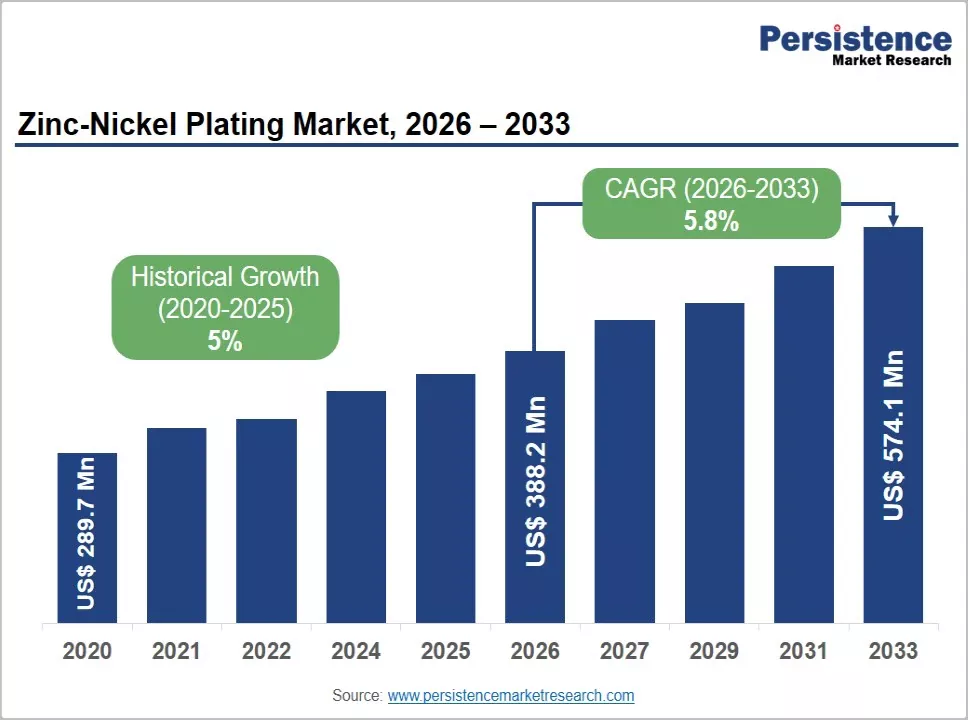
The global zinc-nickel plating market is likely to be valued at US$ 388.2 million in 2026 and is expected to reach US$ 574.1 million by 2033, growing at a CAGR of 5.8% during the forecast period from 2026 to 2033. Cadmium plating once dominated aerospace and military specifications, escalating RoHS and REACH regulatory pressure across the European Union.
It has driven a durable substitution wave toward zinc-nickel alloy coatings, which deliver superior salt-spray performance without the toxicological burden. Automotive OEMs including Stellantis and Toyota Motor Corporation have expanded zinc-nickel electroplating specifications across brake calipers, fasteners, and underbody components as electric vehicle platforms require longer corrosion-protection warranties.
Key Industry Highlights:
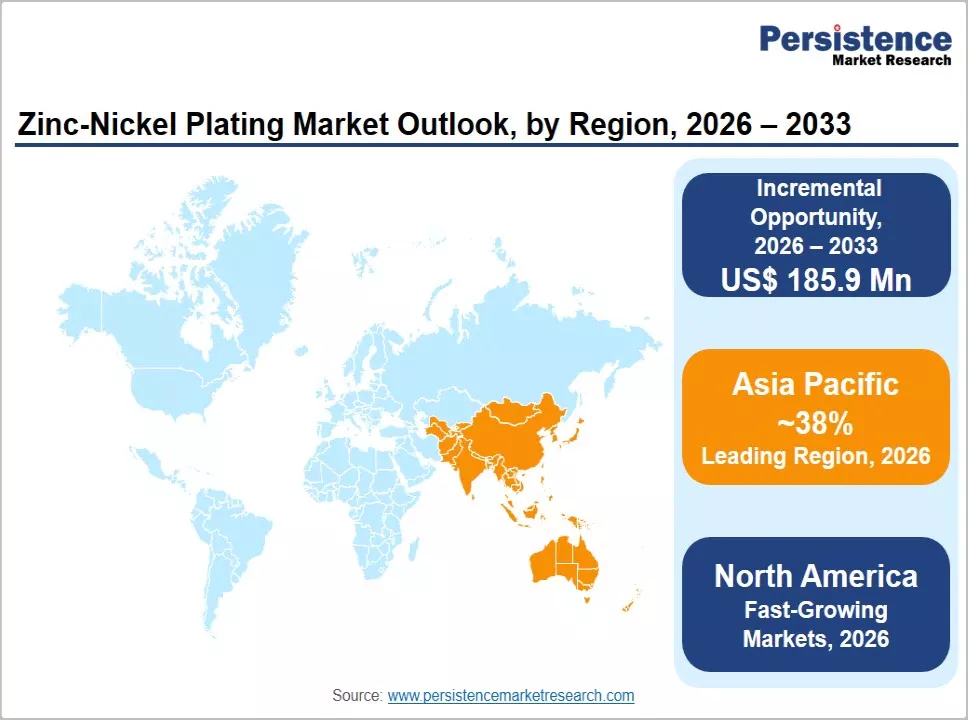
- Leading Region: Asia Pacific is anticipated to be the leading region in the zinc-nickel plating market, supported by a market value of US$ 147.52 million in 2026, driven by China's EV manufacturing scale and India's expanding automotive export ambitions.
- Leading Product Type: High-temperature zinc-nickel plating is projected to represent the leading product type segment in 2026, accounting for 61% of the market share, anchored by NADCAP-qualified aerospace applications and automotive OEM specifications.
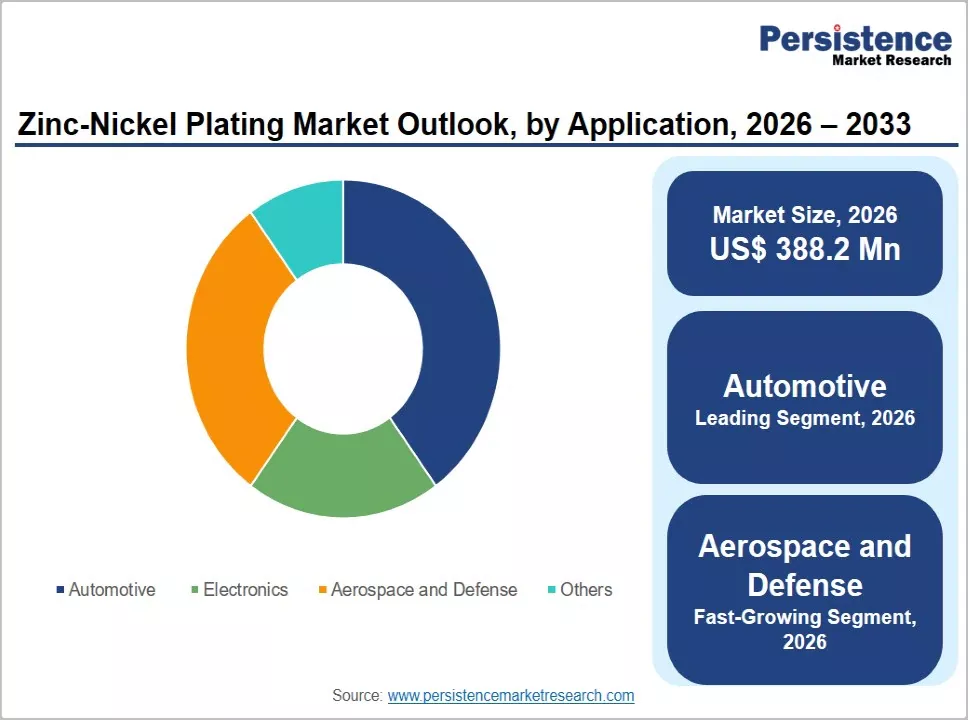
- Fastest-growing Application: Aerospace and defence is anticipated to be the fastest-growing application segment, supported by cadmium replacement programmes and the adoption of zinc-nickel as a preferred coating in maintenance, repair, and overhaul operations.
- Key Opportunity: Next-generation military platform procurement programmes create opportunities for NADCAP-approved plating operators with trivalent chromium passivation capability and automated bath monitoring.
DRO Analysis
Driver - Cadmium Replacement Mandates Across Defense and Aerospace Supply Chains
Regulatory prohibition of cadmium in surface finishing is a primary structural driver for zinc-nickel adoption. The U.S. Department of Defense (DoD) has progressively mandated cadmium elimination across military procurement under MIL-DTL-45204 and related specifications, substituting zinc-nickel alloy coatings that meet or exceed the corrosion performance benchmarks previously met by cadmium plating.
The National Aerospace and Defense Contractors Accreditation Program (NADCAP) process qualification requirements have incorporated zinc-nickel plating as a preferred alternative. This shift is irreversible, once a supply chain has qualified zinc-nickel under a NADCAP-audited special process, reverting to cadmium is both regulatory and contractually prohibitive.
Restraint - Hexavalent Chromium Passivation and Process Chemistry Compliance Costs
Zinc-nickel plating frequently employs trivalent or hexavalent chromium passivation to maximize salt-spray performance. The European Chemicals Agency (ECHA) has placed hexavalent chromium compounds on the SVHC (Substances of Very High Concern) candidate list under REACH Regulation EC 1907/2006, imposing substantial compliance costs on plating operators. Transitioning to trivalent chromium passivation systems requires capital expenditure on new bath chemistry, wastewater treatment upgrades, and re-qualification against customer specifications, a process that can take 12-24 months and cost smaller operators several hundred thousand euros.
Opportunity - Adoption in Next-Generation Military Platform Procurement Programs
Defence procurement programs initiated between 2023 and 2025 present a compelling expansion opportunity for zinc-nickel plating suppliers. The U.S. Army's Next Generation Combat Vehicle program and the UK Ministry of Defense’s Boxer armored vehicle procurement both specify advanced corrosion protection for electrical and mechanical subcomponents in harsh operational environments.
Zinc-nickel alloy coatings, particularly alkaline zinc-nickel plating systems capable of depositing on complex geometries and high-strength steel without hydrogen embrittlement, are well-positioned to capture specification slots across these platforms. First-tier defense contractors holding NADCAP-approved plating operations hold a structural advantage in qualifying for these program supply chains.
Category-wise Analysis
Product Type Insights
Why Does High-Temperature Zinc-Nickel Plating Command the Largest Market Share?
High-temperature zinc-nickel plating accounts for 61% of the zinc-nickel plating market in 2026, equivalent to US$ 236.80 million. This dominance reflects the segment's established position in automotive and aerospace supply chains, where elevated bath temperatures (typically 55-65°C in alkaline systems) produce denser, more uniform alloy deposits with tighter nickel content control.
Brake system components, wheel hub assemblies, and engine fasteners for OEMs including Ford Motor Company and BMW AG are routinely specified under high-temperature process parameters because the resulting deposit morphology delivers measurably superior adhesion and post-plate adhesion on complex geometries. The segment's entrenched position in NADCAP-audited aerospace supply chains further insulates it from displacement.
Low-temperature zinc-nickel plating is the fastest-growing segment, gaining traction as electronics and EV battery hardware manufacturers seek processes compatible with temperature-sensitive substrates. MacDermid Enthone's low-temperature alkaline zinc-nickel chemistry, qualified for IPC-6012 Class 3 printed circuit board surface finishing, is expanding adoption among electronics contract manufacturers who require corrosion-resistant coatings on copper alloy connectors and shielding components without thermal degradation risk.
Application Analysis
What Is Driving Automotive Sector Dominance in the Zinc-Nickel Plating Industry?
The automotive segment accounts for 57% of the zinc-nickel plating market in 2026, equivalent to US$ 221.27 million. Automotive OEMs and their Tier-1 suppliers are the defining buyers in this market because corrosion protection is a warranty liability item, not a discretionary specification.
Zinc-nickel electroplated fasteners, brake caliper brackets, and anti-lock braking system (ABS) sensor housings must meet ISO 9227 salt-spray thresholds defined in OEM supplier quality manuals, in many cases exceeding 720 hours to white corrosion. Continental AG and ZF Friedrichshafen AG both maintain approved supplier lists for zinc-nickel plating that gate access to high-volume platform contracts.
Aerospace and defense is the fastest-growing application segment. The U.S. Air Force's F-35 sustainment program expanded its qualified products list for zinc-nickel plated fasteners and hydraulic fittings in 2023, citing fatigue-performance parity with cadmium on high-strength steel alloys.
Regional Insights
North America Zinc-Nickel Plating Market Trends
North America accounts for 20% of the zinc-nickel plating market in 2026, representing US$ 77.64 million. The region's demand base is anchored in automotive Tier-1 manufacturing corridors across Michigan, Ohio, and Ontario, where just-in-time supply chain structures favor proximity plating services. The Inflation Reduction Act (IRA) domestic content requirements are incentivizing onshore EV component manufacturing, which indirectly expands regional zinc-nickel plating demand as local fastener and bracket production scales.
U.S. Zinc-Nickel Plating Market Trends
The U.S. zinc-nickel plating market represents 88% of the North America regional market in 2026, equivalent to US$ 68.32 million. Defense procurement (specifically DoD cadmium replacement programs) constitutes the most structurally durable demand driver, complemented by EV platform ramp-ups at General Motors' (GM) assembly facilities in Michigan and Tennessee. Continued NADCAP audit expansion in aerospace MRO will deepen specification penetration through 2033.
Canada Zinc-Nickel Plating Market Trends
The Canada zinc-nickel plating market represents 12% of the North America regional market in 2026, equivalent to US$ 9.32 million. Ontario-based Tier-1 automotive suppliers serving Stellantis and Honda Motor Co. assembly plants drive the majority of regional demand. Bilateral supply chain integration under the Canada-U.S.-Mexico Agreement (CUSMA) ensures that OEM specification changes in the U.S. cascade rapidly into Canadian supplier qualification requirements.
Europe Zinc-Nickel Plating Market Trends
Europe accounts for 17% of the zinc-nickel plating market in 2026, representing US$ 104.81 million. The region's regulatory environment is the most stringent for surface finishing chemistry, with REACH and EU End-of-Life Vehicles Directive 2000/53/EC amendments creating durable pull for cadmium-free corrosion coatings. Germany's dense automotive OEM and Tier-1 supplier ecosystem sustains the region's outsized market contribution relative to its manufacturing scale.
Germany Zinc-Nickel Plating Market Trends
The Germany zinc-nickel plating market represents 34% of the Europe regional market in 2026, equivalent to US$ 35.64 million. BMW AG and Mercedes-Benz Group AG supplier quality standards mandate zinc-nickel alloy coatings across underbody fastener categories, creating consistent, recurring demand through established approved vendor relationships. As German OEMs accelerate EV platform transitions toward 2030 fleet emissions targets, zinc-nickel specification depth per vehicle is expected to increase.
U.K. Zinc-Nickel Plating Market Trends
The U.K. zinc-nickel plating market represents 18% of the Europe regional market in 2026, equivalent to US$ 18.87 million. Aerospace and defense manufacturing (centered on the BAE Systems and Rolls-Royce plc supply chains) constitutes the primary demand base, with NADCAP-qualified plating operations in the West Midlands and South West England serving platform-critical component requirements. Post-Brexit alignment with UK REACH chemical regulations preserves the cadmium substitution mandate that underpins structural zinc-nickel demand.
Asia Pacific Zinc-Nickel Plating Market Trends
Why Is Asia Pacific the Leading Region in the Market?
Asia Pacific accounts for 38% of the zinc-nickel plating market in 2026, representing US$ 147.52 million, the largest regional share globally. China's automotive production volumes and India's rapidly expanding two-wheeler and passenger vehicle manufacturing base are the twin engines of regional growth. Japanese and South Korean automotive OEMs exporting platform specifications to regional Tier-1 networks are propagating zinc-nickel plating adoption across Southeast Asian manufacturing clusters with particular speed.
China Zinc-Nickel Plating Market Trends
The China zinc-nickel plating market represents 35% of the Asia Pacific regional market in 2026, equivalent to US$ 51.63 million. BYD Company Limited and SAIC Motor Corporation have incorporated zinc-nickel plated fastener specifications into EV platform supplier manuals, creating a rapidly scaling procurement channel for domestic and international plating operators. China's GB/T 12599 national standard for electroplated zinc-nickel coatings is progressively aligning with ISO 4042, reducing friction in multinational supply chain qualification processes.
India Zinc-Nickel Plating Market Trends
The India zinc-nickel plating market represents 19% of the Asia Pacific regional market in 2026, equivalent to US$ 28.03 million. Tata Motors Limited and Mahindra & Mahindra are expanding zinc-nickel plating specifications as they qualify for export-oriented OEM programs that impose international corrosion testing standards. India's Production Linked Incentive (PLI) scheme for automotive components is funding surface finishing capacity upgrades among Indian Tier-2 suppliers, with zinc-nickel electroplating lines among the prioritized technology investments.
Competitive Landscape
The zinc-nickel plating industry operates across two distinct competitive tiers. Captive plating operations embedded within large Tier-1 automotive and aerospace manufacturers (such as those within Continental AG and Lockheed Martin Corporation's production networks) handle the highest-volume, most specification-critical work in-house.
The external market is served by independent job shops and specialty finishers, where KC Jones Plating, MacDermid Enthone (the chemistry supplier that shapes process capability), Chem Processing Inc., Paramount Metal Finishing, Micro Metal Finishing, Plating Technology Inc., DeKalb Metal Finishing, and Pioneer Metal Finishing (PMF) constitute the primary competitive set. Winning in this environment depends less on price and more on NADCAP certification status, salt-spray test track record, and the ability to plate complex geometries with consistent alloy deposit composition, differentiators that require capital investment and technical depth that constrain rapid competitive entry.
Key Industry Developments:
- In August 2026, MKS' Atotech announced that it would present its zinc nickel and non-PFAS zinc flake corrosion protection technologies at EBRATS 2026 in São Paulo, Brazil, from 9 to 12 September 2026.
Companies Covered in Zinc-Nickel Plating Market
- Chem Processing Inc.
- DeKalb Metal Finishing
- KC Jones Plating
- MacDermid Enthone
- Micro Metal Finishing
- Paramount Metal Finishing
- Pioneer Metal Finishing (PMF)
- Plating Technology Inc.
Frequently Asked Questions
The market is valued at US$ 388.20 million in 2026 and is forecast to reach US$ 574.1 million by 2033, expanding at a CAGR of 5.8%.
Accelerating electric vehicle production requiring extended corrosion protection warranties on underbody components.
High-temperature zinc-nickel plating holds the largest product segment share at 61% in 2026. Its dominance reflects entrenched qualification within NADCAP-audited aerospace processes and automotive OEM supplier standards.
Asia Pacific leads the market with a 38% share in 2026, valued at US$ 147.52 million. The region's position rests on China's high-volume EV manufacturing base.
The highest-value opportunity lies in defense platform cadmium replacement programs, where zinc-nickel alloy coatings are qualifying under next-generation military procurement specifications across the U.S. Army and allied defense programs.
Leading companies include KC Jones Plating, Chem Processing Inc., Paramount Metal Finishing, Pioneer Metal Finishing (PMF), DeKalb Metal Finishing, and Micro Metal Finishing.


