




- Specialty & Fine Chemicals
- White Cement Market
White Cement Market Size, Share, and Growth Forecast 2026 - 2033
White Cement Market by Product Type (White Portland Cement, White Masonry Cement, White Blended Cement, White Rapid Hardening Cement, Specialty White Cement, Others), Grade (Type I, Type II, Type III, Specialty Grades), Application (Residential Construction, Commercial Construction, Infrastructure & Public Works, Industrial Construction, Architectural & Decorative Applications, Precast Concrete, Tile Grouting & Fixing, Wall Putty & Surface Finishes, Flooring & Terrazzo Applications, Others), End-user, and Regional Analysis, 2026 - 2033

White Cement Market Size and Trend Analysis
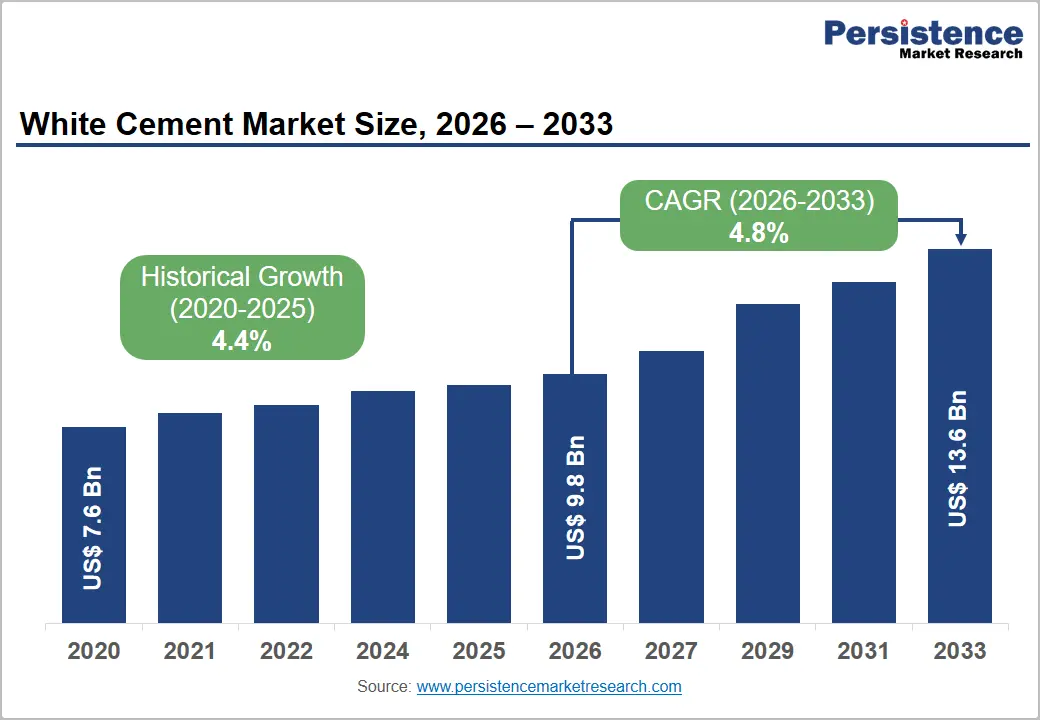
The global white cement market size is expected to be valued at US$ 9.8 billion in 2026 and projected to reach US$ 13.6 billion by 2033, growing at a CAGR of 4.8% between 2026 and 2033. This steady expansion is primarily driven by accelerating urbanization across the Asia Pacific and Middle East & Africa regions, rising consumer preference for aesthetically superior construction finishes, and sustained infrastructure investment by national governments.
Growing adoption of white cement in architectural and decorative applications, from premium residential façades to high-specification public infrastructure, is reinforcing demand, while growing construction activity in emerging economies presents a structurally durable demand pipeline through the forecast period.
Key Industry Highlights
- Leading Region: Asia Pacific leads the global white cement market with approximately 38% share in 2025, driven by large-scale urbanization in India and China and rising specification standards in commercial and residential construction across the region.
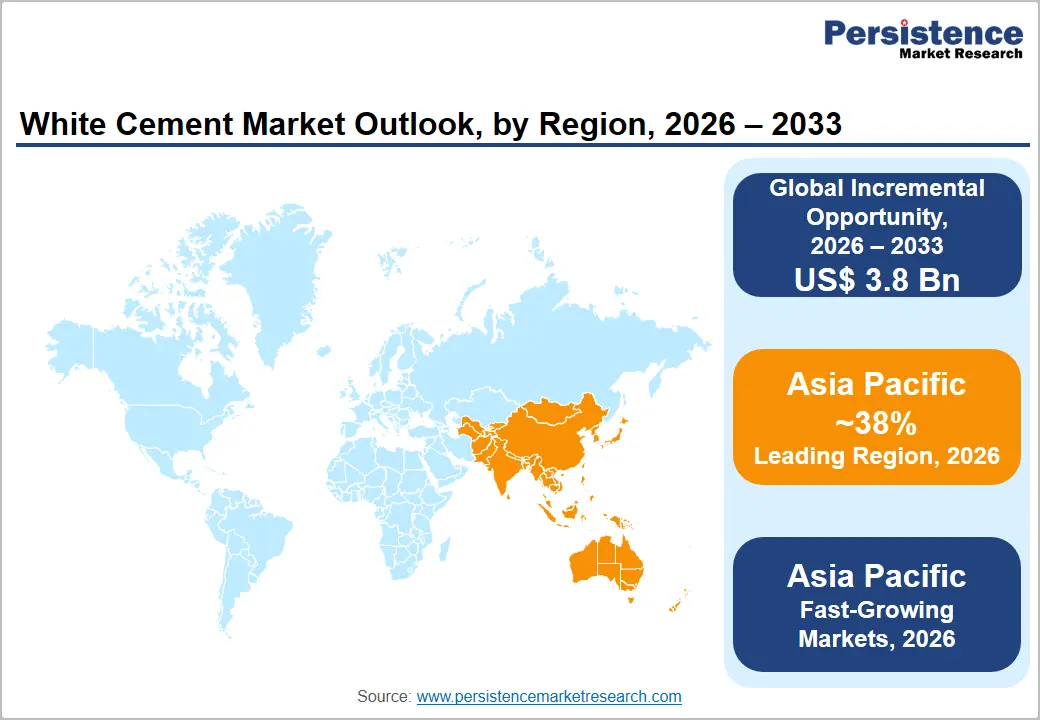
- Fastest Growing Region: Asia Pacific is also the fastest-growing region, projected at a CAGR of 6.2% through 2033, catalyzed by India's government housing programs, Southeast Asia's urban construction boom, and rapid adoption of premium architectural finishes.
- Dominant Product Type: White Portland Cement dominates the product type category with approximately 62% market share in 2025, sustained by universal compliance with ASTM C150 and EN 197-1 standards and deep entrenchment across commercial and residential construction specifications globally.
- Fast-Growing Application: Architectural & Decorative Applications is the fastest-growing application segment, driven by rising architect specifications of exposed decorative concrete, contemporary façade systems, and premium interior finishes in commercial construction across developed and emerging markets.
- Key Opportunity: Low-carbon and EPD-certified white cement formulations represent the key actionable opportunity: producers that invest in sustainable product lines can capture specification-driven demand in EU and North American green building procurement markets where embodied carbon is increasingly a decisive criterion.
Market Dynamics
Drivers - Accelerating Urbanization and Premium Construction Activity in Emerging Economies
For construction materials manufacturers and distributors, the urbanization wave sweeping Asia Pacific, the Middle East, and Sub-Saharan Africa signals a structural, multi-decade demand corridor for white cement that rewards early capacity investment and distribution network development. The United Nations projects that by 2050, 68% of the global population will reside in urban areas, up from 56% in 2021, with the most rapid urban growth concentrated in India, China, Nigeria, and Indonesia, markets where rising middle-class aspirations are translating into strong demand for premium-finish residential and commercial construction.
White cement, which commands a price premium of 2-3x over grey cement due to its superior brightness, low iron content, and architectural versatility, is increasingly specified in high-rise residential projects, luxury hotel developments, and civic infrastructure schemes. This price premium dynamic also means that producers serving emerging urban markets can sustain higher unit margins than commodity grey cement suppliers, making strategic entry into these geographies particularly attractive for incumbents and new entrants alike.
Rising Demand for Architectural and Decorative Applications in Commercial Construction
White cement's expanding role in architectural and decorative segments, from precast façade panels and terrazzo flooring to tile grouts and decorative renders, is redefining it from a niche commodity into a premium performance material, with direct implications for pricing power and product differentiation strategies. The Global Construction Perspectives and Oxford Economics forecast that global construction output will grow by 42% to reach US$ 15.2 trillion by 2030, with commercial and institutional construction, segments that most heavily specify decorative and architectural finishes, constituting the fastest-growing sub-category in developed markets.
White cement's unique optical properties, including a brightness index exceeding 85 on the Whiteness Scale, make it the material of choice for architects specifying contemporary clean-line aesthetics in commercial interiors and façades. Producers that invest in technical sales capabilities and maintain consistent product quality, particularly in terms of low manganese and iron oxide content, are best positioned to capture specification-driven demand, which tends to lock in repeat purchase relationships with architectural firms and major contractors.
Restraints - High Production Costs and Energy Intensity Relative to Grey Cement
White cement's manufacturing process imposes structural cost disadvantages that constrain margin expansion and limit the addressable market to projects where aesthetic or performance requirements justify the premium. Producing white cement requires the use of low-iron raw materials, specifically kaolin-rich limestone and silica, which are geographically concentrated and command higher extraction and logistics costs than the raw inputs used in grey cement production.
More critically, the kiln firing process for white cement must operate at temperatures of approximately 1,450-1,500°C, and the rapid quenching step required to preserve whiteness substantially increases fuel consumption; energy costs can account for 30-40% of total production costs according to assessments by the European Cement Association (CEMBUREAU). These cost pressures are amplified in markets with high industrial energy tariffs, directly compressing producer margins and, in some cases, pricing white cement out of cost-sensitive construction segments.
Substitution Risk from Alternative Architectural Finish Materials
White cement faces increasing substitution pressure from alternative architectural finish materials such as polymer-based renders, fiber cement boards, and engineered stone panels that can deliver similar aesthetics at comparable or lower installation costs, particularly in commercial construction projects. Producers of these substitute materials have significantly advanced product performance, with modern polymer renders offering high brightness, improved crack resistance, and faster application compared to conventional white cement plasters, making them attractive for contractors operating under tight timelines and budget constraints.
Regulatory focus on embodied carbon in construction materials has further accelerated interest in alternative façade systems with lower emission profiles. As sustainability standards become more influential in procurement and project specification decisions, white cement manufacturers are under growing pressure to strengthen product innovation and environmental credentials. This has increased investments in low-carbon white cement formulations, energy-efficient production technologies, and sustainability certifications to maintain competitiveness in specification-driven architectural and infrastructure markets.
Market Opportunities
Expansion in Gulf Cooperation Council (GCC) Infrastructure and Mega-Project Pipeline
The Gulf Cooperation Council (GCC) nations represent one of the most compelling near-term growth opportunities for white cement producers globally, as the region's unprecedented infrastructure investment cycle, anchored by Saudi Arabia's Vision 2030, the UAE's national infrastructure agenda, and Qatar's post-World Cup urban development programs, is generating sustained specification demand for premium construction materials.
Saudi Arabia alone has earmarked over US$ 1 trillion in public and private investment across giga-projects including NEOM, The Red Sea Project, and Diriyah Gate, all of which feature extensive architectural concrete, decorative façade systems, and high-specification interior finishes that strongly favor white cement.
Regional producers such as Saudi White Cement Company and Ras Al Khaimah Cement Company are strategically positioned to serve this demand, but international players with superior technical product grades and white cement specialty blends can compete effectively through specification partnerships with global architecture and engineering firms active in the region. Companies that establish relationships with EPC contractors and regional distributors in the GCC before the peak construction phases of these megaprojects are likely to secure long-term supply agreements that will sustain volume through the early 2030s.
Growth in Sustainable and Low-Carbon White Cement Formulations
The accelerating decarbonization agenda in global construction creates a differentiated product opportunity for white cement producers that can credibly offer low-carbon or blended white cement formulations, an area where first-movers can command specification preference and premium pricing in environmentally regulated markets. The International Energy Agency (IEA) identifies cement manufacturing as responsible for approximately 7% of global CO2 emissions, and as green building certification systems, including LEED, BREEAM, and DGNB, increasingly weight embodied carbon metrics, specifiers in North America, Europe, and Australia are actively seeking cement products with verified lower carbon footprints. Several white cement producers, including Cementir Holding N.V. through its Aalborg White brand, have already introduced supplementary cementitious material (SCM)-blended white cement products designed to reduce clinker-to-cement ratios and associated CO2 emissions without compromising whiteness or strength. Producers that invest in lifecycle assessment (LCA) documentation, Environmental Product Declarations (EPDs), and third-party certification for their low-carbon white cement lines can differentiate on sustainability credentials, a factor that is increasingly decisive in public procurement and institutional building specifications across the EU and North America.
Category-wise Analysis
Product Type Insights
White portland cement is likely to command the leading position in the product type category, accounting for approximately 62% of the global white cement market in 2026. Its dominance is reinforced by compatibility with established construction codes, broad contractor familiarity, and an extensive distribution ecosystem developed over decades. White portland cement meets the ASTM C150 and EN 197-1 standards that most commercial and institutional construction projects require, making it the default specification choice across a wide range of architectural and structural applications.
While specialty grades and blended variants are gaining traction, particularly in sustainability-driven procurement contexts, white portland cement retains a durable leadership position due to its performance predictability and the high switching costs associated with reformulating product specifications mid-project.
Grade Insights
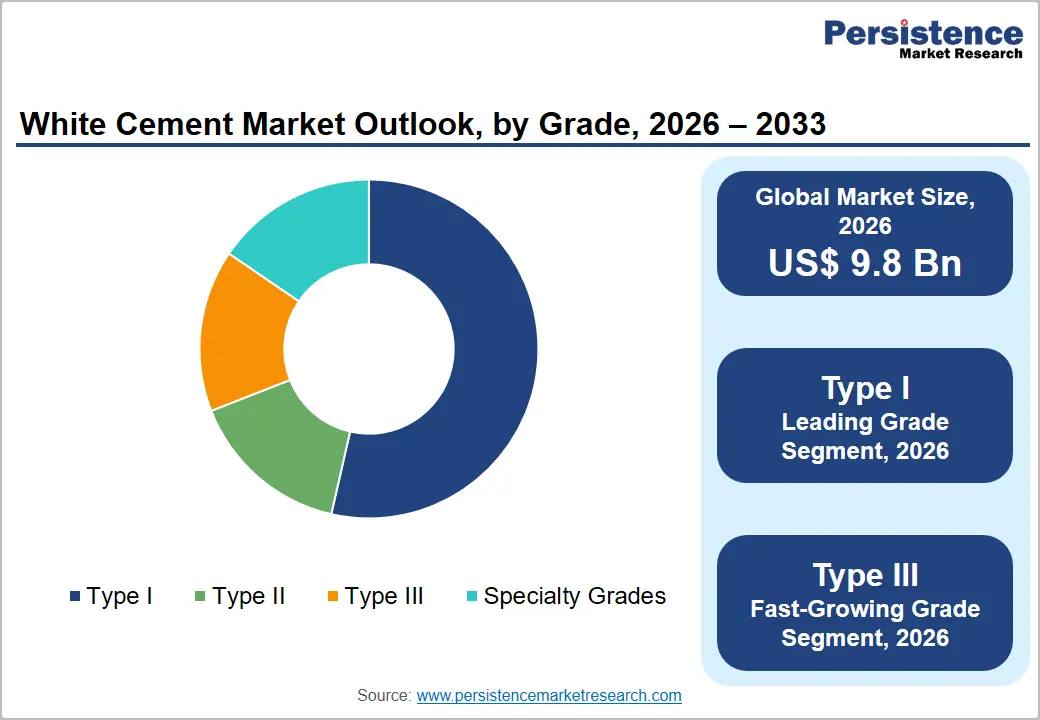
Type I white cement grade dominates the market, accounting for approximately 55% of total market volume in 2026, due to its broad suitability across general construction applications and widespread acceptance under major building standards such as ASTM C150 and EN 197. Its leadership is supported by strong contractor preference, as the material offers reliable strength development, compatibility with conventional admixtures, and well-established performance characteristics throughout the construction supply chain.
The segment’s large volume base is further reinforced by extensive usage in residential, commercial, and infrastructure projects where standard curing timelines are acceptable. Although Type III white cement is gaining traction in precast construction and time-sensitive projects because of its rapid early strength properties, Type I continues to maintain a substantially larger share owing to its cost-effectiveness, specification familiarity, and versatility across a broad range of structural and decorative applications.
Application Analysis
Architectural & decorative applications represent the leading application segment for white cement, accounting for approximately 28% of total demand in 2026, a position that reflects the premium pricing environment in this segment and the strong product-market fit between white cement's optical properties and the requirements of contemporary architectural design. Demand in this segment is driven by its use in exposed concrete façades, decorative renders, ornamental precast elements, and high-specification interior finishes, where the material's consistent brightness index, critical for achieving uniform color when pigmented, makes it irreplaceable relative to grey cement alternatives.
According to the European Concrete Platform, decorative and architectural concrete applications are among the fastest-growing end-use categories for cement in developed markets, with sustainability-certified architectural concrete, which frequently specifies white cement as the base, gaining prominence in public and institutional buildings. The premium nature of architectural applications also means this segment delivers disproportionately high revenue contribution relative to its volume share, sustaining white cement producers' ability to invest in product quality and technical support capabilities.
End-user Insights
The commercial end-use segment leads the white cement market, accounting for approximately 34% of market share in 2026, supported by the high material intensity and large-scale procurement associated with commercial construction projects. Retail centers, hospitality properties, office campuses, and mixed-use developments extensively utilize white cement in architectural finishes, precast structures, flooring, façades, and decorative concrete applications to meet premium design and aesthetic requirements.
Strong growth in commercial infrastructure investment across emerging economies such as India, Vietnam, Indonesia, and Saudi Arabia continues to support segment expansion. The dominance of the commercial sector is further strengthened by the scale of individual projects, where a single large commercial development can consume substantial quantities of white cement across multiple applications. Rising urbanization, increasing investment in modern commercial spaces, and growing emphasis on visually differentiated construction materials continue to reinforce demand from this segment globally.
Regional Insights
North America White Cement Market Trends and Insights
North America represents approximately 18% of the global white cement market in 2026. The market here is characterized by high per-unit value rather than volume scale, with white cement predominantly deployed in architectural concrete, tile grouting, and decorative precast applications. Tightening environmental building standards, particularly LEED v4.1 certification requirements, are increasingly directing specifiers toward low-carbon white cement alternatives, signaling a product mix shift that will reward producers capable of offering certified sustainable formulations.
Market participants should anticipate growing specification preference for Environmental Product Declaration (EPD)-backed products as green procurement policies expand at federal and state levels.
U.S. White Cement Market Size
The United States accounts for approximately 75% of North America's white cement consumption in 2026, supported by robust commercial construction pipelines in metropolitan markets including New York, Los Angeles, Miami, and Dallas, where premium architectural finishes are standard project specifications. The demand is reinforced by strong activity in the renovation and retrofit segment, where white cement-based renders and tile adhesives command consistent volumes. The U.S. market is trending toward higher-specification blended white cement products aligned with green building mandates, positioning quality-differentiated producers for above-average value growth.
Europe White Cement Market Trends and Insights
Europe is poised to account for approximately 22% of global white cement market share in 2026, making it the second-largest regional market, shaped by a sophisticated specification culture, strong architectural heritage, and an increasingly stringent sustainability regulatory environment under the EU Green Deal and revised Construction Products Regulation (CPR). Demand is concentrated in Germany, France, Spain, and the U.K., with white cement extensively specified for façade restoration, historic building renovation, and premium new-build residential and commercial projects.
The region's embodied carbon reduction targets are accelerating producer investment in blended and supplementary cementitious material (SCM)-enhanced white cement formulations, reshaping the product portfolio of major regional producers including Cementir Holding and Dyckerhoff GmbH. Europe's market evolution points toward premiumization and sustainability certification as the twin axes of competitive differentiation.
Germany White Cement Market Size
Germany represents approximately 18% of Europe's white cement consumption in 2026, underpinned by one of the region's most technically demanding architectural construction sectors and a renovation market driven by the country's aging building stock and ambitious Gebäudeenergiegesetz (Building Energy Act) compliance requirements. Demand from precast concrete manufacturers, a well-developed sector in Germany, provides a stable industrial volume base. Germany's trajectory points toward accelerating demand for certified low-carbon white cement variants as public procurement increasingly mandates EPD documentation.
U.K. White Cement Market Size
The U.K. accounts for approximately 14% of Europe's white cement market in 2026, with demand driven by the country's active commercial construction sector, particularly in London and other major urban centers, and a sizeable heritage building renovation market that specifies white cement mortars and renders for conservation compliance. UK Concrete's industry data highlights steady growth in architectural precast concrete, a segment that disproportionately consumes white cement. The trajectory toward net-zero buildings under the UK Net Zero Strategy will progressively favor producers offering low-embodied-carbon white cement products.
France White Cement Market Size
France represents approximately 12% of Europe's white cement market in 2026, driven by a mature architectural construction sector, a culturally embedded preference for high-quality exterior renders and decorative finishes, and sustained renovation activity in the country's substantial pre-war residential building stock.
The French government's MaPrimeRenov renovation subsidy program is channeling meaningful investment into building envelope upgrades, creating consistent demand for white cement-based renders and plasters. France's white cement market is forecast to grow steadily, with premiumization and sustainability certification increasingly determining producer competitiveness.
Asia Pacific White Cement Market Trends and Insights
Asia Pacific is the dominant regional market, holding approximately 38% of global white cement demand in 2026, and is simultaneously the fastest-growing region, projected to expand at a CAGR of approximately 6.2% between 2026 and 2033. The region's structural growth story is anchored in India's rapidly expanding urban construction sector, China's sustained investment in high-specification commercial and infrastructure development, and Southeast Asia's emerging middle-class-driven residential construction boom. China remains the largest single country market, with white cement heavily specified in the country's voluminous commercial and hospitality construction pipeline.
India White Cement Market Size
India is likely to accounts for approximately 22% of Asia Pacific's white cement consumption in 2026 and is the fastest-growing national market globally, propelled by the Pradhan Mantri Awas Yojana (PMAY) housing program, rapid commercial construction in Tier-1 and Tier-2 cities, and a booming wall putty segment, where white cement is the primary raw material, that is growing at double-digit rates annually. Domestic producers UltraTech Cement and JK Cement dominate supply, with JK Cement operating the world's largest single-location white cement plant. India's market trajectory strongly favors capacity expansion and value-added product development by incumbents.
Japan White Cement Market Size
Japan is poised to represent approximately 10% of Asia Pacific's white cement demand in 2026, with consumption concentrated in the country's mature architectural precast concrete sector and high-specification renovation market. The demand is stable rather than high-growth, reflecting Japan's demographic profile and relatively modest new-build residential construction volumes. However, the country's strong tradition of design-led architecture and stringent material quality standards sustain consistent demand for premium white cement grades. Investment in seismic-resistant precast construction systems, a government priority, is a measured growth catalyst for specialized white cement demand.
South Korea White Cement Market Size
South Korea accounts for approximately 8% of Asia Pacific's white cement market in 2026, with demand anchored in the country's active high-rise residential construction sector and a developed interior finishes industry that extensively uses white cement-based tile adhesives and grouts. South Korea's well-established precast concrete manufacturing sector, supplying both domestic and export markets, is a stable demand driver. Rising consumer preference for European-style interior aesthetics in premium residential developments is gradually upgrading specification standards toward higher-brightness white cement products, supporting value-driven market growth.
Competitive Landscape
The global white cement market is moderately consolidated, with competition shaped primarily by production scale, access to high-purity limestone reserves, and strategically located manufacturing facilities near export hubs and high-growth construction regions. Market participants compete through consistent whiteness quality, broad distribution coverage, and technical collaboration with architects, contractors, and infrastructure developers. While large integrated producers maintain advantages in raw material sourcing and operational efficiency, regional manufacturers remain competitive through localized supply networks and cost-effective offerings tailored to domestic construction demand.
A key competitive trend is the growing emphasis on sustainability-oriented product portfolios, particularly low-carbon and environmentally certified white cement variants aimed at green building projects. Companies are increasingly investing in energy-efficient kilns, alternative fuels, clinker optimization, and Environmental Product Declarations (EPDs) to strengthen positioning in specification-driven markets. Strategic priorities also include export expansion, premium decorative applications, and partnerships with construction material distributors to improve market penetration and customer retention.
Key Developments:
- January 2026: Cementir Holding N.V. highlighted its sustainable transition in white cement through the expansion of its low-carbon D-Carb product range, offering up to 20% lower CO2 emissions while maintaining performance and supporting global decarbonization goals.
- October 2025: Asian Paints commenced commercial production at its new white cement manufacturing facility in Fujairah, UAE, with an initial capacity of 265,000 tons annually, marking the company’s expansion into the global white cement market.
- February 2025: Mannok launched its new Ultra White Cement, manufactured by Çimsa at its Mersin plant in Türkiye, expanding its premium cement portfolio across the UK and Ireland with a high-whiteness product for decorative and structural applications.
Companies Covered in White Cement Market
- UltraTech Cement
- JK Cement
- Cementir Holding N.V. (Aalborg White)
- Çimsa Çimento Sanayi ve Ticaret A.Ş.
- Royal White Cement
- Holcim Group
- Dyckerhoff GmbH
- Federal White Cement
- India Cements Ltd.
- Saudi White Cement Company
- CEMEX S.A.B. de C.V.
- Societe Tuniso-Andalouse de Ciment Blanc (SOTACIB)
- Ras Al Khaimah Cement Company
- Adana Çimento
- Cementos Portland Valderrivas
- Cimsa (standalone distribution entities)
- Lehigh Hanson (Heidelberg Materials)
- Suez Cement Company
- Oman Cement Company
- Trinidad Cement Limited
Frequently Asked Questions
The global White Cement market is valued at US$ 9.8 billion in 2026 and is projected to reach US$ 13.6 billion by 2033, growing at a CAGR of 4.8%.
Rising urbanization, premium construction demand, and growing use of decorative architectural materials are key demand drivers.
Asia Pacific leads the market with around 38% share due to strong residential and commercial construction activity.
Growing demand for low-carbon and sustainability-certified white cement products presents a major market opportunity.
Major companies include UltraTech Cement, JK Cement, Cementir Holding, Çimsa, Holcim, Federal White Cement, and CEMEX.


