




- Aerospace & Defense
- Unmanned Aerial Vehicle Landing Gear Market
Unmanned Aerial Vehicle Landing Gear Market Size, Share, and Growth Forecast 2026 - 2033
Unmanned Aerial Vehicle Landing Gear Market by Type (Fixed, Retractable Landing Gear), Material (Aluminum, Composite), Application (Military and Defense, Commercial, Government and Public Safety), End-User, UAV Type, and Regional Analysis, 2026 - 2033

Unmanned Aerial Vehicle Landing Gear Market Size and Trend Analysis
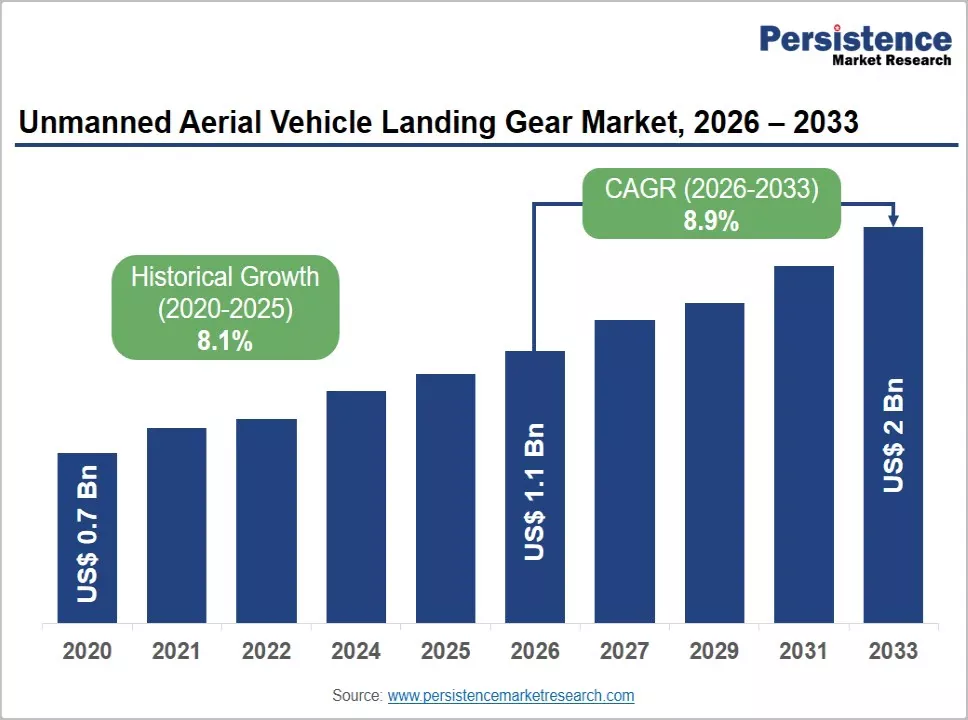
The global unmanned aerial vehicle landing gear market size is likely to be valued at US$ 1.1 billion in 2026, and is estimated to reach US$ 2 billion by 2033, growing at a CAGR of 8.9% during the forecast period 2026 - 2033.
Growth is underpinned by the expanding fleets of medium and large military drones, the emergence of collaborative combat aircraft, and rising commercial cargo and inspection operations that require durable and lightweight landing systems across developed and emerging economies.
The market registered a historical CAGR of 8.1% during 2020 - 2025, reflecting platform development delays and a strong reliance on small drones that use simple skid or belly-landing designs. However, the forecast period anticipates stronger acceleration as larger runway-capable unmanned aircraft move into series production, defense buyers prioritize affordable and scalable airframe components, and composite and additive manufacturing technologies lower weight and cost.
Key Industry Highlights
- Dominant Type: Fixed landing gear is set to command around 56% of the revenue share in 2026, while retractable landing gear is likely to grow the fastest at about 10.4% CAGR through 2033, as high-speed and long-endurance unmanned aircraft require lower aerodynamic drag.
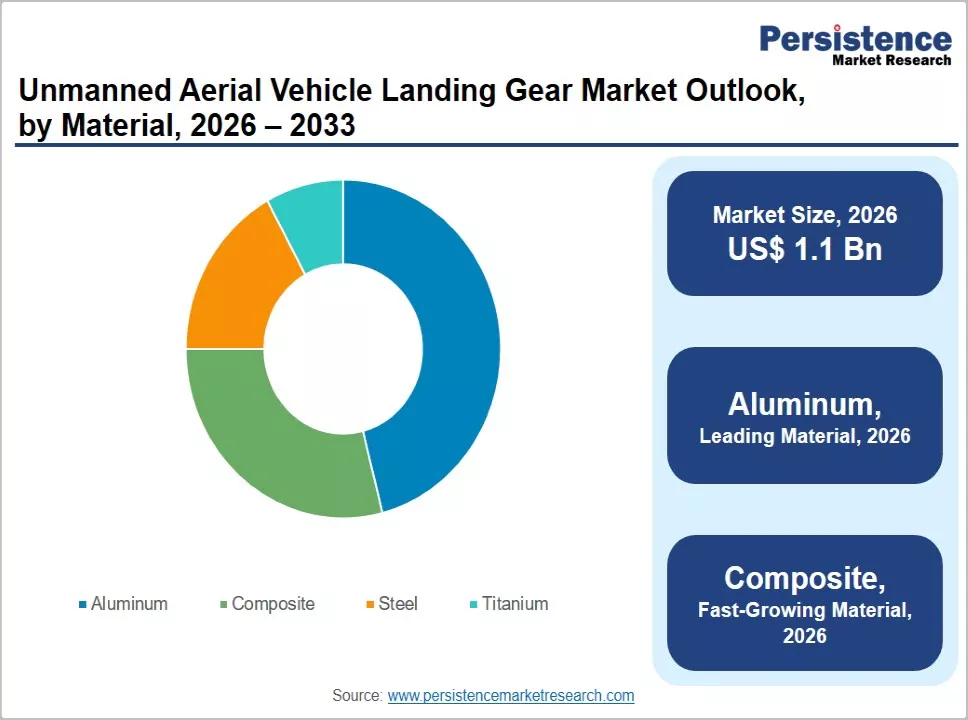
- Leading Material: Aluminum is expected to lead with 37% in 2026, while composite materials are likely to be the fastest-growing at about 10.8% CAGR during 2026 - 2033, reflecting demand for lighter, corrosion-resistant, and impact-tolerant structures.
- Dominant Application: Military and defense is anticipated to lead with an estimated 58% share in 2026, while commercial applications are slated to represent the fastest-growing segment at 11.6% CAGR from 2026 to 2033, driven by cargo, inspection, and mapping missions.
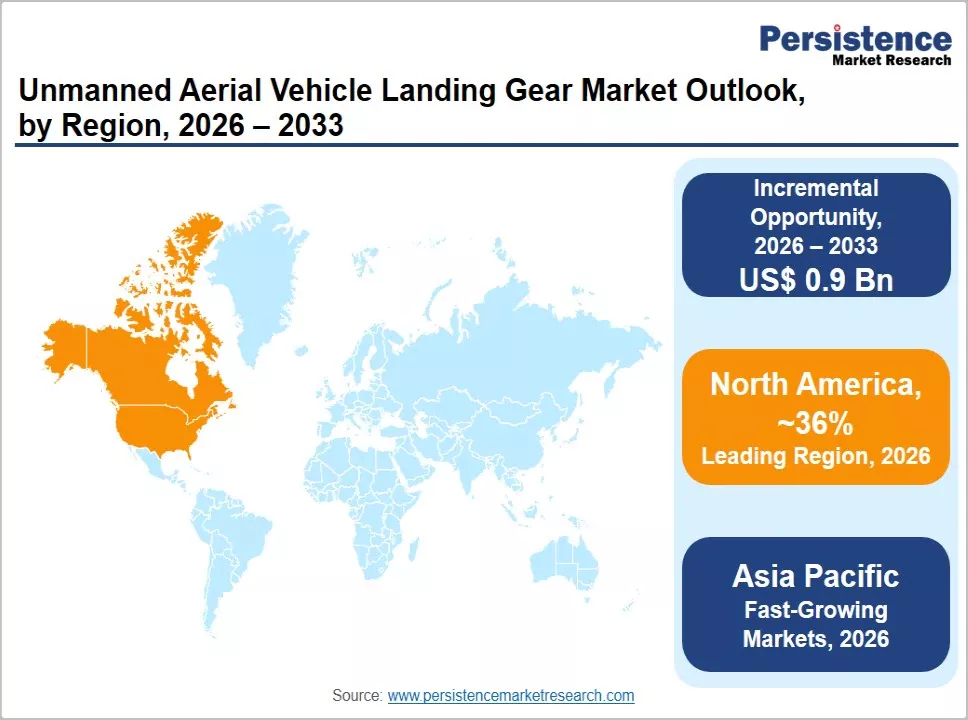
- Regional Leadership: North America is poised to dominate with an estimated 36% share in 2026, while Asia Pacific is expected to register the fastest growth at 10.2% CAGR through 2033, led by defense modernization in China and India.
- Competitive Environment: Competitive dynamics include partnerships between aerostructure specialists and drone makers, design-to-cost initiatives for attritable aircraft, and expansion of aftermarket service offerings.
DRO Analysis
Drivers: Expanding Military UAV Fleets and Collaborative Combat Aircraft as Primary Growth Catalyst
Growth in military unmanned aircraft is the leading force driving the unmanned aerial vehicle landing gear market, as defense forces move beyond small reconnaissance drones toward larger platforms that take off and land on runways, carry heavier payloads, and operate for extended periods.
Programs for collaborative combat aircraft, medium-altitude long-endurance drones, and large cargo UAVs require landing gear capable of absorbing high sink rates, supporting steering and braking, and withstanding repeated cycles on unprepared surfaces. The selection of production contracts for the first U.S. Air Force collaborative combat aircraft and the increasing number of national programs in Europe, Asia Pacific, and Australia are creating a multi-year pipeline of landing gear demand. Each platform typically requires a bespoke gear design that includes struts, actuators, wheels, brakes, and control electronics, which supports high content per aircraft.
Design-to-Cost Manufacturing and Material Innovation
Defense planners are also emphasizing affordable mass, which is pushing suppliers to develop landing gear that can be produced quickly, at lower cost, and with standard machining capabilities. Anduril has highlighted its use of a simpler landing gear on its Fury aircraft that can be manufactured by ordinary machine shops, illustrating this shift.
At the same time, lightweight composites, titanium alloys, and additive manufacturing are improving the strength-to-weight ratio of structural components, enabling greater payload and endurance. These developments, along with growing demand for health-monitoring sensors in gear systems, are expected to support sustained market growth through 2033.
Restraints: Weight and Cost Trade-offs, Certification Complexity, and Alternative Recovery Methods
Landing gear is a safety-critical subsystem, and its development involves substantial engineering, testing, and certification effort. For smaller unmanned platforms, additional gear weight directly reduces payload and flight endurance, leading designers to favor skids, belly landings, parachute recovery, or catapult launch and net capture systems instead of wheeled gear. Vertical take-off and landing configurations further reduce the need for conventional landing gear in many commercial and tactical missions.
Qualification Timelines and Supplier Concentration
Military and large commercial platforms require extensive structural, fatigue, and environmental testing before landing gear can be certified, and program delays often cascade into supplier schedules. The supply base for high-integrity actuators, forgings, and electronic controllers is also concentrated among a limited number of specialists, which can create bottlenecks when multiple programs scale simultaneously.
Budget cycles in defense procurement add further uncertainty, and the low unit prices of expendable drones limit the potential for premium gear content. These factors collectively moderate adoption, highlighting the need for modular designs and standardized components that can be applied across platforms.
Opportunities: Commercial Cargo Drones, Hybrid VTOL Platforms, and Aftermarket Services
Commercial cargo and logistics drones are emerging as a significant source of new demand for the market. Operators are developing medium and heavy-lift unmanned aircraft to carry parcels, medical supplies, and industrial goods between regional hubs, and these aircraft need reliable gear for repeated take-offs and landings on small airfields and unpaved strips. Hybrid VTOL designs that combine vertical lift with fixed-wing cruise are also opening opportunities for compact retractable and semi-retractable gear that balances efficiency with operational flexibility.
Aftermarket and Lifecycle Services
As unmanned fleets mature, demand for maintenance, repair, overhaul, and replacement parts is expected to rise, particularly for wheels, brakes, struts, and actuators that wear with repeated cycles. Suppliers are likely to expand service networks, spares pooling, and digital health monitoring that supports predictive maintenance. Additive manufacturing is also expected to enable faster production of customized parts and low-volume replacements, creating new revenue pools for both original equipment manufacturers and independent service providers through 2033.
Category-wise Insights
Type Analysis
Why Does Fixed Landing Gear Lead the Unmanned Aerial Vehicle Landing Gear Market?
Fixed landing gear is the leading type segment, expected to hold about 56% of the unmanned aerial vehicle landing gear market revenue share in 2026. It is widely used across small and tactical fixed-wing drones, training aircraft, and agricultural platforms because of its low cost, simplicity, and reliability.
Fixed gear avoids complex actuation and retraction systems, which reduces maintenance requirements and failure points. Manufacturers also benefit from shorter development cycles and easier integration into airframes, supporting strong volume demand from both military and commercial operators. Foldable and detachable fixed gear designs are also gaining acceptance because they simplify transportation and field deployment of tactical systems.
Retractable landing gear is likely to grow the fastest through 2033. These systems fold into the fuselage or wings after take-off, reducing drag and enabling higher cruising speeds, longer range, and improved fuel or battery efficiency. They are essential for medium-altitude long-endurance drones, jet-powered combat aircraft, and heavier cargo platforms.
Indian defense developers, for example, have indigenously built tricycle retractable gear with hydro-gas struts and nose wheel steering for large unmanned aircraft, while European programs are specifying electrically actuated systems with integrated controls. Rising demand for faster and more capable unmanned aircraft is therefore expected to increase the share of retractable systems.
Material Analysis
Why Does Aluminum Lead Landing Gear Materials?
Aluminum is the leading material segment, projected to capture about 37% of the revenue share in 2026. The material offers a favorable combination of strength, machinability, corrosion resistance, and cost, making it suitable for struts, brackets, wheel hubs, and structural frames across a wide range of UAV classes. Its established supply chain and well-understood fatigue behavior simplify qualification for both military and commercial programs. Aluminum is particularly valued for design-to-cost platforms that must be produced in larger quantities with limited tooling investment. Continuous improvements in high-strength aluminum alloys and precision forging are further extending component life.
Composite materials represent the fastest-growing segment, anticipated to achieve about 10.8% CAGR during the 2026 - 2033 period. Carbon fiber and glass fiber composites deliver high stiffness and energy absorption at low weight, which directly improves payload capacity and endurance.
Composite leaf-spring legs and reinforced gear structures are increasingly used on light and medium UAVs, and manufacturers continue to introduce reinforced designs that improve shock absorption and stability during landing. Titanium and steel remain important for high-load applications, such as large MALE aircraft and combat drones, where fatigue strength and durability under repeated heavy landings are critical.
Application Analysis
Why Does Military and Defense Lead Landing Gear Applications?
Military and defense is the leading application segment, expected to hold about 58% of the market revenue share in 2026. Armed forces operate the largest and most capable unmanned aircraft, which require robust gear with high energy absorption, braking, and steering.
Large-scale programs, including collaborative combat aircraft and tactical drones such as those derived from the XQ-58 family, which has a conventional take-off and landing derivative with built-in landing gear, are increasing the volume and sophistication of orders. Long program lifecycles and sustained funding also provide stable, predictable demand for original equipment and spares.
Commercial applications are the fastest-growing application segment, expected to showcase about 11.6% CAGR through 2033. Cargo delivery, infrastructure inspection, aerial mapping, and agricultural drones are scaling as regulators permit longer-range operations.
Government and public safety users, including border patrol, firefighting, and search and rescue agencies, are also adding mid-size unmanned aircraft. Consumer and recreational drones contribute volume but remain price sensitive and generally rely on simple fixed or foldable gear. Regulatory progress on beyond-visual-line-of-sight flight and heavier payload categories is expected to increase demand for sturdier, higher-capacity gear in these segments.
Regional Insights
North America Unmanned Aerial Vehicle Landing Gear Market Trends and Insights
North America is anticipated to account for an estimated 36% of the global unmanned aerial vehicle landing gear market in 2026. The region's industry is likely to benefit from large defense budgets, the transition of collaborative combat aircraft from prototyping into production, and a deep base of aerospace suppliers.
The U.S. Air Force announced in June 2026 that Anduril and General Atomics would build its first production collaborative combat aircraft, while the U.S. Navy and Marine Corps are advancing their own unmanned combat programs. These initiatives are expected to generate sustained demand for landing gear, actuators, and braking systems through 2033. Strong aftermarket networks and a large installed base of medium-altitude drones further support recurring revenue for spares and overhaul services.
U.S. Unmanned Aerial Vehicle Landing Gear Market Size
The U.S. is estimated to account for approximately 84% of the North America unmanned aerial vehicle landing gear market in 2026. Market growth is likely to be supported by collaborative combat aircraft production, Marine Corps efforts to field an operational unmanned tactical aircraft based on the Valkyrie platform, and continued purchases of medium-altitude long-endurance drones. Domestic supply chain priorities are expected to encourage the use of standard machining and forging capabilities, enabling new entrants to participate alongside established aerospace suppliers. Growing demand from Customs and Border Protection and public safety agencies is likely to further support investments through 2033.
Canada Unmanned Aerial Vehicle Landing Gear Market Size
Canada is projected to represent approximately 16% of the North America unmanned aerial vehicle landing gear market in 2026. Market expansion is expected to be driven by aerospace manufacturers supplying landing gear for global unmanned programs, surveillance requirements across the Arctic and maritime approaches, and expanding commercial drone operations for mining, forestry, and remote logistics. Cold-weather performance and rough-field capability are likely to be key purchasing criteria, creating opportunities for robust composite and titanium gear designs through 2033. Domestic aerospace suppliers are also expected to benefit from export programs that include unmanned aircraft built by allied nations.
Europe Unmanned Aerial Vehicle Landing Gear Market Trends and Insights
Europe is estimated to account for approximately 27% of the global unmanned aerial vehicle landing gear market in 2026. The region's market is expected to benefit from rising defense spending, the multinational Eurodrone program, and new collaborative combat aircraft initiatives.
Established aerospace suppliers are developing landing gear, actuation, steering, and electronic controls for large European unmanned aircraft, and strong engineering expertise in landing systems is likely to support competitiveness. Stringent certification requirements are also expected to favor suppliers with proven airworthiness credentials. Growing cooperation between aerostructure specialists and start-up drone makers is expected to broaden the supplier base for medium-sized unmanned aircraft.
Germany Unmanned Aerial Vehicle Landing Gear Market Size
Germany is anticipated to account for approximately 21% of the Europe unmanned aerial vehicle landing gear market in 2026. Demand is expected to be supported by German leadership in the Eurodrone program, increased Bundeswehr procurement, and efforts to field collaborative combat aircraft. In 2026, Rheinmetall and Boeing Australia formed a partnership to offer the MQ-28 Ghost Bat to the German air force with a target deployment date of 2029. Local aerospace and automotive suppliers are likely to strengthen domestic landing gear manufacturing through 2033.
Why Is Asia Pacific Expected to Be the Fastest-Growing Region in the Unmanned Aerial Vehicle Landing Gear Market?
Asia Pacific is projected to account for approximately 24% of the global unmanned aerial vehicle landing gear market in 2026, and is anticipated to register the fastest growth, expanding at an estimated CAGR of 10.2% through 2033. Market expansion is likely to be driven by defense modernization, indigenous unmanned aircraft development, and growing commercial drone operations.
China and India are expected to remain the primary demand centers, while Japan, South Korea, and Australia are also likely to accelerate procurement of surveillance and combat unmanned systems. Rising investment in indigenous production capacity is also encouraging local suppliers to qualify forged and machined gear components.
China Unmanned Aerial Vehicle Landing Gear Market Size
China is estimated to represent approximately 44% of the Asia Pacific unmanned aerial vehicle landing gear market in 2026. The country's market is expected to benefit from large-scale production of military and commercial unmanned aircraft, a vertically integrated aerospace supply chain, and domestic development of advanced stealth and high-altitude drones. State-backed aerospace manufacturers are likely to continue investing in composite structures and retractable gear systems to support new platforms through 2033. Growing demand for commercial cargo drones in logistics hubs along the eastern seaboard is also expected to widen the customer base.
India Unmanned Aerial Vehicle Landing Gear Market Size
India is projected to account for approximately 17% of the Asia Pacific unmanned aerial vehicle landing gear market in 2026. The market is expected to witness strong expansion, supported by the indigenization policies of the Ministry of Defence, programs such as the Rustom-II (TAPAS) and SWIFT unmanned aircraft, and domestic capabilities in retractable landing gear developed by the Defence Research and Development Organisation. The Production Linked Incentive scheme for drones is also expected to encourage local manufacturing of components.
Competitive Landscape
The global unmanned aerial vehicle landing gear market structure is moderately consolidated, with the top vendors, including Safran Landing Systems, Collins Aerospace, Liebherr-Aerospace, and Héroux-Devtek, controlling around half of the revenue share. These established players leverage extensive certification experience, integrated actuation and control capabilities, and long-term relationships with defense primes. They are also known to invest in lightweight materials, electrically actuated systems, and health monitoring technologies to maintain technological leadership.
Supplier strategies increasingly emphasize shorter development cycles, so that new unmanned programs can move from design to flight testing more quickly.
Regional and niche competitors such as Magellan Aerospace, UAVOS, and Hyundai WIA are focusing on specialized segments, small and medium UAV gear, and emerging eVTOL and cargo drone platforms. Barriers such as airworthiness certification and structural testing limit new entrants, but design-to-cost initiatives are enabling machine-shop-level suppliers and additive manufacturing specialists to participate in attritable aircraft programs. Market consolidation is expected to increase gradually as global aerospace suppliers acquire niche capabilities, while drone makers continue to form direct partnerships for landing gear development.
Key Market Developments
- In June 2026, the U.S. Air Force selected Anduril Industries and General Atomics Aeronautical Systems to build the service's first production Collaborative Combat Aircraft, moving the Increment 1 program from prototyping into production.
- In January 2026, the U.S. Marine Corps selected Northrop Grumman for its Collaborative Combat Aircraft effort, with Kratos' Valkyrie, including a conventional take-off and landing derivative with built-in landing gear, expected to provide the air vehicle.
- In February 2025, UAVOS developed a reinforced composite landing gear designed to improve shock absorption, stability, and overall performance of unmanned aerial vehicles.
Companies Covered in Unmanned Aerial Vehicle Landing Gear Market
- Safran Landing Systems
- Collins Aerospace
- Liebherr-Aerospace
- Héroux-Devtek Inc.
- Magellan Aerospace Corporation
- Triumph Group, Inc.
- UAVOS
- Hyundai WIA Corporation
- Parker Hannifin Corporation
- CIRCOR Aerospace & Defense
Frequently Asked Questions
The global unmanned aerial vehicle landing gear market is valued at US$ 1.1 billion in 2026 and is projected to reach US$ 2 billion by 2033, expanding at a CAGR of 8.9% during 2026 - 2033.
Expanding military UAV fleets, the move of collaborative combat aircraft into production, rising commercial cargo and inspection operations, and advances in composite and additive manufacturing are driving the market. Government programs aimed at affordable, scalable unmanned aircraft are also supporting demand across developed and emerging economies.
Fixed landing gear leads types with about 56% share, aluminum leads materials with about 37%, and military and defense leads applications with an estimated 58% in 2026. Retractable gear, composite materials, and commercial applications are the fastest-growing segments, at about 10.4%, 10.8%, and 11.6% CAGR respectively.
North America dominates the market with an estimated 36% share in 2026, supported by large defense budgets and collaborative combat aircraft production programs. Asia Pacific is projected to be the fastest-growing region at a 10.2% CAGR through 2033.
Commercial cargo drones, hybrid VTOL platforms, composite and additively manufactured components, and aftermarket maintenance services are key market opportunities.
The market is moderately consolidated, with Safran Landing Systems, Collins Aerospace, Liebherr-Aerospace, and Héroux-Devtek controlling around half of the revenue share.


