




- Aerospace & Defense
- Unexploded Ordnance Detection Market
Unexploded Ordnance Detection Market Size, Share, and Growth Forecast 2026 - 2033
Unexploded Ordnance Detection Market by Technology (Ground Penetrating Radar (GPR), Magnetometry, Acoustic Detection, Electromagnetic Induction, Robotics & UAVs), Application (Military, Civilian, Construction, Mining), and Regional Analysis, 2026 - 2033

Unexploded Ordnance Detection Market Size and Trend Analysis
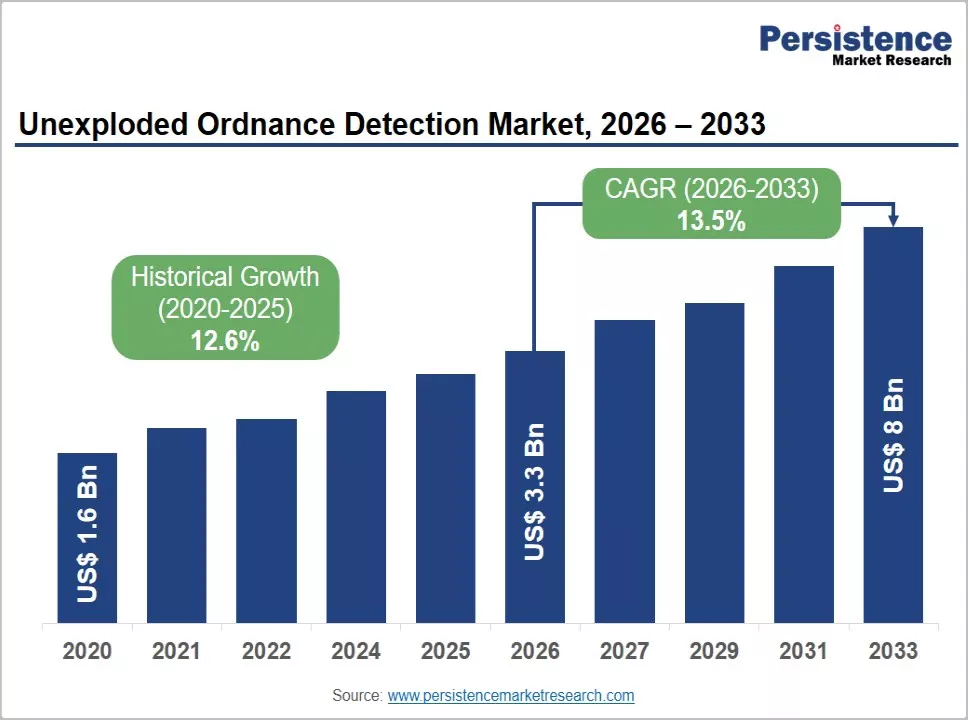
The global unexploded ordnance detection market size is likely to be valued at US$ 3.3 billion in 2026, and is estimated to reach US$ 8 billion by 2033, growing at a CAGR of 13.5% during the forecast period 2026 - 2033.
Growth is underpinned by expanding explosive remnant contamination in conflict-affected regions, rising military and humanitarian clearance funding, and rapid adoption of AI-enabled drone and robotic survey systems.
The market has been expanding at a double-digit pace, supported by post-conflict clearance programs and mandatory pre-construction ordnance surveys. However, the forecast period anticipates stronger acceleration as Ukraine's clearance requirements, European defense modernization, and large-scale reconstruction programs increase demand for faster, safer, and more reliable detection technologies. Multi-sensor fusion, machine learning-based target classification, and unmanned platforms are expected to shorten survey cycles and reduce operator exposure.
Key Industry Highlights
- Dominant Technology: Ground penetrating radar (GPR) is set to command around 34% of the revenue share in 2026, while robotics and UAVs are likely to grow the fastest at 18.4% CAGR through 2033, as AI-enabled aerial surveys reduce operator exposure.
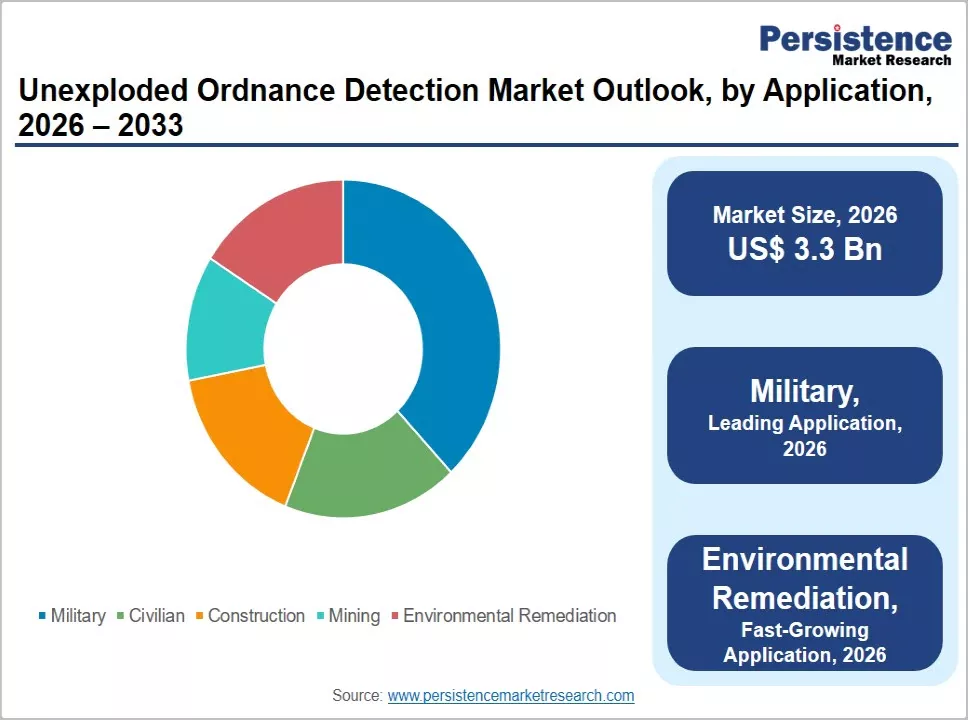
- Leading Application: Military is expected to lead with 44% in 2026, while construction is likely to be the fastest-growing at about 15.2% CAGR during 2026 - 2033, reflecting mandatory pre-construction ordnance surveys and reconstruction programs.
- Demand Catalyst: Donor and government commitments for demining, particularly in Ukraine, are expanding procurement of detection equipment, survey services, and operator training.
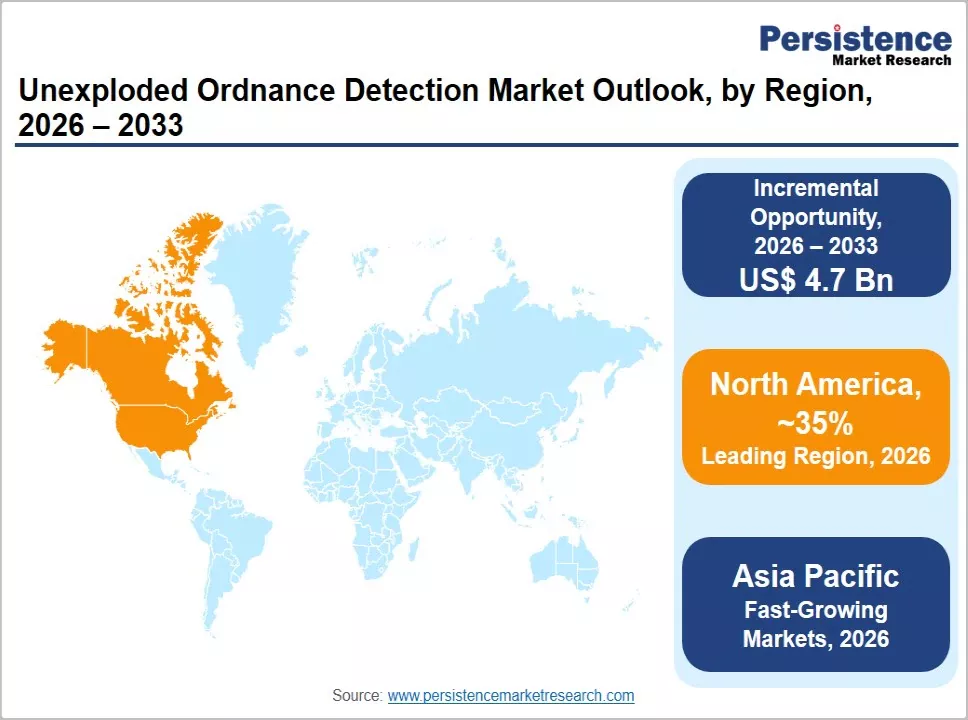
- Regional Leadership: North America is poised to dominate with an estimated 35% share in 2026, while Europe is projected to register the fastest growth at a 15.4% CAGR through 2033.
- Competitive Environment: Competitive dynamics include sensor miniaturization, AI-driven target recognition partnerships, and expansion of unmanned detection offerings by defense and geophysical specialists.
DRO Analysis
Drivers: Expanding Ordnance Contamination and Clearance Funding as Primary Growth Catalyst
Legacy and newly deposited explosive hazards are the leading force driving the unexploded ordnance detection market, as governments, defense ministries, and humanitarian operators seek to restore contaminated land to safe use. Estimates cited by defense researchers suggest that as much as 10% of ordnance fired in conflict zones and on training ranges fails to detonate, leaving hazards that persist for decades.
The war in Ukraine has sharply raised the scale of this challenge, with Ukrainian authorities reporting that more than 40,000 square kilometres were surveyed and returned to use during 2023 - 2025 and a further 5,000 square kilometres targeted for 2026. International partners are responding with dedicated equipment deliveries, clearance funds, and technology programs, which directly support procurement of detection systems.
AI-Enabled Surveys and Sensor Fusion
Technological progress is accelerating adoption. Drone-mounted magnetometers, electromagnetic induction arrays, hyperspectral imagers, and thermal sensors, combined with machine learning classifiers, can scan large areas far faster than handheld detectors while keeping personnel outside hazardous zones.
Defense organizations are also validating these methods, as AI models that can be rapidly retrained to recognize new munition types strengthen the case for unmanned detection in both military and humanitarian missions. Humanitarian operators, national mine action authorities, and defense ministries are therefore expanding procurement budgets, which supports sustained demand for both detection hardware and survey services across the forecast period.
Restraints: Complex Terrain, False Alarms, and Skilled Workforce Constraints
Detection performance remains highly dependent on terrain, soil conditions, vegetation, and burial depth. Mineralized soils, dense vegetation, and cluttered sites produce high false alarm rates, forcing operators to excavate or verify large numbers of harmless metal fragments, which slows clearance and raises cost per hectare.
Current AI-based aerial detection is most effective for surface-laid and shallow items, while deeply buried or vegetation-covered ordnance still requires ground-based sensors and manual verification. Operations in active conflict zones also face the risk of re-contamination, as previously cleared areas can become hazardous again after renewed shelling.
Capital Costs and Operator Training Gaps
Advanced multi-sensor platforms, ruggedized robots, and UAV payloads carry high acquisition costs, and many humanitarian operators depend on short-cycle donor funding that complicates equipment investments.
Certified operators, data analysts, and explosive ordnance disposal specialists are in limited supply, while standards for validating AI-assisted detection are still evolving. These constraints slow technology adoption among smaller operators and in low-income affected countries, despite clear safety and productivity benefits. Ongoing standardization work and shared validation datasets are expected to ease these barriers gradually.
Opportunities: Reconstruction Programs and Unmanned Survey Platforms Creating New Demand Pools
Post-conflict reconstruction and large infrastructure programs are opening substantial new demand. Partner governments increasingly link demining to the rebuilding of housing, roads, farmland, and energy assets, which requires systematic ordnance surveys before construction begins.
In Europe, pre-construction clearance checks are already routine in countries where Second World War ordnance is regularly uncovered, and similar practices are spreading to mining, energy, and transport projects elsewhere. Agricultural land return in Ukraine, where clearance contracts are financed through European support instruments, is also creating a repeatable service model. These dynamics are expected to create multi-year contracts for survey, mapping, and verification services.
Technology Partnerships and Service-Based Models
Drone-based detection, autonomous ground vehicles, and cloud-based mapping platforms enable survey-as-a-service offerings that lower upfront costs for customers. Collaboration among sensor manufacturers, AI developers, universities, and clearance operators is also expanding benchmark datasets and validation tools, improving reliability and encouraging broader adoption across mining, environmental remediation, and civil engineering applications.
Category-wise Insights
Technology Analysis
Why Does Ground Penetrating Radar Lead the Unexploded Ordnance Detection Market?
Ground penetrating radar (GPR) is the leading technology segment, expected to hold about 34% of the unexploded ordnance detection market revenue share in 2026. GPR detects both metallic and non-metallic objects, including plastic-cased munitions that metal detectors can miss, and provides depth information that supports excavation decisions. It is widely used on military routes, former training ranges, airfields, and construction sites. Modern systems offer multichannel arrays, vehicle-towed configurations, and 3D visualization, while processing software increasingly automates anomaly identification.
Established procurement channels and proven field reliability keep GPR central to clearance programs. Pairing GPR with metal detection in dual-sensor systems further improves discrimination between ordnance and clutter.
Robotics and UAVs represent the fastest-growing technology segment, anticipated to achieve an 18.4% CAGR during the 2026 - 2033 period. Drone-mounted magnetometers, electromagnetic sensors, and optical imaging payloads can survey large or dangerous areas rapidly while keeping personnel at a distance. Recent trials by defence agencies have shown that AI tools can identify surface munitions from drone imagery and that models can be retrained quickly to recognize new threat types.
Growing investment in autonomous systems and falling sensor costs are encouraging both military and humanitarian operators to integrate unmanned platforms into clearance workflows. Endurance, payload capacity, and regulatory approvals for beyond-line-of-sight flights remain the key factors shaping adoption.
Magnetometry, electromagnetic induction, and acoustic detection remain important in specific use cases. Magnetometers are valued for locating buried ferrous ordnance, including large aerial bombs, while electromagnetic induction detectors are the standard for low-metal landmine clearance. Acoustic and seismic methods are still emerging and are mainly used in research and specialized applications, although multi-sensor fusion is increasingly combining these technologies to reduce false alarms.
Application Analysis
Which Application Dominates Unexploded Ordnance Detection?
The military application segment dominates, projected to capture about 44% of the revenue share in 2026. Armed forces require detection for route clearance, base protection, breaching operations, and clearing former training ranges.
Defense budgets are increasingly directed toward autonomous and counter-explosive ordnance capabilities, supported by lessons from recent conflicts where drones and explosive devices are reshaping the battlefield. Procurement is typically supported by multi-year programs, which provides stable demand for detectors, robots, and training services, although purchasing cycles remain tied to government budgets and security conditions. Growing cooperation among NATO members on counter-explosive hazard capabilities is also encouraging shared standards and joint procurement.
Construction is the fastest-growing application segment, expected to expand at about 15.2% CAGR through 2033. Developers and infrastructure owners increasingly conduct ordnance risk assessments and magnetometer or GPR surveys before excavation, piling, and dredging, particularly in regions affected by Second World War contamination and in reconstruction zones. Regulatory requirements, insurance considerations, and the high cost of project delays are making surveys a standard step in project planning.
Offshore wind and port development also contribute to demand for specialized detection services. Specialist contractors with certified geophysicists and explosive ordnance disposal teams are well positioned to capture this demand.
Civilian humanitarian clearance, mining, and environmental remediation form the remaining application base. Humanitarian operators rely on donor funding to clear agricultural land and settlements, mining companies survey sites in post-conflict regions, and environmental remediation programs address contaminated former military sites, supporting steady demand for detection technologies and survey services.
Regional Insights
North America Unexploded Ordnance Detection Market Trends and Insights
North America is anticipated to account for an estimated 35% of the global unexploded ordnance detection market in 2026. The region's industry is likely to benefit from large defense budgets, extensive remediation of former military sites, and strong funding for humanitarian demining abroad.
The presence of leading defense contractors, sensor developers, and research institutions supports rapid commercialization of unmanned and AI-enabled detection systems. Military laboratories and universities are also developing drone-based electromagnetic arrays and multi-sensor datasets, which is expected to strengthen domestic capabilities through 2033. Regional contractors also benefit from defense-related research funding and a mature market for geophysical survey services.
U.S. Unexploded Ordnance Detection Market Size
The U.S. is estimated to account for approximately 78% of the North America unexploded ordnance detection market in 2026. Market growth is likely to be supported by the Department of Defense's munitions response program for former defense sites, active range sustainment, and expanding investment in autonomous systems.
Federal programs for conventional weapons destruction abroad also sustain demand for detection equipment and training. Army and defense research organizations are testing drone-mounted sensors to identify unexploded ordnance while keeping personnel out of harm's way, which is expected to accelerate adoption of unmanned detection. Contracts for range clearance and base closure activities are expected to provide a stable pipeline for survey and verification services.
Canada Unexploded Ordnance Detection Market Size
Canada is projected to represent approximately 22% of the North America unexploded ordnance detection market in 2026. Demand is expected to be driven by clearance of legacy military training areas, ordnance surveys for mining and infrastructure projects, and contributions to international demining efforts, including support for Ukraine.
Canadian contractors and geophysical survey firms are likely to expand use of drone-based magnetometry and GPR for remote and northern sites. Defence modernization and growing interest in autonomous systems are anticipated to support further adoption through 2033. Collaboration with allied nations on clearance training is also likely to support equipment exports and technology sharing.
Why Is Europe Expected to Register the Fastest Growth in the Unexploded Ordnance Detection Market?
Europe is projected to account for approximately 30% of the global unexploded ordnance detection market in 2026 and is anticipated to register the fastest growth, expanding at an estimated CAGR of 15.4% through 2033. Growth is likely to be driven by Ukraine's large-scale clearance requirements, renewed defense spending across NATO members, and routine ordnance surveys in countries with Second World War contamination.
International coalitions and the European Union are funding equipment, training, and clearance operations, while European defense and research agencies are trialing AI-enabled drone detection to support military engineers. Defense ministries across the region are also increasing investment in engineer units and explosive ordnance disposal robotics.
Ukraine Unexploded Ordnance Detection Market Size
Ukraine is estimated to represent approximately 32% of the Europe unexploded ordnance detection market in 2026. Demand is expected to benefit from international funding commitments, including EUR 70 million announced by partner countries at the 2026 International Mine Action Conference in Brussels, and equipment deliveries planned by the Demining Capability Coalition. Authorities are prioritizing agricultural land, energy infrastructure, and housing, encouraging the use of drones, mechanical clearance, and digital mapping.
Continued shelling that re-contaminates cleared areas is likely to sustain recurring survey requirements through 2033. Local companies and international technology firms are partnering to bring AI-based mapping and unmanned systems into operational use.
Asia Pacific Unexploded Ordnance Detection Market Trends and Insights
Asia Pacific is projected to account for approximately 22% of the global unexploded ordnance detection market in 2026. Legacy contamination in Southeast Asia, Second World War ordnance across the Pacific, and expanding infrastructure and mining activity are expected to support demand.
Governments in the region are also modernizing military engineering capabilities, while donor-supported programs continue clearance in heavily affected countries. The region is anticipated to see steady adoption of drone-based surveys as sensor costs decline and local operators gain experience. Cooperation with international organizations is expected to support technology transfer and demining training.
China Unexploded Ordnance Detection Market Size
China is estimated to represent approximately 31% of the Asia Pacific unexploded ordnance detection market in 2026. The market is expected to benefit from large infrastructure programs, mining activity, and military modernization, all of which require ground surveys and engineering clearance capabilities.
Domestic manufacturers of geophysical instruments and unmanned platforms are expanding their product ranges, supported by government priorities for self-reliance in sensing technologies. Increasing integration of drone-based magnetometry and radar with AI analytics is projected to support market growth through 2033. Export-oriented domestic suppliers are also likely to strengthen their presence in emerging markets.
Australia Unexploded Ordnance Detection Market Size
Australia is projected to account for approximately 14% of the Asia Pacific unexploded ordnance detection market in 2026. Demand is expected to be supported by clearance of former defense sites, ordnance surveys for mining and infrastructure projects, and regional assistance programs addressing Second World War ordnance in Pacific island nations.
The country is also home to established metal detector manufacturers and survey specialists, which supports exports and local innovation. Defense investment in autonomous systems is likely to further increase uptake of unmanned detection technologies. Remote operations and a large mining sector are expected to favor drone-mounted and autonomous sensing platforms.
Competitive Landscape
The global unexploded ordnance detection market structure is moderately fragmented, with defense contractors, specialist sensor manufacturers, and geophysical survey companies competing alongside clearance service operators. Established players, including Chemring Group, Teledyne FLIR, and L3Harris Technologies, leverage government relationships, explosive ordnance disposal robotics portfolios, and integrated systems capabilities, while investing steadily in AI-enabled detection, autonomy, and unmanned platforms to retain technological leadership.
Specialist companies such as FOERSTER, Minelab Electronics, Vallon, and GSSI focus on metal detectors, magnetometers, and ground penetrating radar with strong reputations among clearance operators. Barriers such as safety certification, field-proven reliability, and procurement relationships limit new entrants, but software and AI developers, including Safe Pro Group, are participating through drone-based detection analytics. Partnerships between sensor manufacturers, drone makers, and research institutions are expected to increase, along with gradual consolidation as larger firms acquire niche technology providers.
Key Market Developments
- In November 2026, partner countries announced EUR 70 million for demining in Ukraine at the International Mine Action Conference in Brussels, supporting survey, clearance, and equipment maintenance.
- In June 2026, the Demining Capability Coalition confirmed equipment worth EUR 205 million for delivery to Ukraine in 2026, alongside a EUR 95 million fund for explosive hazard clearance.
- In April 2026, the UK Defence Science and Technology Laboratory and the British Army completed a trial of AI-powered drones to detect landmines and unexploded ordnance, demonstrating rapid retraining of AI models for new threats.
Companies Covered in Unexploded Ordnance Detection Market
- Chemring Group PLC
- Teledyne FLIR LLC
- L3Harris Technologies, Inc.
- Institut Dr. Foerster GmbH & Co. KG (FOERSTER)
- Minelab Electronics Pty Ltd
- Vallon GmbH
- Geophysical Survey Systems, Inc. (GSSI)
- Geometrics, Inc.
- SENSYS Sensorik & Systemtechnologie GmbH
- Safe Pro Group Inc.
Frequently Asked Questions
The global unexploded ordnance detection market is valued at US$ 3.3 billion in 2026 and is projected to reach US$ 8 billion by 2033, expanding at a CAGR of 13.5% during 2026 - 2033.
Expanding explosive remnant contamination, rising military and humanitarian clearance funding, and rapid adoption of AI-enabled drone and robotic survey systems are driving the market.
Ground penetrating radar leads technologies with about 34% share, while military leads applications with about 44% in 2026.
North America dominates with an estimated 35% share in 2026, supported by large defense budgets and site remediation programs, while Europe is projected to grow fastest at a 15.4% CAGR through 2033.
Reconstruction programs, mandatory pre-construction ordnance surveys, and unmanned survey-as-a-service models are key market opportunities.
The market is moderately fragmented, with Chemring Group, Teledyne FLIR, L3Harris Technologies, FOERSTER, and Minelab Electronics among the key participants.


