




- Aerospace & Defense
- Low-cost Carrier Market
Low-cost Carrier Market Size, Share, and Growth Forecast 2026–2033
Low-cost Carrier Market by Aircraft Type (Narrow Body, Wide Body, Others), Destination (Domestic, International), Haul (Long Haul, Short Haul), and Regional Analysis, 2026–2033

Low-cost Carrier Market Size and Trend Analysis
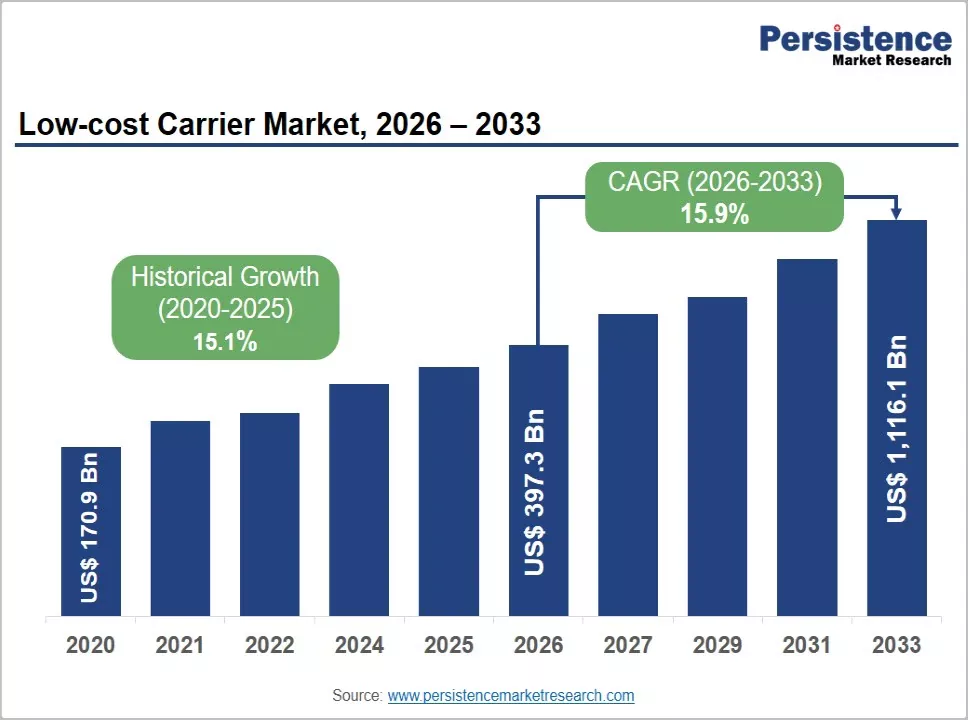
The global low-cost carrier market size is likely to be valued at US$ 397.3 billion in 2026 and is projected to reach US$ 1,116.1 billion by 2033, growing at a CAGR of 15.9% during the forecast period between 2026 and 2033.
Low-cost carriers are no longer only domestic and short-haul discounters. They are the fastest-growing part of commercial aviation, as fleets standardize on fuel-efficient narrow bodies, networks stretch into long-haul and secondary-city routes, and ancillary revenue, digital distribution, and in-flight connectivity lift income per passenger. The forecast period is defined by very large aircraft orders, widebody experimentation, and aggressive market entry across Asia, the Middle East, and Latin America. Airlines, lessors, airports, and aircraft makers should read this as a capacity-led category in which unit cost, delivery slots, and engine reliability determine competitive position.
Key Industry Highlights
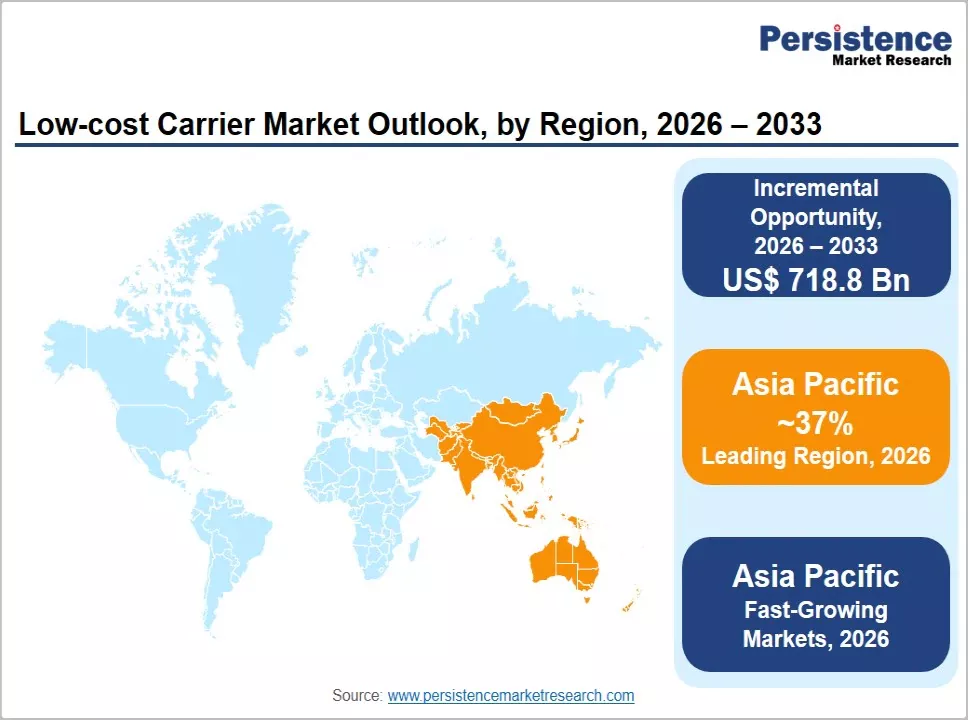
- Dominant and Fastest growing Region: Asia Pacific holds 37% of the market revenue in 2026 and is projected to grow at an estimated 17.4% CAGR through 2033, driven by India, China, and Southeast Asia. Rising incomes, new airports, large unserved populations, and the fleet scale of IndiGo, AirAsia, and Scoot keep passenger growth well above the global average.
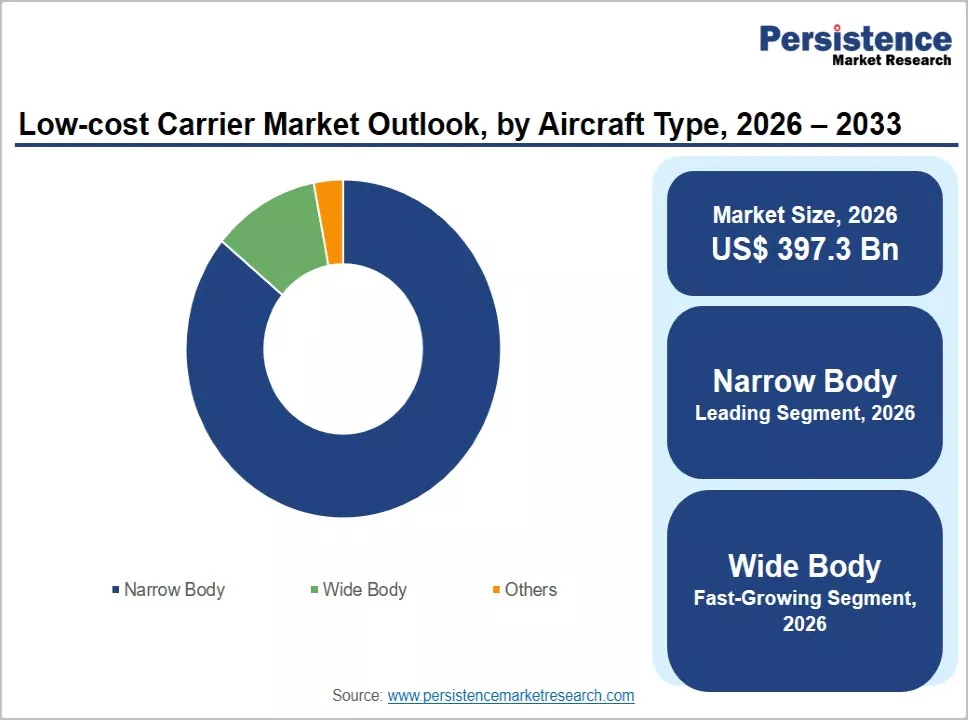
- Leading Aircraft Type: Narrow body aircraft command about 86% of 2026 revenue, as the Airbus A320 family, the Boeing 737 family, and the Airbus A220 form the backbone of fleets at AirAsia, Ryanair, IndiGo, Southwest Airlines, and Wizz Air. Single-type fleets cut crew training, maintenance, and spare-part costs.
- Leading Destination and Haul: Domestic routes account for around 54% of revenue and short haul for about 74%, reflecting high-frequency, high-utilization flying in the U.S., India, China, and Europe. Quick turnarounds and several daily rotations per aircraft remain the core of the low-cost model.
- Fastest growing Aircraft Type and Emerging Opportunity: Wide body aircraft are the fastest-growing type as long-haul low-cost services gain traction. IndiGo placed its first widebody order for 30 Airbus A350-900 aircraft in April 2025, with purchase rights for 70 more, while Scoot operates Boeing 787 Dreamliners and AirAsia is exploring routes between the Gulf and Europe.
DRO Analysis
Driver- Fleet Standardization, Rising Air Travel Demand, and Ancillary Revenue Growth
Low-cost carriers win by combining single-type fleets, high aircraft utilization, point-to-point networks, and ancillary income from baggage, seat selection, and onboard sales. Demand is strongest where air travel is still under-penetrated: schedule data for 2025 showed IndiGo and Wizz Air among the five fastest-growing airlines in the world on capacity, frequency, route, and available seat kilometer growth. Large orders underline the confidence, as AirAsia ordered 150 Airbus A220-300 aircraft in May 2026, the largest single firm order the A220 program has received, with deliveries starting in 2028. The model is also spreading beyond pure low-cost carriers, as Southwest Airlines introduced checked-bag fees in 2025 and moved to assigned seating from 2026.
Restraint- Aircraft and Engine Supply Constraints, Fuel Price Volatility, and Thin Margins
Delivery delays and engine reliability problems restrict capacity growth, because aircraft and engine makers struggle to meet demand. Pratt & Whitney geared turbofan engine inspections have grounded aircraft at carriers such as Wizz Air and IndiGo, forcing costly leases of older aircraft and wet-leased capacity. Fuel is the largest cost line and cannot easily be passed on to price-sensitive customers, while airport charges, labor costs, and environmental levies in Europe add further pressure. Several carriers have struggled to remain profitable: Spirit Airlines entered Chapter 11 restructuring in 2025, and IndiGo reported a quarterly loss in mid-2026.
Opportunity- Long-Haul Expansion, Connectivity Services, and Digital Distribution
Long-haul low-cost service, airline partnerships, and digital retailing represent the largest white space. IndiGo has paired its A350-900 order with partnerships involving Delta Air Lines, Air France-KLM, and Virgin Atlantic to feed international traffic, while AirAsia aims to build what its leadership calls the world's first true low-cost network carrier. In July 2026, five carriers backed by the investment firm Indigo Partners, including Wizz Air, announced plans to equip more than 1,000 aircraft with Starlink connectivity, opening scope for paid onboard services. Direct online sales, dynamic pricing, and personalized offers further raise yield per passenger.
Category-wise Analysis
Why Do Narrow Body Aircraft Command a Majority of the Global Low-cost Carrier Market?
Narrow body aircraft are projected to lead the segment, hold nearly 86% of market share in 2026. Single-aisle jets offer the lowest trip cost on short and medium routes, fast turnarounds, and easy deployment across secondary airports. Ryanair and flydubai operate Boeing 737 fleets, Southwest Airlines flies an all-737 network, and IndiGo, AirAsia, Wizz Air, Eurowings, Spirit Airlines, and JetBlue Airways rely heavily on the Airbus A320 and A321 families, with AirAsia's A220 order extending the model. Fleet commonality lowers training and maintenance costs and gives carriers flexibility to move aircraft between markets.
Wide body aircraft are likely to be the fastest-growing segment, driven by long-haul low-cost models and high-density seating on busy medium-haul trunk routes. Scoot flies Boeing 787 Dreamliners alongside its narrow body fleet, IndiGo's A350-900 order points to long-haul international services from India while AirAsia is exploring routes between the Gulf and Europe. The Others category, which includes regional jets and turboprops, serves thin routes and smaller airports where narrow bodies cannot fill seats.
Destination Insights
What Is Driving Domestic Dominance Across the Low-cost Carrier Industry?
Domestic routes are expected to lead the segment, hold about 54% of market share in 2026. The largest low-cost markets, including the U.S., India, China, Indonesia, and Brazil, are built on high-volume domestic flying where air travel has displaced long-distance road and rail trips. IndiGo, Southwest Airlines, and JetBlue Airways serve dense domestic networks, while Ryanair, Wizz Air, and Eurowings sit at the opposite end, with most of their revenue from cross-border European routes that count as international.
International is likely to be the fastest-growing destination segment, supported by liberalized air service agreements, new overseas bases, and long-haul additions. flydubai connects the Gulf with South Asia, Africa, and Eastern Europe, Scoot and AirAsia link Southeast Asia with Australia, North Asia, and India, and Wizz Air is expanding from Central and Eastern Europe into Western Europe and the Middle East. Airport capacity and bilateral traffic rights are the main constraints on this expansion.
Haul Insights
Why Does Short Haul Hold the Largest Share of the Global Low-cost Carrier Market?
Short haul is projected to lead the haul segment, account for around 74% of market share in 2026. Flights of under about four hours allow several rotations a day, maximize aircraft utilization, and carry the lowest trip costs. Ryanair, Eurowings, Southwest Airlines, Spirit Airlines, JetBlue Airways, and flydubai concentrate largely on this model, using secondary airports, simple fares, and fast gate turns to keep unit costs low.
Long haul is likely to be the fastest-growing haul type, as carriers deploy widebody and long-range narrow body aircraft on routes of eight hours or more. Scoot's Boeing 787 services, IndiGo's planned A350-900 deployment, and JetBlue Airways' transatlantic flights to London, Paris, and Amsterdam on the A321LR show the model spreading across regions. Success depends on higher cabin mix, connecting partners, and enough ancillary revenue to cover longer flights.
Regional Insights
North America Low-cost Carrier Market Trends and Insights
North America is forecast to account for around 27% of the low-cost carrier market in 2026. The region has a mature low-cost sector led by Southwest Airlines, JetBlue Airways, and Spirit Airlines, with ultra-low-cost fare models alongside growing premium and ancillary offers. Restructuring, consolidation, and aircraft engine issues are shaping capacity, but demand for price-led domestic and leisure travel remains deep.
U.S. Low-cost Carrier Market Size
The U.S. is estimated to hold around 90% of the North America regional market in 2026. Southwest Airlines, JetBlue Airways, and Spirit Airlines compete for leisure and visiting-friends-and-relatives traffic, and Southwest's move to checked-bag fees and assigned seating shows the sector converging on unbundled pricing models.
Canada Low-cost Carrier Market Size
Canada is expected to account for over 10% of the North America regional market in 2026. Ultra-low-cost entrants such as Flair Airlines have pushed fares down on domestic and transborder routes and stimulated demand in underserved cities and across long distances.
Europe Low-cost Carrier Market Trends and Insights
Europe is anticipated to command around 29% of market share in 2026. Ryanair, Wizz Air, and Eurowings operate in the region with the highest low-cost penetration, supported by open skies within the European Union, many secondary airports, and heavy leisure demand. Airport charges, passenger taxes, environmental levies, and engine supply constraints are the main pressures on margins.
Germany Low-cost Carrier Market Size
Germany is projected to account for around 18% of the Europe regional market in 2026. Eurowings, part of Lufthansa Group, serves leisure and city routes, while Ryanair has cut capacity at regional German airports in response to high aviation taxes and charges and has announced its exit from Bremen Airport from summer 2027.
U.K. Low-cost Carrier Market Size
The U.K. is estimated to account for nearly 21% of the Europe regional market in 2026. London and regional airports host large Ryanair and Wizz Air operations alongside domestic carriers such as easyJet, and demand for city breaks and sun holidays supports high-frequency flying.
Which Region Will Drive the Fastest Low-cost Carrier Growth Through 2033?
Asia Pacific is forecast to dominate and be the fastest-growing region, capturing around 37% of market share in 2026 and expanding at an estimated 17.4% CAGR through 2033. Rising incomes, new airports, large unserved populations, and aggressive fleet orders by IndiGo and AirAsia are driving growth. AirAsia's 150-aircraft A220 order and Scoot's long-haul model show the region leading in both capacity and network innovation, while governments continue to liberalize air service agreements.
China Low-cost Carrier Market Size
China is projected to hold 29% of the Asia Pacific regional market in 2026. Fast-growing domestic travel, new airport capacity, and low-cost players such as Spring Airlines support demand, although state-linked network carriers also compete strongly on price in the domestic market.
India Low-cost Carrier Market Size
India is expected to account for around 26% of the Asia Pacific regional market in 2026. IndiGo carries the largest share of domestic passengers, and with hundreds of aircraft on order the country is one of the fastest-growing aviation markets, supported by airport expansion and the UDAN regional connectivity scheme.
Competitive Landscape
The global low-cost carrier market is fragmented at the global level but concentrated within each region, with a small group of large carriers leading the major markets. Ryanair, Southwest Airlines, IndiGo, AirAsia, and Wizz Air lead on fleet scale, network density, and unit cost, while Eurowings, flydubai, Scoot, Virgin Australia, JetBlue Airways, and Spirit Airlines compete through regional networks, parent group support, or hybrid and ultra-low-cost fare models. Competitive intensity is rising as carriers add long-haul services, partnerships, and digital ancillary offers, and as aircraft deliveries, engine availability, and airport slots become scarce. Winning requires low unit costs, secured delivery slots, balance sheets strong enough to withstand fuel shocks, and a growing share of ancillary and loyalty revenue.
Key Industry Developments
- In May 2026, AirAsia placed a firm order for 150 Airbus A220-300 aircraft powered by Pratt & Whitney GTF engines, the largest single firm order for the A220 program. The first aircraft are due for delivery from 2028, and the order includes a 12-year engine maintenance agreement. AirAsia said the aircraft will help it open new markets and routes across Asia and beyond as it builds what it calls the world's first true low-cost network carrier.
- In July 2026, Frontier Airlines announced that it will install SpaceX's Starlink in-flight Wi-Fi on its entire fleet of 183 Airbus A320-family aircraft, as part of a programme in which five carriers backed by Indigo Partners, including Wizz Air, Volaris, JetSMART, and Cebu Pacific, will equip more than 1,000 aircraft with the service. The program brings satellite connectivity to low-cost fleets across North America, Europe, Latin America, and Asia.
Companies Covered in Low-cost Carrier Market
- AirAsia
- Eurowings
- flydubai
- IndiGo
- JetBlue Airways
- Ryanair
- Scoot
- Southwest Airlines
- Spirit Airlines
- Virgin Australia
- Wizz Air
Frequently Asked Questions
The global low-cost carrier market is valued at US$ 397.3 billion in 2026.
Rising air travel demand in under-penetrated markets, fleet standardization, high aircraft utilization, ancillary revenue growth, and large aircraft orders, partly offset by engine and delivery delays, fuel price volatility, and thin margins.
Narrow body aircraft hold around 86% of the market. Single-aisle jets offer the lowest trip cost on short and medium routes, fast turnarounds, and the fleet commonality that keeps training and maintenance costs low.
Asia Pacific leads with a 37% share in 2026, driven by India, China, and Southeast Asia, where rising incomes, new airports, and large fleet orders are expanding access to air travel.
The largest opportunities are long-haul low-cost services, airline partnerships, in-flight connectivity, direct digital distribution, and expansion in emerging aviation markets.
Leading companies include Ryanair, Southwest Airlines, IndiGo, AirAsia, and Wizz Air. The market is fragmented globally but concentrated regionally, with large carriers competing on unit cost, fleet access, and ancillary revenue.


