




- Aerospace & Defense
- eVTOL and Advanced Air Mobility Market
eVTOL and Advanced Air Mobility Market Size, Share, and Growth Forecast, 2026 - 2033
eVTOL and Advanced Air Mobility Market by Aircraft Type (eVTOL Passenger Aircraft, Autonomous Cargo Drones), Application (Cargo Transport, Delivery Drones), Propulsion (Fully Electric, Hybrid-Electric), Offering, and Regional Analysis for 2026 - 2033

eVTOL and Advanced Air Mobility Market Size and Trends Analysis
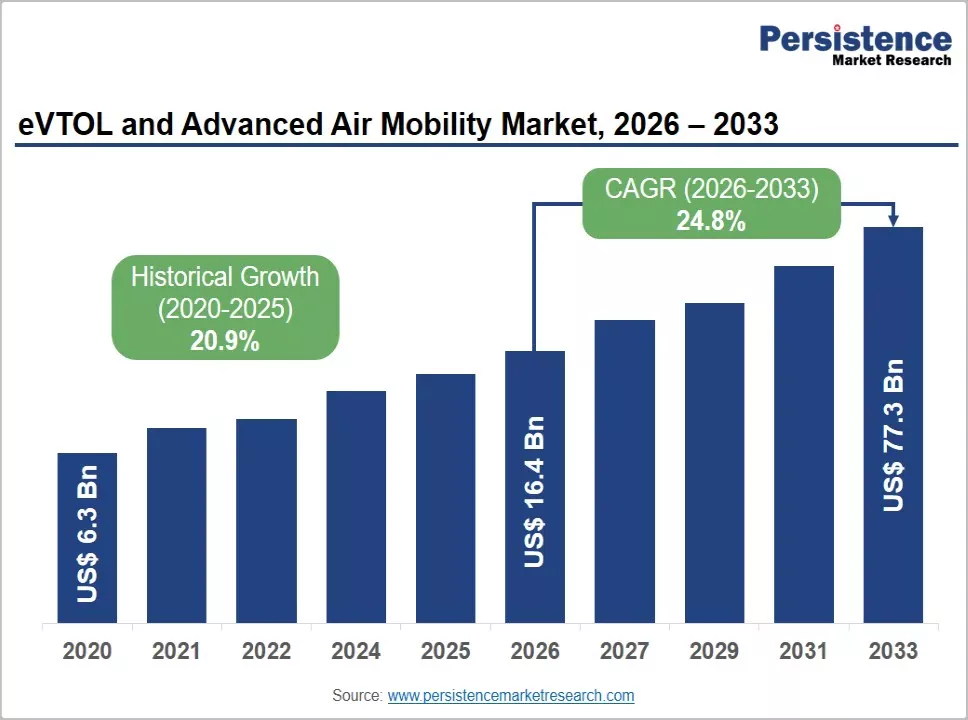
The global eVTOL and advanced air mobility market size is likely to be valued at US$ 16.4 billion in 2026 and is expected to reach US$ 77.3 billion by 2033, growing at a CAGR of 24.8% between 2026 and 2033, supported by progress in electric aircraft development, cargo drone deployment, and regulatory integration of powered-lift operations. Investment in aircraft certification, battery systems, vertiports, and unmanned traffic management is expanding the commercial ecosystem. Cargo transport currently represents a major application, while passenger aircraft development is advancing through certification programs and demonstration operations.
Key Industry Highlights
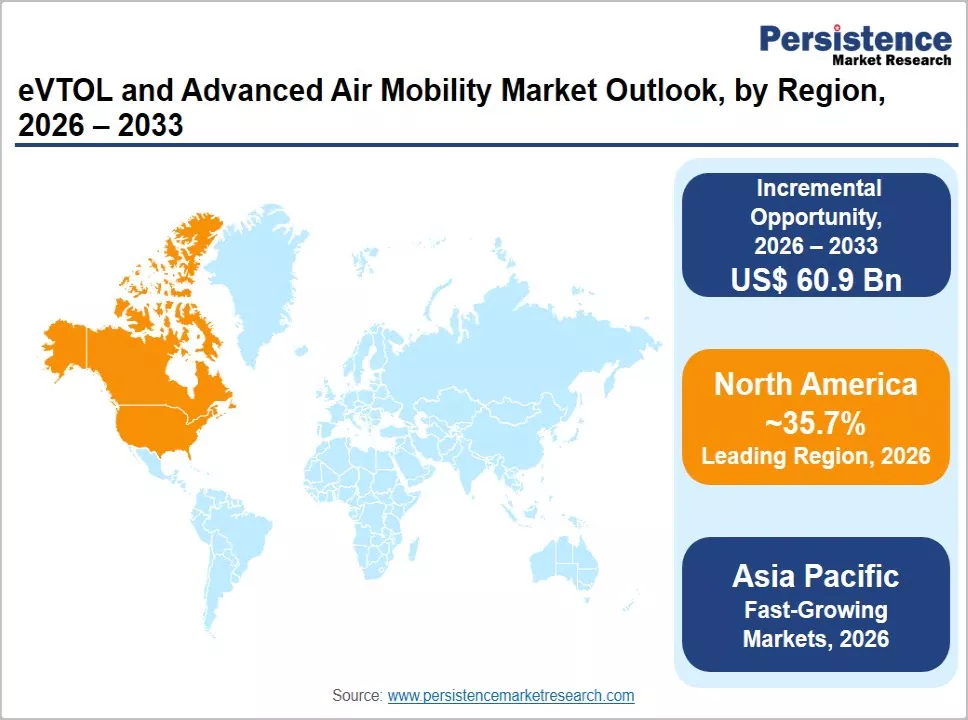
- Leading Region: North America, anticipated to account for 35.7% of the market, supported by aircraft development programs, aerospace investment, FAA rulemaking, and a large aviation services ecosystem.
- Fastest-growing Region: Asia Pacific, driven by commercial drone activity, government-backed low-altitude aviation programs, manufacturing capacity, and expanding urban and regional mobility initiatives.
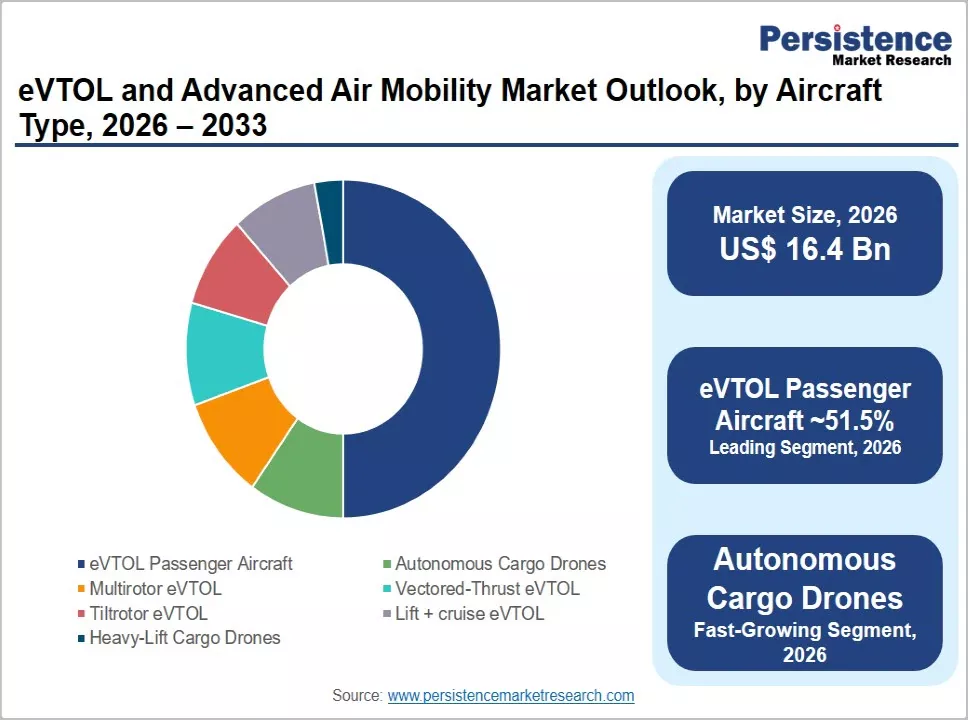
- Leading Aircraft Type: eVTOL passenger aircraft, accounting for approximately 51.5% of the market in 2026, supported by investment in urban air taxi and regional passenger aircraft programs.
- Leading Application: Cargo transport, accounting for 58.8% of the market in 2026, supported by logistics, industrial supply, medical delivery, and remote-area transport requirements.
DRO Analysis
Drivers - Regulatory Progress Is Supporting the Introduction of Powered-Lift Aircraft
Regulatory frameworks are moving from conceptual guidance toward defined certification and operating requirements. In the U.S., the Federal Aviation Administration issued its powered-lift pilot certification and operations rule in October 2024, effective January 2025. The rule establishes pilot qualification pathways and operating provisions for powered-lift aircraft, supporting their integration into the national airspace system.
The FAA also continues to develop aircraft-specific airworthiness criteria for eVTOL designs. In Europe, EASA maintains dedicated SC-VTOL technical requirements. These frameworks are important for manufacturers, operators, insurers, and infrastructure providers because certification clarity supports investment planning and route development.
Electric Propulsion and Distributed Aircraft Design Are Expanding Commercial Use Cases
Advances in electric motors, power electronics, flight-control systems, battery management, and lightweight structures are improving the technical basis for eVTOL aircraft. Distributed electric propulsion supports multiple lift-producing units and enables aircraft configurations such as multirotor, vectored-thrust, tiltrotor, and lift-plus-cruise designs. These configurations address different payload, range, noise, and operational requirements.
Electric aircraft development is also extending beyond passenger transport into cargo, medical logistics, offshore support, and industrial operations. The expansion of charging systems and high-power ground infrastructure is strengthening the connection between aircraft development and wider airport, logistics, and energy-sector investment.
Restraint - Certification, Battery Performance, and Infrastructure Costs Remain Major Barriers
Aircraft certification remains a lengthy and capital-intensive process because eVTOL designs combine characteristics of fixed-wing aircraft, helicopters, and advanced electric systems. Manufacturers must demonstrate airworthiness, battery safety, flight-control reliability, redundancy, and operational performance under demanding conditions. Battery energy density, charging time, thermal management, and degradation also influence payload and route economics.
Commercial operations require vertiports, charging equipment, maintenance facilities, trained personnel, and air traffic coordination. These costs are incurred before large passenger volumes are established. Differences between national certification systems and operating rules further complicate international deployment and increase the resources required for market entry.
Opportunities - Autonomous Cargo Operations Are Expanding Logistics Applications
Autonomous cargo drones represent a major growth opportunity as logistics operators seek faster and more flexible delivery networks. These aircraft support medical supplies, industrial components, e-commerce parcels, and deliveries to remote or difficult-to-access locations.
Autonomous operations reduce dependence on onboard crew and support repeatable routes, subject to airspace approvals and operational safeguards. The opportunity is relevant to healthcare networks, mining, energy, ports, and regional distribution systems. Growth in unmanned traffic management, detect-and-avoid technology, remote identification, and automated fleet monitoring is expanding the supporting service market alongside aircraft sales.
Regional Air Mobility and Vertiport Networks Create New Infrastructure Opportunities
Regional air mobility offers an opportunity to connect secondary cities, airports, island communities, and locations with limited ground transport links. Aircraft with greater range and payload capacity expand the addressable market beyond dense urban air taxi routes.
Vertiports, charging stations, passenger terminals, maintenance hubs, and digital traffic-management platforms form a complementary investment layer. Partnerships among aircraft manufacturers, airlines, airport operators, real estate groups, and local authorities are shaping early infrastructure plans. The development of regional routes and cargo corridors is expected to support diversified revenue streams for operators and infrastructure providers.
Category-wise Analysis
Aircraft Type Insights
eVTOL passenger aircraft are anticipated to account for approximately 51.5% of the market in 2026. The segment includes aircraft designed to carry passengers on urban and regional routes, including multirotor, vectored-thrust, tiltrotor, and lift-plus-cruise configurations. Passenger aircraft development is supported by investment from aerospace manufacturers, aviation operators, and mobility companies. Designs differ in the balance between vertical lift capability, cruise efficiency, range, payload, and mechanical complexity. Tiltrotor and vectored-thrust concepts combine vertical takeoff with wing-borne cruise, while multirotor configurations use multiple electric rotors for lift and control. Certification progress and operator partnerships remain central to commercial deployment.
Autonomous cargo drones are anticipated to be the fastest-growing aircraft type, with a projected CAGR of 29.6%. Demand is supported by the need to move time-sensitive goods across urban, rural, and industrial locations. Heavy-lift cargo drones address larger payload requirements in offshore energy, mining, construction, and emergency response, while smaller autonomous aircraft support parcel and medical deliveries. Their operating model is based on repeatable routes, remote supervision, automated navigation, and integration with logistics systems. Cargo applications also provide early operational use cases in locations where passenger certification, public acceptance, and vertiport access are more complex.
Application Insights
Cargo transport is anticipated to account for 58.8% of the market in 2026. The category includes autonomous delivery drones, heavy-lift cargo aircraft, industrial logistics, medical supply transport, and movement of goods between distribution facilities. Cargo operations have a broad range of potential customers, including e-commerce companies, hospitals, manufacturers, energy operators, and public agencies. Medical logistics is relevant for the movement of blood products, vaccines, diagnostic samples, and emergency supplies. Industrial users also require reliable transport of tools and components to offshore platforms, remote facilities, and geographically constrained sites.
Delivery drones are projected to be the fastest-growing application, with a CAGR of 21.7%, supported by logistics automation and demand for shorter delivery times. Within passenger applications, regional air mobility is the fastest-growing segment as operators evaluate links between cities, airports, and underserved communities. Urban air taxis remain a prominent passenger use case, particularly for airport transfers and high-value point-to-point journeys. Commercial expansion depends on aircraft certification, operating approvals, route economics, passenger acceptance, and the availability of landing and charging infrastructure.
Propulsion & Operation Insights
Fully electric propulsion held 58.2% of the market in 2026 and remains the leading propulsion category. Battery-powered systems are used across passenger eVTOL aircraft and autonomous cargo drones, with distributed electric motors supporting multiple aircraft configurations. The segment benefits from fewer direct combustion emissions, modular propulsion architecture, and the ability to integrate electric powertrains with advanced flight-control systems.
Hybrid-electric propulsion is projected to be the fastest-growing propulsion category, with a CAGR of approximately 38.2%. Hybrid systems combine electric propulsion with an additional power source or range-extending generation system, addressing operating profiles that require greater range, endurance, or payload flexibility. Turboelectric and parallel-hybrid configurations support different approaches to power generation and propulsion distribution.
Regional Insights
North America eVTOL and Advanced Air Mobility Market Trends
North America is anticipated to account for approximately 35.7% of the global market in 2026. The region benefits from a large aerospace manufacturing base, venture and institutional investment, established aviation operators, and active regulatory development. The U.S. is the principal market, while Canada contributes through aerospace engineering, electric aviation research, and regional transportation initiatives. Commercial activity is advancing across passenger aircraft, cargo operations, battery systems, vertiports, and airspace management.
U.S. eVTOL and Advanced Air Mobility Market Trends
The U.S. leads regional development through aircraft certification programs and a concentrated group of eVTOL manufacturers, including Joby Aviation, Archer Aviation, BETA Technologies, and Wisk Aero. The FAA’s powered-lift rule, effective January 2025, establishes pilot certification and operating provisions for this aircraft category. The agency is also evaluating aircraft-specific certification pathways. In October 2026, the FAA issued BETA Technologies a Special Airworthiness Market Survey Certificate for its ALIA A250, authorizing flight operations with operators and participants for market-survey purposes. This milestone supports expanded operational data collection while remaining distinct from full type certification.
Europe eVTOL and Advanced Air Mobility Market Trends
Europe is a significant development market, supported by aerospace engineering, aircraft manufacturing, urban mobility programs, and coordinated aviation regulation. Germany, the U.K., and France host aircraft developers, suppliers, and research institutions. EASA’s dedicated SC-VTOL certification framework addresses the airworthiness requirements of vertical takeoff and landing aircraft. European operating rules for VTOL-capable aircraft also establish performance requirements for intended operations. Regulatory harmonization is important for cross-border deployment, although national infrastructure planning, airspace constraints, noise requirements, and local approvals influence the timing of commercial services.
Germany eVTOL and Advanced Air Mobility Market Trends
Germany has a strong aerospace and advanced manufacturing base, with capabilities in propulsion, avionics, lightweight materials, and aircraft systems. The country has supported eVTOL development through engineering programs and investment in next-generation aviation. Demand opportunities include airport transfers, regional mobility, medical transport, and industrial logistics. German suppliers also contribute components and systems to international aircraft programs, linking the domestic market to global production networks.
EASA certification requirements shape aircraft development and market access in Germany. Manufacturers must demonstrate compliance with airworthiness, propulsion, battery, and operational safety requirements. Vertiport planning and integration with existing airports and public transport networks are important to route economics. Germany’s industrial base supports demand for simulation, testing, maintenance, and specialized engineering services alongside aircraft manufacturing.
U.K. eVTOL and Advanced Air Mobility Market Trends
The U.K. is an important European market because of its aerospace research base, aviation services sector, and activity among eVTOL developers. Vertical Aerospace is developing its Valo aircraft, while other industry participants are advancing propulsion, flight-control, and infrastructure technologies. In April 2026, Vertical Aerospace announced a two-way piloted transition flight in its full-scale tiltrotor eVTOL under civil aviation Design Organisation Approval oversight. The test demonstrated transition between helicopter and airplane flight modes and represented a development milestone in its certification program.
The UK market is also supported by interest in airport connections, regional mobility, and specialist cargo operations. The Civil Aviation Authority’s engagement with emerging aircraft concepts and the wider EASA-derived technical environment influence certification and operating requirements. Investment opportunities extend to vertiport design, charging, pilot training, maintenance, and airspace-management services.
Asia Pacific eVTOL and Advanced Air Mobility Market Trends
Asia Pacific is anticipated to be the fastest-growing regional market, supported by manufacturing scale, urbanization, commercial drone adoption, and government interest in low-altitude aviation. China is advancing passenger-carrying autonomous eVTOL operations, while Japan is developing a phased roadmap for commercial advanced air mobility. India and Southeast Asian markets offer opportunities in cargo logistics, medical supply delivery, industrial transport, and future regional passenger services. The region’s diverse regulatory environments and infrastructure readiness influence the pace of adoption.
China eVTOL and Advanced Air Mobility Market Trends
China is a leading market for autonomous passenger eVTOL development and low-altitude aviation. EHang’s EH216-S received type, production, and standard airworthiness certification from the Civil Aviation Administration of China. In March 2025, EHang announced that two operators had received the first batch of Air Operator Certificates for civil human-carrying pilotless aerial vehicles, supporting commercial sightseeing and related services at approved sites in Guangzhou and Hefei. These approvals provide an operating reference for passenger-carrying autonomous aircraft.
China’s market is supported by domestic aircraft manufacturing, electronics supply chains, drone operations, and government initiatives focused on the low-altitude economy. Commercial applications include tourism, cargo delivery, emergency response, and future urban mobility. Expansion depends on operational approvals, airspace management, public safety, infrastructure, and the ability to scale aircraft production while maintaining certification and maintenance standards.
Competitive Landscape
The global eVTOL and Advanced Air Mobility Market is developing around aircraft manufacturers, aerospace groups, autonomous aviation companies, propulsion suppliers, and infrastructure providers. Competition is shaped by certification progress, aircraft range and payload, battery performance, manufacturing readiness, flight-test results, operating partnerships, and access to capital.
Companies are pursuing differentiated aircraft configurations and operating models. Some focus on piloted passenger air taxis, while others target autonomous passenger transport, cargo logistics, regional mobility, or hybrid-electric applications. Strategic partnerships with airlines, airport operators, local governments, defense organizations, and logistics providers support market access. Competitive investment also extends to vertiports, charging systems, flight simulation, maintenance, and unmanned traffic management, reflecting the importance of the wider operating ecosystem.
Key Industry Developments
- In April 2026, Vertical Aerospace completed a two-way piloted transition flight in its full-scale tiltrotor eVTOL under civil aviation Design Organisation Approval oversight, advancing its Valo aircraft development and certification program.
- In July 2026, Eve Air Mobility announced that Brazil’s ANAC had opened consultation on updated airworthiness criteria for its Eve 100 and that the company had applied to EASA to begin type-certificate validation in Europe.
- In October 2026, the U.S. Federal Aviation Administration issued BETA Technologies a Special Airworthiness Market Survey Certificate for its ALIA A250, authorizing expanded flight operations for market-survey purposes.
Companies Covered in eVTOL and Advanced Air Mobility Market
- Joby Aviation, Inc.
- Archer Aviation Inc.
- BETA Technologies, Inc.
- EHang Holdings Limited
- Eve Air Mobility
- Wisk Aero LLC
- Vertical Aerospace Ltd.
- AutoFlight
- SkyDrive Inc.
- Volocopter GmbH
- Airbus SE
- Embraer S.A.
- Lilium GmbH
- XPeng AeroHT
- Supernal LLC
- Electra.aero, Inc.
Frequently Asked Questions
The global eVTOL and Advanced Air Mobility Market is projected to be valued at US$16.4 billion in 2026.
The market is expected to reach US$77.3 billion by 2033.
The market is projected to expand at a CAGR of 24.8% between 2026 and 2033.
eVTOL passenger aircraft is anticipated to remain the leading aircraft type, accounting for approximately 51.5% of the market in 2026.
Major companies include Joby Aviation, Archer Aviation, BETA Technologies, Wisk Aero, Eve Air Mobility, Vertical Aerospace, EHang, and SkyDrive.


