




- Aerospace & Defense
- Unmanned Aerial Vehicle Battery Market
Unmanned Aerial Vehicle Battery Market Size, Share, and Growth Forecast 2026 - 2033
Unmanned Aerial Vehicle Battery Market by UAV Type (Medium-Altitude Long Endurance (MALE), High-Altitude Long Endurance (HALE), Tactical, Small), Battery Type (Fuel Cell, Lithium-ion, Nickel Cadmium, Lithium Polymer, Others), and Regional Analysis, 2026 - 2033

Unmanned Aerial Vehicle Battery Market Size and Trend Analysis
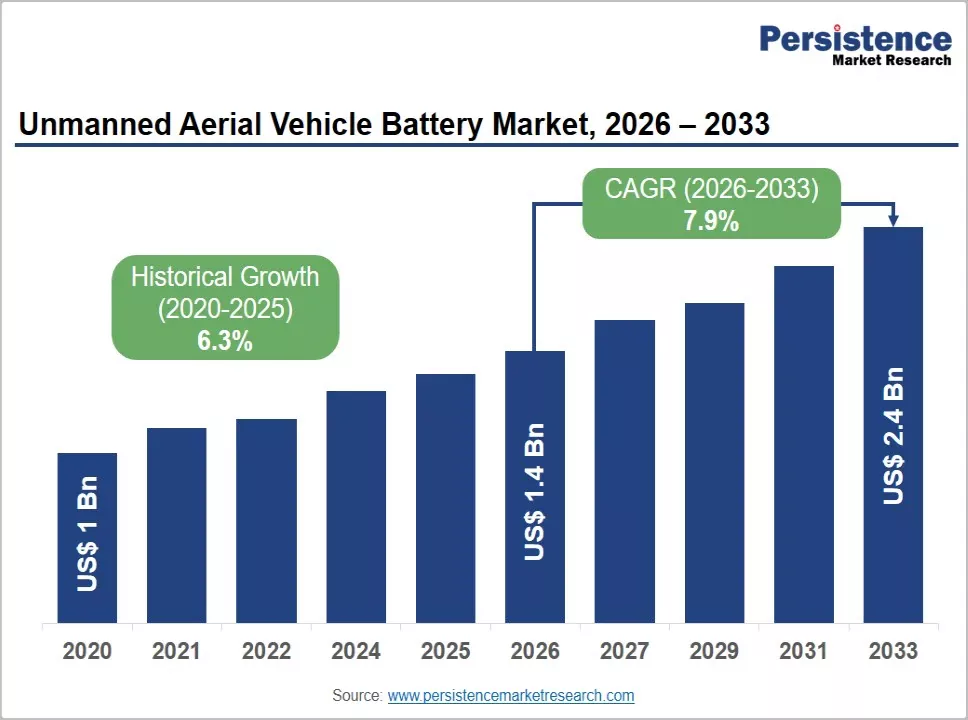
The global unmanned aerial vehicle battery market size is likely to be valued at US$ 1.4 billion in 2026, and is estimated to reach US$ 2.4 billion by 2033, growing at a CAGR of 7.9% during the forecast period 2026 - 2033.
Growth is underpinned by the expanding procurement of military drones, rising commercial deployment in logistics, inspection, and agriculture, and rapid advances in high-energy-density cell chemistries across developed and emerging economies.
The market registered a historical CAGR of 6.3% during 2020 - 2025, reflecting supply chain constraints, platform certification delays, and the high cost of advanced cells. However, the forecast period anticipates stronger acceleration as defense forces scale attritable and long-endurance fleets, regulators open beyond-visual-line-of-sight (BVLOS) operations, and domestic battery supply chains gain commercial momentum.
Key Industry Highlights
- Dominant UAV Type: Small UAVs are set to command around 44% of the revenue share in 2026, while high-altitude long endurance (HALE) platforms are likely to grow the fastest at about 9.6% CAGR through 2033, as stratospheric and solar-electric aircraft demand ultra-light, high-energy cells.
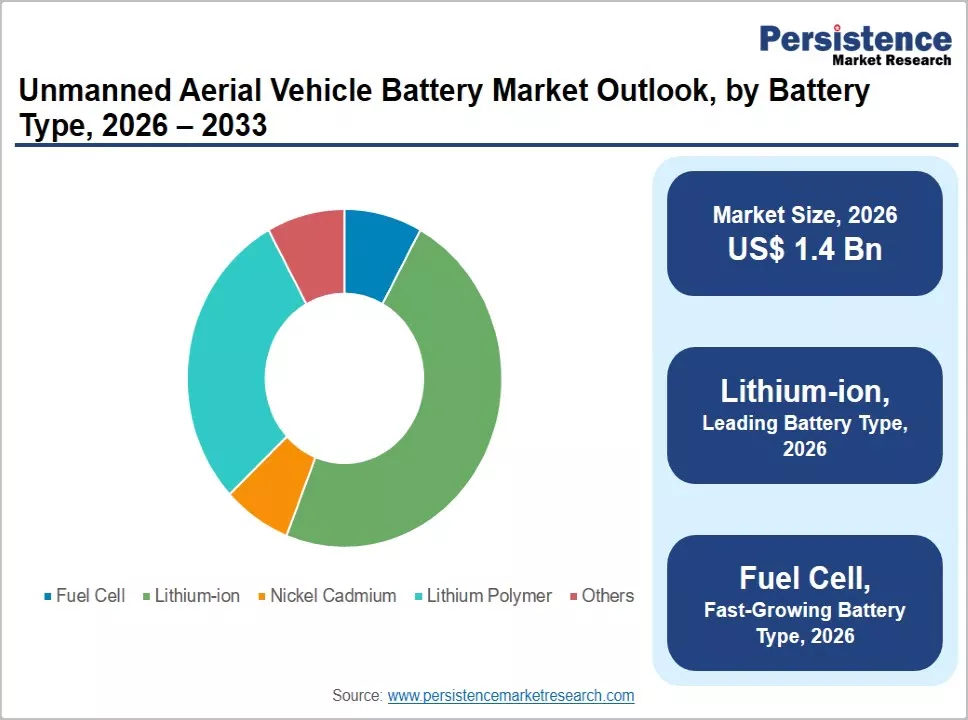
- Leading Battery Type: Lithium-ion batteries are expected to lead with roughly 40% in 2026, while fuel cells are likely to be the fastest-growing at about 13.4% CAGR during 2026 - 2033, reflecting the need for endurance beyond the reach of conventional cells.
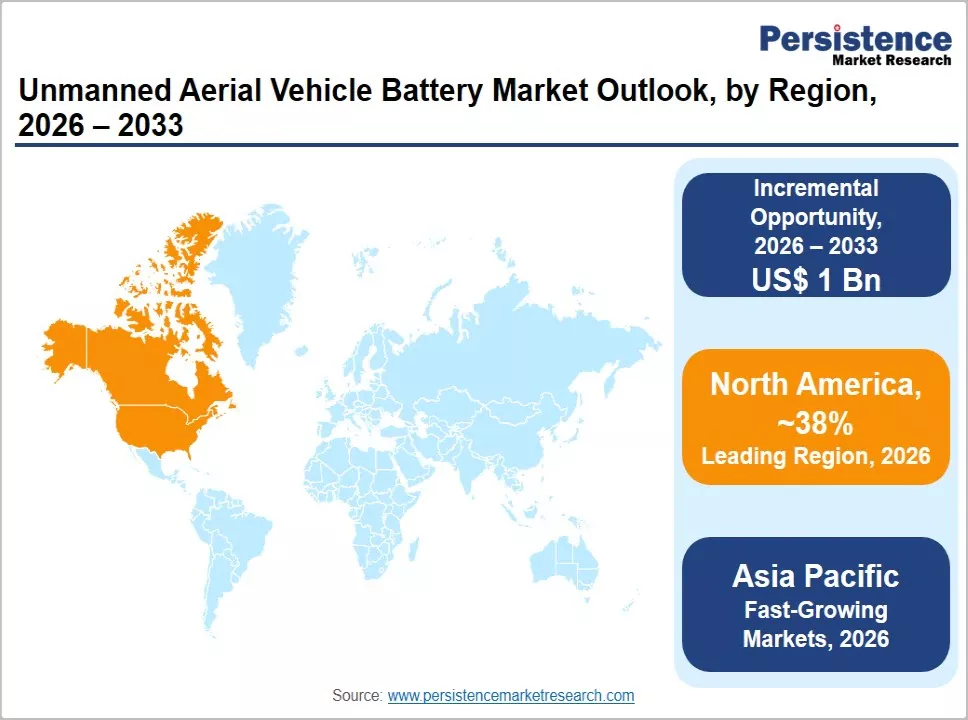
- Regional Leadership: North America is poised to dominate with an estimated 38% share in 2026, while Asia Pacific is anticipated to register the fastest growth at 9.1% CAGR through 2033, led by manufacturing scale-up in China and rising defense and agricultural drone adoption in India.
- Technology Shift: Silicon-anode lithium-ion cells delivering 450-500 Wh/kg are moving from pilot lines into volume production, enabling flight-time gains of up to twice those of standard cells. Domestic production of such cells is also being scaled to address defense supply chain security requirements.
- Competitive Environment: Competitive dynamics include domestic capacity expansion for NDAA-compliant cells, strategic partnerships between battery makers and drone manufacturers, and new production sites on multiple continents.
DRO Analysis
Drivers: Rising Military Drone Procurement and Endurance-Driven Cell Innovation as Primary Growth Catalyst
Military drone procurement is the leading force driving the unmanned aerial vehicle battery market growth, as armed forces worldwide shift toward large inventories of small, attritable, and long-endurance unmanned systems. Recent conflicts have demonstrated the mass use of first-person-view (FPV) drones, loitering munitions, and tactical reconnaissance platforms, each of which relies on batteries that are consumed or replaced at high frequency.
Governments in the U.S., Europe, and Asia Pacific are allocating dedicated funding to scale drone production, which directly raises demand for cells, packs, and battery management systems. Battery performance also defines mission duration, payload capacity, and operational range, making energy storage one of the most critical and value-intensive subsystems on any unmanned aircraft. In parallel, commercial applications such as parcel delivery, infrastructure inspection, mapping, precision agriculture, and public safety are expanding the installed base of drones that require regular battery replacement.
High-Energy-Density Chemistries and Domestic Supply Chains
Advances in cell technology are reshaping the competitive value proposition of UAV batteries. Silicon-anode lithium-ion cells that deliver around 450 to 500 Wh/kg are now being shipped to drone manufacturers, and the technology is being adapted for production on conventional cell manufacturing equipment, which supports faster scaling. Defense buyers are also prioritizing domestic and allied supply chains that comply with the National Defense Authorization Act (NDAA), encouraging new investments in U.S. and European cell production. This combination of higher endurance, localized manufacturing, and government-backed demand is expected to sustain market growth through 2033.
Restraints: Safety Risks, Cell Supply Concentration, and Limited Energy Density in Legacy Chemistries
Safety and regulatory complexity remain significant challenges for the unmanned aerial vehicle battery market. Lithium-based cells carry thermal runaway risks, particularly under high discharge rates, fast charging, and physical impact, and incidents can lead to platform loss or restrictions on air transport and storage. Shipping of lithium batteries is subject to dangerous goods regulations and UN 38.3 testing, which adds time and cost to international trade. In addition, much of the global cell manufacturing capacity and critical material processing is concentrated in a small number of countries, leaving drone makers exposed to trade restrictions, export controls, and price volatility.
Cost Premiums and Qualification Barriers
High-performance cells carry substantial cost premiums over commodity lithium-ion and lithium polymer packs, which limits adoption in price-sensitive commercial segments. Military and aviation customers also require extensive qualification, abuse testing, and traceability documentation before a new cell can be integrated, often extending procurement timelines by many months. Fuel cell systems add further complexity through hydrogen storage, refueling logistics, and higher system weights at smaller scales. These factors collectively moderate the pace of adoption of next-generation power sources, highlighting the need for scalable manufacturing, standardized pack designs, and streamlined certification pathways.
Opportunities: BVLOS Commercial Operations, Hydrogen Fuel Cells, and Stratospheric Platforms
Regulatory progress on BVLOS operations is opening large commercial opportunities for the UAV battery market. Aviation authorities in North America, Europe, and Asia Pacific are moving toward frameworks that allow drones to operate routinely beyond the operator's line of sight, which is essential for scalable parcel delivery, utility inspection, and emergency response. These use cases require higher energy density, longer cycle life, and rapid turnaround between flights, creating demand for premium cells and swappable pack architectures. Delivery operators are already entering supplier collaborations to secure longer range and heavier payload capability.
Hydrogen, Hybrid Power, and High-Altitude Platforms
Hydrogen fuel cells and hybrid power systems are emerging as credible options for long-endurance missions, such as pipeline monitoring, maritime surveillance, and border patrol, where flight times of several hours are required. High-altitude pseudo-satellite aircraft that combine solar arrays with lightweight rechargeable cells are another promising segment, supported by telecommunications and Earth observation programs. Battery-as-a-service models, second-life applications, and recycling programs are also expected to create new revenue pools for suppliers and drone fleet operators through 2033.
Category-wise Insights
UAV Type Analysis
Why Do Small UAVs Lead the Unmanned Aerial Vehicle Battery Market?
Small UAVs are the leading UAV type segment, expected to hold about 44% of the unmanned aerial vehicle battery market revenue share in 2026. This category includes consumer, commercial, and military multirotor and fixed-wing drones, as well as FPV and loitering systems used in defense operations. Their high production volumes, short flight endurance, and frequent pack replacement create a recurring demand base for lithium polymer and lithium-ion batteries.
Standardization around common pack formats and rapid charging has also reduced costs and encouraged adoption across logistics, agriculture, and public safety. Ongoing improvements in motor efficiency and lightweight airframes are also increasing the value of every incremental watt-hour of onboard energy.
HALE platforms are likely to grow the fastest through 2033 at about 9.6% CAGR. These aircraft operate at stratospheric altitudes for days or weeks, using solar power during the day and stored energy at night. Every gram of battery weight directly affects flight duration, which makes ultra-high-energy-density cells, including silicon-anode and lithium-sulfur designs, essential. Telecommunications relay, persistent surveillance, and climate monitoring programs are supporting investment in this segment.
Medium-altitude long endurance (MALE) and tactical UAVs represent stable, value-rich segments. MALE aircraft rely on battery systems for avionics redundancy, payload power, and engine start, while tactical drones increasingly adopt higher-capacity lithium-ion packs and hybrid architectures to extend reconnaissance missions. Defense modernization programs and export demand are expected to sustain steady growth in both categories.
Battery Type Analysis
Why Does Lithium-ion Lead Battery Types in UAV Applications?
Lithium-ion batteries lead the battery type segment, projected to capture about 40% of the revenue share in 2026. They offer a favorable balance of energy density, cycle life, and cost, and are available in cylindrical and pouch formats suitable for tactical and commercial drones. Continuous improvements, such as silicon-rich anodes and higher-nickel cathodes, are increasing gravimetric energy density, allowing operators to extend flight times without redesigning airframes. Supply chain maturity and established safety standards further support their dominant position.
Fuel cells represent the fastest-growing battery type, anticipated to achieve about 13.4% CAGR during the 2026 - 2033 period. Hydrogen fuel cells provide significantly longer endurance than conventional batteries and enable quick refueling, making them attractive for inspection, mapping, and surveillance missions. Their growth is supported by lightweight composite hydrogen tanks, improved membrane technologies, and pilot deployments by commercial and defense operators, although hydrogen logistics and higher upfront costs remain barriers to wider adoption.
Lithium polymer batteries hold a strong position in small and high-discharge applications, such as racing, FPV, and multirotor drones, where power density and flexible form factors are valued. Nickel cadmium batteries are gradually declining because of lower energy density and environmental restrictions, while other chemistries, including lithium-sulfur and solid-state, remain in early commercialization but are attracting investment for high-altitude and long-range platforms. Hybrid architectures that pair batteries with small engines or fuel cells are also gaining attention as a way to bridge the gap between electric and fuel-based endurance.
Regional Insights
North America Unmanned Aerial Vehicle Battery Market Trends and Insights
North America is anticipated to account for an estimated 38% of the global unmanned aerial vehicle battery market in 2026. The region's industry is likely to benefit from large defense budgets, a strong drone manufacturing base, and growing commercial BVLOS activity. Federal restrictions on procuring drones and components from covered foreign entities are encouraging investments in domestic cell production, while the Blue UAS framework continues to shape supplier selection.
Competition among established battery manufacturers and silicon-anode specialists is also expected to intensify through 2033 as demand outpaces domestic capacity. Defense primes, drone start-ups, and battery specialists are increasingly forming supply agreements that lock in cell availability for multi-year production programs, which improves demand visibility for suppliers.
U.S. Unmanned Aerial Vehicle Battery Market Size
The U.S. is estimated to account for approximately 78% of the North America unmanned aerial vehicle battery market in 2026. Market growth is likely to be supported by Department of Defense programs for small unmanned systems, Collaborative Combat Aircraft development, and expanding commercial delivery operations. Naval and industrial funding for domestic lithium-ion cell production is expected to strengthen local supply chains, while collaborations between battery developers and delivery drone operators are anticipated to accelerate adoption of high-energy cells.
Rising demand from public safety agencies and the energy sector is likely to further support investments through 2033. Recent combat lessons on drone attrition are also pushing program offices to specify higher production rates and shorter battery replacement cycles for small unmanned aircraft.
Canada Unmanned Aerial Vehicle Battery Market Size
Canada is projected to represent approximately 22% of the North America unmanned aerial vehicle battery market in 2026. Market expansion is expected to be driven by updated drone regulations that enable wider BVLOS operations, together with demand from mining, forestry, pipeline monitoring, and remote community logistics.
Cold-weather performance is a key purchasing criterion, which is likely to favor premium lithium-ion packs with thermal management and creates opportunities for fuel cell power systems across long-distance inspection missions through 2033. Remote and northern operating environments also favor battery thermal management and heated pack designs.
Europe Unmanned Aerial Vehicle Battery Market Trends and Insights
Europe is estimated to account for approximately 24% of the global unmanned aerial vehicle battery market in 2026. The region's market is expected to benefit from rising defense spending, European Union (EU) drone strategies, and the introduction of U-space airspace services for commercial operations.
New European production capacity for drone batteries, including facilities opened by U.S.-based suppliers, is likely to reduce dependence on imported cells and shorten lead times. Strong regulatory standards for battery safety and recycling are also expected to favor established suppliers with certified products. The growing use of drones for border surveillance and critical infrastructure protection is expected to add sustained demand for tactical battery packs across member states.
Germany Unmanned Aerial Vehicle Battery Market Size
Germany is anticipated to account for approximately 22% of the Europe unmanned aerial vehicle battery market in 2026. Demand is expected to be supported by increased defense procurement, the growth of domestic drone manufacturers developing reconnaissance and loitering systems, and industrial inspection applications.
Utilities and infrastructure operators are likely to adopt drones for grid, wind farm, and rail monitoring, creating demand for durable, high-cycle batteries. Local automotive battery expertise is also expected to support technology transfer into aerospace-grade cells through 2033. Collaboration between research institutes, automotive cell makers, and drone start-ups is expected to speed up the commercialization of lightweight cells for aerospace use.
Why Is Asia Pacific Expected to Be the Fastest-Growing Region in the Unmanned Aerial Vehicle Battery Market?
Asia Pacific is projected to account for approximately 27% of the global unmanned aerial vehicle battery market in 2026, and is anticipated to register the fastest growth, expanding at an estimated CAGR of 9.1% through 2033. Market expansion is likely to be driven by large-scale drone manufacturing, government support for low-altitude economy initiatives, and increasing defense modernization.
China and India are expected to remain the primary demand centers, while Japan, South Korea, and Australia are also likely to expand adoption in logistics, surveying, and surveillance. Rapid progress in electric aircraft testing, agricultural drone adoption, and smart city projects is also strengthening regional demand.
China Unmanned Aerial Vehicle Battery Market Size
China is estimated to represent approximately 52% of the Asia Pacific unmanned aerial vehicle battery market in 2026. The country's market is expected to benefit from a deeply integrated lithium polymer and lithium-ion supply base, high-volume production of commercial and consumer drones, and policy support for the low-altitude economy.
Growth in drone-based delivery, agricultural spraying, and urban air mobility testing is likely to generate steady battery demand, while domestic suppliers continue to improve energy density and fast-charging performance through 2033. Export-oriented manufacturers are also developing smart batteries with embedded diagnostics to meet the needs of fleet operators overseas.
India Unmanned Aerial Vehicle Battery Market Size
India is projected to account for approximately 17% of the Asia Pacific unmanned aerial vehicle battery market in 2026. The market is expected to witness strong expansion, supported by the Drone Rules 2021, the Production Linked Incentive scheme for drones and drone components, and the Namo Drone Didi program for agricultural drone adoption.
Defense procurement of indigenous unmanned systems is also likely to encourage local cell assembly and pack manufacturing, reducing import dependence and supporting new domestic battery suppliers. Growing interest from start-ups in agriculture, mapping, and last-mile delivery is expected to widen the customer base beyond defense users.
Competitive Landscape
The global unmanned aerial vehicle battery market structure is moderately fragmented, with leading vendors, including Amprius Technologies, EnerSys, Saft, and EaglePicher Technologies, accounting for roughly one-third of the revenue share. These established players leverage long-standing defense relationships, qualification credentials, and diversified chemistry portfolios. They continue to invest in higher-energy-density cells, intelligent battery management systems, and domestic production capacity to strengthen their positions.
Vertical integration, from cell design to pack assembly and battery management software, is increasingly viewed as a source of competitive advantage because it shortens qualification timelines.
Regional and specialized competitors such as Ultralife Corporation, Intelligent Energy, and Epsilor are focusing on tactical power systems, fuel cell modules, and customized military packs, while Asian suppliers continue to dominate high-volume lithium polymer packs for commercial drones. Barriers such as safety certification and supply chain compliance limit new entrants, but silicon-anode and solid-state start-ups are entering through partnerships with drone manufacturers. Market consolidation is expected to increase gradually as battery makers acquire niche technology developers and drone OEMs secure long-term supply agreements.
Key Market Developments
- In September 2026, Amprius Technologies introduced a second-generation SiCore silicon-anode cell delivering 500 Wh/kg at a 1C continuous discharge rate for long-endurance unmanned aircraft, designed for volume production on conventional cell manufacturing equipment.
- In May 2026, Amprius Technologies and Matternet announced a strategic collaboration to deploy silicon-anode cells in Matternet's M2 delivery drone and to develop batteries optimized for its next-generation aircraft.
- In May 2026, Titan Batteries opened a drone battery manufacturing facility in Tilburg, the Netherlands, giving the U.S.-based supplier full-scale production capacity in both North America and Europe.
Companies Covered in Unmanned Aerial Vehicle Battery Market
- Amprius Technologies, Inc.
- EnerSys
- Saft Groupe S.A.
- EaglePicher Technologies, LLC
- Ultralife Corporation
- Intelligent Energy Limited
- Denchi Group Limited
- Epsilor Ltd.
- Shenzhen Grepow Battery Co., Ltd.
- Titan Batteries
Frequently Asked Questions
The global unmanned aerial vehicle battery market is valued at US$ 1.4 billion in 2026 and is projected to reach US$ 2.4 billion by 2033, expanding at a CAGR of 7.9% during 2026 - 2033.
Expanding procurement of military drones, rising commercial deployment in logistics, inspection, and agriculture, and rapid advances in high-energy-density cell chemistries are driving the market. Domestic supply chain initiatives and regulatory progress on BVLOS operations are further supporting demand across developed and emerging economies.
Small UAVs lead UAV types with about 44% share, and lithium-ion batteries lead battery types with an estimated 40% in 2026. High-altitude long endurance platforms and fuel cells are the fastest-growing segments, expanding at about 9.6% and 13.4% CAGR respectively.
North America dominates the market with an estimated 38% share in 2026, supported by large defense budgets, a strong drone manufacturing base, and domestic cell production initiatives. Asia Pacific is projected to be the fastest-growing region at a 9.1% CAGR through 2033.
BVLOS commercial operations, hydrogen fuel cell and hybrid power systems, high-altitude platforms, and battery-as-a-service models are key market opportunities.
The market is moderately fragmented, with Amprius Technologies, EnerSys, Saft, and EaglePicher Technologies accounting for roughly one-third of the revenue share.


