




- Aerospace & Defense
- Business Jet Simulators Market
Business Jet Simulators Market Size, Share, and Growth Forecast 2026–2033
Business Jet Simulators Market by Type (Full Flight Simulators, Fixed Base Simulators), Platform (Commercial Aviation, Military Aviation), Component (Hardware, Software, Services), Application (Pilot Training, Aircraft Maintenance Training), and Regional Analysis, 2026–2033

Business Jet Simulators Market Size and Trend Analysis
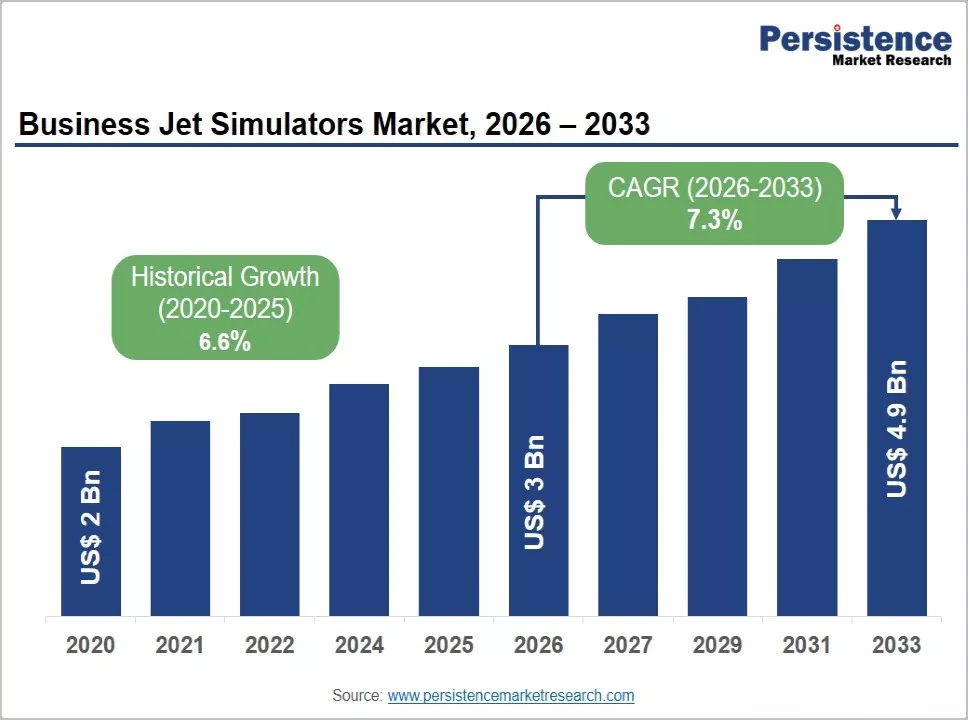
The global business jet simulators market size is likely to be valued at US$ 3 billion in 2026 and is projected to reach US$ 4.9 billion by 2033, growing at a CAGR of 7.3% during the forecast period between 2026 and 2033.
Business jet simulators are no longer only a regulatory requirement for pilots. They are the main way crews learn new aircraft, practice emergencies that cannot be safely flown, and keep their qualifications current, while a growing share of maintenance and cabin crew training also moves into virtual environments.
The forecast period is defined by new aircraft entering service, a shortage of qualified pilots and technicians, and the expansion of training centers by aircraft makers and specialist providers. Simulator makers, training operators, aircraft manufacturers, and flight departments should read this as a capacity-led category in which regulatory approval, aircraft-type coverage, and training network reach determine competitive position.
Key Industry Highlights
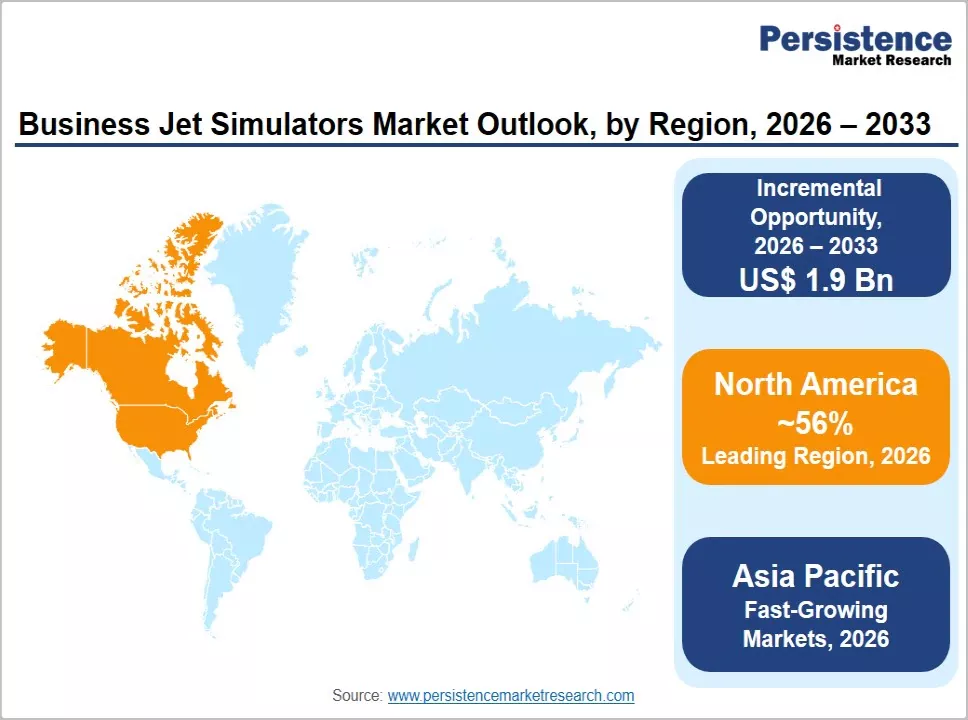
- Dominant and Fastest-growing Region: North America holds 56% of the market revenue in 2026, supported by the world's largest business jet fleet and the training networks of CAE and FlightSafety International, while Asia Pacific is projected to be the fastest-growing region at an estimated 9.1% CAGR through 2033, driven by China, India, and Southeast Asia.
- Leading Type and Platform: Full flight simulators command about 78% of 2026 revenue, as regulators require qualified full-motion devices for type ratings and recurrent checks. Commercial aviation, which covers corporate and charter operations, accounts for around 82% of revenue.
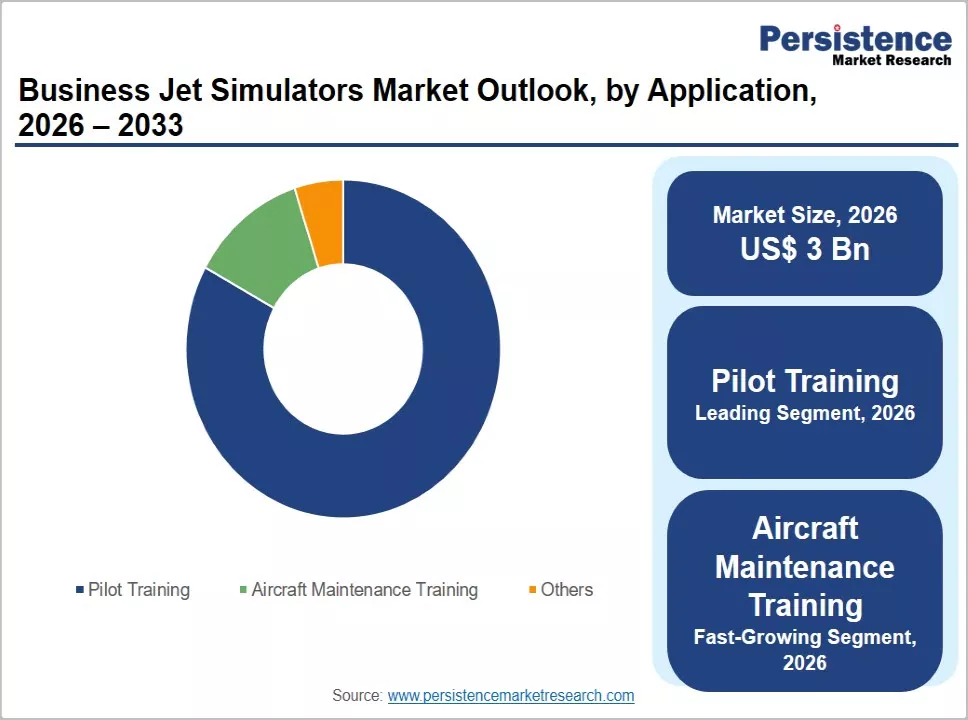
- Leading Component and Application: Hardware accounts for about 46% of revenue, reflecting the cost of motion systems, visual systems, and replica cockpits, while pilot training holds around 83% because every crew member must complete initial and recurrent simulator sessions.
- Fastest-growing Segments and Emerging Opportunity: Fixed base simulators, military platforms, services, and maintenance training are the fastest-growing segments. CAE announced four additional business jet full flight simulators in the Americas in October 2026 and said it expects a need for 120,000 new business aviation professionals globally by 2034.
DRO Analysis
Driver- New Aircraft Deliveries, Pilot Demand, and Regulatory Training Requirements
Every new business jet type needs approved simulators before its customers' pilots can train, so new aircraft programs create new simulator orders. TRU Simulation announced FAA Level D qualification for its Cessna Citation Ascend simulator in February 2026, and FlightSafety International received FAA approval for a Global 7500 simulator at its Columbus learning center the same month. Regulators require regular recurrent simulator training, which gives training centers steady, repeat demand, and CAE estimates the industry needs 120,000 new business aviation professionals by 2034.
Restraint- High Capital Cost, Long Qualification Timelines, and Cyclical Aircraft Demand
A full flight simulator is a major investment, covering the motion platform, visual system, replica cockpit, and an approved training bay, and it must pass regulatory qualification before it can earn revenue. Qualification can take months and depends on obtaining aircraft data from the manufacturer, which limits how fast new devices enter service. Demand is also tied to business jet sales and flight hours, which are cyclical and sensitive to economic conditions, and the market is concentrated, since CAE and FlightSafety dominate training and make it difficult for new providers to gain scale.
Opportunity- Fixed Base Trainers, Maintenance Training, and Emerging Aviation Markets
Lower-cost fixed base trainers, virtual maintenance training, and training capacity in emerging markets represent the largest white space. Training providers are adding digital platforms and part-task trainers that let crews prepare before using costly full flight time, and technician training is moving into virtual and mixed-reality environments. Growth in business aviation across Asia Pacific, the Middle East, and Latin America creates demand for local training centers, which reduces the cost and time of sending crews abroad. Independent builders such as Axis Flight Simulation have also qualified Challenger 350 simulators in the U.S. and Europe, adding competition for mid-size aircraft.
Category-wise Analysis
Why Do Full Flight Simulators Command a Majority of the Global Business Jet Simulators Market?
Full flight simulators are projected to lead the segment, holding nearly 78% of market share in 2026. Regulators allow Level D devices to replace aircraft time for type rating and many emergency procedures, so operators have no alternative to full-motion simulators for core training. CAE operates more than 130 full flight simulators across its business aviation network, FlightSafety International supports Textron Aviation programs with more than 70 simulators, and TRU Simulation builds devices for the Citation range.
Fixed base simulators are likely to be the fastest-growing type, as flight departments use lower-cost devices for procedure practice, systems training, and recurrent preparation. They need less space and no motion platform, making them suited to flight schools, operators, and manufacturers that cannot invest in a full simulator.
Platform Insights
What Is Driving Commercial Aviation Dominance Across the Business Jet Simulators Industry?
Commercial aviation is expected to lead the segment, holding about 82% of market share in 2026. Corporate flight departments, charter operators, and fractional ownership programs need steady, type-specific crew training, and aircraft makers such as Bombardier and Textron work with training partners for every new model.
Military aviation is likely to be the fastest-growing platform, as governments adapt business jets for special missions, surveillance, and transport, and as defense primes such as Lockheed Martin, Northrop Grumman, and Elbit Systems expand their training offers. These programs often involve long-term service contracts.
Component Insights
Why Does Hardware Hold the Largest Share of the Global Business Jet Simulators Market?
Hardware is projected to lead the component segment, accounting for around 46% of market share in 2026. Motion systems, visual displays, control loading, and replica cockpits make up most of the cost of a new simulator, and suppliers such as Thales Group, Rockwell Collins, and Diamond Visionics provide high-fidelity visual systems and avionics.
Services are likely to be the fastest-growing component, driven by training center operations, upgrades, maintenance, and software updates that keep simulators aligned with aircraft changes. Software, which includes aircraft models and instructor tools, is growing as providers add data analytics and adaptive training.
Application Insights
How Does Pilot Training Stay Ahead of Other Business Jet Simulator Applications?
Pilot training is projected to lead the application segment, accounting for about 83% of market share in 2026. Initial type ratings and recurrent checks are required for every crew, and the shortage of experienced pilots increases demand for efficient training.
Aircraft maintenance training is likely to be the fastest-growing application, as technicians need to learn systems on new aircraft without taking real aircraft out of service. Virtual and mixed-reality trainers lower cost, and the others category includes cabin crew and dispatcher training.
Regional Insights
North America Business Jet Simulators Market Trends and Insights
North America is forecast to lead this regional market, account for around 56% of the business jet simulators market in 2026. The region has the world's largest business jet fleet, the headquarters of Textron, Boeing, Lockheed Martin, and Raytheon Technologies, and the dense training networks of CAE and FlightSafety International, which are expanding capacity to match fleet growth.
U.S. Business Jet Simulators Market Size
The U.S. is estimated to hold around 87% of the North America regional market in 2026. Training centers in Florida, Texas, Ohio, and Nevada serve large corporate and charter fleets, and new simulator approvals such as TRU Simulation's Citation Ascend and FlightSafety's Global 7500 devices support steady investment.
Canada Business Jet Simulators Market Size
Canada is expected to account for around 13% of the North America regional market in 2026. The country is home to CAE and Bombardier, and Canadian training and manufacturing capabilities supply simulators and crew training for global operators of Challenger and Global aircraft.
Europe Business Jet Simulators Market Trends and Insights
Europe is anticipated to command around 14% of market share in 2026. The region has strong demand from charter operators and corporate fleets, a regulatory framework that recognizes EASA-qualified devices, and suppliers such as Thales Group, Indra Sistemas, and Reiser Simulation. Training centers such as Vienna and Farnborough serve operators across the continent.
Germany Business Jet Simulators Market Size
Germany is projected to account for around 16% of the Europe regional market in 2026. Corporate and charter operators, aerospace engineering firms, and the airline training sector support demand for type-specific and maintenance simulators.
U.K. Business Jet Simulators Market Size
The U.K. is estimated to account for nearly 22% of the Europe regional market in 2026. A large business aviation sector around London and a major training center at Farnborough sustain demand for Citation, Gulfstream, and Embraer simulators.
Which Region Will Drive the Fastest Business Jet Simulators Growth Through 2033?
Asia Pacific is forecast to be the fastest-growing region, capturing around 12% of market share in 2026 and expanding at an estimated 9.1% CAGR through 2033. Rising numbers of high-net-worth individuals, new business aviation infrastructure, and the need for local training centers are driving growth, while global providers expand capacity through partnerships and joint ventures.
China Business Jet Simulators Market Size
China is projected to hold 32% of the Asia Pacific regional market in 2026. Domestic business aviation is growing from a small base, and local operators and training schools are adding simulators to reduce reliance on overseas centers.
India Business Jet Simulators Market Size
India is expected to account for around 16% of the Asia Pacific regional market in 2026. Growth in charter flying, new airports, and policy support for business aviation are raising pilot demand, and operators are looking for local training capacity.
Competitive Landscape
The global business jet simulators market is highly concentrated in training and moderately fragmented in simulator manufacturing. CAE and FlightSafety International lead on network scale, aircraft-type coverage, and manufacturer partnerships, while TRU Simulation + Training, Thales Group, Rockwell Collins, Frasca International, and Reiser Simulation compete through device design, visual systems, and cost-effective trainers. Aircraft makers such as Bombardier, Textron, and Boeing influence the market through type-specific training approvals, and defence primes including Lockheed Martin, Raytheon Technologies, Northrop Grumman, and Elbit Systems serve military platforms. Competitive intensity is rising as providers add digital platforms, virtual maintenance trainers, and capacity in emerging markets. Winning requires fast regulatory qualification, access to aircraft data, a global training network, and a strong services offer.
Key Industry Developments
- In February 2026, TRU Simulation + Training, a Textron company and an affiliate of Textron Aviation, announced that its full flight simulator for the Cessna Citation Ascend had achieved FAA Level D qualification, with EASA Level D qualification anticipated later in 2026. The simulator expands advanced training capacity for midsize jet pilots as the Citation Ascend enters service.
- In October 2026, CAE announced at the NBAA Business Aviation Convention and Exhibition that four additional business jet full flight simulators, covering the Bombardier Global 6500, Embraer Praetor 600, Pilatus PC-24, and Cessna Citation CJ4, are now available in the Americas. The additions take CAE's global business aviation training network to more than 130 full flight simulators, and the company said it anticipates a need for 120,000 new business aviation professionals globally by 2034.
Companies Covered in Business Jet Simulators Market
- Aerosim Technologies
- Boeing
- Bombardier
- CAE Inc.
- Diamond Visionics
- Elbit Systems
- FlightSafety International
- Frasca International
- Indra Sistemas
- L-3 Communications
- Lockheed Martin
- Northrop Grumman
- Raytheon Technologies
- Reiser Simulation
- Rockwell Collins
- Simcom Aviation Training
- Textron
- Thales Group
- TRU Simulation + Training
Frequently Asked Questions
The global business jet simulators market is valued at US$ 3 billion in 2026.
New aircraft deliveries, pilot and technician demand, and regulatory training requirements, partly offset by high capital cost, long qualification timelines, and cyclical aircraft demand.
Full flight simulators hold around 78% of the market. Regulators allow Level D devices to replace aircraft time for type ratings and many emergency procedures, so operators have no alternative for core training.
North America leads with a 56% share in 2026, driven by the world's largest business jet fleet and the training networks of CAE and FlightSafety International, while Asia Pacific is the fastest-growing region.
The largest opportunities are fixed base trainers, virtual maintenance training, digital training platforms, and new training centers in emerging aviation markets.


