




- Specialty & Fine Chemicals
- Triclosan Market
Triclosan Market Size, Share, and Growth Forecast, 2026 – 2033
Triclosan Market by Grade (Industrial Grade, Pharmaceutical Grade), Application (Personal Care Products, Healthcare Products, Textiles, Plastics & Polymers, Industrial Products, Others), End-user (Personal Care and Cosmetics, Healthcare, Agriculture, Others), and Regional Analysis for 2026-2033

Triclosan Market Share and Trends Analysis
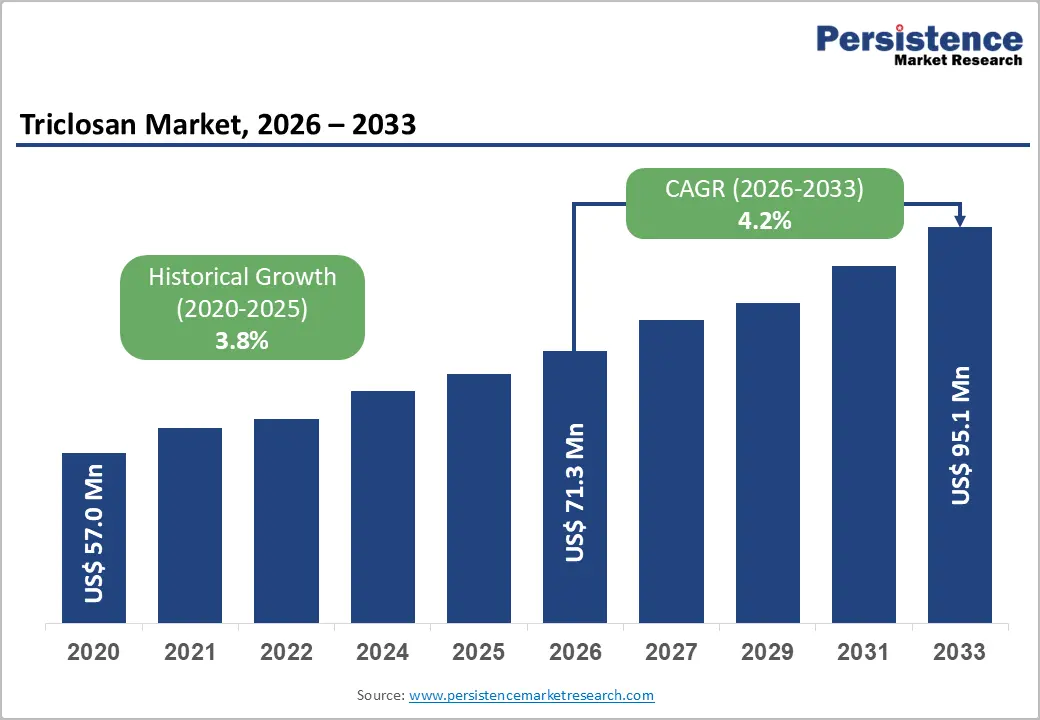
The global triclosan market size is likely to be valued at US$71.3 million in 2026 and is estimated to reach US$95.1 million by 2033, growing at a CAGR of 4.2% during the forecast period from 2026 to 2033, driven by rising demand for antimicrobial compounds across regulated hygiene applications, supported by structured formulation requirements in personal care and healthcare products. Demographic shifts toward urban sanitation awareness, particularly in emerging economies, strengthen baseline consumption.
Key Industry Highlights:
- Leading Grade: The industrial grade segment is expected to hold around 62% revenue share in 2026, driven by large-scale industrial and personal care manufacturing integration.
- Fastest-Growing Grade: The pharmaceutical grade segment is projected to be the fastest-growing segment, supported by regulated healthcare formulation expansion.
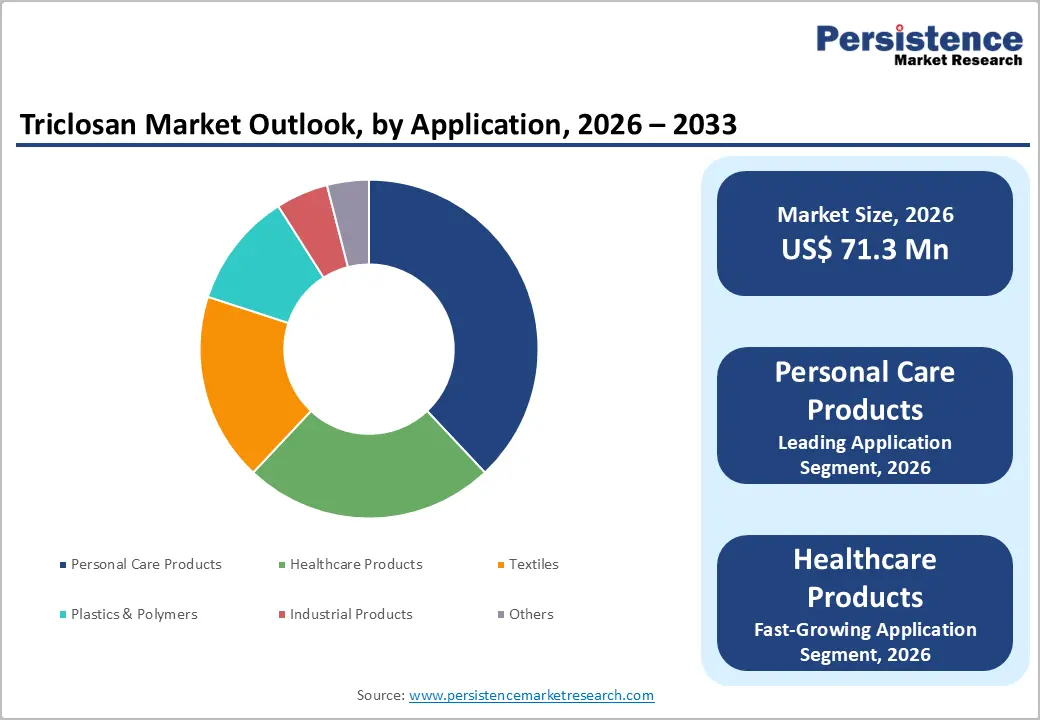
- Leading Application: Personal care products are estimated to hold roughly 38% revenue share in 2026, due to high-volume hygiene product manufacturing.
- Fastest-growing Application: Healthcare products are forecast to record the fastest growth, driven by the expansion of infection prevention systems in clinical environments.
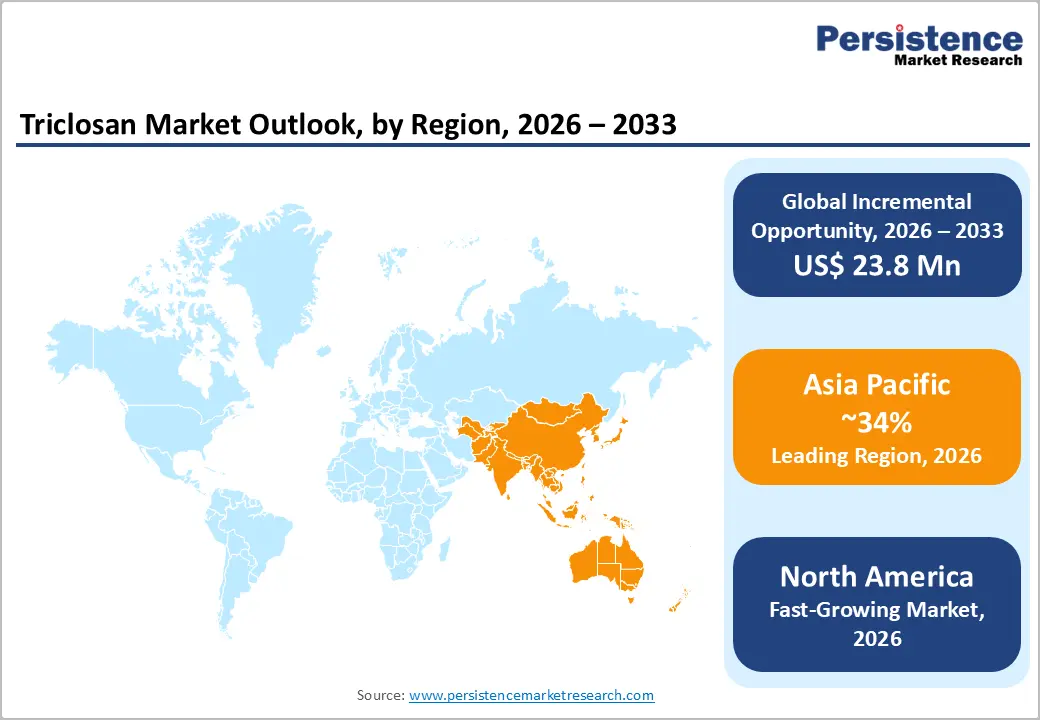
- Regional Leadership: Asia Pacific is projected to capture roughly 34% of the market share by 2026 due to manufacturing expansion and healthcare infrastructure development.
- Competitive Environment: Moderately fragmented structure driven by specialty chemical producers and pharmaceutical ingredient suppliers.
- Innovation Trends: Controlled-release antimicrobial systems and pharmaceutical-grade formulation technologies are reshaping application efficiency and compliance standards.
DRO Analysis
Driver - Rising demand from industrial applications
Population increases and urbanization expand the need for antimicrobial additives in plastics and polymers. Government data from the U.S. EPA in 2025 indicate that registered pesticide uses of triclosan supported stable industrial volumes despite consumer restrictions. Producers respond with refined grades suitable for material preservation. This integration reduces microbial degradation in end products and supports supply chain reliability. Demand from manufacturers of durable goods translates into volume growth.
Infrastructure projects in Asia and North America incorporate treated materials for longevity. Regulatory approvals for non-consumer applications sustain production capacity utilization. Companies invest in process optimizations that lower unit costs. The outcome is predictable revenue streams from B2B channels. Scalability improves as facilities adopt continuous manufacturing methods.
Restraint - Regulatory limitations on consumer exposure
The FDA rules prohibit triclosan in many over-the-counter antiseptic washes, reducing accessible market channels. Compliance requires reformulation or market withdrawal in affected categories. This constraint narrows demand from personal care manufacturers. Supply chains face inventory adjustments and potential write-downs. Margins compress when volumes shift to lower-margin industrial outlets.
Uncertainty around future EPA registration reviews affects long-term planning. Producers limit capital allocation to restricted applications. Scalability suffers from fragmented demand across permitted uses. Overall capacity utilization remains below potential in consumer-facing lines.
Opportunity - Development of Compliant Formulations for Textiles
Innovation in embedding techniques allows incorporation into fibers while meeting emission standards. Policy support for durable antimicrobial textiles in medical and industrial settings opens pathways. Producers collaborate with textile firms to validate performance under use conditions. Market expansion follows from the replacement of less effective alternatives. Growth logic centers on hygiene requirements in high-traffic environments.
Regulatory incentives for reduced microbial contamination in apparel drive adoption. Pilot programs demonstrate extended product life and lower replacement frequency. The pathway includes the scale-up of finishing processes. Companies position offerings for global supply chains seeking standardized solutions.
Category-wise Analysis
Grade Insights
The industrial-grade segment is expected to lead, accounting for approximately 62% of the global revenue share in 2026. The segment dominates due to broad use in large-scale manufacturing of plastics and hygiene-related intermediates. Production facilities such as chemical formulation units in India demonstrate integration of industrial-grade inputs for bulk antimicrobial applications. Cost efficiency and compatibility with polymer processing support sustained demand.
The pharmaceutical-grade segment is likely to represent the fastest-growing segment, propelled by increasing regulatory compliance requirements in healthcare formulations. Growth is driven by precision dosing requirements in clinical antiseptics and topical applications. Pharmaceutical formulation units in North America utilize high-purity inputs for controlled antimicrobial products. Stringent safety validation enhances adoption in regulated healthcare environments.
Application Insights
Personal care products are projected to lead the market, capturing around 38% of the revenue share in 2026. Widespread use in soaps, toothpaste, and hygiene products supports the dominance of this segment. A formulation example includes antimicrobial toothpaste lines developed under regulated concentration limits in Southeast Asia. High consumer hygiene awareness sustains demand.
Healthcare products are expected to be the fastest-growing segment, driven by increasingly stringent infection prevention and control measures across clinical settings. The expansion of hospital hygiene initiatives is boosting the use of antimicrobial products in antiseptic cleansers, surgical scrubs, and surface disinfection applications. For example, hospitals across Europe are increasingly incorporating antimicrobial scrubs into preoperative and surgical protocols to enhance patient safety and reduce the risk of healthcare-associated infections. Additionally, regulatory requirements and established clinical hygiene standards continue to support the sustained adoption of these products, contributing to segment growth.
End-user Insights
The personal care and cosmetics segment is likely to lead with a projected 41% of the triclosan market share in 2026, due to widespread consumer hygiene product integration. High-volume production of hygiene products supports the dominance of this segment. Cosmetic manufacturers in East Asia incorporate antimicrobial agents in deodorants and cleansers. Consumer-driven hygiene awareness reinforces structured demand.
The healthcare segment is anticipated to be the fastest-growing segment, fueled by the expansion of infection prevention systems in hospitals and diagnostic centers. Clinical hygiene standardization increases antimicrobial procurement in medical environments. Healthcare facilities in emerging economies adopting structured infection control programs demonstrate the rising demand. Expansion of healthcare infrastructure supports sustained uptake.
Regional Insights
North America Triclosan Market Trends
North America is forecast to be the fastest-growing market for triclosan, stimulated by increasing demand for advanced antimicrobial materials, healthcare hygiene solutions, and specialty industrial applications. Continuous innovation in antimicrobial technologies and strong healthcare investments are creating new opportunities. Regulatory compliance requirements are encouraging the development of application-specific formulations with enhanced performance characteristics.
U.S. Triclosan Market Insights
The U.S. is projected to account for approximately 78% of the North America market share in 2026. Strong healthcare infrastructure, advanced consumer product manufacturing, and extensive industrial activity support demand. Product innovation initiatives by specialty chemical and healthcare companies are expanding application areas.
Canada Triclosan Market Insights
Canada is likely to represent around 22% of the North America market share in 2026, supported by growth in healthcare services, industrial manufacturing, and hygiene-focused consumer products. Public health initiatives are increasing awareness regarding antimicrobial solutions. Expansion of advanced manufacturing capabilities is creating opportunities for integration into specialty materials and polymer products.
Europe Triclosan Market Trends
Europe is expected to account for approximately 28% of the market share in 2026, supported by established regulatory frameworks, advanced chemical manufacturing capabilities, and sustained demand for antimicrobial materials. Product utilization remains concentrated in healthcare, industrial products, and specialized hygiene applications. Regulatory evaluations continue to encourage innovation in compliant formulations.
Germany Triclosan Market Insights
Germany is forecast to contribute around 27% of the Europe market share in 2026. Strong industrial manufacturing activity across plastics, polymers, and specialty chemicals supports consumption. Expansion of antimicrobial material development programs is encouraging wider industrial adoption. Research investments and advanced production capabilities continue to strengthen growth prospects.
U.K. Triclosan Market Insights
The U.K. is expected to account for nearly 18% of the Europe share in 2026. Demand is supported by healthcare modernization initiatives and growth in hygiene-oriented consumer products. Increasing focus on infection prevention within healthcare facilities is creating opportunities for antimicrobial formulations. Collaboration between healthcare suppliers and specialty chemical manufacturers is supporting product innovation and commercialization.
Asia Pacific Triclosan Market Trends
Asia Pacific is anticipated to be the leading region, accounting for a market share of 34% in 2026, driven by expanding personal care manufacturing, rising healthcare expenditure, and large-scale industrial production. Strong demand from textiles, plastics, healthcare products, and hygiene applications continues to support consumption. Growing urban populations and increasing awareness regarding antimicrobial products are encouraging wider adoption.
China Triclosan Market Insights
China is expected to account for approximately 42% of the Asia Pacific share in 2026. Large-scale production of personal care products, textiles, and specialty chemicals supports substantial demand. Expansion of healthcare infrastructure and industrial manufacturing facilities is creating new application opportunities. Investments in advanced material technologies are increasing utilization across value-added consumer and industrial products.
India Triclosan Market Insights
India is projected to represent nearly 21% of the Asia Pacific share in 2026. Rising healthcare expenditure, expanding pharmaceutical production, and increasing hygiene awareness are supporting adoption. Government initiatives focused on healthcare accessibility are contributing to demand growth. Expansion of domestic personal care and specialty chemical manufacturing is strengthening consumption across multiple end-use sectors.
Competitive Landscape
The global triclosan market is moderately fragmented, characterized by the presence of specialty chemical manufacturers and pharmaceutical ingredient suppliers. Competition is defined by regulatory compliance capability, production efficiency, and formulation integration capacity. Key participants include BASF SE, Merck KGaA, Clariant AG, Jiangsu Huanxin High-tech Materials, and Vivimed Labs.
The market structure reflects regulated supply concentration across industrial chemical producers and specialty formulation companies. Competitive positioning depends on raw material sourcing stability and compliance with global chemical safety frameworks. Demand concentration in healthcare and personal care applications shapes supplier strategies.
Key Industry Developments:
- In January 2026, Hello Products launched whipped fluoride toothpaste featuring a triclosan-free formulation, reinforcing the shift toward alternative antimicrobial and clean-label oral care products in the toothpaste segment.
Companies Covered in Triclosan Market
- BASF SE
- Merck KGaA
- Clariant AG
- Jiangsu Huanxin High-tech Materials
- Sino Lion
- Kumar Organic Products Limited
- Salicylates and Chemicals Pvt. Ltd.
- Vivimed Labs
- Shandong Aoyou Biological Technology Co. Ltd.
Frequently Asked Questions
The global triclosan market is projected to reach US$71.3 million in 2026.
Rising demand for antimicrobial ingredients in healthcare, personal care, and industrial hygiene applications drives the triclosan market.
The triclosan market is poised to witness a CAGR of 4.2% from 2026 to 2033.
Expansion of antimicrobial medical coatings and integration into specialty textiles and polymer applications create key market opportunities.
Some of the key market players include BASF SE, Merck KGaA, Clariant AG, Jiangsu Huanxin High-tech Materials, and Vivimed Labs.


