




- Healthcare Services
- Teleneurology Market
Teleneurology Market Size, Share, and Growth Forecast 2026 - 2033
Teleneurology Market by Service Type (Tele-Consulting, Tele-Monitoring, Tele-Education), Application (Stroke, Parkinson’s, Epilepsy, Headache, Multiple Sclerosis), End-user (Patients, Providers, Payers), and Regional Analysis, 2026 - 2033

Teleneurology Market Size and Trends Analysis
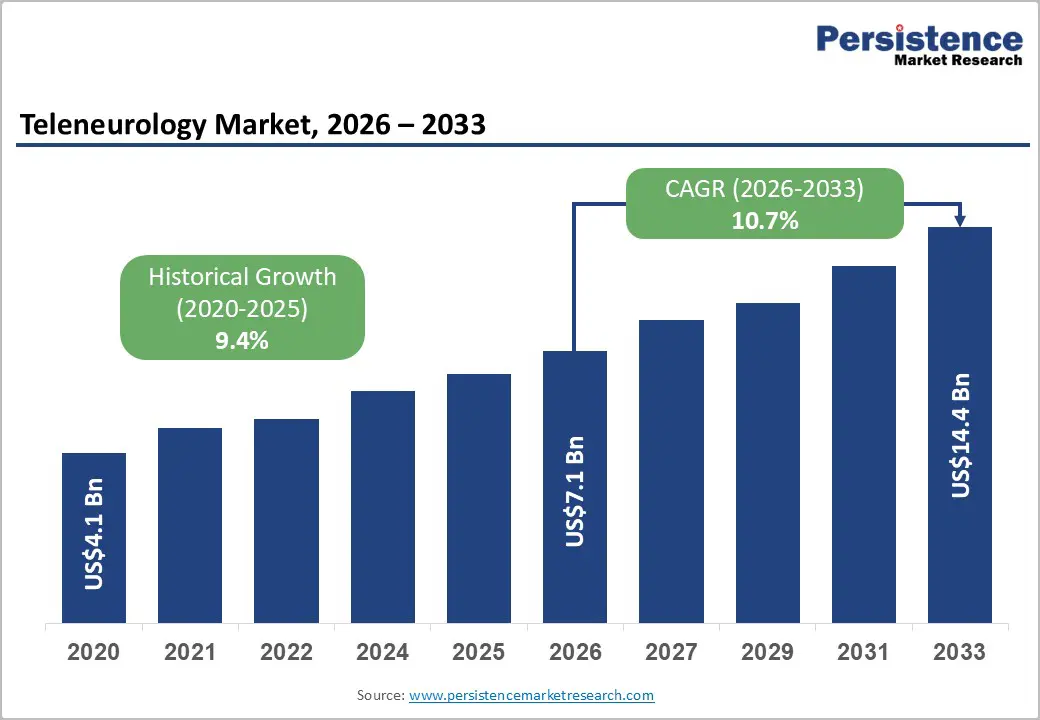
The global teleneurology market size is expected to be valued at US$7.1 billion in 2026 and is predicted to reach US$14.4 billion by 2033, surging at a CAGR of 10.7% during the forecast period from 2026 to 2033, driven by urgent treatment delays and a shortage of specialists.
Stroke, one of the leading causes of death globally, requires intervention within minutes. Teleneurology enables real-time expert evaluation and treatment decisions even in hospitals without on-site neurologists.
Key Industry Highlights:
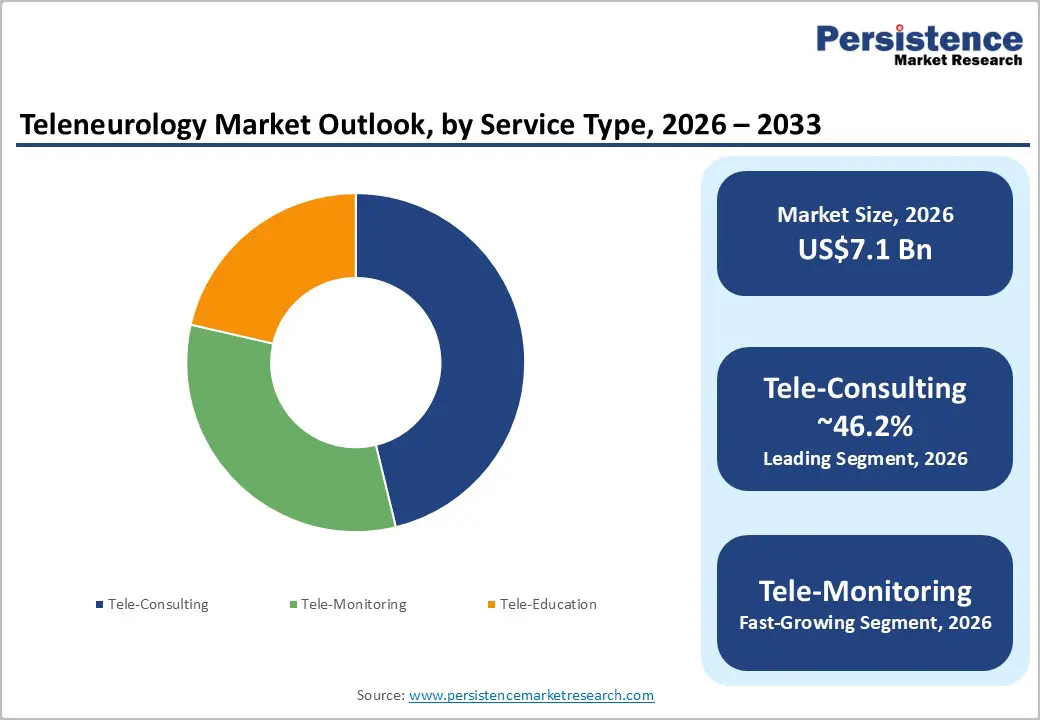
- Leading Service Type: Tele-consulting, around 46.2% in 2026, as most neurological evaluations, including speech, cognition, and motor function, can be reliably assessed over video without requiring physical presence.
- Dominant Application: Stroke, nearly 32.6% share in 2026, as it is highly time-sensitive, and teleneurology enables immediate expert decisions, with studies showing outcomes comparable to in-person treatment.
- Recent Collaboration: In January 2026, WVU Rockefeller Neuroscience Institute collaborated with Paraguay’s health authorities to help launch the country’s first national teleneurology and telestroke network.
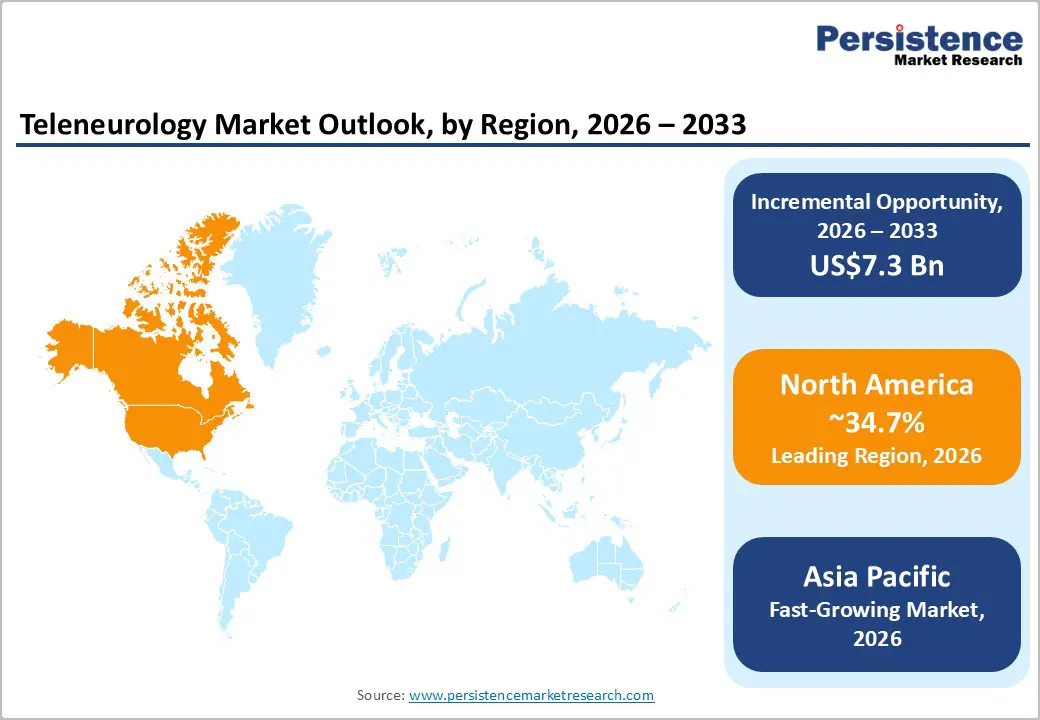
- Leading Region: North America, with 34.7% share in 2026, as hospitals have already embedded teleneurology into emergency workflows, including telestroke, supported by superior infrastructure and reimbursement systems that enable routine use.
- Fast-growing Region: Asia Pacific, owing to a large gap between neurologist availability and patient demand, as well as rising smartphone penetration and government-backed telehealth programs.
DRO Analysis
Driver - Increasing Burden of Neurological Disorders Globally
The rising incidence of neurological conditions is a key factor bolstering teleneurology adoption. According to the World Health Organization (WHO), neurological disorders are now the leading cause of disability globally. Conditions such as stroke, Alzheimer’s, Parkinson’s, and epilepsy are increasing due to aging populations and lifestyle factors. WHO further mentioned that there were approximately 11.9 million new cases of stroke worldwide in 2021 alone.
The yearly surge is overwhelming for the existing neurology infrastructure, especially in regions with limited specialist availability. Teleneurology delivers a broad way to manage this load by enabling remote consultations, follow-ups, and continuous monitoring. For instance, stroke cases continue to rise globally, creating urgent demand for rapid-response systems such as telestroke networks. As healthcare systems struggle to keep up with high patient volumes, teleneurology is becoming essential for expanding access while maintaining timely and specialized care.
Shortage of Neurologists in Remote, Rural, or Underserved Areas
Another important driver is teleneurology’s role in addressing the shortage of neurologists, especially in rural and underserved areas. Several hospitals lack full-time neurology specialists, leading to delayed or inadequate care. Teleneurology bridges this gap by connecting local clinicians with remote experts through real-time video consultations and data sharing.
The model allows patients to receive specialist-level care without traveling long distances, while also supporting doctors in small facilities. Evidence shows that such networks significantly improve access and enable novel treatments in regions that previously lacked neurological expertise.
Restraint - Regulatory and Payment Complexities Slow Large-scale Adoption
Teleneurology expansion is significantly constrained by fragmented licensing rules and inconsistent reimbursement systems. In various countries, especially the U.S., physicians must be licensed in the same state where the patient is located, which directly limits cross-border care delivery and increases administrative burden. The American Medical Association notes that differing state-level policies mean a service reimbursed in one region may be non-reimbursable or even restricted in another, creating uncertainty for providers.
Complex billing structures and eligibility restrictions act as financial disincentives, specifically for telestroke networks where reimbursement pathways are still evolving. These regulatory inconsistencies reduce expandability, delay hospital adoption, and make it difficult for teleneurology providers to build standardized, multi-region service models.
Opportunity - Increasing Use of Digital Biomarkers and Smartphone-based Monitoring
Teleneurology is opening new opportunities through smartphone-based monitoring of neurological conditions. Apps and wearable-linked platforms now capture continuous data on movement, speech, and cognition, allowing clinicians to track disease progression remotely. For instance, researchers associated with the National Institutes of Health have validated smartphone-based tools for Parkinson’s disease.
The tools help measure tremor and gait patterns in real-world settings, improving clinical decision-making outside hospital visits. Studies published in npj Digital Medicine showcase how passive data collection can detect subtle symptom changes earlier than periodic clinical assessments. This creates opportunities for proactive intervention, personalized treatment adjustments, and continuous care models that extend beyond traditional episodic consultations.
Expansion of Remote Neuro-rehabilitation through Immersive Technologies
Virtual rehabilitation programs that use immersive tools to deliver therapy at home are expected to open the door to new opportunities. Technologies such as Virtual Reality (VR) are being integrated into teleneurology platforms to support recovery from stroke, traumatic brain injury, and neurodegenerative conditions. Clinical research from the National Library of Medicine shows that VR-based neuro-rehabilitation improves motor function and patient engagement compared to conventional therapy.
In practice, hospitals are deploying guided VR sessions where therapists remotely monitor patient performance and adjust exercises in real time. This approach reduces the requirement for frequent hospital visits while maintaining therapy intensity. It makes rehabilitation more accessible and adjustable, especially for patients with mobility constraints.
Category-wise Analysis
Service Type Insights
The tele-consulting segment is predicted to dominate with nearly 46.2% of the share in 2026, owing to the high dependency of neurology on visual assessment, history-taking, and expert interpretation, all of which can be done effectively over video. Unlike other specialties, multiple neurological evaluations, such as checking speech, coordination, or cognition, can be performed remotely with guidance from a specialist. Evidence from studies shows high patient acceptance across conditions, with strong satisfaction regardless of disease type, making it expandable across outpatient care.
In India’s Karnataka Brain Health Initiative, nearly 95% of patients were willing to continue teleconsultations, showcasing its practicality even in low-resource settings.
Tele-monitoring is anticipated to be the fastest-growing segment in the forecast period. It is attributed to the requirement of continuous tracking of neurological diseases rather than episodic visits. Conditions such as Parkinson’s, epilepsy, and dementia show fluctuations that cannot be captured in occasional consultations. Developments in wearables, remote EEG, and AI-based analytics now allow real-time tracking of seizures, movement patterns, and cognitive decline. Research shows that such systems enable long-term and continuous data collection with high accuracy, thereby improving early detection and intervention.
Application Insights
Stroke is estimated to lead with nearly 32.6% of the share in 2026, as it is extremely time-sensitive and protocol-based, making it ideal for telemedicine. Treatment decisions such as thrombolysis must be made within minutes. Teleneurology enables neurologists to assess scans and guide treatment instantly. Clinical data shows over 50% of teleneurology consultations involve cerebrovascular conditions, underlining its central role. Also, teleneurology has demonstrated high diagnostic accuracy for stroke, with sensitivity above 95%, reinforcing trust among clinicians. The urgency, standardization of care pathways, and measurable outcomes make stroke the most commercially and clinically dominant application.
Epilepsy is projected to remain in the second position in the forthcoming years. It is spurred by the requirement of long-term management, frequent follow-ups, and continuous monitoring. Patients often require medication adjustments and seizure tracking rather than physical examinations. Studies show telemedicine improves continuity of care and patient satisfaction in epilepsy management, especially during disruptions such as the COVID-19 period. Even simple telephonic follow-ups have been proven effective for outpatient epilepsy care, reducing hospital visits without compromising outcomes. This makes epilepsy one of the most recurring use cases in teleneurology.
Regional Insights
North America Teleneurology Market Trends
In 2026, North America is estimated to dominate with approximately 34.7% of the share in 2026. Its well-established healthcare infrastructure and early telehealth adoption are propelling growth. Hospitals across the region have already integrated telestroke networks, remote EEG, and AI-enabled diagnostics into routine workflows. Reimbursement systems are also well-defined, which reduces financial uncertainty for providers. The burden of neurological diseases is also high.
Data linked to the National Institutes of Health indicates nearly 795,000 stroke cases occur annually in the U.S., pushing demand for rapid remote care. This combination of infrastructure, policy support, and disease burden keeps the region ahead.
U.S. Teleneurology Market Trends
The U.S. market is growing fast because of the ongoing integration of teleneurology into hospital systems and insurance-backed coverage. Telestroke programs are widely deployed across trauma centers, allowing neurologists to guide treatment remotely in minutes. Private players are also launching AI-based tools, including seizure detection and stroke triage, which improve efficiency and reimbursement eligibility. Government-backed coverage expansion, such as Medicare telehealth support, has further accelerated adoption, making virtual neurology a standard rather than an optional service.
Asia Pacific Teleneurology Market Trends
Asia Pacific is expected to be the fastest-growing region through 2033 because of massive unmet demand combined with ongoing digital expansion. Large populations, rising neurological disorders, and a shortage of specialists create a strong requirement for remote care.
Governments are actively investing in telehealth. For example, India’s telestroke initiatives aim to connect rural hospitals with urban neurologists. At the same time, increasing smartphone penetration and mobile health platforms are enabling extensive deployment even in semi-urban areas. This mix of demand gap and digital infrastructure growth is pushing faster adoption than in mature markets.
Japan Teleneurology Market Trends
Japan stands out due to its surging aging population and high neurological disease burden. The country has one of the largest elderly populations globally, which directly increases cases of stroke, dementia, and Parkinson’s disease. To manage this, the government is promoting home-based care and telemedicine adoption. Unique digital infrastructure and high acceptance of wearable devices are also supporting remote monitoring for chronic neurological conditions, especially epilepsy and movement disorders.
India Teleneurology Market Trends
India’s growth is augmented by rural access gaps and government-backed programs. A large portion of the population lacks access to neurologists, especially outside metro cities. Initiatives such as the Karnataka Brain Health Initiative, led by the National Institute of Mental Health and Neurosciences, are expanding teleneurology services at the community level. These programs connect primary health centers with specialists, improving early diagnosis and stroke management. Increasing smartphone usage and low-cost teleconsultation models are also making services more accessible across tier-2 and rural regions.
Europe Teleneurology Market Trends
Europe is growing steadily due to structured digital health policies and cross-border care frameworks. Various countries have harmonized regulations that allow teleconsultations across regions, improving access to specialists. Aging populations and rising chronic neurological conditions are also increasing demand for continuous care models such as tele-rehabilitation and monitoring. Public healthcare systems are investing in remote care to reduce hospital burden and improve long-term disease management.
U.K. Teleneurology Market Trends
The U.K. is progressing through superior public healthcare support and stroke-focused programs. The National Health Service (NHS) has widely implemented teleconsultation for stroke and dementia care, improving access in rural areas. Stroke remains a key concern, with around 100,000 cases annually, pushing hospitals to adopt telestroke networks for quick intervention. Telemedicine is also being used to reduce long waiting times and support continuous neurological care outside hospitals.
Germany Teleneurology Market Trends
Germany is advancing through digital health reforms and increased telemedicine reimbursement. The country has introduced policies to promote digital health applications (DiGA) and remote consultations. These are encouraging hospitals and clinics to adopt tele-neurology services. A well-established healthcare infrastructure and a focus on outpatient digital care are helping expand use cases such as remote monitoring and rehabilitation. The rising elderly population and emphasis on home-based care are further pushing providers to integrate teleneurology into routine clinical practice.
Competitive Landscape
The global teleneurology market is moderately fragmented, with multiple categories of competitors rather than a few dominant leaders. Large virtual care platforms such as Teladoc Health and American Well (Amwell) compete alongside niche neurology-focused providers, including Sevaro Health and TeleSpecialists. Hospital-led networks such as the Medical University of South Carolina and regional systems are also building in-house teleneurology hubs. This creates overlapping competition between vendors and providers, not just among tech companies.
Companies are no longer competing only on video consultation. The core battleground is end-to-end neurological care platforms. These are combining tele-consulting, AI diagnostics, imaging, and remote monitoring. Firms such as Koninklijke Philips and Medtronic are entering the devices and neuro-monitoring markets, while telehealth players are adding AI triage and documentation tools. This convergence is compelling competitors to build full-stack networks rather than single services.
Key Industry Developments:
- In April 2026, UPMC Washington launched a new hospital inpatient tele-neurosurgery consultation service. It aims to broaden access to specialized neurological care close to home with this launch. UPMC neurosurgery specialists will provide real-time consultations for hospitalized patients with intracranial or spine conditions.
- In May 2025, the Cleveland Clinic announced the development of a new neurological institute designed to expand teleneurology capabilities. The initiative aims to extend specialist neurological expertise to remote and regional hospitals through real-time virtual consultations, continuous monitoring, and AI-supported diagnostics.
- In March 2025, the University of Alabama at Birmingham (UAB) achieved a key milestone as it completed 10,000 consults of the acute teleneurology service. UAB focuses on broadening access to neurologic care across Alabama. The program has already expanded geographically in partnership with Mobile Infirmary and St. Vincent’s Hospitals.
Companies Covered in Teleneurology Market
- Providence
- Lakewood Health System
- Eagle Telemedicine
- Medical University of South Carolina
- Blue Sky Telehealth
- Teladoc Health, Inc.
- The Australian Stroke Alliance
- American Well
- Sevaro Health, Inc.
- Access TeleCare, LLC
- TeleSpecialists
- Others
Frequently Asked Questions
The global teleneurology market is projected to be valued at US$7.1 billion in 2026.
The teleneurology market is expected to reach US$14.4 billion by 2033.
Shift toward integrated care models blending tele-consulting, remote monitoring, AI-supported diagnostics, and hospital network partnerships is a key market trend.
Tele-consulting is predicted to be the leading service with around 46.2% of share in 2026, attributed to the requirement for quick specialist access for diagnosis and triage before moving to advanced monitoring or treatment.
The teleneurology market is expected to grow at a CAGR of 10.7% from 2026 to 2033.
Providence, Lakewood Health System, Eagle Telemedicine, and Medical University of South Carolina are a few key market players.


