




- Off-Road Equipment & Machinery
- Tamping Machine Market
Tamping Machine Market Size, Share, and Growth Forecast, 2026 - 2033
Tamping Machine Market by Product Type (Straight Track Tamping Machines, Multi-purpose Tamping Machines (MPT), Others), Application (Track Maintenance, New Railway Lines Construction), Power Source, and Regional Analysis for 2026 - 2033

Tamping Machine Market Size and Trends Analysis
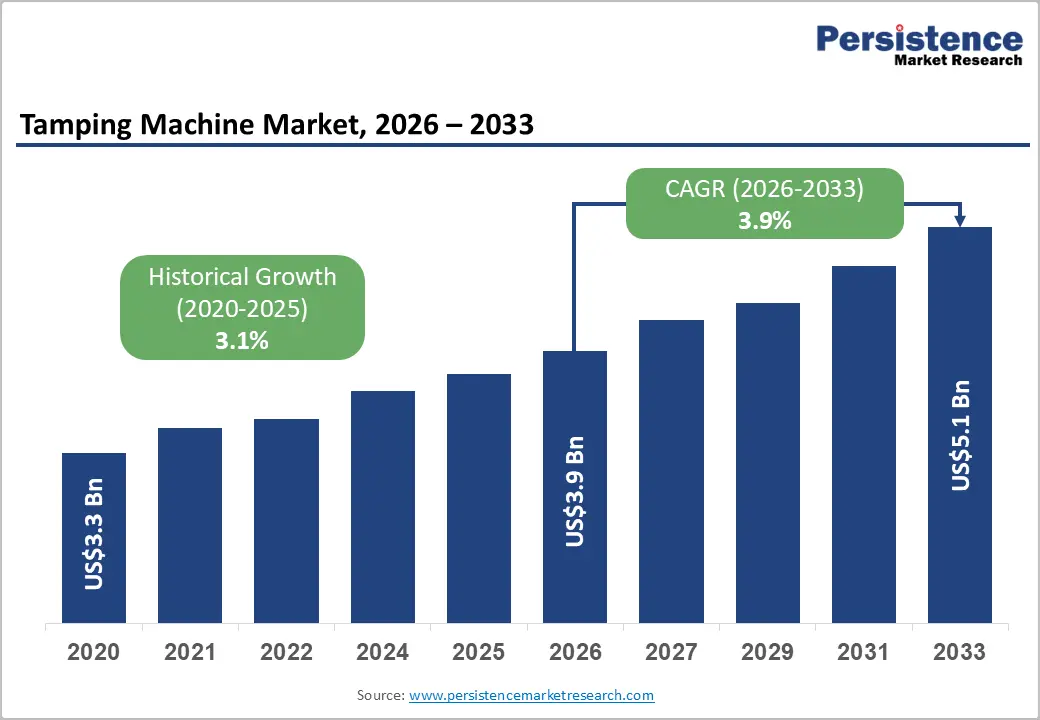
The global tamping machine market size is likely to be valued at US$3.9 billion in 2026 and is expected to reach US$5.1 billion by 2033, growing at a CAGR of 3.9% between 2026 and 2033, driven by sustained investments in railway infrastructure modernization, expansion of high-speed rail networks, and increasing emphasis on predictive maintenance across rail transportation systems. Railway operators worldwide are prioritizing mechanized track maintenance to improve safety, reduce operational disruptions, and extend asset lifecycles. Government-funded rail expansion programs in Asia Pacific, Europe, and North America are creating stable demand for advanced tamping equipment. The integration of automation, digital monitoring systems, and energy-efficient power sources is further supporting market growth while enhancing operational productivity and maintenance accuracy.
Key Industry Highlights:
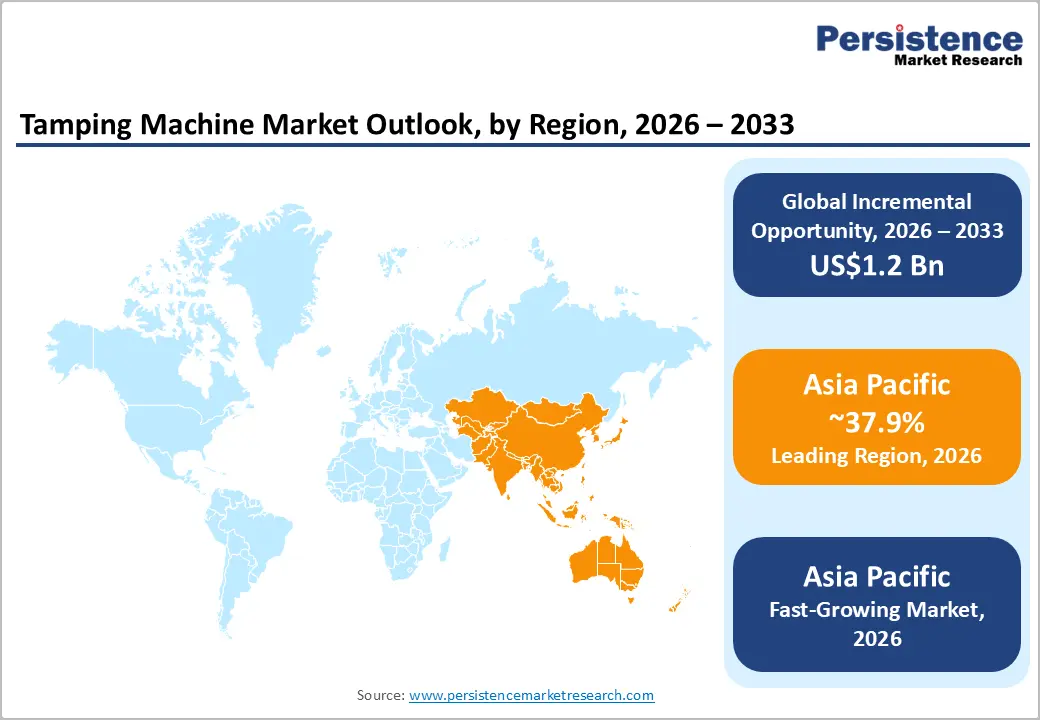
- Leading Region: Asia Pacific is projected to account for approximately 37.9% of the market share in 2026, supported by large-scale railway expansion projects, extensive high-speed rail networks, and growing investments in mechanized track maintenance across China, India, and Southeast Asia.
- Fastest-growing Region: Asia Pacific is expected to register the highest growth rate through 2033, driven by ongoing railway infrastructure development, metro rail construction, dedicated freight corridor projects, and increasing adoption of advanced maintenance technologies.
- Dominant Product Type: Straight track tamping machines are anticipated to account for approximately 48.5% of the market share in 2026, owing to their extensive use in routine maintenance operations across conventional railway networks.
- Leading Application: Track maintenance is expected to hold approximately 86.4% of the market share in 2026, supported by recurring maintenance requirements for existing rail infrastructure, increasing rail traffic volumes, and growing adoption of preventive maintenance practices.
DRO Analysis
Driver - Growing Global Railway Infrastructure Investments Accelerating Demand for Mechanized Track Maintenance
Railway infrastructure spending remains a primary growth driver for the tamping machine market. According to the International Union of Railways (UIC), rail networks globally transport billions of passengers and significant freight volumes annually, creating continuous demand for track maintenance equipment. Governments in China, India, the European Union, and the United States are allocating substantial budgets toward railway modernization and expansion projects. India's National Rail Plan and dedicated freight corridor initiatives, China's high-speed rail expansion exceeding 45,000 km, and the U.S. Bipartisan Infrastructure Law collectively support increased procurement of track maintenance machinery.
Tamping machines play a critical role in restoring ballast conditions and track geometry, directly influencing rail safety and operating efficiency. As rail operators seek to minimize track possession times and reduce maintenance-related disruptions, automated tamping equipment offers measurable productivity gains. This trend strengthens long-term equipment replacement cycles and supports recurring demand from railway infrastructure authorities and private operators.
Increasing Focus on Railway Safety and Predictive Maintenance Technologies
Regulatory agencies worldwide continue to strengthen track safety requirements, driving investment in advanced maintenance equipment. Organizations such as the Federal Railroad Administration (FRA), the European Union Agency for Railways (ERA), and national rail safety regulators emphasize preventive maintenance strategies to reduce derailment risks and operational failures.
Modern tamping machines equipped with GPS-based positioning systems, track geometry measurement technologies, and automated correction mechanisms enable rail operators to identify and rectify track defects more efficiently. The adoption of predictive maintenance frameworks supported by IoT sensors and real-time data analytics is further increasing demand for technologically advanced tamping systems. Rail operators can reduce maintenance costs, improve asset utilization, and extend track lifespan through precision maintenance programs. Consequently, equipment manufacturers are expanding their portfolios with intelligent tamping solutions that align with evolving railway safety standards and digital transformation objectives.
Restraint - High Capital Costs and Extended Equipment Replacement Cycles
The significant acquisition and ownership costs associated with tamping machines remain a major challenge for market growth. Advanced hydraulic and multi-purpose tamping machines can require substantial capital investments, often limiting adoption among smaller railway operators and contractors. Beyond initial procurement costs, maintenance, spare parts, operator training, and compliance expenses contribute to total ownership costs.
Railway infrastructure agencies frequently operate under long-term procurement cycles, extending replacement periods for existing equipment. Economic uncertainties, public budget constraints, and fluctuating infrastructure funding can delay capital expenditure decisions. Supply chain disruptions affecting hydraulic components, electronic systems, and specialized steel assemblies further increase procurement lead times and operating expenses. These factors collectively constrain market expansion despite strong underlying demand for rail maintenance modernization.
Opportunity - Expansion of High-Speed Rail Networks Creating Long-Term Equipment Demand
The rapid expansion of high-speed rail systems presents a substantial opportunity for tamping machine manufacturers. High-speed rail infrastructure requires extremely precise track geometry and frequent maintenance interventions to maintain operational safety and performance standards. Countries including China, India, Japan, Spain, France, and Saudi Arabia are actively investing in new high-speed rail corridors.
Unlike conventional rail systems, high-speed rail tracks require advanced tamping technologies capable of achieving tighter tolerances and enhanced maintenance precision. Manufacturers offering automated measurement systems, digital diagnostics, and intelligent maintenance capabilities are positioned to benefit from these infrastructure programs. As high-speed rail investments continue over the next decade, demand for specialized tamping machinery is expected to increase steadily across both developed and emerging economies.
Electrification and Sustainable Railway Maintenance Solutions
Sustainability initiatives are creating opportunities for next-generation electric tamping equipment. Governments and transportation authorities increasingly prioritize low-emission construction and maintenance operations to meet climate objectives. Electric tamping machines offer reduced emissions, lower operating noise, and improved suitability for enclosed environments such as tunnels, urban rail corridors, and metro systems.
The transition toward electrified rail networks further complements the adoption of electric maintenance equipment. Battery technology improvements, enhanced energy efficiency, and growing environmental regulations are encouraging equipment manufacturers to expand electric product portfolios. Railway operators pursuing carbon reduction targets are expected to increase investment in environmentally sustainable maintenance solutions, supporting long-term market opportunities for electric tamping technologies.
Category-wise Analysis
Product Type Insight
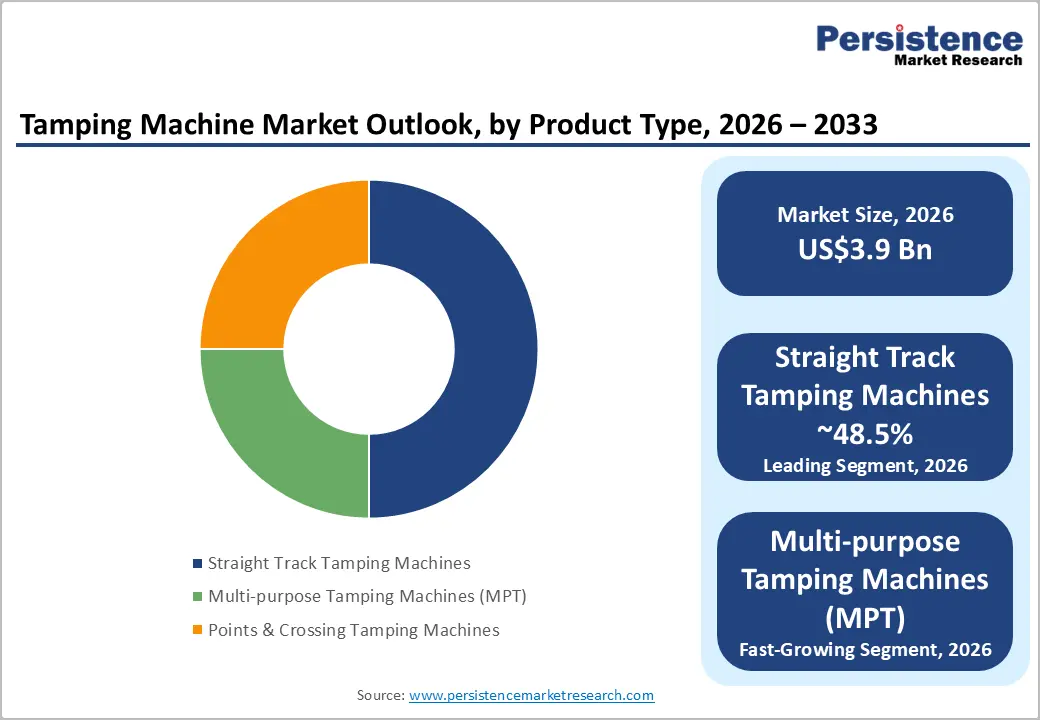
Straight track tamping machines are anticipated to account for approximately 48.5% of the market share in 2026, making them the leading product segment. Their dominance is driven by extensive use across conventional railway networks, where straight track sections comprise the majority of rail infrastructure. These machines offer efficient ballast compaction and track geometry correction at lower operating costs. For example, major railway operators such as Indian Railways and European rail infrastructure managers utilize straight track tamping equipment for routine maintenance across high-traffic corridors. Their reliability and suitability for large-scale maintenance programs continue to support market leadership.
Multi-purpose Tamping Machines (MPT) are anticipated to represent the fastest-growing segment. These machines combine tamping, stabilization, and track measurement functions in a single platform, helping operators reduce maintenance time and labor requirements. Their adoption is increasing in high-speed rail projects across China, Japan, and Europe, where maintenance precision and reduced track possession times are critical. As railway operators pursue greater automation and operational efficiency, demand for MPT systems is expected to grow steadily.
Application Insights
Track maintenance is anticipated to account for approximately 86.4% of the market share in 2026, making it the dominant application segment. Railway tracks require periodic tamping to maintain alignment, safety, and operational efficiency. Aging rail infrastructure in North America and Europe, along with heavily utilized freight and passenger corridors in Asia Pacific, supports sustained demand for maintenance equipment. For instance, freight operators in the United States and national rail authorities in Europe increasingly use mechanized tamping systems as part of predictive maintenance programs to reduce disruptions and extend track life.
New railway line construction is anticipated to remain the fastest-growing application segment through 2033. Significant investments in high-speed rail, metro systems, and dedicated freight corridors are driving demand for tamping equipment during track installation. Examples include India's Mumbai–Ahmedabad High-Speed Rail project, China's ongoing railway expansion initiatives, and metro development projects across Southeast Asia. Growing urbanization, increasing freight movement, and government-backed transportation infrastructure programs are expected to sustain strong growth in this segment.
Regional Insights
North America Tamping Machine Market Trends
North America accounts for a significant share of the global tamping machine market, supported by extensive freight rail networks, aging railway infrastructure, and growing investments in transportation modernization. The region continues to prioritize mechanized maintenance solutions to improve track safety, reduce downtime, and enhance network reliability.
U.S. Tamping Machine Market Trends
The U.S. is expected to dominate the North America market due to its extensive Class I freight rail network and ongoing rail infrastructure upgrades. Federal funding under the Bipartisan Infrastructure Law has accelerated investments in rail modernization, track rehabilitation, and passenger rail expansion. The Federal Railroad Administration (FRA) continues to support safety enhancement initiatives, encouraging railway operators to adopt advanced tamping machines equipped with automated track geometry measurement and predictive maintenance capabilities. Freight rail operators are increasingly investing in digital asset management systems to improve maintenance efficiency and extend infrastructure lifespan.
Canada Tamping Machine Market Trends
Canada contributes steadily to regional demand through freight corridor expansion and urban transit modernization projects. Investments in commuter rail networks in major cities such as Toronto, Montreal, and Vancouver are generating demand for specialized track maintenance equipment. Railway operators are increasingly deploying mechanized tamping solutions to maintain operational efficiency across long-distance freight routes and urban transit systems. Sustainability objectives and emissions reduction targets are also encouraging the adoption of more fuel-efficient maintenance machinery.
Technological innovation remains a defining characteristic of the North America market. GPS-enabled tamping systems, automated inspection technologies, and integrated maintenance management platforms are becoming increasingly common. Strong private-sector participation and long-term infrastructure investment programs are expected to support stable market growth throughout the forecast period.
Europe Tamping Machine Market Trends
Europe remains one of the most advanced tamping machine markets globally, benefiting from mature rail infrastructure, stringent safety regulations, and continuous investment in high-speed rail networks. The region's focus on rail modernization and sustainable transportation supports consistent demand for advanced maintenance equipment.
Germany Tamping Machine Market Trends
Germany represents the largest market in Europe due to its extensive railway network and strong rail engineering industry. Investments in digital rail infrastructure, automated maintenance technologies, and network modernization projects continue to drive equipment procurement. German railway operators prioritize precision maintenance solutions that improve operational reliability and reduce maintenance-related disruptions.
France Tamping Machine Market Trends
France remains a major contributor due to its extensive high-speed rail network. The country's ongoing investments in rail modernization and network expansion create strong demand for advanced tamping machines capable of maintaining strict track geometry requirements. Frequent maintenance cycles on high-speed corridors support recurring equipment utilization.
U.K. Tamping Machine Market Trends
The U.K. continues to invest in railway upgrades, signaling modernization, and capacity enhancement projects. Infrastructure managers are increasingly implementing predictive maintenance strategies supported by digital monitoring systems and automated track inspection technologies, strengthening demand for intelligent tamping equipment.
Spain Tamping Machine Market Trends
Spain's extensive high-speed rail infrastructure continues to generate demand for specialized track maintenance machinery. Ongoing investments in network extensions and cross-border rail connectivity projects support long-term equipment procurement requirements.
The European Union Agency for Railways promotes harmonized safety standards across member states, encouraging operators to adopt technologically advanced maintenance solutions. Sustainability objectives, carbon reduction targets, and smart mobility initiatives are accelerating the deployment of automated and lower-emission tamping equipment. Future growth will be supported by Trans-European Transport Network (TEN-T) projects and continued investment in sustainable rail transportation infrastructure.
Asia Pacific Tamping Machine Market Trends
Asia Pacific accounted for approximately 37.9% of the global market share in 2025, making it the largest and fastest-growing regional market. Rapid urbanization, railway expansion programs, industrial development, and strong government infrastructure spending continue to drive demand for tamping machines across the region.
China Tamping Machine Market Trends
China remains the dominant market within Asia Pacific, supported by the world's largest high-speed rail network and extensive freight transportation infrastructure. Continuous expansion of passenger and freight rail corridors, coupled with ongoing maintenance requirements, creates substantial demand for tamping equipment. The country's strong domestic manufacturing ecosystem also supports equipment availability and technological development.
India Tamping Machine Market Trends
India represents one of the fastest-growing markets in the region. Major initiatives such as Dedicated Freight Corridors, station redevelopment programs, metro rail expansion, and the Mumbai–Ahmedabad High-Speed Rail project are increasing demand for mechanized track maintenance equipment. Indian Railways continues to modernize maintenance operations through greater adoption of automated tamping systems to improve safety and operational efficiency.
Japan Tamping Machine Market Trends
Japan maintains a technologically sophisticated railway sector focused on precision maintenance and reliability. High-speed Shinkansen networks require advanced tamping machinery capable of maintaining stringent operational standards. Railway operators continue investing in automation, predictive maintenance technologies, and intelligent asset management systems.
Government support remains a critical growth driver throughout Asia Pacific. National transportation strategies increasingly position railways as sustainable alternatives to road transportation, supporting long-term investment in maintenance infrastructure. The region's competitive manufacturing costs, expanding supplier ecosystem, and robust project pipeline reinforce its position as the leading growth engine for the global tamping machine market.
Competitive Landscape
The global tamping machine market exhibits a moderately consolidated structure, with leading manufacturers collectively accounting for a significant share of global revenue. Major players such as Plasser & Theurer, CRRC Corporation Limited, and Harsco Rail maintain strong competitive positions through extensive product portfolios and global service networks. Market competition centers on automation capabilities, maintenance precision, lifecycle support services, and operational efficiency improvements. Regional manufacturers compete through cost advantages and localized support capabilities, while global leaders focus on technological innovation and long-term railway operator partnerships.
Leading manufacturers prioritize automation, digitalization, predictive maintenance technologies, and geographic expansion. Competitive differentiation increasingly depends on lifecycle service offerings, intelligent diagnostics, energy-efficient equipment designs, and integrated maintenance solutions. Strategic partnerships with railway authorities and infrastructure operators remain essential for securing long-term procurement opportunities.
Key Industry Developments:
- In June 2025, Plasser & Theurer introduced the upgraded CompactFlex 2x4 tamping machine for Busan Metro, incorporating provisions for single-operator functionality, night-vision camera systems, and enhanced operational flexibility for urban rail maintenance applications.
- In February 2025, Plasser & Theurer announced the commercial rollout of advanced one-person-operation solutions on its 09-16/CST Dynamic tamping platform, combining tamping, ballast sweeping, and dynamic track stabilization in a single pass to address labor shortages and shorter maintenance windows.
Companies Covered in Tamping Machine Market
- Plasser & Theurer
- CRRC Corporation Limited
- Harsco Rail
- Geismar
- Loram Maintenance of Way
- Matisa Group
- Speno International SA
- ROBEL Bahnbaumaschinen GmbH
- Vossloh AG
- China Railway Construction Heavy Industry Corporation (CRCHI)
- Remputmash Group
- Gemac Engineering Machinery Co., Ltd.
- Sinara Transport Machines Holding
- Nordco Inc.
- System7 Rail Holding LLC
- Racine Railroad Products, Inc.
Frequently Asked Questions
The global tamping machine market is anticipated to be valued at US$3.9 billion in 2026.
The tamping machine market is projected to reach US$5.1 billion by 2033.
Key trends include the growing adoption of multi-purpose tamping machines, integration of digital track geometry measurement systems, increasing use of predictive maintenance technologies, expansion of high-speed rail networks, and rising demand for electric and environmentally sustainable maintenance equipment.
Straight track tamping machines are the leading product type segment, anticipated to account for approximately 48.5% of market share, owing to their extensive deployment across conventional railway maintenance operations.
The tamping machine market is expected to expand at a CAGR of 3.9% between 2026 and 2033.
Major companies include Plasser & Theurer, CRRC Corporation Limited, Harsco Rail, Geismar, and Loram Maintenance of Way.


