




- Advanced Materials
- Surface Disinfection Systems Market
Surface Disinfection Systems Market Size, Share, and Growth Forecast 2026 - 2033
Surface Disinfection Systems Market by Technology (UVC Disinfection Systems, Hydrogen Peroxide Vapor (HPV) Systems, Ozone-Based Systems, Fogging & Electrostatic Sprayers, Others), Form (Wipes, Liquid, Spray), End Use (Healthcare Facilities, Pharmaceutical & Biotechnology, Medical Device Manufacturing, Academics & Research Institutes, Food & Beverage, Transportation, Commercial Buildings), and Regional Analysis for 2026 - 2033

Surface Disinfection Systems Market Size and Trend Analysis
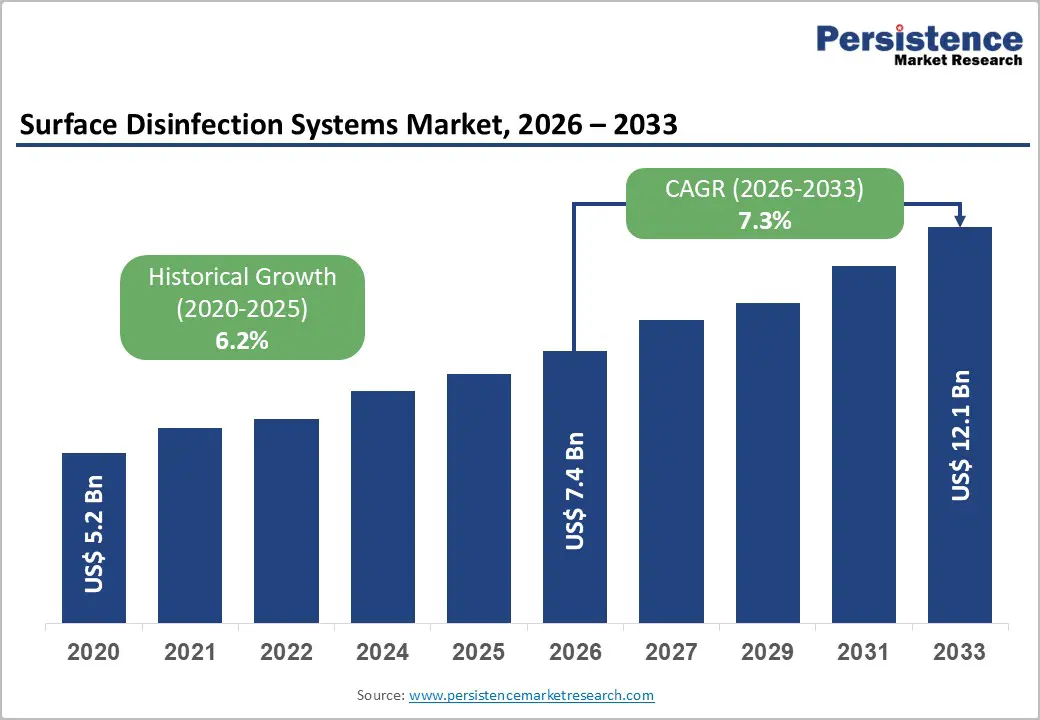
The global surface disinfection systems market is valued at US$ 7.4 Bn in 2026 and is projected to reach US$ 12.1 Bn by 2033, growing at a CAGR of 7.3% between 2026 and 2033.
Robust growth of the surface disinfection systems market is primarily driven by a global surge in healthcare-associated infections (HAIs) and expanding infection prevention mandates across healthcare, pharmaceutical, and life sciences sectors. According to the World Health Organization (WHO), out of every 100 acute-care hospital patients, 7 in high-income countries and 15 in low- and middle-income countries acquire at least one HAI during their hospital stay, creating persistent demand for automated, high-efficacy disinfection technologies.
Key Industry Highlights:
- Leading Region: North America dominates the global Surface Disinfection Systems market, driven by the highest concentration of advanced healthcare infrastructure, stringent infection control mandates from the CDC and FDA, and the presence of major market participants including Ecolab, STERIS, and 3M.
- Fastest Growing Region: Asia Pacific is the fastest-growing regional market, propelled by China's Healthy China 2030 initiative, India's expanding pharmaceutical manufacturing sector, and rapidly improving healthcare infrastructure across ASEAN economies, with China's UV disinfection market growing at a 9.4% CAGR.
- Dominant Segment (Technology): UVC Disinfection Systems lead the technology category with approximately 42% market share in 2026, driven by proven pathogen elimination efficacy, rapid room decontamination capability, and documented 30% reductions in HAI rates in hospitals deploying robotic UVC platforms.
- Fastest Growing Segment (Technology): Hydrogen Peroxide Vapor (HPV) Systems represent the fastest-growing technology segment, expanding at a 7.0% CAGR through 2033, as pharmaceutical manufacturers and biotechnology cleanrooms increasingly adopt HPV for validated terminal bio-decontamination.
- Key Market Opportunity: The expansion of pharmaceutical and biotechnology cleanroom facilities globally, particularly across India, China, and Ireland presents a high-value opportunity for HPV systems and eco-friendly sporicidal disinfectant suppliers, with over 54% of formulators targeting green, biodegradable formulations by 2025.
| Key Insights | Details |
|---|---|
| Surface Disinfection Systems Market Size (2026E) | US$ 7.4 Bn |
| Market Value Forecast (2033F) | US$ 12.1 Bn |
| Projected Growth CAGR (2026 - 2033) | 7.3% |
| Historical Market Growth (2020 - 2025) | 6.2% CAGR |
DRO Analysis
Drivers - Rising Incidence of Healthcare-Associated Infections (HAIs) and Stringent Regulatory Mandates
The escalating burden of hospital-acquired infections remains one of the most critical demand catalysts for surface disinfection systems globally. The Centers for Disease Control and Prevention (CDC) estimates that approximately 1 in 31 hospital patients in the United States contracts at least one HAI during their hospital stay, amounting to roughly 1.7 million cases and approximately 99,000 associated deaths annually.
This alarming incidence rate compels healthcare administrators to invest in automated disinfection technologies, including UVC robotic systems and hydrogen peroxide vapor (HPV) decontamination, which have demonstrated up to a 30% reduction in HAI rates. Moreover, enforcement of rigorous disinfection standards by agencies such as the U.S. FDA, EPA, and WHO has made compliance-driven procurement a consistent driver across developed and emerging healthcare markets alike.
Accelerating Adoption of Automated and Touchless Disinfection Technologies
The global shift toward automation and touchless disinfection is fundamentally reshaping the surface disinfection systems market. Facilities are increasingly prioritizing solutions that reduce dependence on manual labour, ensure comprehensive surface coverage, and minimize operator exposure to chemical agents. The International Ultraviolet Association (IUVA) reported that adoption rates for UVC disinfection systems in hospitals and public transportation infrastructure increased by over 30% between 2022 and 2024.
Advanced systems such as AI-integrated UVC robots, electrostatic sprayers, and fogging technologies are gaining strong traction across hospitals, pharmaceutical cleanrooms, and food processing facilities. Global healthcare private equity investments reached an estimated USD 115 billion in 2024, marking the second-highest deal total on record, which is channelling significant capital toward upgrading infection control infrastructure, including deployment of high-efficiency surface disinfection platforms.
Restraints - High Capital Investment and Maintenance Costs Limiting SME Adoption
Advanced surface disinfection systems, particularly UVC robotic platforms and hydrogen peroxide vapor (HPV) systems, carry substantial upfront capital costs and require specialized technical expertise for maintenance and validation. Smaller institutional buyers, such as hospitals with fewer than 200 beds, frequently defer upgrades due to budget constraints approximately 25% of these entities delayed disinfection technology procurement in 2024.
This cost sensitivity is particularly acute in low- and middle-income countries where healthcare budgets are constrained, thereby limiting market penetration in these regions and creating a tiered adoption landscape globally.
Safety and Regulatory Compliance Challenges for Advanced Disinfection Technologies
The deployment of technologies such as UVC systems, ozone-based disinfection, and certain chemical fogging solutions is subject to stringent safety regulations related to UV radiation exposure, ozone emissions, and chemical residue management. Regulatory bodies, including the U.S. Occupational Safety and Health Administration (OSHA) and the European Chemicals Agency (ECHA) impose rigorous compliance requirements that can delay product approvals, increase operational complexity, and deter facilities from transitioning away from conventional manual disinfection practices. Industry surveys indicate that approximately 42% of institutional buyers cite regulatory complexity and concerns over chemical residues as significant barriers to broader adoption.
Opportunities - Pharmaceutical and Biotechnology Cleanroom Expansion Driving Demand for HPV Systems
The rapid expansion of pharmaceutical manufacturing facilities and biopharmaceutical cleanrooms globally is creating significant growth opportunities for high-level bio-decontamination technologies, particularly Hydrogen Peroxide Vapor (HPV) systems. In October 2025, Ecolab Life Sciences launched its Klercide™ Rapid Sporicide, a next-generation sporicidal disinfectant developed specifically to elevate pharmaceutical cleanroom safety while reducing production changeover time a move indicative of the sector's innovation intensity.
The International Society for Pharmaceutical Engineering (ISPE) notes that global pharmaceutical manufacturing capacity is expanding substantially, particularly across India, China, and Ireland, each requiring validated bio-decontamination solutions to comply with GMP (Good Manufacturing Practice) and FDA 21 CFR Part 11 standards. HPV systems are the gold standard for terminal sterilization of enclosed cleanroom environments, and this sector's growth represents a resilient, long-cycle demand driver.
Emergence of Eco-Friendly and Bio-Based Disinfection Formulations
Growing environmental awareness and tightening sustainability regulations are spurring significant investment in eco-friendly and biodegradable surface disinfection solutions. Industry data indicates that over 54% of formulators are actively targeting eco-friendly and biodegradable formulations by 2025, with bio-based compositions currently representing less than 10% of total market share but expected to grow substantially.
Institutional buyers have demonstrated willingness to pay a premium of approximately 12% for certified 'green' disinfectant solutions, and in 2024, these accounted for roughly 15% of all new product launches in the disinfectant sector. The Asia Pacific and Middle East regions remain significantly underpenetrated in bio-based disinfection solutions, with over 60% growth intent among B2B suppliers targeting these markets, positioning eco-innovation as a high-value commercial opportunity for market participants.
Category-wise Analysis
Technology Insights
Among all technology segments, UVC disinfection systems command the leading position, accounting for approximately 42% of total revenue in 2026. UVC technology's dominance is underpinned by its proven efficacy in inactivating a broad spectrum of pathogens, including drug-resistant organisms such as MRSA, VRE, and C. difficile, without reliance on chemical residues.
UVC systems, spanning portable wand devices to fully autonomous robotic platforms, offer rapid room decontamination in under 15 minutes, making them particularly valuable in high-throughput hospital environments. The CDC's documentation of a 12% decline in HAIs in U.S. hospitals employing UVC protocols between 2020 and 2023 further validates widespread adoption.
Form Insights
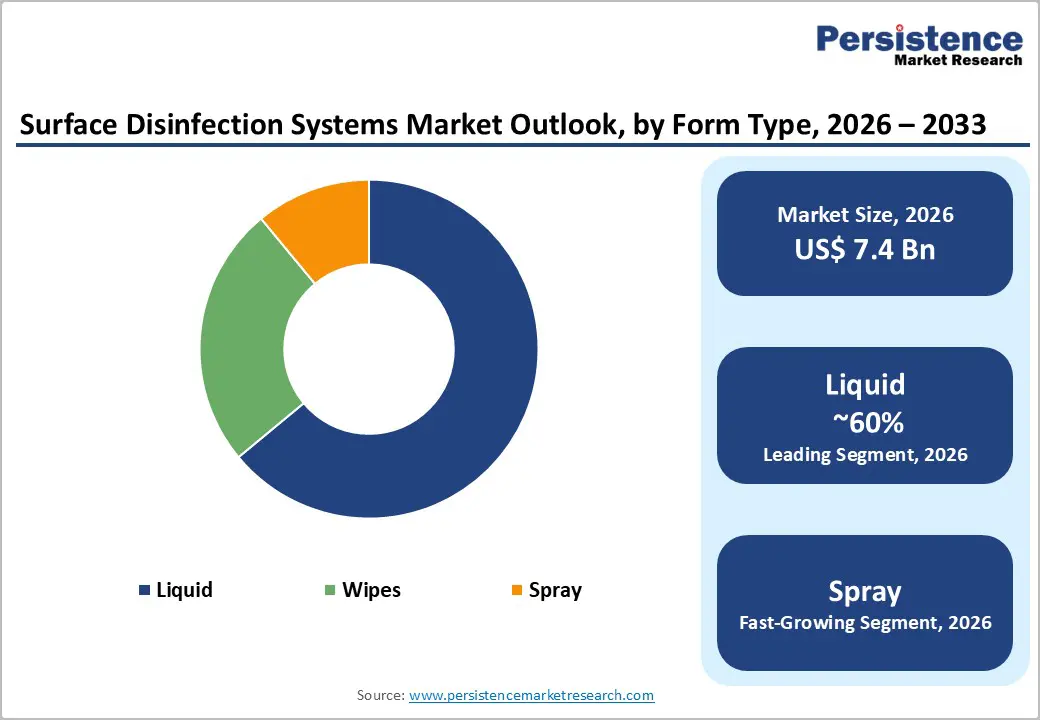
The liquid form accounts for a dominant share in the surface disinfection systems market, representing approximately 60% of the total market by form type in 2026. Liquid disinfectants are preferred across healthcare facilities, pharmaceutical manufacturing plants, and industrial environments owing to their superior versatility, ability to cover large surface areas efficiently, compatibility with automated dispensing and application systems, and cost-effectiveness at scale.
The U.S. Environmental Protection Agency (EPA) has approved over 500 liquid-based surface disinfectant formulations for use against SARS-CoV-2, reflecting the segment's regulatory maturity and the industry's established preference for liquid solutions. Hospitals, laboratories, and food processing plants consistently deploy liquid disinfectants as their primary environmental cleaning agents, and this entrenched utilization pattern is expected to support segment leadership through the forecast period.
End-user Insights
The Healthcare Facilities segment is the largest end-use contributor, accounting for approximately 32% of the global surface disinfection systems market revenue in 2026. The segment's dominance is a direct consequence of the relentless pressure on hospitals, surgical centres, and ambulatory care facilities to maintain pathogen-free environments amidst increasing patient volumes. Globally, over 313 million surgical procedures are performed annually according to WHO data, each requiring rigorous pre- and post-operative surface disinfection in operating theatres and recovery suites.
High-touch surfaces, including patient beds, countertops, IV poles, and medical equipment demand frequent, validated disinfection using multiple technology modalities. Infection control guidelines mandated by health authorities, including the CDC's Guidelines for Environmental Infection Control, further cement healthcare facilities as the market's anchor end-use segment, driving consistent procurement of both capital equipment and consumable disinfection products.
Regional Analysis
North America Surface Disinfection Systems Market Trends
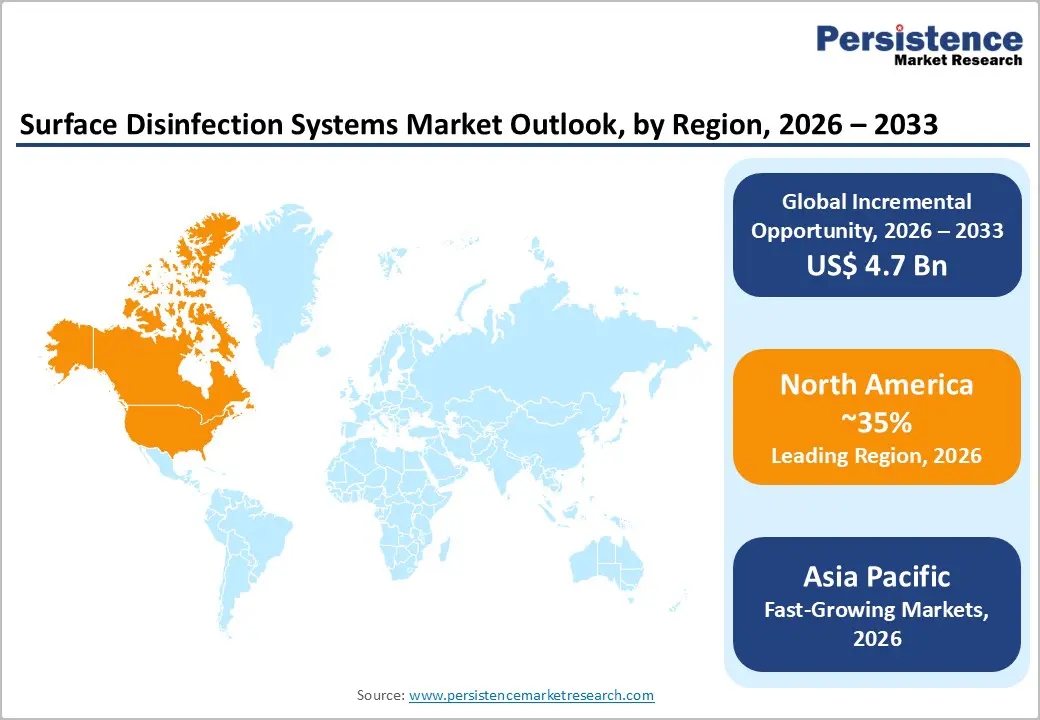
North America holds the largest share of the global surface disinfection systems market, driven by its advanced healthcare infrastructure, high density of surgical procedures, and stringent regulatory environment. The United States accounts for most regional revenues, with healthcare facilities representing the primary demand engine. Enforcement by the CDC, FDA, and EPA mandates rigorous infection control protocols across hospital networks, driving continuous procurement upgrades.
The regional innovation ecosystem is particularly dynamic, with major industry players including 3M Company, Ecolab, STERIS Plc, and The Clorox Company headquartered in the U.S. and investing heavily in next-generation disinfection technologies. Canada contributes additional demand through approvals by Health Canada for advanced disinfection products and growing healthcare infrastructure investments.
Asia Pacific Surface Disinfection Systems Market Trends
Asia Pacific is the fastest-growing regional market for surface disinfection systems, propelled by rapid healthcare infrastructure expansion in China, India, Japan, and the ASEAN economies. China's government-led 'Healthy China 2030' initiative has catalysed a 35% increase in UVC product adoption in hospitals between 2021 and 2024, according to the China National Health Commission. The ultraviolet disinfection equipment market in China alone is projected to grow at a substantial CAGR of 9.4% through 2033, underscoring the country's pivotal role in regional growth dynamics.
India represents one of the most promising growth markets, driven by expanding pharmaceutical manufacturing. The country is among the world's leading active pharmaceutical ingredient (API) producers, and rising awareness of HAI prevention in a rapidly urbanizing healthcare system. Japan continues to lead in advanced disinfection technology adoption, with a focus on automation and robotics in healthcare settings.
Europe Surface Disinfection Systems Market Trends
Europe represents the second-largest regional market for surface disinfection systems, led by Germany, the U.K., France, and Spain. Germany is projected to dominate the European market through the forecast period, supported by high healthcare expenditure, robust national public health initiatives, and rapid adoption of technologically advanced automated disinfection systems. The European infection control market is projected to grow from USD 14.99 billion in 2025 to USD 20.58 billion by 2030 at a CAGR of 6.6%, with cleaning and disinfection products representing the largest product category.
The European Chemicals Agency (ECHA) and the EU Biocidal Products Regulation (BPR 528/2012) govern product registration and usage protocols across member states, creating a framework that encourages adoption of safe, validated disinfection solutions while harmonizing standards across the continent.
Competitive Landscape
The global surface disinfection systems market exhibits a moderately consolidated structure, with a handful of multinational corporations, including Ecolab, STERIS Plc, 3M Group, Reckitt Benckiser, and The Clorox Company commanding significant revenue shares. These players differentiate through broad product portfolios spanning chemical formulations, UVC hardware, and IoT-integrated service platforms.
Competitive strategies centre on continuous R&D investment, strategic acquisitions to fill technology gaps, and geographic expansion into emerging markets. Key differentiators include regulatory expertise, EPA/FDA-registered product portfolios, and digital hygiene monitoring integration.
Key Developments:
- In January 2026, Far-UVC technology offers an advanced method for surgical site disinfection by using short-wavelength ultraviolet light to inactivate pathogens while remaining safer for human exposure. It enables continuous surface and air disinfection in occupied surgical environments.
- In October 2025, Ecolab Life Sciences launched the Klercide™ Rapid Sporicide, a pharmaceutical cleanroom sporicidal disinfectant designed to reduce production turnover time and enhance user safety in GMP-regulated environments.
Companies Covered in Surface Disinfection Systems Market
- 3M Group
- Reckitt Benckiser Group
- Procter & Gamble
- The Clorox Company
- STERIS Plc
- Ecolab
- Laxness AG
- Neogen Corp
- DuPont
- Cantel Medical
- Johnson & Johnson
- Getinge AB
- Senex Disinfection Services
- Diversey Holdings Ltd.
- Paul Hartmann AG
Frequently Asked Questions
The global Surface Disinfection Systems market is valued at US$ 7.4 Bn in 2026 and is forecast to reach US$ 12.1 Bn by 2033, expanding at a CAGR of 7.3% during 2026 - 2033.
The market's growth is primarily driven by the rising incidence of Healthcare-Associated Infections (HAIs) with the WHO estimating up to 15 HAI cases per 100 patients in low- and middle-income countries combined with mandatory regulatory compliance requirements from bodies such as the U.S. EPA, FDA, CDC, and WHO.
The UVC Disinfection Systems segment is the dominant technology category, holding approximately 42% of market revenue in 2025. UVC technology's broad-spectrum pathogen inactivation capability, residue-free disinfection, and compatibility with AI-integrated robotic delivery platforms drive its leadership.
North America is the leading region, accounting for the largest revenue share of approximately 35% of the global market. This dominance is attributable to advanced healthcare infrastructure, high surgical volumes, rigorous infection control regulations enforced by the CDC, FDA, and EPA, and the concentrated presence of global market leaders, including Ecolab, STERIS Plc, 3M, and The Clorox Company, in the U.S. market.
Leading companies in the Surface Disinfection Systems market include Ecolab Inc., STERIS Plc, Reckitt Benckiser Group Plc, 3M Group (Solventum), The Clorox Company, Procter & Gamble, Lanxess AG, Neogen Corporation, DuPont, Cantel Medical (Medivators), and Johnson & Johnson (Kenvue).


