




- Industrial Machinery
- Spray Washer Market
Spray Washer Market Size, Share, and Growth Forecast 2026 - 2033
Spray Washer Market by Product Type (Pressure Washers, Ultrasonic Washers), Technology (Electric Washers, Gas-Powered Washers), Application (Industrial Cleaning, Others), End-user (Automotive Industry), and Regional Analysis, 2026 - 2033

Spray Washer Market Size and Trends Analysis
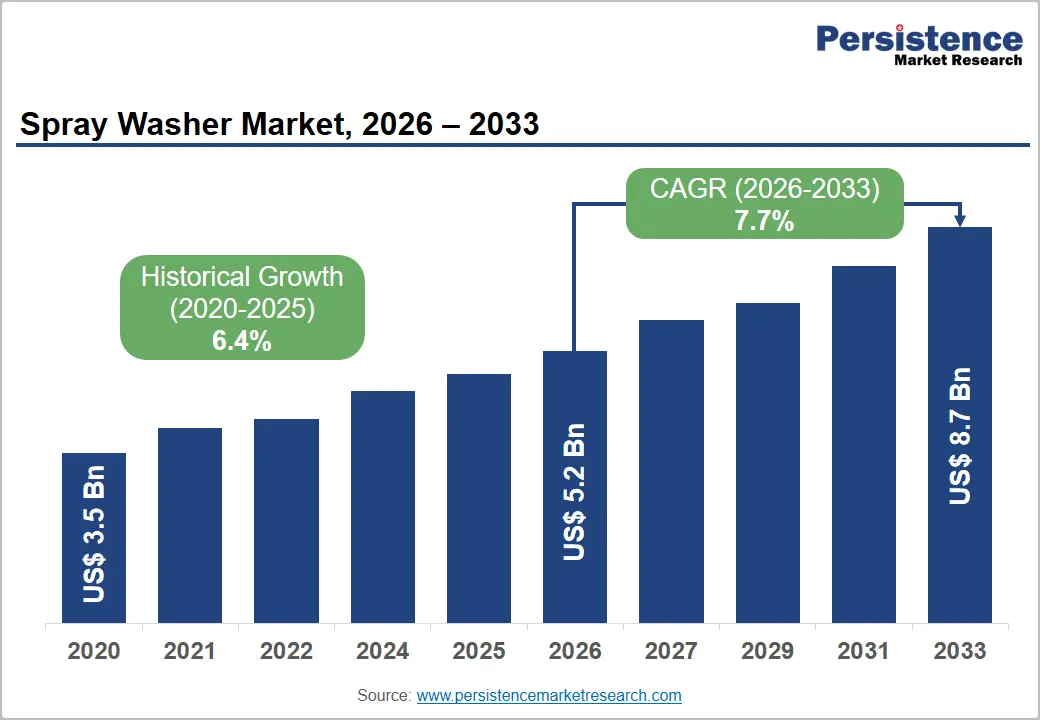
The global spray washer market size is likely to be valued at US$5.2 billion in 2026 and is estimated to reach US$8.7 billion by 2033, growing at a CAGR of 7.7% during the forecast period 2026 to 2033, driven by rising demand for precision cleaning in automotive and aerospace manufacturing, as well as strict environmental regulations promoting water-efficient and chemical-free cleaning tools. The shift toward automated and IoT-enabled industrial equipment is further supporting adoption across large-scale production facilities.
Key Industry Highlights:
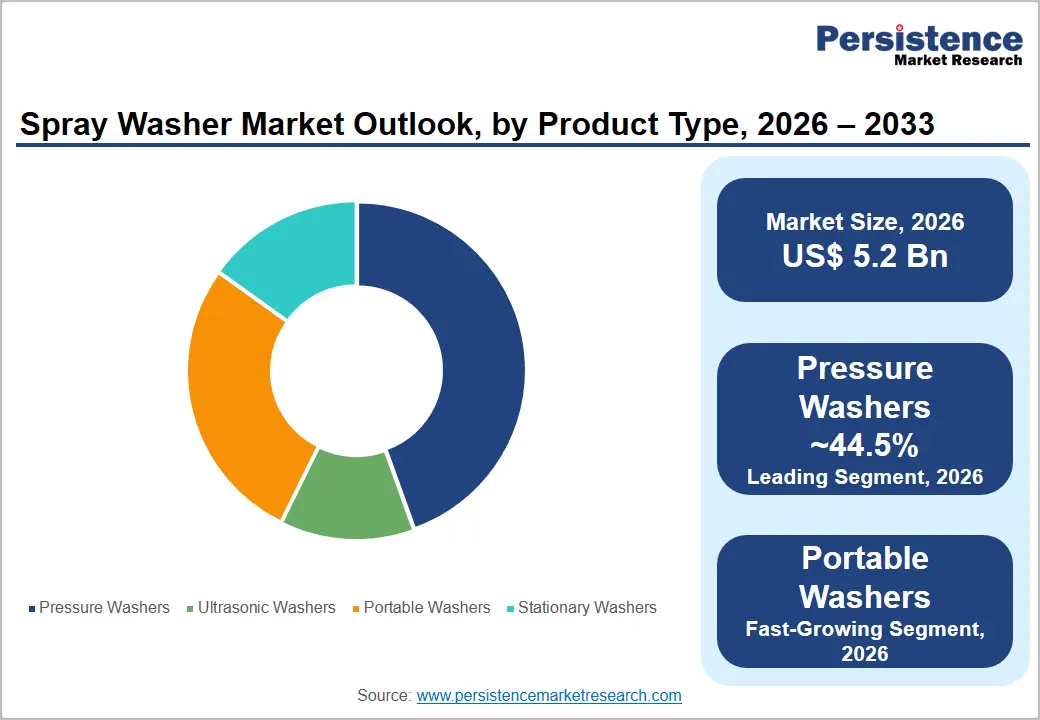
- Leading Product Type: Pressure washers, approximately 44.5% share in 2026, as they deliver faster and more consistent removal of grease and contaminants compared to manual cleaning methods.
- Dominant Technology: Electric washers, nearly 36.4% share in 2026, fueled by their low emissions and suitability for indoor as well as urban industrial use.
- Leading Region: North America, with about 48.8% share in 2026, owing to strict environmental regulations and high adoption of automated cleaning tools.
- Fast-growing Region: Asia Pacific, backed by increasing shift from manual to automated cleaning in export-driven manufacturing hubs.
- Latest Product: In January 2026, Kärcher introduced its new Comfort range of premium pressure washers, covering K4 to K7 model classes. The company incorporated eco!Mode functionality, digital app support, improved detergent handling, and upgraded ergonomics to improve resource efficiency and user experience.
DRO Analysis
Driver - High Commercial and DIY Versatility
Spray washers serve a wider range of end users than most cleaning equipment categories. In commercial settings, they are used for fleet vehicle maintenance, construction equipment degreasing, and facilities upkeep. In residential use, they clean driveways, decks, vehicles, and home exteriors. This dual-market footprint is a structural demand driver. The rising popularity of Do-It-Yourself (DIY) home improvement projects has increased demand for efficient and powerful cleaning solutions.
Pressure washers are seen as indispensable for achieving professional-level results at home. Product launches are showcasing this versatility. In 2024, Generac Power Systems launched smart pressure washers with mobile app connectivity, tapping into the smart home trend and improving user convenience. Also, Kärcher, recognized as the world's best-selling brand of pressure washers in 2025 by Guinness World Records, broadened its Home & Garden lineup with new horizontal models designed to serve both everyday residential tasks and more demanding commercial applications.
Rising Need to Conserve Water Worldwide
Spray washers use significantly less water than a standard garden hose to complete the same cleaning task, making them a practical choice where water conservation is a priority. The average garden hose faucet delivers eight gallons of water per minute, or five gallons per minute when fitted with a spray nozzle. In contrast, pressure washing systems can complete the same job using just two to three gallons per minute, while operating at pressures as high as 2,000 Pounds per Square Inch (PSI). It is a level that substantially reduces the time required per task, compounding the water savings.
Industry data consistently puts the water reduction advantage at 75%. Also, the U.S. Environmental Protection Agency (EPA) has acknowledged the conservation value of spray-based cleaning through its WaterSense program. Since the WaterSense program was launched in 2006, consumers and businesses have saved a total of more than 7.5 trillion gallons of water by adopting water-saving products and practices, with 1.1 trillion gallons saved in 2022 alone.
Restraint - Geometric Limitations May Prevent Full Surface Coverage on Complex Parts
Spray washers deliver high-pressure jets in a directional pattern, which means they can only clean surfaces within the direct path of the spray. This is a well-documented limitation in industrial parts cleaning. A spray parts washer is ineffective on parts with complex geometries as it is line-of-sight. This means it cannot penetrate all areas of a component. However, immersion-based systems reach all surfaces and clean complex parts with consistent results in less time. The problem is specifically acute in precision engineering.
Blind holes and internal grooves are difficult for a spray washer to completely clean in a bulk load. Washing complex parts in bulk will likely leave parts in the center basket wet if they are dried with hot air. For parts in aerospace, medical device, or precision machining applications, where cleanliness inside channels and cavities is important, spray washers alone are often insufficient. Manufacturers must either switch to immersion cleaning or adopt hybrid spray-immersion systems, adding cost and process complexity.
Opportunity - Connected Sensors to Enable Condition-Based Maintenance of Washers
Integrating Internet of Things (IoT) sensors into industrial spray washer systems allows operators to monitor wash solution temperature, fluid concentration, nozzle pressure, and filtration condition in real time. It helps them to act on that data before a failure occurs. This shifts maintenance from a scheduled or reactive model to a predictive one. According to the latest report, predictive maintenance using sensor-based monitoring can reduce machine downtime by 30% to 50% and extend equipment life by 20% to 40%.
The broad industrial context validates this approach. Unplanned downtime costs factories between 5% and 20% of their potential output, according to estimates from the International Society of Automation. For spray washer operators running high-volume cleaning lines, an unexpected breakdown in a wash system can halt downstream production entirely. IoT-enabled wash systems address this vulnerability by providing advance warning of degrading conditions before they cause line stoppages.
Green Chemistry and Optimized Spray Design to Reduce Resource Consumption
A new generation of spray washer systems is being designed around lower operating temperatures and environmentally cleaner chemical formulations. Phosphorus-free cleaning chemistries are central to this shift. Traditional phosphate-based detergents contribute to aquatic eutrophication. It is a process where excess nutrients cause algae blooms that deplete oxygen in water bodies. Phosphorus-free alternatives eliminate this discharge risk while maintaining cleaning performance.
The U.S. EPA's WaterSense at Work guidance for commercial wash-down sprayers specifically frames resource efficiency as the primary levers for reducing the environmental impact of spray cleaning operations. It includes water volume, energy used for heating, and chemical concentration. At the same time, it provides calculation frameworks for quantifying wash-down water and energy savings from equipment retrofits or replacements. Alongside chemistry improvements, nozzle engineering advances are enabling better cleaning coverage at lower spray volumes. This is further reducing both water use and the energy required to heat wash solutions to operating temperature.
Category-wise Analysis
Product Type Insights
Pressure washers are predicted to lead with a share of approximately 44.5% in 2026, owing to their superior cleaning efficiency and regulatory compliance. These remove grease, oil, and contaminants faster than manual or immersion cleaning. This reduces labor time and improves consistency in industrial operations. Agencies such as the U.S. EPA highlight that high-pressure water systems can reduce the demand for harsh solvents in surface cleaning. This is important as industries move away from solvent-based cleaning due to VOC restrictions.
Portable washers are estimated to be the fastest-growing segment over the forecast period, due to flexibility and rising decentralized operations. These washers are easy to move and do not require fixed installation. This makes them suitable for construction sites, maintenance work, and small workshops. The rise of contract cleaning and facility management services has increased demand for such mobile equipment. For example, Public Works Department India uses portable pressure washers for on-site road and infrastructure cleaning.
Technology Insights
Electric washers are anticipated to dominate with a share of nearly 36.4% in 2026, owing to low emissions and ease of use. These washers are widely preferred as they produce no direct emissions and operate with low noise. This makes them suitable for indoor industrial use and urban environments. Regulatory bodies such as the European Commission have enforced strict emission norms that restrict fuel-powered equipment in enclosed spaces. Electric washers also require less maintenance, as they have fewer moving parts compared to gas-powered systems.
Gas-powered washers are expected to remain in the second position in 2026, as they deliver higher pressure output and do not rely on electricity. This makes them suitable for large-scale outdoor cleaning, construction, mining, and oil & gas operations. The Occupational Safety and Health Administration notes that heavy equipment cleaning often requires high-pressure systems that can operate in remote areas, where electric supply is limited. In infrastructure projects, companies such as Caterpillar Inc. use gas-powered washers to clean heavy machinery on-site.
Regional Insights
North America Spray Washer Market Trends
North America is predicted to dominate in 2026 with a share of approximately 48.8%, owing to strict cleaning standards and early technology adoption. The region has high regulatory pressure on industrial cleaning and wastewater handling. The U.S. EPA enforces rules on oil discharge and surface contaminants. This pushes industries to adopt advanced spray and pressure washers. Sectors such as aerospace and automotive also demand high precision cleaning. For example, Boeing uses automated spray systems for component cleaning to meet safety standards. The region also has a strong presence of equipment manufacturers, which supports fast product innovation and adoption.
U.S. Spray Washer Market Trends
A share of nearly 62.4% is expected to be held by the U.S. in 2026, backed by infrastructure upgrades and reshoring of manufacturing. The White House Infrastructure Investment and Jobs Act has increased spending on roads, bridges, and industrial facilities. This creates demand for heavy-duty cleaning equipment. Companies are also bringing manufacturing back to the U.S. This trend is visible in sectors including semiconductors and EVs. For instance, Intel is investing in new fabrication plants that require high cleanliness levels. Spray washers are used in these plants to remove micro-level contaminants. This combination of policy support and industrial expansion is boosting growth.
Asia Pacific Spray Washer Market Trends
Asia Pacific is anticipated to be the fastest-growing region in 2026, with a share of nearly 29.6%, spurred by ongoing industrialization and export manufacturing. Countries in this region are extending their manufacturing base. This includes electronics, automotive parts, and machinery. Governments are also supporting industrial growth. The Asian Development Bank has highlighted exponential growth in industrial output across Southeast Asia. Export-focused industries require consistent cleaning standards to meet global quality norms. Hence, factories are investing in modern spray washing systems. The shift from manual cleaning to automated systems is also fueling demand.
China Spray Washer Market Trends
China will likely lead in Asia Pacific in 2026 with a share of around 34.9%, spurred by a large-scale manufacturing and automation push. The country remains a global manufacturing hub. The government’s Made in China 2025 strategy focuses on upgrading industrial processes. This includes automation and precision cleaning. Companies such as BYD Company are extending EV production. EV components require clean surfaces to ensure performance and safety, which bolsters demand for advanced spray washers.
India Spray Washer Market Trends
In 2026, India is projected to account for a share of approximately 24.2%, owing to infrastructure expansion and SME adoption. Government initiatives such as Make in India are boosting local manufacturing. The Ministry of Commerce and Industry India has reported steady growth in industrial production in recent years. SMEs are also upgrading their cleaning processes. Portable and electric spray washers are gaining traction in sectors such as automotive repair and metal fabrication.
Europe Spray Washer Market Trends
Europe will likely see decent growth over the forecast period, with a share of nearly 13.9% in 2026, due to sustainability regulations and technology upgrades. The region focuses on reducing water use and chemical discharge. The European Commission has introduced policies on industrial emissions and water reuse. This encourages the use of efficient spray washing systems with recycling features. Industries are replacing old cleaning setups with automated and closed-loop systems. Companies such as Bosch use advanced cleaning systems in manufacturing to meet environmental and quality standards.
Germany Spray Washer Market Trends
Germany is projected to register a substantial share of approximately 40.3% in 2026, backed by its well-established industrial base and engineering focus. The country has a large automotive and machinery sector. These industries require precise and repeatable cleaning processes. The Fraunhofer Society has published studies on industrial cleaning efficiency, exhibiting the role of automated spray systems in improving production quality. Local manufacturers are also early adopters of Industry 4.0, which supports the integration of smart spray washers with production lines.
U.K. Spray Washer Market Trends
A share of around 18.6% is predicted to be held by the U.K. in 2026, supported by the maintenance and service sectors. The country has a well-established facility management and service industry. This increases demand for portable and electric washers. Environmental compliance is also a prominent factor. The Environment Agency regulates wastewater discharge from industrial cleaning. This encourages the use of controlled spray systems instead of manual washing. Sectors such as rail and public infrastructure further use pressure washers for regular maintenance, thereby fostering steady demand.

Competitive Landscape
The global spray washer market is fragmented to moderately fragmented with no single company exercising dominant control. Leading players include Better Engineering, Niagara Systems LLC, Alfred Kärcher SE & Co. KG, Ecoclean Group, Cleaning Technologies Group, ALMCO, PROCECO, and Alliance Manufacturing Inc. These companies compete primarily on cleaning efficiency, automation capabilities, water and chemical consumption reduction, and customization for specific manufacturing environments.
A defining feature of the competitive landscape is the emphasis on application-specific solutions. Companies are developing specialized spray washers for EV components, aerospace parts, medical devices, and precision-engineered metal components. Vendors that can provide complete cleaning programs, including equipment, detergents, maintenance services, and waste management, are gaining a more competitive edge compared with suppliers delivering standalone machines.
Key Industry Developments:
- In April 2026, MOVA launched its M3 Commercial Cleaning Robot at Interclean Amsterdam 2026, featuring an integrated large-capacity water tank and combined sweeping and scrubbing functionality. The company stated that the design reduces maintenance requirements and improves cleaning productivity in commercial facilities such as hospitals, hotels, and office buildings.
- In April 2026, Tennant Company launched the X16 SWEEP autonomous industrial cleaning machine in partnership with Brain Corp, bringing AI-supported robotic cleaning capabilities to warehouses, logistics centers, and manufacturing facilities. The system was developed to provide continuous autonomous operation and support increasing industrial automation requirements.
- In January 2026, VMI Group launched the VMI Can Washer 2.0, a next-generation modular can washing system developed for beverage can manufacturing facilities. The company highlighted advanced software monitoring, predictive maintenance functionality, greater automation, and reduced energy, chemical, gas, and water consumption compared with earlier models.
Companies Covered in Spray Washer Market
- Alfred Kärcher SE & Co. KG
- DEWALT
- Stanley Black & Decker
- Generac Power Systems
- BOSCH
- Nilfisk Group
- FNA Group
- Briggs & Stratton
- Techtronic Industries
- Others
Frequently Asked Questions
The global spray washer market is projected to be valued at US$5.2 billion in 2026.
The market is expected to reach US$8.7 billion by 2033.
Key market trends include rising adoption of smart washers and integration of water recycling systems.
Pressure washers are expected to be the leading product type with a share of nearly 44.5% in 2026, as they reduce dependence on chemical solvents by using high-pressure water systems.
The market is expected to grow at a CAGR of 7.7% from 2026 to 2033.
Alfred Kärcher SE & Co. KG, DEWALT, and Stanley Black & Decker are a few key market players.


