




- Inks, Coatings, Adhesives & Sealants (ICAS)
- Specialty Fruit Coatings Market
Specialty Fruit Coatings Market Size, Share, and Growth Forecast 2026 - 2033
Specialty Fruit Coatings Market by Coating Type (Lipid-Based Coatings, Polysaccharide-Based Coatings, Protein-Based Coatings, Composite Coatings), Material Source (Natural / Plant-Based, Animal-Based, Synthetic), Functionality, Application Method, and Regional Analysis, 2026 - 2033

Specialty Fruit Coatings Market Size and Trend Analysis
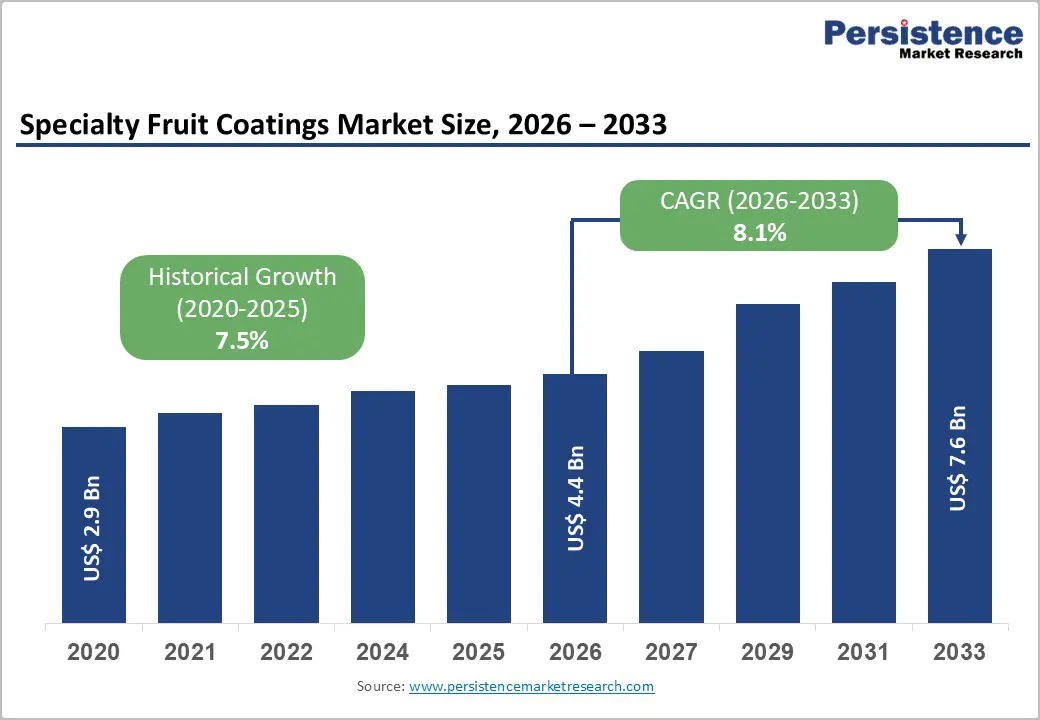
The global specialty fruit coatings market size is expected to be valued at US$ 4.4 billion in 2026 and projected to reach US$ 7.6 billion by 2033, growing at a CAGR of 8.1% between 2026 and 2033.
Growth is driven by rising demand for fresh, minimally processed fruits and the need to reduce post-harvest losses across supply chains. Global fruit production reached nearly 900 million tons, with 20-30% losses in developing regions due to spoilage, moisture loss, and contamination. Specialty coatings extend shelf life by controlling moisture, gas exchange, and microbial activity, supported by clean-label trends, regulations, and expanding e-commerce grocery channels.
Key Industry Highlights:
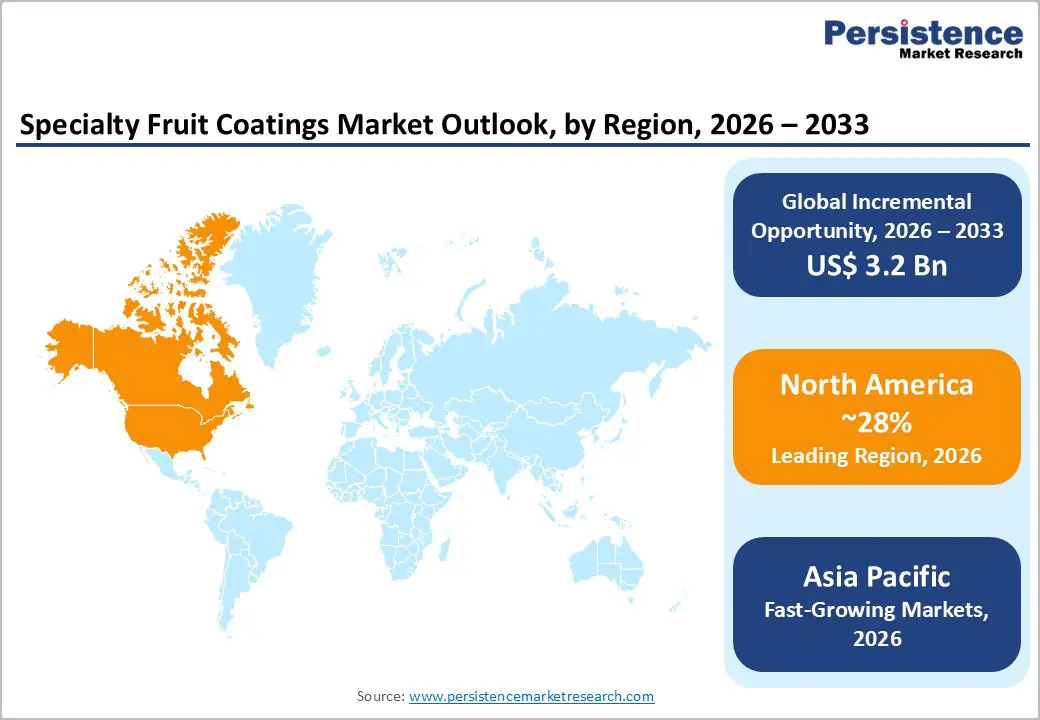
- Leading Region: North America leads the specialty fruit coatings market with a 28% share (2025), supported by advanced supply chains, large-scale production, and strong regulatory adoption of edible coatings.
- Fastest Growing Region: Asia Pacific is the fastest-growing region, driven by rising fruit production and export demand, with strong government support for post-harvest technologies.
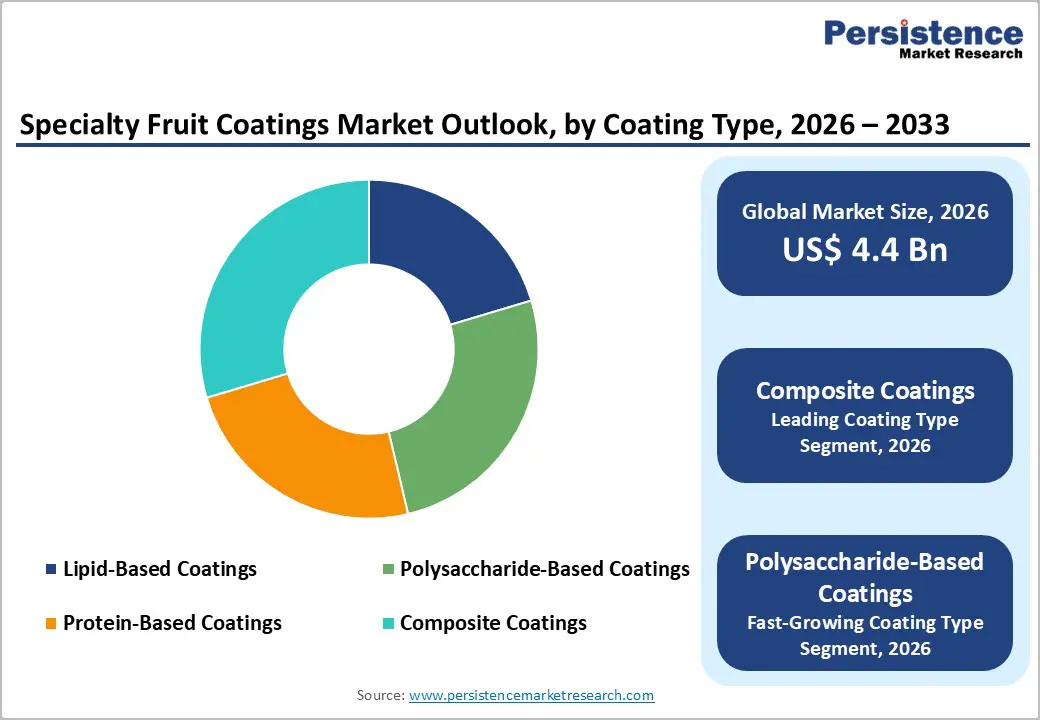
- Leading Coating Type: Composite coatings dominate with a 38% share (2025) due to their superior multifunctional performance in shelf-life extension and quality preservation.
- Fastest Growing Functionality: Antimicrobial coatings are the fastest-growing segment, driven by increasing focus on food safety and microbial control in global fruit supply chains.
- Opportunity: Natural and plant-based coatings (45% share) present strong opportunities, supported by sustainability trends and increasing demand for clean-label solutions in high-value fruit exports.
| Key Insights | Details |
|---|---|
| Specialty Fruit Coatings Size (2026E) | US$ 4.4 Billion |
| Market Value Forecast (2033F) | US$ 7.6 Billion |
| Projected Growth CAGR (2026 - 2033) | 8.1% |
| Historical Market Growth (2020 - 2025) | 7.5% |
Market Dynamics
Drivers - Increasing Demand for Fresh Produce Shelf-Life Extension and Waste Reduction
Rising consumer preference for fresh, minimally processed fruits, along with the rapid expansion of organized retail and online grocery platforms, is significantly driving demand for specialty fruit coatings. Global fruit production has exceeded 900 million tons, with post-harvest losses reaching 20-30% in many regions due to spoilage, moisture loss, and microbial contamination, highlighting the urgent need for effective preservation solutions across supply chains.
Specialty coatings help extend the shelf life of fruits such as apples, citrus, and berries by up to 2-4 weeks, reducing waste and improving profitability. These coatings can lower respiration rates by nearly 50% in certain fruits, slowing ripening and maintaining quality. The continued growth of e-commerce grocery channels further reinforces the need for advanced post-harvest protection technologies.
Advancements in Bio-Based Edible Coating Technologies Enhancing Performance
Technological advancements in edible coatings, particularly those based on polysaccharides, plant-derived polymers, and structured lipids, are significantly improving barrier properties and functional performance. Bio-based coatings have demonstrated the ability to reduce weight loss by 15-20% in fruits such as apples and citrus, while also limiting microbial growth and enhancing surface protection during storage and transportation.
Regulatory approvals for natural antimicrobial and barrier ingredients have accelerated product innovation and commercialization. Additionally, improvements in application technologies, including automated spraying systems, have reduced operational costs by around 10-15%, making advanced coatings more accessible. These developments are driving a shift toward multifunctional coatings that integrate moisture control, gas exchange regulation, and antimicrobial protection.
Restraints - Stringent Regulatory Frameworks Limiting Use of Synthetic Coating Materials
Strict food safety regulations in regions such as Europe and the United States have imposed limitations on synthetic and petroleum-based coatings due to concerns over chemical migration and consumer health. Regulatory bodies continue to evaluate coating compositions, leading to restrictions on certain conventional waxes and requiring manufacturers to shift toward safer, compliant alternatives across global markets.
These regulatory requirements often necessitate reformulation using bio-based materials, which can increase production costs by nearly 20% in some cases. Additionally, obtaining safety approvals for new ingredients is time-consuming and expensive, delaying commercialization. Such compliance challenges create uncertainty for suppliers and slow the adoption of advanced specialty coatings, particularly in highly regulated markets.
High Capital Investment Requirements Limiting Adoption Among Small Producers
The adoption of specialty fruit coatings requires significant investment in application infrastructure, including dipping systems, automated spray lines, and electrostatic coating equipment. Setting up a mechanized coating facility can exceed US$ 50,000 for medium-scale operations, making it financially challenging for small and marginal producers to implement such technologies.
Small-scale farmers, who represent a large share of global fruit production, often lack access to capital and technical expertise. Additionally, irregular fruit surfaces can lead to uneven coating application, increasing labor and operational costs. In price-sensitive markets, the added cost of coatings is not always matched by higher selling prices, limiting adoption beyond export-oriented and premium supply chains.
Opportunities - Rising Adoption Across Emerging Markets with High Post-Harvest Losses
Emerging markets in Asia Pacific and Latin America present strong growth opportunities due to high post-harvest losses and expanding horticulture sectors. A significant share of global food loss is attributed to perishable fruits, creating demand for preservation technologies. Government-led initiatives and agricultural programs are actively promoting post-harvest solutions to improve fruit quality and extend market reach.
Edible coatings have demonstrated the ability to extend shelf life by 10-25% for fruits such as mangoes, citrus, and berries, enabling longer transportation and export potential. With fruit production in Asia Pacific growing steadily, countries like India, China, Thailand, and Vietnam are becoming key demand centers for specialty coatings.
Growing Demand for Sustainable and Natural-Based Coating Solutions
Increasing consumer preference for clean-label and environmentally sustainable products is driving demand for natural and plant-based fruit coatings. Regulatory policies promoting reduction of plastic use are encouraging the adoption of biodegradable, edible coatings as alternatives to conventional packaging solutions in the fresh produce industry.
Consumer insights indicate strong preference for recognizable, natural ingredients, supporting the use of coatings derived from plant and marine sources such as waxes and polysaccharides. Rising production of high-value fruits like bananas, avocados, and berries further strengthens demand for moisture barrier and antimicrobial coatings, creating opportunities for innovation in sustainable formulations.
Category wise Analysis
Coating Type Insights
Composite coatings dominate the specialty fruit coatings market, accounting for approximately 38% of the market share in 2025. These coatings integrate lipids, polysaccharides, and proteins to deliver enhanced moisture retention, gas permeability control, and surface protection. Their superior performance in reducing spoilage and extending shelf life for fruits like apples, citrus, and berries makes them highly preferred in export-oriented and premium supply chains.
Polysaccharide-Based coatings are the fastest-growing segment due to increasing demand for biodegradable and clean-label solutions. Derived from materials such as starch, cellulose, and chitosan, these coatings provide effective barrier properties while maintaining environmental sustainability. Their compatibility with natural additives and regulatory acceptance further supports rapid adoption across global fresh produce markets.
Material Source Insights
Natural / Plant-Based coatings lead the market with an estimated 45% share in 2025, driven by strong alignment with sustainability goals and clean-label trends. These coatings, derived from plant waxes and biopolymers, help reduce oxidation and preserve fruit quality. Regulatory approvals and increasing consumer preference for natural ingredients further strengthen their dominance across major fresh produce markets.
Synthetic coatings are emerging as the fastest-growing category due to their consistency and scalability in large-scale operations. Continuous improvements in formulation have enhanced their safety and functional performance. These coatings are particularly suitable for high-volume fruit processing and export supply chains where uniformity, durability, and cost efficiency are critical requirements.
Functionality Insights
Moisture barrier coatings accounted for the largest share in 2025, as they are crucial role for minimizing water loss and maintaining fruit firmness during storage and transportation. Their ability to preserve texture, visual appeal, and weight makes them essential for exporters and retailers dealing with perishable fruits.
Antimicrobial Coatings represent the fastest-growing segment, driven by increasing emphasis on food safety and spoilage prevention. These coatings inhibit microbial growth on fruit surfaces, improving shelf stability and reducing contamination risks. Their importance is rising in long-distance supply chains and e-commerce distribution channels requiring extended product freshness.
Application Method Insights
Spraying is the leading application method, capturing approximately 42% of the market share in 2025 due to its efficiency and ability to provide uniform coverage across different fruit types. It integrates well with automated packing systems and reduces labor requirements, making it ideal for large-scale commercial fruit processing operations.
Electrostatic Coating is the fastest-growing method, supported by its ability to improve adhesion and reduce material wastage. This technology ensures precise and uniform coating even on irregular fruit surfaces. Its growing adoption in advanced facilities reflects the need for higher efficiency, cost optimization, and improved coating performance.
Regional Insights
North America Specialty Fruit Coatings Market Trends and Insights
North America maintains its leadership position, accounting for approximately 28% of the global share in 2025, due to large-scale fruit production and a well-established fresh produce supply chain. The United States plays a central role, with high production volumes of apples, citrus, and berries driving demand for coatings. Post-harvest losses of around 15% highlight the need for technologies that enhance shelf life and maintain product quality.
Strong regulatory support and innovation ecosystems further strengthen the market. Advanced research in coating formulations and application technologies continues to improve efficiency and performance. Collaboration between academic institutions and industry players enables the commercialization of new solutions, ensuring sustained adoption across domestic and export-oriented supply chains.
Europe Specialty Fruit Coatings Market Trends and Insights
Europe is characterized by a mature market structure supported by a robust horticulture sector and strict food safety standards. Countries such as Germany, France, Spain, and the United Kingdom contribute significantly to regional demand, with large volumes of fruit production supporting widespread application of specialty coatings across domestic and export markets.
The region is projected to grow at a CAGR of approximately 7.8%, driven by sustainability initiatives and regulatory alignment. Strong emphasis on clean-label products and biodegradable materials encourages innovation in coating technologies. Research institutions and regulatory bodies continue to support the development of compliant, high-performance coatings for premium produce.
Asia Pacific Specialty Fruit Coatings Market Trends and Insights
Asia Pacific is the fastest-growing region, accounting for approximately 30% of the global market share and supported by rapid expansion in fruit production. Countries such as China, India, Thailand, and Vietnam are key contributors, with increasing exports of tropical fruits driving demand for advanced coating solutions to maintain quality during long-distance transportation.
Government initiatives and investments in post-harvest infrastructure are accelerating adoption across the region. Cost advantages in manufacturing and access to raw materials further support market growth. Additionally, rising focus on export quality and shelf-life extension continues to position Asia Pacific as a high-growth hub for specialty fruit coatings.
Competitive Landscape
The global specialty fruit coatings market is moderately consolidated, with a mix of large multinational ingredient suppliers and specialized solution providers shaping the competitive landscape. Leading players focus on advanced formulation capabilities, strong distribution networks, and continuous investment in research and development of edible, bio-based, and multifunctional coating technologies to cater to large-scale packers and exporters.
At the same time, regional and niche players contribute to a dynamic environment by offering customized and natural-based solutions. Competition is driven by innovation in composite coatings, fruit-specific formulations, and service-oriented models that include technical support and application expertise. Increasing emphasis on sustainability, certifications, and strategic collaborations is further influencing market positioning and expansion strategies.
Key Developments:
- In June 2024, BASF launched a bio-based composite coating for tropical fruits like mango, banana, and papaya, reducing spoilage and weight loss by around 35% in trials, targeting export supply chains in Southeast Asia and key horticulture markets.
- In October 2024, Cargill expanded polysaccharide-based coating production in Brazil to support Latin America’s fruit export sector, focusing on citrus, avocado, and berries, aligning with increasing demand for moisture barrier and antimicrobial coating solutions.
- In March 2025, DuPont introduced an antimicrobial spray coating for berries and stone fruits, gaining EFSA evaluation support, designed to reduce microbial load while maintaining taste and appearance, addressing growing food safety and shelf-life requirements.
Companies Covered in Specialty Fruit Coatings Market
- Mantrose-Haeuser Co., Inc.
- Pace International LLC
- AgroFresh Solutions, Inc.
- Decco Worldwide (UPL Limited)
- Fomesa Fruitech S.L.
- JBT Corporation
- Xeda International
- Citrashine (Fomesa Group)
- AgriCoat NatureSeal Ltd.
- Valent BioSciences LLC
- Ingredion Incorporated
- Cargill, Incorporated
- Tate & Lyle PLC
- DSM-Firmenich
- Kerry Group plc
Frequently Asked Questions
The specialty fruit coatings market is projected to reach US$ 4.4 Billion in 2026, driven by rising fruit production and post-harvest preservation needs.
A key driver is the need to reduce 20-30% post-harvest losses, boosting demand for shelf-life extension solutions.
North America leads with a 28% share (2025) due to advanced infrastructure and strong regulatory adoption.
Natural and plant-based coatings (45% share) offer strong opportunities driven by sustainability and clean-label demand.
Key players include BASF SE, Cargill, Incorporated, DuPont de Nemours, Inc., Kraft Heinz Company, Archer Daniels Midland Company, Ingredion Incorporated, and Tate & Lyle PLC.


