




- Inks, Coatings, Adhesives & Sealants (ICAS)
- North America Security Seals Market
North America Security Seals Market Size, Share, and Growth Forecast 2026 - 2033
North America Security Seals Market by Product Type (Bolt Seals, Cable Seals, Strap Seals, Padlock Seals, Plastic Seals, Electronic/RFID Seals, Tamper-Evident Seals, Others), Material Type (Plastic, Steel, Composite), Distribution Channel (Direct Sales, Distributors & Wholesalers, Online), End-user, and Regional Analysis, 2026 - 2033

North America Security Seals Market Size and Trend Analysis
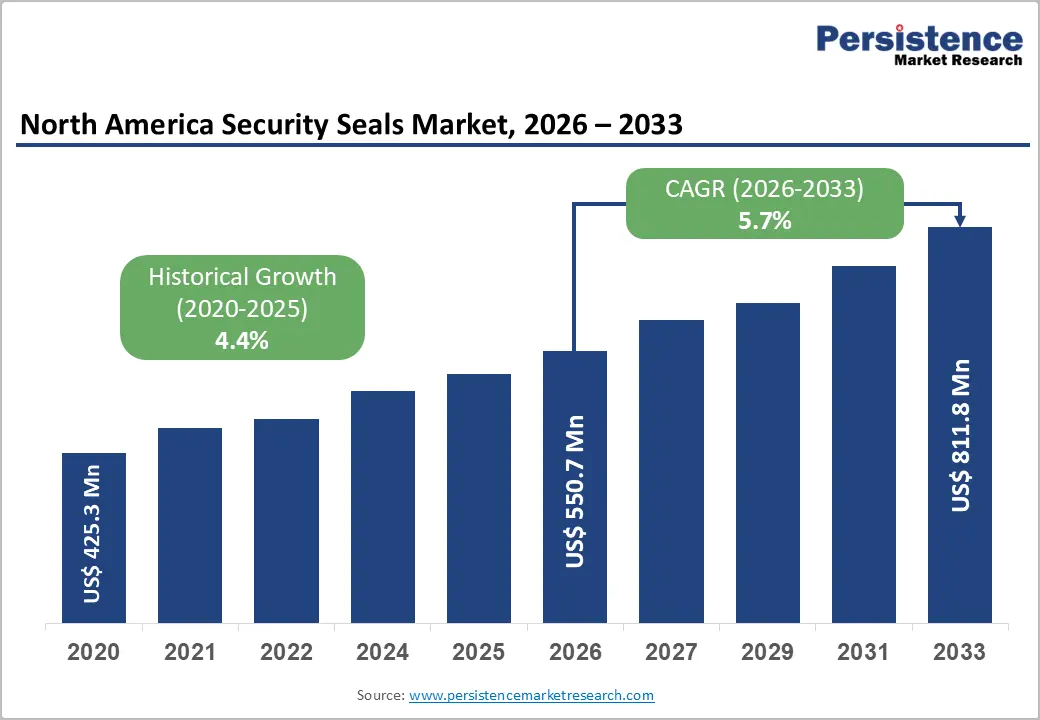
The North America security seals market size is likely to be valued at US$ 550.7 million in 2026 and is expected to reach US$ 811.8 million by 2033, growing at a CAGR of 5.7% during the forecast period from 2026 to 2033.
The market is propelled by escalating global trade volumes, tightening regulatory mandates around cargo and supply chain security, and an accelerating transition toward smart, electronic, and RFID-enabled seals.
Key Industry Highlights:
- Dominant Product Segment: Logistics & transportation is the dominant end-use segment, holding 38% market share, underpinned by mandatory CBP sealing requirements for ocean containers, growing 3PL operations, and multi-nodal supply chain complexity across U.S. road, rail, and ocean freight networks.
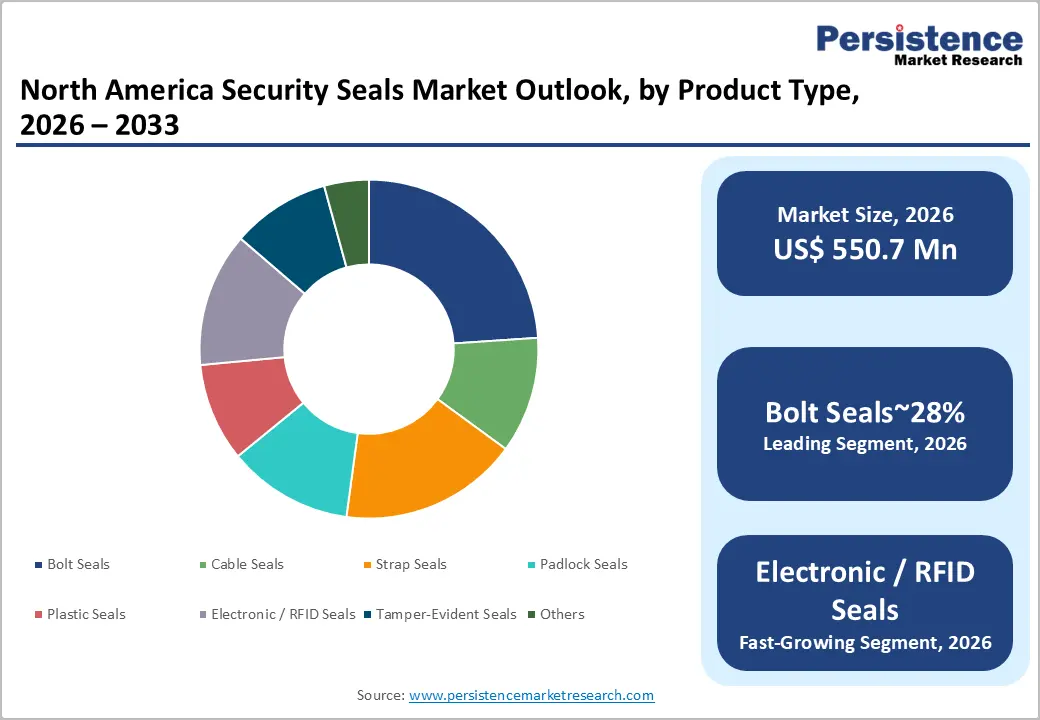
- Fastest-Growing Product Segment: Electronic/RFID Seals represent the fastest-growing product type, driven by accelerating supply chain digitalization, DoD RFID mandates, pharmaceutical track-and-trace compliance requirements, and growing buyer preference for tamper-detection seals with real-time digital audit-trail capabilities.
- Key Opportunity: Integrating IoT and GPS technologies into security seals offers a high-value opportunity, as major logistics operators and government agencies seek real-time cargo visibility, automated exception alerts, and digital chain-of-custody documentation that mechanical seals alone cannot provide.
Market Dynamics
Drivers - Stringent Regulatory Frameworks Mandating Tamper-Evident Sealing
Government and intergovernmental regulations are a foundational growth driver for the North America security seals market. The U.S. Customs and Border Protection (CBP), under the Customs-Trade Partnership Against Terrorism (C-TPAT) program, mandates the use of high-security seals that meet ISO 17712:2013 standards on all conveyances transporting goods into the United States.
In 2023, the CBP processed over 26 million cargo entries at U.S. ports of entry, each requiring compliant sealing. Similarly, the Transportation Security Administration (TSA) and the FDA's Drug Supply Chain Security Act (DSCSA) enforce traceability and tamper-evidence requirements across pharmaceutical and air cargo shipments. These regulatory compulsions create a recurring, non-discretionary demand for certified security seals that cannot be bypassed, ensuring a stable revenue base for market participants.
Rapid Expansion of E-Commerce and Cold Chain Logistics
The explosive growth of e-commerce across North America is generating substantial incremental demand for security seals. According to the U.S. Census Bureau, U.S. retail e-commerce sales reached approximately US$ 1.1 trillion in 2023, and the trend is expected to continue accelerating through the forecast period. Each shipment, whether B2C parcel or B2B freight, requires some form of tamper-evidence, boosting demand for plastic and strap seals.
The Global Cold Chain Alliance (GCCA) reports continued expansion of temperature-controlled warehousing in the U.S. and Canada, intensifying demand for seals in food, pharmaceutical, and biotech shipments. The proliferation of third-party logistics (3PL) operators and fulfillment centers further augments seal consumption as supply chains become more multi-nodal and require integrity assurance at every transfer point.
Restraints - Price Volatility of Raw Materials
The North American security seals market faces significant margin pressure due to volatility in raw material costs, primarily petrochemical-derived plastics and steel. Data from the U.S. Bureau of Labor Statistics (BLS) indicates that producer price indices for plastics materials and resins surged by over 25% between 2020 and 2022 before partially stabilizing.
Steel prices remain subject to Section 232 tariff-related disruptions. For mid-tier and smaller manufacturers, these fluctuating input costs compress margins and make competitive pricing difficult, potentially reducing investment in product innovation and limiting market expansion.
Growing Threat of Seal Counterfeiting and Duplicate Seals
Despite growing regulatory oversight, counterfeit security seals continue to pose a significant challenge to market integrity. The International Chamber of Commerce (ICC) has flagged counterfeiting as a persistent supply chain vulnerability, with fake or substandard seals often being indistinguishable from legitimate products.
In several enforcement operations, authorities have seized large consignments of non-compliant seals masquerading as ISO 17712-certified products. This undermines buyer confidence, particularly among smaller logistics operators with limited procurement quality controls, and may dampen the adoption of premium-priced seals, acting as a brake on value-based market growth.
Opportunities - Accelerating Adoption of Electronic and RFID-Enabled Seals
The shift toward smart logistics and Industry 4.0 is creating a substantial growth opportunity for electronic and RFID-based security seals in North America. The RFID Journal and industry white papers note that RFID-enabled seals provide real-time tracking, automated tamper detection, and digital audit trails, capabilities that traditional mechanical seals cannot offer.
The U.S. Department of Defense (DoD) has been advancing its use of RFID in supply chain operations since its MIL-STD-129 mandate, signaling a broader government-driven shift. With the global RFID market projected to expand rapidly, seal manufacturers that integrate NFC/RFID technology can command significant price premiums and capture a growing share of the government, defense, and high-security logistics segments, segments where data integrity requirements are non-negotiable.
Surge in Cross-Border Trade and Port Modernization Investments
North America's ongoing port and infrastructure modernization under the Bipartisan Infrastructure Law (BIL), which allocates over US$ 17 billion to ports, waterways, and freight infrastructure, is set to dramatically increase cross-border cargo volumes. The U.S. International Trade Administration noted that U.S. goods exports exceeded US$ 2 trillion in 2023.
Expanded port handling capacity translates directly into greater deployment of high-security, ISO-compliant bolt and cable seals for containerized cargo. Additionally, the United States-Mexico-Canada Agreement (USMCA), which facilitates increased intra-regional trade flows, creates multi-country compliance requirements, opening markets for seal manufacturers offering standardized, multi-jurisdictional, traceable products.
Category-wise Analysis
By Product Type Insight
Bolt seals represent the dominant segment within the product type category, accounting for approximately 28% of the North American security seals market. Their preeminence is rooted in their widespread mandated use for sealing ISO shipping containers in compliance with ISO 17712:2013 standards, which classifies bolt seals as 'high security.'
The U.S. Customs and Border Protection (CBP) explicitly requires high-security seals on all inbound containerized cargo, creating a structural, non-discretionary demand source. Bolt seals are preferred across ocean freight, intermodal rail, and road transport due to their superior cut resistance and clear tamper-evidence. As U.S. container trade volumes grow, the American Association of Port Authorities (AAPA) reported over 50 million TEU movements in 2023, bolt seal consumption correspondingly scales upward.
By Material Type Insights
Steel is the leading material type, accounting for roughly 45% of the market share. Steel seals, particularly steel bolt and cable seals, are mandated for high-security applications under ISO 17712 and are the material of choice for container sealing at U.S. ports of entry. The superior tensile strength, resistance to cutting and environmental weathering, and the ability to meet regulatory classification standards give steel seals an unassailable position in the logistics and government segments.
The American Iron and Steel Institute (AISI) notes that North America maintains robust domestic steel production capacity, giving seal manufacturers relative supply stability. While plastic seals dominate by volume in low-security, retail, and e-commerce applications, steel commands the highest average selling price and value share.
By Distribution Channel Insights
Direct sales are the leading distribution channel, accounting for approximately 52% of market revenues. Large-volume buyers, including ocean carriers, port operators, government agencies, and major logistics companies, prefer direct procurement from manufacturers to ensure product authenticity, regulatory compliance, and volume-based pricing.
The scale of procurement in regulated segments such as government and defense necessitates direct contractual relationships. Furthermore, major market participants such as TydenBrooks and Brady Corporation maintain dedicated enterprise sales teams and custom solutions offerings. However, online channels are gaining traction among SME buyers and in retail applications, with platforms such as Amazon Business and manufacturer e-stores enabling rapid, low-volume procurement of plastic and strap seals.
By End-User Insights
Logistics & transportation is the dominant end-use segment, accounting for an estimated 38% of the total market. The sheer scale and regulatory intensity of North American freight operations, spanning road, rail, ocean, and air, drives this dominance. The Bureau of Transportation Statistics (BTS) reports that U.S. freight movement exceeded 10 billion ton-miles annually, with every intermodal transfer point representing a potential seal application.
C-TPAT compliance requirements and CBP's mandatory seal standards for inbound ocean containers are structural demand catalysts. The segment also benefits from increasing supply chain complexity, with more multi-nodal shipments requiring sealing at multiple handoff points. Continued growth in third-party logistics, express freight, and hazardous material transportation further solidifies this segment's leadership position.
Competitive Landscape
The North America security seals market exhibits a moderately consolidated structure, with a handful of well-established players, notably TydenBrooks, Brady Corporation, and Mega Fortris, commanding significant share, while a long tail of regional and specialty manufacturers addresses niche end-uses. Market leaders differentiate through proprietary seal designs, ISO 17712 certifications, and vertically integrated manufacturing.
Key strategies include geographic expansion into emerging markets, product line extensions into electronic and RFID-enabled seals, and strategic partnerships with logistics technology providers. Emerging business model trends include seal-as-a-service platforms integrating real-time tracking and digital chain-of-custody documentation, reflecting the broader convergence of physical security and supply chain digitalization.
Key Developments
- January, 2025: TydenBrooks expanded its electronic seal portfolio by introducing a next-generation GPS-enabled container seal designed to meet evolving C-TPAT and WCO SAFE Framework compliance requirements, targeting major U.S. ocean freight carriers.
- March, 2024: Brady Corporation announced the launch of an enhanced range of tamper-evident seals with embedded QR code and RFID dual-authentication technology for pharmaceutical cold chain logistics, aligning with FDA DSCSA track-and-trace mandates.
- November, 2023: Mega Fortris strengthened its North American distribution network through a partnership with a leading U.S.-based logistics solutions provider, expanding its high-security bolt seal availability across major U.S. port and intermodal hubs.
North America Security Seals Market- Key Insights
| Key Insights | Details |
|---|---|
| Historical Market Value (2020) | US$ 425.3 Mn |
| Current Market Value (2026) | US$ 550.7 Mn |
| Projected Market Value (2033) | US$ 811.8 Mn |
| CAGR (2026 - 2033) | 5.7% |
| Leading Region | U.S., 85% share |
| Dominant Product Type | Bolt Seals, 28% share |
| Top-ranking Product | Logistics & Transportation, 38% |
| Incremental Opportunity | US$ 261.1 Mn |
Companies Covered in North America Security Seals Market
- TydenBrooks
- American Casting & Manufacturing Corp.
- Brady Corporation
- Cambridge Security Seals
- Mega Fortris
- Essentra plc
- Transport Security Inc.
- Acme Seals Ltd.
- EnvoPak
- JW Products
- United Security Seals
- North American Security Seal Solutions Inc.
- Harcor Security Seals
- HSA International Group
- Unisto AG
- Yoseal
- Onseal
Frequently Asked Questions
The North America Security Seals Market is estimated at US$ 550.7 Million in 2026 and is projected to reach US$ 811.8 Million by 2033, expanding at a forecast CAGR of 5.7%. Historically, the market grew at a CAGR of 4.4% between 2020 and 2025, reflecting consistent underlying demand growth across logistics, healthcare, and government end-uses.
The primary demand drivers include mandatory compliance with ISO 17712:2013 standards enforced by the U.S. Customs and Border Protection (CBP) under the C-TPAT program, surging e-commerce-driven parcel volumes, regulatory requirements under the FDA's Drug Supply Chain Security Act (DSCSA) for pharmaceutical traceability, and rapid adoption of RFID and electronic seals across smart logistics operations.
Bolt seals are the leading product type segment, holding approximately 28% market share. Their dominance is driven by their classification as 'high security' under ISO 17712:2013 and their mandatory use for sealing containerized cargo entering U.S. ports as required by the U.S. Customs and Border Protection (CBP). Electronic/RFID seals are the fastest growing subsegment.
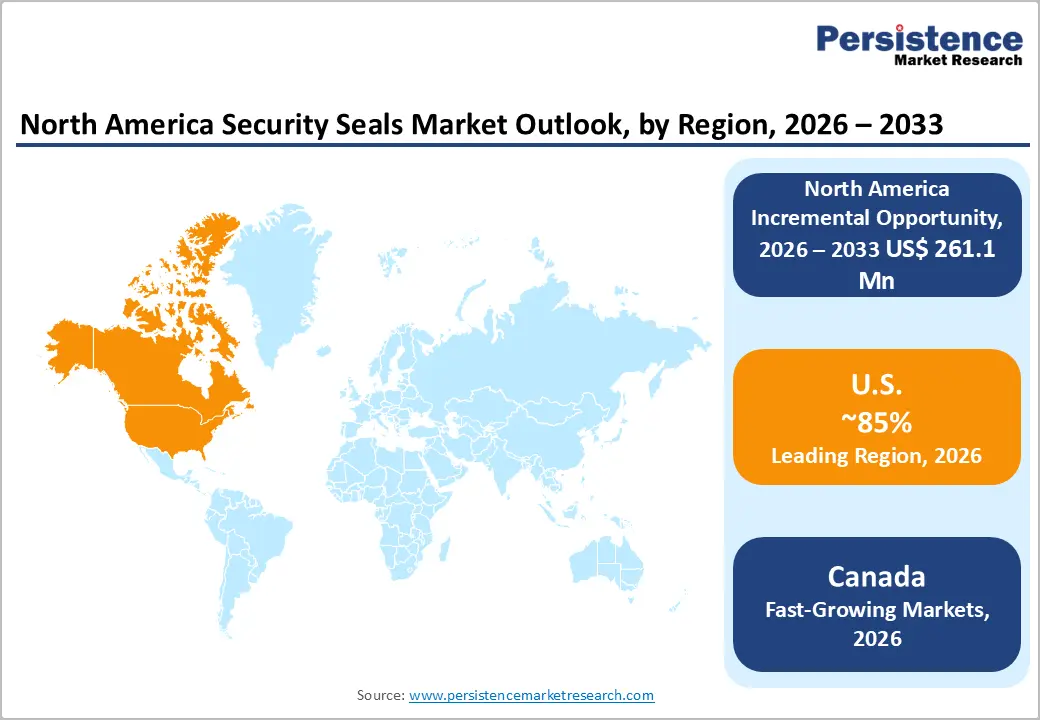
North America is the leading regional market, anchored by the United States' position as the world's largest goods importer. The region's leadership is cemented by the C-TPAT program, TSA cargo security mandates, and a highly mature logistics infrastructure. U.S. container port throughput exceeding 50 million TEU annually creates structural, non-discretionary demand for ISO-certified high-security seals.
The most significant growth opportunity lies in the development and commercialization of IoT-integrated and GPS/RFID-enabled smart security seals. As supply chains digitalize and real-time cargo visibility becomes a regulatory and operational imperative, particularly under DoD RFID mandates and pharmaceutical DSCSA track-and-trace requirements, manufacturers offering digital seal solutions command significant price premiums and access high-growth, high-margin market segments.
Key market participants include TydenBrooks, Brady Corporation, American Casting & Manufacturing Corp., Cambridge Security Seals, Mega Fortris, Essentra plc, Transport Security Inc., Acme Seals Ltd., EnvoPak, Harcor Security Seals, and HSA International Group, among others. These companies compete on product certification, technological innovation, manufacturing scale, and distribution network reach.


