




- Advanced Materials
- Smart Fabrics Market
Smart Fabrics Market Size, Share, and Growth Forecast 2026 - 2033
Smart Fabrics Market by Product Type (Passive, Active, Very Smart), by Functionality (Sensing, Energy Harvesting, Luminescence & Aesthetics, Thermoelectricity, Others), Industry (Healthcare & Medical, Sports & Fitness, Military & Defense, Fashion & Entertainment, Automotive & Transportation, Architecture & Construction, Others), and Regional Analysis, 2026 - 2033

Smart Fabrics Market Size and Trend Analysis
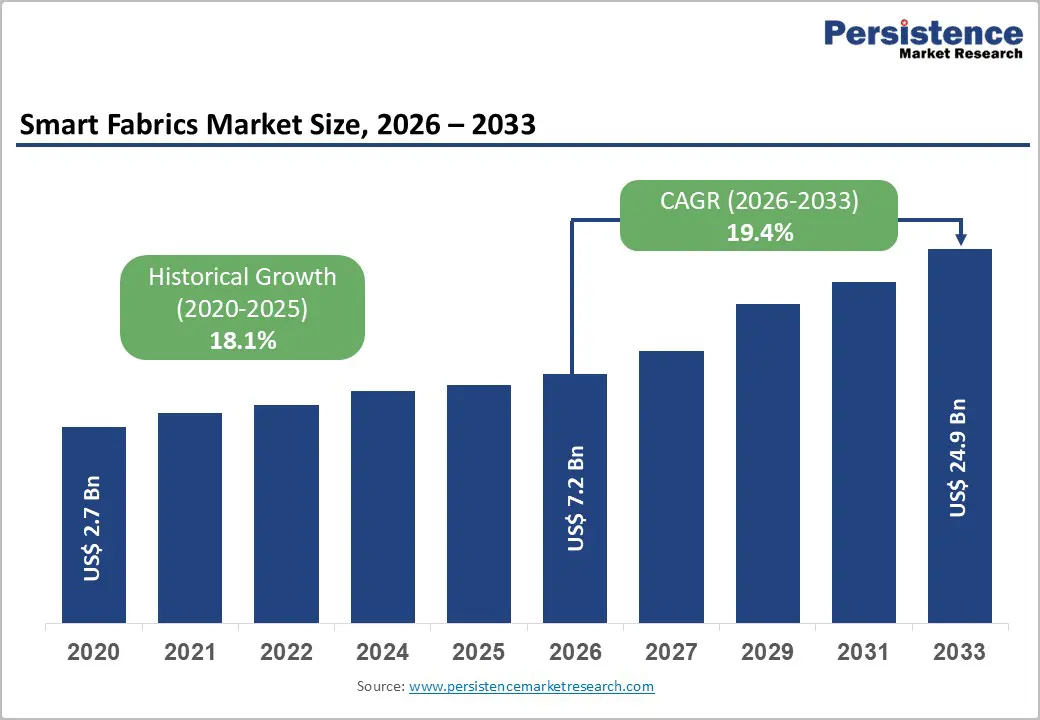
The global Smart Fabrics Market size is expected to be valued at US$ 7.2 billion in 2026 and projected to reach US$ 24.9 billion by 2033, growing at a CAGR of 19.4% between 2026 and 2033.
Rapid advances in textile electronics, wearable health monitoring, and energy-harvesting capabilities drive growth. Integration of conductive fibers, micro-sensors, and flexible electronics enables fabrics to track vital signs, generate power, and adapt to environmental conditions. Rising investments in IoT-enabled wearables, smart healthcare, and defense applications further accelerate adoption. Strong historical growth reflects increasing commercialization and expanding use across performance apparel, medical textiles, and intelligent uniforms.
Key Industry Highlights:
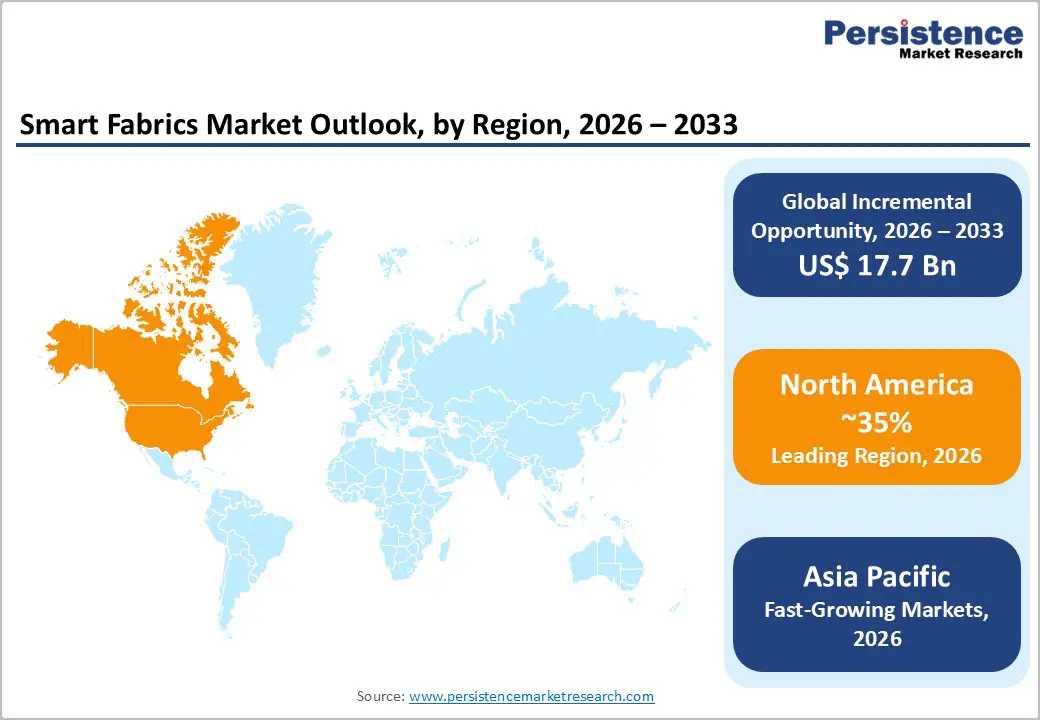
- Leading Region: North America leads with 35% share (2025), driven by strong defense R&D, telehealth expansion, and a mature wearable technology ecosystem.
- Fastest Growing Region: Asia Pacific emerges as the fastest growing, holding 30% share (2025) and expanding rapidly due to manufacturing scale and policy-driven innovation.
- Leading Product Type: Active smart fabrics dominate with 44% share (2025), supported by high adoption in sports, healthcare, and defense applications.
- Fastest Growing Functionality: Energy harvesting is the fastest growing segment, gaining traction due to demand for self-powered wearable systems.
- Key Opportunity: Healthcare-focused smart fabrics, including remote monitoring garments and smart bandages, present strong growth potential aligned with digital health and aging population trends.
| Key Insights | Details |
|---|---|
|
Smart Fabrics Size (2026E) |
US$ 7.2 Billion |
|
Market Value Forecast (2033F) |
US$ 24.9 Billion |
|
Projected Growth CAGR (2026–2033) |
19.4% |
|
Historical Market Growth (2020–2025) |
18.1% |
Market Dynamics
Drivers - Rapid Integration of Wearable Electronics and IoT Enabled Smart Textiles Driving Market Expansion
The integration of wearable electronics and IoT platforms into fabrics is a key growth driver, enabling real-time monitoring of biometrics such as heart rate, respiration, and activity levels. Smart garments now incorporate micro-sensors, flexible batteries, and wireless modules, transforming textiles into connected systems.
Support from global standardization bodies such as International Electrotechnical Commission and Institute of Electrical and Electronics Engineers, along with rising chronic disease prevalence reported by World Health Organization, is accelerating adoption. Increasing use in sports performance tracking and healthcare monitoring is driving smart fabrics toward mainstream commercialization.
Growing Demand for Sustainable Self Powered Energy Harvesting Smart Textile Solutions
Rising demand for sustainable and energy-efficient solutions is driving the adoption of energy harvesting smart textiles that reduce dependence on external power sources. These fabrics convert kinetic, thermal, or solar energy into electricity to power embedded sensors and communication systems.
Innovations such as piezoelectric yarns, triboelectric fibers, and photovoltaic textile layers are improving feasibility and scalability. Research from institutions like North Carolina State University and publications such as Journal of Textile Engineering & Fashion Technology highlight advancements in self-powered textiles. Government-backed innovation programs are further supporting deployment across healthcare, defense, and performance apparel sectors.
Restraints - High Production Complexity and Expensive Advanced Materials Limiting Market Adoption
High manufacturing complexity and material costs remain major barriers to smart fabrics adoption. These textiles require specialized conductive fibers, nanomaterials, and embedded micro-sensors, making them significantly more expensive than conventional fabrics. Production often involves precision coating, printing technologies, and controlled environments, increasing capital and operational costs.
Industry insights suggest smart fabrics can cost 2–3 times more than standard textiles, limiting penetration in price-sensitive regions. This cost gap is particularly restrictive in mass-market apparel segments across developing economies. Until economies of scale, material innovation, and cost-efficient manufacturing processes improve, adoption in low-margin and high-volume markets will remain constrained.
Lack of Standardization and Complex Global Regulatory Approval Frameworks Hindering Growth
The absence of globally harmonized standards for safety, biocompatibility, and electromagnetic compatibility is a key restraint. Organizations such as International Electrotechnical Commission and International Organization for Standardization are developing frameworks, but global alignment remains limited.
Regulatory fragmentation forces manufacturers to navigate multiple approval systems, including requirements from U.S. Food and Drug Administration and regional medical device regulations. These processes extend product timelines and raise compliance costs, discouraging smaller firms. The lack of unified global standards continues to slow commercialization, especially in healthcare and other high-risk applications.
Opportunities - Emerging Energy Harvesting Smart Fabrics for Military and Outdoor Performance Applications
Energy harvesting smart fabrics present a strong opportunity in Military & Defense and outdoor sports applications. These textiles can convert motion, body heat, or sunlight into electrical energy, enabling self-powered uniforms that support communication systems, GPS devices, and health monitoring sensors.
Research and defense-backed innovation programs are accelerating development of piezoelectric and triboelectric fibers capable of generating usable power from daily activity. Advances in electroactive materials such as those developed by Arkema are enabling flexible, wearable energy systems. Government-supported initiatives in regions like the U.S. and Europe are helping transition these technologies from lab-scale research to commercial deployment.
Expanding Healthcare Applications for Continuous Remote Monitoring Smart Textiles
Healthcare and medical applications offer a major growth opportunity, particularly in remote patient monitoring and chronic disease management. Smart fabrics embedded with textile-based sensors can continuously track vital signs such as heart rate, respiration, and physical activity, supporting real-time health insights and early intervention.
Research initiatives supported by National Institutes of Health have validated smart garments and wearable systems for clinical use, including cardiac monitoring and wound care. Integration with digital health platforms and electronic records is enabling scalable telehealth solutions. Growing emphasis on preventive care and reimbursement models is expected to further drive adoption across healthcare systems globally.
Category-wise Analysis
Product Type Insights
Active smart fabrics lead the product type segment, accounting for approximately 44% of the global market share in 2025. These fabrics respond dynamically to external stimuli such as temperature, moisture, and mechanical stress using technologies like phase change materials and electroactive fibers. Their dominance is driven by strong adoption across sports & fitness, healthcare & medical, and military & defense, where adaptive comfort and performance enhancement are critical.
Very smart fabrics are emerging as the fastest-growing category, driven by advancements in embedded electronics, AI integration, and connectivity. These fabrics enable autonomous responses such as thermal regulation and real-time alerts. Supported by defense projects and innovation programs, their adoption is expanding in advanced applications including military systems, smart interiors, and high-end wearable technology.
Functionality Analysis
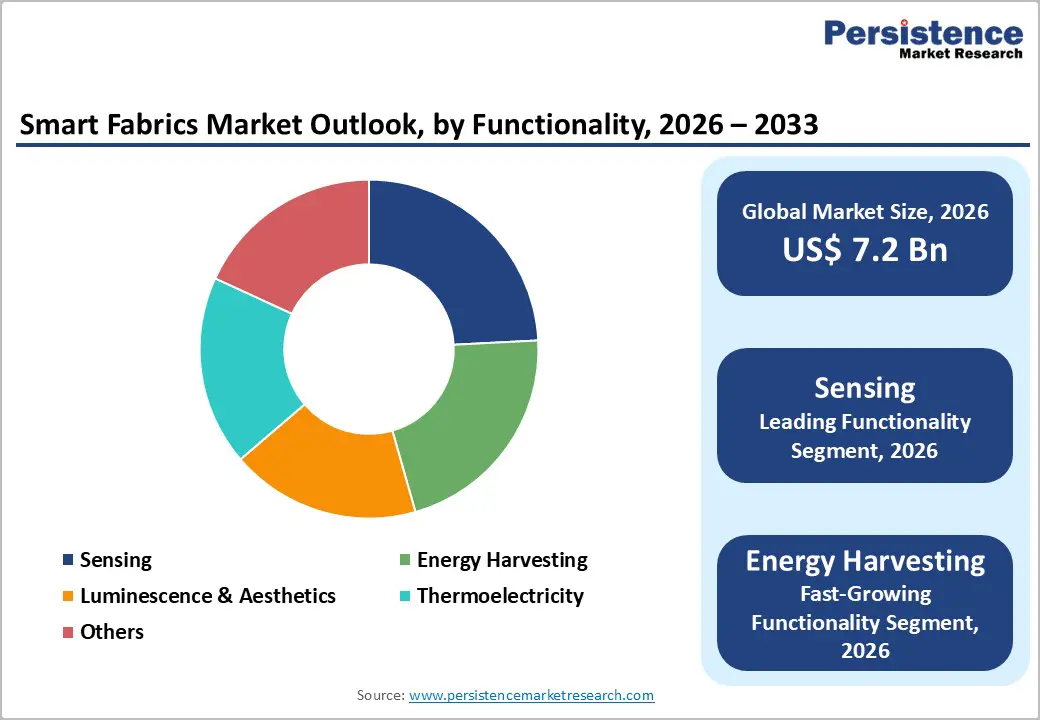
Sensing is the leading functionality segment, representing around 38% of the global market share in 2025. These fabrics integrate sensors such as strain gauges, temperature sensors, and pressure sensors to capture physiological and environmental data. Their widespread use in fitness tracking, medical monitoring, and performance analysis across industries like healthcare and sports drives their dominant position.
Energy harvesting is the fastest-growing functionality, driven by the need for self-powered wearable systems. These fabrics convert kinetic, thermal, or solar energy into usable power, reducing reliance on batteries. Increasing innovation in piezoelectric and triboelectric materials, along with rising demand for sustainable and long-duration wearable solutions, is accelerating adoption across defense, outdoor, and healthcare applications.
Industry Analysis
Healthcare & Medical is the leading end-use segment, holding approximately 32% of the global market share in 2025. Applications include smart bandages, wearable monitoring garments, and connected medical textiles that enable continuous tracking of vital signs. Growth is driven by increasing chronic disease prevalence and the shift toward remote and preventive healthcare, supported by organizations such as the World Health Organization and Centers for Disease Control and Prevention.
Healthcare & Medical is also the fastest-growing segment, fueled by expanding telehealth adoption and digital health ecosystems. Support from institutions such as the National Institutes of Health and evolving regulatory pathways from the U.S. Food and Drug Administration are accelerating commercialization. Integration with electronic health records and remote monitoring platforms is further strengthening adoption globally.
Regional Insights
North America Smart Fabrics Market Trends and Insights
North America leads the global Smart Fabrics Market, accounting for approximately 35% of the market share in 2025, driven by a strong ecosystem of innovation, advanced R&D capabilities, and early adoption of wearable technologies. The region benefits from extensive funding and research initiatives supported by agencies such as the Defense Advanced Research Projects Agency and the National Science Foundation, along with active commercialization by major sportswear and technology companies.
The United States dominates regional growth through applications in defense, healthcare, and performance apparel. Regulatory clarity from bodies such as the U.S. Food and Drug Administration further enhances product adoption. Strong collaboration between academia, startups, and established players continues to position North America as the most mature and commercially advanced smart fabrics market globally.
Europe Smart Fabrics Market Trends and Insights
Europe represents a highly innovative market for smart fabrics, supported by strong policy frameworks and sustainability initiatives. Countries such as Germany, the United Kingdom, and France are leading adoption across automotive, healthcare, and smart textile applications. Regulatory alignment under frameworks like REACH and EU MDR is enabling safer material use and standardized product development across the region.
The market is projected to grow at a CAGR of approximately 20% during the forecast period, driven by increasing investments in digital health and sustainable textiles. Government-backed programs and healthcare systems are accelerating adoption of smart garments for remote monitoring and elderly care. However, varying reimbursement systems and multi-country approval requirements remain key challenges for smaller players.
Asia Pacific Smart Fabrics Market Trends and Insights
Asia Pacific holds approximately 30% of the global market share in 2025 and is emerging as the fastest-growing region, supported by large-scale textile manufacturing capabilities and rapid technological adoption. Countries such as China, India, Japan, and South Korea are investing heavily in smart textile innovation, backed by industrial policies and infrastructure development.
China leads production and scaling, while India benefits from initiatives like “Make in India” promoting advanced textile manufacturing. Japan and South Korea focus on high-end applications in healthcare and electronics-integrated fabrics. Strong cross-border collaborations and increasing domestic demand for wearable technologies are transforming the Asia Pacific into a comprehensive ecosystem for smart fabrics development and commercialization.
Competitive Landscape
The global smart fabrics market is moderately consolidated, characterized by the presence of large multinational players alongside specialized material innovators and niche technology startups. A limited number of firms control key areas such as advanced materials, intellectual property, and supply chain capabilities, while smaller companies focus on specific functionalities like sensing, energy harvesting, and sustainable textiles. Strategic approaches such as vertical integration, partnerships with research institutions, and technology licensing are widely adopted to strengthen market positioning.
Key competitive differentiators include expertise in material innovation, sensor integration, regulatory compliance, and biocompatibility. The market is increasingly shifting toward platform-driven models, with growing emphasis on integrated solutions and data-enabled services. Trends such as subscription-based analytics, co-development agreements, and scalable smart textile platforms are redefining competition beyond traditional product-based offerings.
Key Developments:
- In March 2025, DuPont introduced Elysium conductive fibers designed for scalable sensing fabrics, enabling improved integration with IoT platforms. The innovation supports real-time data transmission and enhances performance capabilities across wearable technology and smart textile applications.
- In July 2024, Adidas partnered with the Massachusetts Institute of Technology to develop AI-embedded athletic wear. These smart garments were tested in Olympic training environments, focusing on performance tracking, adaptive feedback systems, and next-generation sportswear innovation.
- In November 2024, Toray Industries unveiled solar energy-harvesting textiles designed for automotive applications. Supported by government funding in Japan, the development focuses on integrating photovoltaic capabilities into fabrics to power in-vehicle systems and improve energy efficiency.
Companies Covered in Smart Fabrics Market
- AIQ Smart Clothing Inc.
- Adidas AG
- Nike Inc.
- DuPont de Nemours Inc.
- Toray Industries Inc.
- Sensoria Inc.
- Gentherm Inc.
- Interactive Wear AG
- Ohmatex ApS
- Schoeller Textil AG
- Hexoskin
- Textronics Inc.
- Google LLC
- Jabil Inc.
- Kolon Industries Inc.
Frequently Asked Questions
The Smart Fabrics Market is projected to reach US$ 7.2 billion in 2026, driven by growing adoption of IoT-enabled wearables and smart textiles across key industries.
Integration of textile-based sensors and IoT connectivity for real-time health monitoring and performance tracking is a major demand driver.
Active smart fabrics lead the segment with 44% share (2025) due to their adaptive properties in high-performance applications.
North America leads with 35% share (2025), supported by strong R&D, defense investments, and advanced wearable ecosystems.
Energy harvesting smart fabrics enabling self-powered wearables represent a key growth opportunity across multiple sectors.
Leading market players include DuPont, Toray Industries, Adidas, Gentherm, Schoeller Textiles, Milliken & Company, and Outlast Technologies.


