




- Biotechnology
- Single-Cell Genome Sequencing Market
Single-Cell Genome Sequencing Market Size, Share, and Growth Forecast, 2026 - 2033
Single-Cell Genome Sequencing Market by Product Type (Reagents & Consumables, Instruments, Software & Services), Sequencing Technology (Short-read NGS, Long-read, PCR, Microarray), Application (Oncology, Others), and Regional Analysis for 2026 - 2033

Single-Cell Genome Sequencing Market Size and Trends Analysis
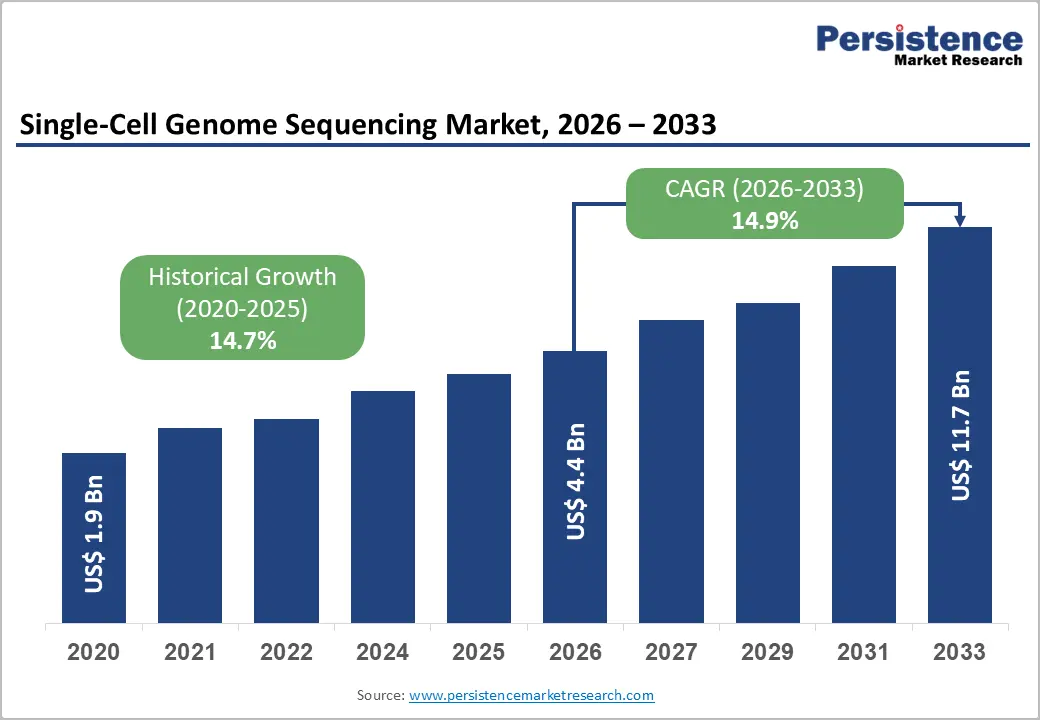
The global single-cell genome sequencing market size is likely to be valued at US$4.4 billion in 2026 and is expected to reach US$11.7 billion by 2033, growing at a CAGR of 14.9% during the forecast period from 2026 to 2033, driven by increasing demand for ultra-high-resolution genomic profiling to study cellular heterogeneity in complex diseases such as cancer, immune disorders, and neurological conditions.
Large-scale initiatives such as the NIH Human Cell Atlas and National Cancer Institute (NCI) single-cell oncology research programs (ongoing 2023 - 2025), which focus on mapping cellular diversity in cancer and rare diseases. NIH-funded studies show that tumor heterogeneity and immune microenvironment profiling require single-cell resolution, significantly increasing adoption in translational research. The shift toward cell-level precision diagnostics and personalized therapeutic development is making single-cell genome sequencing a foundational technology in modern biomedical research.
Key Industry Highlights:
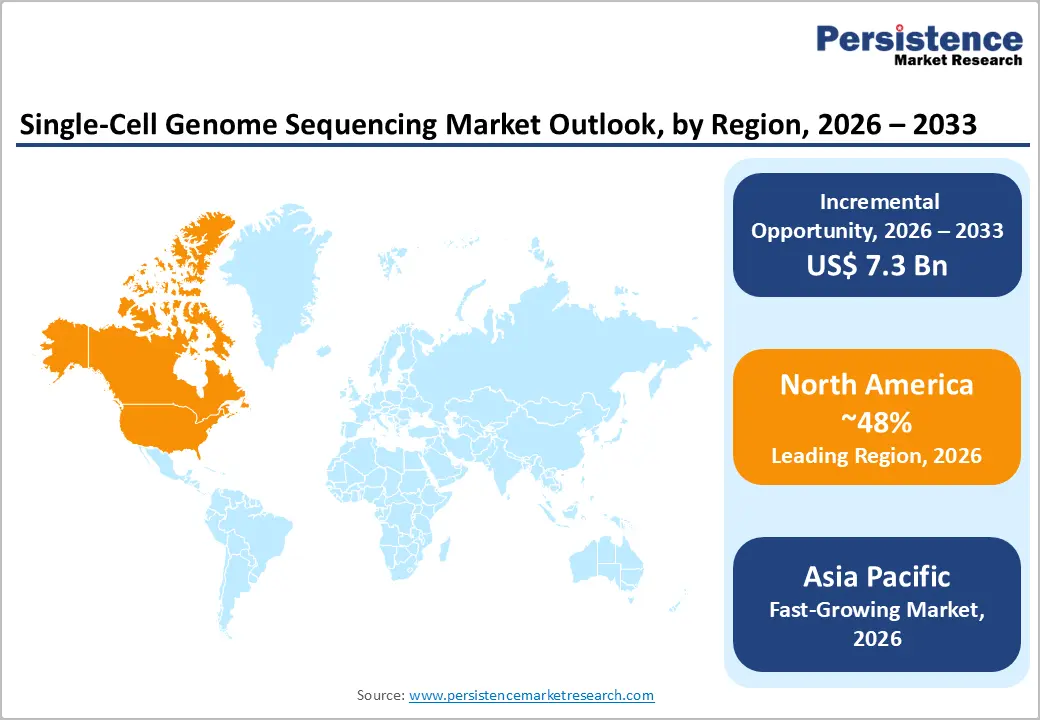
- Leading Region: North America is anticipated to be the leading region, accounting for a market share of 48% in 2026, driven by strong NIH funding, FDA-supported clinical adoption, and leadership in precision medicine and genomics innovation.
- Fastest-growing Region: Asia Pacific is likely to be the fastest-growing region, supported by expanding national genomics programs, rising chronic disease burden, and strong biotech ecosystem growth in countries.
- Leading Product Type: Reagents & consumables are projected to represent the leading product type in 2026, accounting for 45% of the revenue share, driven by recurring demand in every sequencing workflow.
- Leading Sequencing Technology: Short-read NGS is anticipated to be the leading sequencing technology, accounting for over 67% of the revenue share in 2026, supported by its established scalability and cost efficiency.
- Key Opportunity: A major market opportunity in the single-cell genome sequencing market lies in the convergence of AI-powered multi-omics and next-generation sequencing technologies, enabling highly precise cell-level disease analysis that is transforming personalized medicine, cancer diagnostics, and advanced therapeutic discovery.
DRO Analysis
Driver - Expanding Precision Medicine & Oncology Research Mandates
Precision medicine is a major growth driver for the single-cell genome sequencing market as healthcare systems increasingly focus on patient-specific treatment strategies. Single-cell sequencing enables detailed profiling of tumor heterogeneity, clonal evolution, and immune microenvironment, which is critical for advanced oncology research.
National Cancer Institute (NCI, NIH), where single-cell RNA sequencing has been used in large tumor studies showing that over 70% of clinically relevant cancer drug response differences arise from intra-tumor cellular heterogeneity (NIH/NCI research findings, 2025). This highlights why precision oncology increasingly depends on single-cell resolution instead of bulk sequencing.
The NIH Human Cell Atlas and related single-cell mapping efforts (updated datasets 2024-2025) have generated multi-million-cell reference datasets across tissues, enabling more accurate disease classification and biomarker discovery at single-cell resolution. For example, NIH-supported studies in Nature Medicine and Nature Cancer (2024) demonstrate that single-cell profiling improves prediction of drug response compared to bulk sequencing by capturing previously hidden cell subpopulations in tumors.
Restraint - Technical Challenges in Cell Isolation & Sample Preparation
Single-cell workflows require precise separation of individual cells without contamination or loss of viability, which is technically challenging and highly sensitive to procedural errors. Variability in tissue type, sample quality, and cell fragility can significantly affect sequencing accuracy. According to PubMed Central, published benchmarking studies indicate that single-cell RNA-seq data quality varies by up to 40% based on tissue handling protocols. Inefficient isolation can lead to biased results, limiting reproducibility across studies.
Limitations arise during library preparation and whole-genome amplification steps, where technical noise and amplification bias can distort genetic information. Low input DNA from single cells increases the risk of data dropout and sequencing errors. High dependency on skilled personnel and specialized microfluidic systems restricts scalability. These factors collectively raise overall workflow costs and reduce throughput efficiency.
Opportunity - Technological Convergence with Long-Read Sequencing and Spatial Multi-Omics
A major opportunity in the single-cell genome sequencing market lies in the convergence of single-cell sequencing with long-read sequencing and spatial multi-omics technologies. This integration enables researchers to analyze genetic variation along with structural changes, epigenetic features, and spatial tissue organization at single-cell resolution.
According to NIH-funded spatial transcriptomics studies (Nature Biotechnology and Nature Methods, 2025), integrating spatial omics with single-cell sequencing can improve identification of tissue microenvironment signals by capturing cell-to-cell interaction patterns that are invisible in bulk or dissociated-cell sequencing approaches.
The combination of these advanced platforms is enabling next-generation biological discovery and accelerating translational research. Pharmaceutical companies and research institutes are increasingly adopting integrated multi-omics workflows to identify novel biomarkers, therapeutic targets, and disease pathways. This convergence also supports the development of more predictive disease models and improves drug response analysis.
Category-wise Analysis
Product Type Insights
Reagents & consumables are expected to lead the single-cell genome sequencing market, accounting for approximately 45% of revenue in 2026, driven by continuous demand for barcoded kits, microfluidic chips, and amplification reagents required in every sequencing run. This segment benefits from a recurring revenue model because each experiment consumes fresh reagents, making it essential for academic labs, biotech firms, and clinical research centers. For example, widespread use of droplet-based single-cell platforms in cancer and immunology studies depends heavily on consumable reagents for cell capture and library preparation.
Instruments are likely to represent the fastest-growing segment, supported by rapid technological upgrades and increasing adoption of benchtop sequencing systems in mid-sized laboratories. Growth is driven by demand for in-house sequencing capabilities that reduce outsourcing costs and improve turnaround time for genomic analysis. For instance, research institutes are increasingly adopting compact single-cell sequencing platforms for real-time tumor profiling and immune response studies.
Sequencing Technology Insights
Short-read NGS is projected to lead the market, capturing around 67% of the revenue share in 2026, supported by its high accuracy, scalability, and established infrastructure across research and clinical laboratories. It is widely used for transcriptomic profiling, variant detection, and large-scale single-cell studies because of its cost efficiency and compatibility with high-throughput platforms. A notable example includes Illumina-based sequencing systems, which are extensively used in cancer research programs to analyze tumor heterogeneity and gene expression at single-cell resolution.
Long-read sequencing is likely to be the fastest-growing sequencing technology, driven by its ability to resolve complex genomic regions, structural variants, and full-length transcript analysis with higher accuracy. Its adoption is increasing in advanced research applications where short-read limitations reduce interpretability. For instance, long-read platforms are being used in neurological disorder studies to identify structural variations linked to disease progression at single-cell resolution.
Application Insights
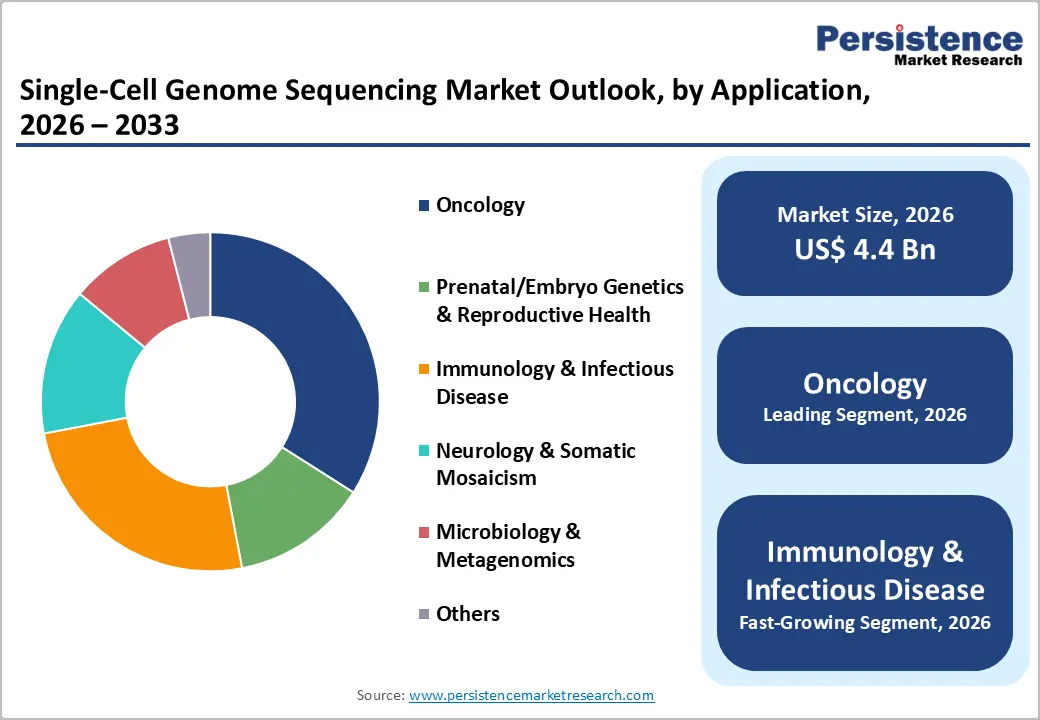
Oncology is expected to lead the single-cell genome sequencing market, accounting for approximately 39% of revenue in 2026, driven by strong demand for tumor heterogeneity analysis, clonal evolution tracking, and measurable residual disease detection in precision cancer research. Single-cell sequencing enables detailed characterization of cancer cell populations that cannot be identified through bulk sequencing methods. A notable example is that it is widely applied in breast and lung cancer studies to identify rare tumor subclones responsible for drug resistance and relapse.
Immunology & infectious diseases are likely to represent the fastest-growing segment, supported by the increasing need for immune profiling, vaccine development, and host-pathogen interaction studies at single-cell resolution. It plays a critical role in understanding immune response variability and disease progression in infectious diseases. A recent example is the NIH-supported Human Cell Atlas-Infectious Disease initiatives (2023 - 2025), where single-cell sequencing was used to map immune cell responses in patients with severe influenza and respiratory infections.
Regional Insights
North America Single-Cell Genome Sequencing Market Trends
North America is anticipated to be the leading region, accounting for a market share of 48% in 2026, driven by strong biotechnology infrastructure, high R&D funding, and rapid adoption of precision medicine in oncology and immunology research. The region benefits from extensive NIH-supported initiatives such as the Human Cell Atlas and cancer genomics programs that promote single-cell analysis for tumor heterogeneity and immune profiling. For instance, 10x Genomics, which has significantly expanded single-cell sequencing adoption through its Chromium platform, is widely used in cancer and immune system research across academic and pharmaceutical institutions.
U.S. Single-Cell Genome Sequencing Market Trends
The U.S. dominates the regional market, driven by strong NIH funding, National Cancer Institute (NCI) research programs, and rapid adoption of single-cell sequencing in oncology clinical trials. Major universities and biotech hubs are increasingly using single-cell technologies for precision cancer therapy development and immunology research.
Canada Single-Cell Genome Sequencing Market Trends
Canada is a significant market for single-cell genome sequencing supported by government-funded genomics programs and collaborations with biotech companies. Canadian research institutes are increasingly adopting single-cell sequencing for cancer research and rare disease studies. Recent developments include expanded participation in international cell atlas projects and growing investment in precision medicine infrastructure, which is enhancing clinical and academic adoption across the country.
Europe Single-Cell Genome Sequencing Market Trends
Europe is likely to be a significant market for single-cell genome sequencing in 2026, due to increasing investments in life sciences research, strong regulatory frameworks, and expanding precision medicine initiatives. Rising adoption of spatial and multi-omics technologies is also enhancing research capabilities. For example, F. Hoffmann-La Roche AG which actively integrates advanced genomic technologies into oncology diagnostics and research solutions.
U.K. Single-Cell Genome Sequencing Market Trends
The U.K. is a significant market for single-cell genome sequencing, supported by Genomics England and NHS-driven precision medicine initiatives. The U.K. is actively using single-cell sequencing in large-scale cancer and rare disease studies. Recent advancements include integration of single-cell data into national health databases and expanded participation in cell atlas projects, strengthening translational research and clinical adoption.
Germany Single-Cell Genome Sequencing Market Trends
Germany dominates the regional market, driven by strong biomedical research infrastructure and government-backed genomics programs. Leading research institutes are increasingly using single-cell sequencing for cancer immunology, neurological disorders, and drug discovery applications. Recent developments include the expansion of national precision medicine programs and increased collaboration between universities and biotech companies.
Asia Pacific Single-Cell Genome Sequencing Market Trends
The Asia Pacific region is likely to be the fastest-growing region, driven by expanding genomics infrastructure, rising healthcare investment, and increasing burden of chronic diseases. Rising focus on cancer research, infectious disease surveillance, and large-scale population genomics projects is supporting market expansion. A valid company-based example is BGI Group, which is actively advancing single-cell sequencing technologies and large-scale genomic projects.
China Single-Cell Genome Sequencing Market Trends
China dominates the regional market, driven by strong government investment in genomics, national precision medicine initiatives, and the rapid expansion of biotechnology companies such as BGI and MGI Tech. Recent developments include large-scale population genome mapping projects and increased application of single-cell sequencing in cancer research and infectious disease studies.
India Single-Cell Genome Sequencing Market Trends
India is a significant market for single-cell genome sequencing, supported by growing biotechnology investments, expanding academic research, and increasing focus on precision healthcare. Recent initiatives include national genomics programs and collaborations with research institutes for cancer and infectious disease studies. India is also witnessing rising adoption of cost-effective sequencing solutions in research laboratories, supporting steady growth in single-cell genomics applications.
Competitive Landscape
The global single-cell genome sequencing market exhibits a moderately fragmented structure, driven by rapid technological innovation, increasing adoption of multi-omics workflows, and strong demand for precision oncology applications. The competitive environment is shaped by continuous product innovation in consumables, instruments, and spatial sequencing platforms, with companies focusing on improving throughput, accuracy, and data integration capabilities.
With key leaders including 10x Genomics, Illumina, Thermo Fisher Scientific, F. Hoffmann-La Roche AG, Bio-Rad Laboratories, QIAGEN, and BGI Group, the market is dominated by a few platform providers while still allowing space for niche innovators such as Mission Bio and Standard BioTools. These players compete through end-to-end workflow integration, expansion into spatial and multi-omics technologies, and strategic partnerships with pharmaceutical and academic institutions.
Key Industry Developments:
- In February 2026, Ultima Genomics introduced its next-generation sequencing platform, the UG200 Series, along with Solaris 2.0 workflows, designed to significantly enhance sequencing output and efficiency. The new system delivers higher throughput, improved genomic coverage, and greater operational flexibility through an advanced wafer-based sequencing architecture.
- In February 2026, CD Genomics launched its Microbial Single-Cell Sequencing Service, strengthening its position in advanced microbiome research by enabling strain-level and single-cell resolution of unculturable microorganisms. The service is designed to decode microbial diversity, including rare and previously inaccessible microbial dark matter, by isolating and sequencing individual microbial cells using high-throughput workflows.
Companies Covered in Single-Cell Genome Sequencing Market
- Agilent Technologies
- BGI Americas
- BGI Group
- Bio-Rad Laboratories
- BioSkryb Genomics
- CD Genomics
- Danaher
- F.Hoffmann-La Roche AG
- Illumina
- MGI Tech
- Mission Bio
- Novogene
Frequently Asked Questions
The global single-cell genome sequencing market is projected to reach US$4.4 billion in 2026.
The single-cell genome sequencing market is driven by rising demand for precision medicine, expanding oncology and immunology research, and increasing adoption of high-resolution genomic analysis technologies.
The single-cell genome sequencing market is expected to grow at a CAGR of 14.9% from 2026 to 2033.
Key market opportunities in the single-cell genome sequencing market lie in the integration of long-read sequencing, spatial multi-omics, AI-driven bioinformatics, and expanding clinical applications in precision medicine and cell therapy research.
Agilent Technologies, BGI Americas, BGI Group, Bio-Rad Laboratories, and BioSkryb Genomics are the leading players.


