




- Biotechnology
- Pharmaceutical Biologics Market
Pharmaceutical Biologics Market Size, Share, and Growth Forecast 2026 - 2033
Pharmaceutical Biologics Market by Product Type (Monoclonal Antibodies, Recombinant Proteins, Vaccines), Application (Oncology, Autoimmune & Inflammatory Diseases), Route of Administration (Intravenous, Subcutaneous), and Regional Analysis, 2026 - 2033

Pharmaceutical Biologics Market Size and Trends Analysis
The global pharmaceutical biologics market size is likely to be valued at US$462 billion in 2026 and is estimated to reach US$850 billion by 2033, growing at a CAGR of 9.1% during the forecast period 2026 to 2033, driven by the rising burden of cancer and autoimmune diseases. Strong dealmaking and fast biosimilar pathways are also widening the product pipeline and access.
Key Industry Highlights
- Leading Product Type: Monoclonal antibodies, about 41.6% share in 2026, because they offer targeted action across oncology and immune diseases and have a large approved portfolio.
- Dominant Application: Oncology, around 34.8% share in 2026, as cancer care relies heavily on antibodies, antibody-drug conjugates, and cell therapies.
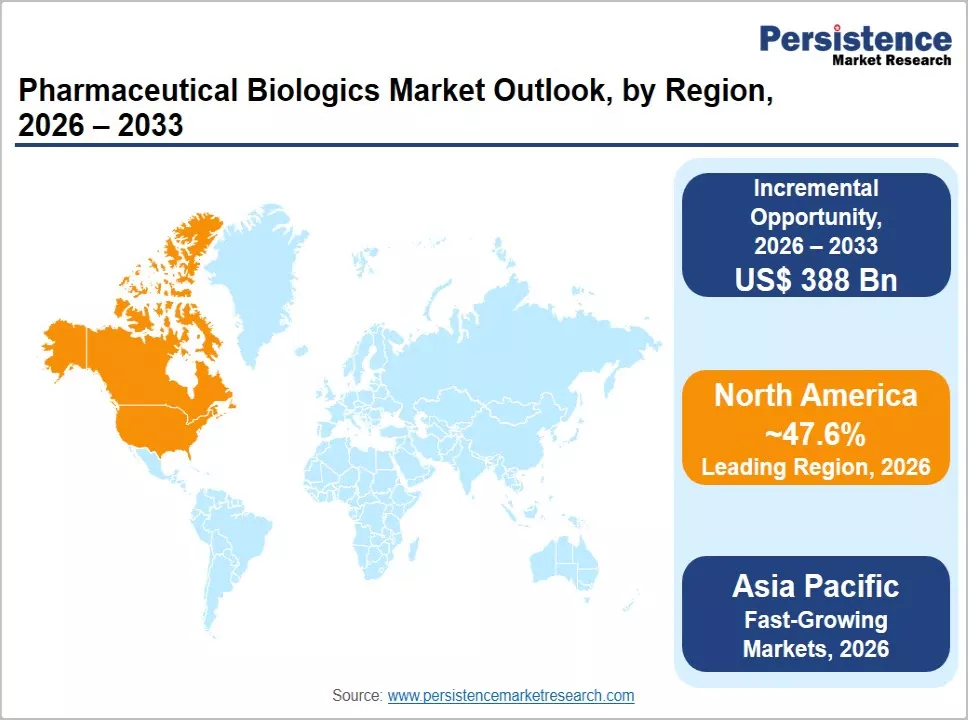
- Leading Region: North America, with about 47.6% share in 2026, owing to high biologic spending, a large innovator base, and rapid adoption of new therapies.
- Fast-growing Region: Asia Pacific, backed by rising regulatory output in China, growing biosimilar development, and expanding access to specialty medicines.
- Latest Agreement: In March 2026, Biogen announced a definitive agreement to acquire Apellis Pharmaceuticals for approximately US$5.6 billion upfront, plus potential additional payments linked to sales milestones. The acquisition would add Apellis’ complement-targeting medicines EMPAVELI and SYFOVRE to Biogen’s portfolio and strengthen its position in rare kidney diseases and immunology. The companies highlighted the opportunity to combine their commercial capabilities and expand the reach of these therapies.
DRO Analysis
Driver- Strong Innovation Pipeline to Push Biologic Adoption
Biologics are moving into more disease areas each year. A trade review reported that the U.S. Food and Drug Administration approved 26 novel therapies in the first half of 2026, seven more than in the same period of 2025. Many of these are antibodies, proteins, and advanced therapies. A steady flow of approvals keeps the biologics market expanding. Including supplemental approvals and label expansions, the tally reached 79 actions.
Large companies are also buying late-stage assets. AbbVie completed the Apogee deal in September 2026. Gilead completed its US$7.8 billion purchase of Arcellx in April 2026. Such deals show strong confidence in antibodies and cell therapies. They also move promising programs into global development and sales networks. Apogee's lead antibody, zumilokibart, showed that roughly two-thirds of treated patients achieved significant skin clearance at 16 weeks in Phase 2. AbbVie paid US$135.11 per share in cash.
Fast Biosimilar Pathways to Reinforce Access
Regulators are cutting the time and cost of biosimilar development. In October 2025, FDA proposed that comparative analytical assessments can generally replace comparative efficacy studies. FDA officials said biosimilar development can take five to eight years, and the draft aims to shorten this. FDA said the current process is slow and expensive, and that modern analytical tools detect product differences better than efficacy studies.
FDA also plans final guidance stating that switching studies are not required to show interchangeability. HHS reported 76 approved biosimilars in October 2025. More biosimilars lower treatment costs and widen patient access to biologic classes that lose patent protection. Some biosimilars have already been approved without switching studies through FDA waivers.
Restraint- Complexity and Uptake Hurdles May Slow Growth
Biologics are costly and hard to make. Production depends on living cell systems, and small process changes can affect product quality. Development is long, and failure risk is high. These factors limit entry for smaller firms and keep prices high for payers and health systems. Biosimilar developers must also prove similarity through detailed analytical and clinical work. Cold-chain handling adds further cost.
Uptake of biosimilars also faces hurdles. In Germany, physician doubts about interchangeability persist even with pharmacy-level substitution rules. FDA's Office of Therapeutic Biologics and Biosimilars has warned of a looming shortage of biosimilars for products losing patent protection. Draft guidance is also still not final. A robust pharmacovigilance system is needed to support substitution.
Opportunity- Next-generation Modalities to Create New Revenue Pools
Newer formats are drawing large investment. In April 2026, Lilly agreed to acquire Kelonia Therapeutics, an in vivo CAR-T developer, for up to US$7 billion. Gilead agreed to buy Tubulis, an antibody-drug conjugate platform, for US$5 billion. It also bought Ouro Medicines, a T-cell engager developer, for US$2.2 billion. These platform deals show a shift beyond conventional antibodies toward engineered formats. Lilly's deal includes US$3.25 billion upfront.
Gene editing is also moving toward approval. Intellia reported positive Phase 3 results for lonvo-z in hereditary angioedema on April 27, 2026. The trial showed an 87% reduction in attacks versus placebo. A rolling Biologics License Application has started. Intellia also reported that 62% of patients were attack-free over six months, versus 11% on placebo. The company has targeted a 2027 U.S. launch.
Long-acting Antibodies and Emerging Markets to Open New Segments
Long-acting antibodies could improve convenience. Apogee's APG333, a TSLP-blocking antibody, suppressed type 2 inflammatory markers for up to six months in Phase 1. Less frequent dosing may widen use in chronic skin and respiratory disease. Zumilokibart is half-life extended and is being studied for atopic dermatitis. APG273 is a possible long-acting combination for asthma.
Emerging markets also offer scope. China approved a record 76 innovative drugs in 2025, up from 48 in 2024. Chinese companies signed outbound licensing deals worth about US$135.66 billion in 2025. This supports a growing regional biologics base. More than 90 biopharma companies applied to list in Hong Kong in 2025, and over 20 completed IPOs.
Category-wise Analysis
Product Type Insights
Monoclonal antibodies are predicted to lead with a share of about 41.6% in 2026, because they provide specific targeting and are used across cancer, autoimmune, and respiratory diseases. They also have the broadest approved portfolio among biologics. Zumilokibart, an IL-13 antibody, shows how new antibodies continue to enter late-stage development. Half-life extension and bispecific designs are widening their use further.
Cell and gene therapies are estimated to be the fastest-growing product type in the forecast period, as new approvals and strong acquisition activity expand the pipeline. Anito-cel for multiple myeloma and lonvo-z for hereditary angioedema show the range of this group. Their base is smaller, which supports faster growth. Intellia's in vivo CRISPR therapy has started a rolling Biologics License Application. Gilead's Arcellx purchase brings a BCMA-directed CAR T-cell therapy.
Application Insights
Oncology is anticipated to dominate with a share of around 34.8% in 2026, because antibodies, antibody-drug conjugates, bispecifics, and CAR-T therapies are central to modern cancer treatment. Large deals in this area show continued company focus. Antibody-drug conjugates and T-cell engagers are attracting large deals.
Autoimmune and inflammatory diseases are expected to be the fastest-growing application in the forecast period, as new antibodies target pathways such as IL-13 and TSLP. Atopic dermatitis, asthma, and IgA nephropathy programs are advancing. Targeted treatment is replacing broad immunosuppression. Atacicept was approved on July 7, 2026 to reduce proteinuria in adults with primary IgA nephropathy.
Regional Insights
North America Pharmaceutical Biologics Market Trends
North America is predicted to dominate in 2026 globally with a share of approximately 47.6%, supported by high biologic spending, a deep innovator base, and a flexible regulatory environment. FDA is also rewriting biosimilar rules to cut development time. Most large acquisitions in 2026 involved North American buyers. Gilead, AbbVie, and Lilly are all U.S. companies, and their deals pulled capital into the region. In October 2025, the FDA Commissioner expected final biosimilar guidance within three to six months, but it remained in draft in August 2026.
U.S. Pharmaceutical Biologics Market Trends
A share of nearly 80.3% is expected to be held by the U.S. in 2026 in North America, as it hosts the leading biologic developers and a large specialty drug market. FDA's biosimilar list showed roughly 100 product names as of October 2026, based on our count. Two more biosimilars were approved in July 2026. Semglee and Wezlana are among biosimilars identified as interchangeable. Officials have said the number of biosimilars should be several times higher.
Asia Pacific Pharmaceutical Biologics Market Trends
Asia Pacific is anticipated to be the fastest-growing region globally in 2026 with a share of around 29.8%. It combines a large patient base with fast-improving regulation. Local developers are also moving from biosimilars toward original biologics and global licensing deals. Hong Kong listings are also giving regional biotech firms new funding.
China Pharmaceutical Biologics Market Trends
China will likely lead in Asia Pacific in 2026 with a share of about 39.4%, based on our analyst view. The National Medical Products Administration approved a record 76 innovative drugs in 2025. China also introduced a commercial insurance catalogue for innovative drugs, which sits alongside the national reimbursement list. The agency plans to speed up review pathways and expand support for novel therapies in 2026. The 2025 approvals compare with 48 in 2024.
India Pharmaceutical Biologics Market Trends
In 2026, India is projected to account for a share of just about 7.9% in Asia Pacific, based on our analyst view. India's biosimilar guidelines allow Phase III trials to be waived when pharmacokinetic and pharmacodynamic equivalence is shown. This supports a strong domestic biosimilar industry. India also requires a single-arm Phase IV study with more than 200 evaluable patients. Biologics not marketed in India can use reference products licensed in an ICH country.
Europe Pharmaceutical Biologics Market Trends
Europe will likely see steady growth in the forecast period with a share of roughly 15.1% in 2026 globally, due to strong biosimilar adoption and established biologic manufacturing. In 2025, the European Medicines Agency published a draft reflection paper on a tailored clinical approach for biosimilars. It suggests comparability and pharmacokinetic data may be enough in some cases. Feedback on the draft was open until September 30, 2025. Medicines for Europe has urged governments to include biosimilar policy in healthcare and industrial strategies.
Germany Pharmaceutical Biologics Market Trends
Germany is predicted to register a substantial share of approximately 22.6% in 2026 in Europe, based on our analyst view, as it has a large payer system and strong manufacturing. The G-BA adopted rules for pharmacy-level biosimilar substitution, effective March 15, 2024. Savings have been seen mainly in anti-TNF biologics. Adoption varies by region and is lower in economically disadvantaged areas. The G-BA rules followed the 2019 GSAV law, which let it regulate interchangeability.
U.K. Pharmaceutical Biologics Market Trends
A share of nearly 14.3% is predicted to be held by the U.K. in 2026 in Europe, based on our analyst view. In 2020, the Medicines and Healthcare products Regulatory Agency signaled plans to remove the comparative efficacy trial requirement for biosimilars. This reflects a post-Brexit effort to ease regulatory burden. The agency's head said it wanted to be a catalyst for change.
Competitive Landscape
The global pharmaceutical biologics market is moderately consolidated, with large multinational drug makers holding leading antibody and protein portfolios. AbbVie, Gilead, Lilly, and Regeneron are active in new modalities and acquisitions. Competition is shifting toward next-generation formats, long-acting dosing, and biosimilar pricing. Regeneron's Otarmeni, approved for a genetic cause of deafness, is its first gene therapy. Competition is also rising from Chinese licensors.
Dealmaking is shaping positions. AbbVie bought Apogee, Gilead bought Arcellx, Tubulis, and Ouro, and Lilly agreed to buy Kelonia. These moves show the push to secure late-stage antibodies, antibody-drug conjugates, and in vivo cell therapies before patent expiries reshape sales. Denali's Avlayah was approved in March 2026 for neurological complications of Hunter syndrome. Competition for the same assets is raising deal values.
Key Industry Developments
- In May 2026, Pfizer and Innovent Biologics entered a global strategic licensing and collaboration agreement covering 12 oncology drug programs, including antibody-drug conjugates (ADCs) and multispecific antibodies. The agreement included an upfront payment of US$650 million to Innovent, with eligibility for up to US$9.85 billion in development, regulatory and commercial milestone payments, plus royalties on licensed products. The companies planned to combine Innovent’s discovery and early-stage development capabilities with Pfizer’s global clinical development and commercialization infrastructure to advance the oncology biologics pipeline.
- In May 2026, ADMA Biologics received U.S. FDA approval to expand the indication for ASCENIV, an intravenous immune globulin product, to include pediatric patients aged two years and older with primary humoral immunodeficiency. Previously, the indication covered patients aged 12 years and older. The expanded label followed completion of a post-marketing pediatric assessment and broadened the eligible patient population for this plasma-derived biologic.
- In April 2026, Samsung Biologics completed its acquisition of the Rockville, Maryland, biologics manufacturing facility from GSK. The site added 60,000 liters of drug-substance manufacturing capacity across two plants and marked Samsung Biologics’ entry into the U.S. market. The company said the expansion would strengthen supply-chain resilience, support clinical and commercial production, and provide pharmaceutical customers with manufacturing options across the U.S. and South Korea.
Companies Covered in Pharmaceutical Biologics Market
- F. Hoffmann-La Roche Ltd
- Merck & Co., Inc.
- AbbVie Inc.
- Amgen Inc.
- Sanofi
- Regeneron Pharmaceuticals
- Eli Lilly and Company
- Gilead Sciences
- Others
Frequently Asked Questions
The global market is projected to be valued at US$462 billion in 2026.
The market is expected to reach US$850 billion by 2033.
Key trends include faster biosimilar pathways and long-acting antibodies.
Monoclonal antibodies are expected to be the leading product type with around 41.6% share in 2026.
The market is expected to grow at a CAGR of 9.1% from 2026 to 2033.
Roche, Merck & Co., AbbVie, Amgen, and Sanofi are a few key market players.


