




- Specialty & Fine Chemicals
- Silicone Antifoam Market
Silicone Antifoam Market Size, Share, and Growth Forecast, 2026 - 2033
Silicone Antifoam Market by Product Type (Oil-Based Silicone Antifoam, Others), Application (Water Treatment, Food & Beverages, Pharmaceuticals, Others), End-User (Industrial Manufacturing, Food Processing, Pharmaceutical, Others), and Regional Analysis for 2026 - 2033

Silicone Antifoam Market Share and Trends Analysis
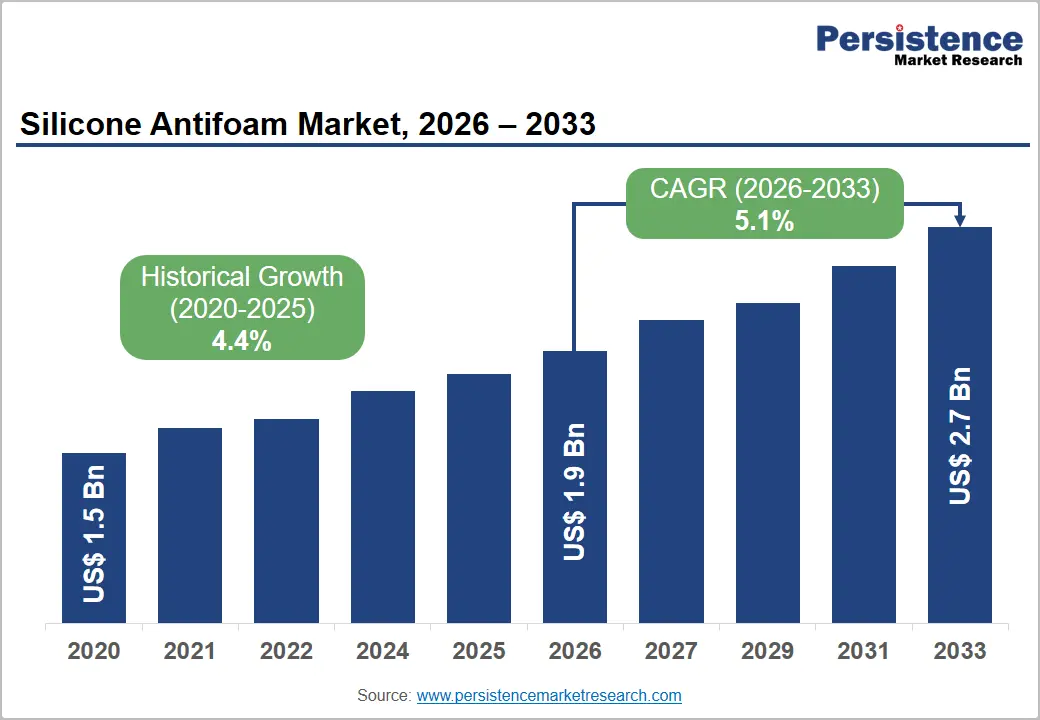
The global silicone antifoam market size is likely to be valued at US$1.9 billion in 2026 and is estimated to reach US$2.7 billion by 2033, growing at a CAGR of 5.1% during the forecast period from 2026 to 2033, driven by expanding industrial processing activities, increasing wastewater treatment requirements, and broader adoption of advanced process-control chemicals.
Growing demand from water treatment, food processing, pharmaceutical manufacturing, and chemical production is strengthening consumption across industrial value chains. Regulatory emphasis on production efficiency and environmental compliance is encouraging deployment of high-performance foam-control solutions. Technology advancements in silicone formulations are improving stability, compatibility, and dosage efficiency.
Key Industry Highlights:
- Leading Product Type: Oil-based silicone antifoam is set to hold around 35% revenue share in 2026, driven by performance in industrial non-aqueous systems.
- Fastest-growing Product Type: Water-based silicone antifoam is projected as the fastest-growing segment, supported by environmental compliance and aqueous process compatibility.
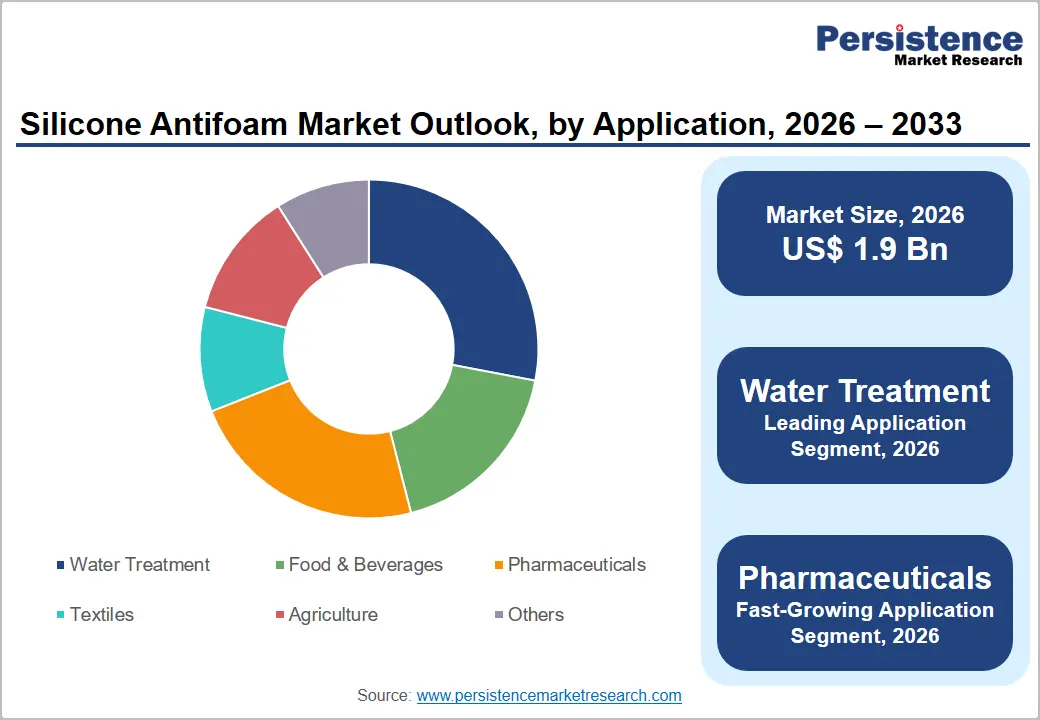
- Leading Application: Water treatment is estimated to hold roughly 28% revenue share in 2026, due to infrastructure investments and regulatory standards.
- Fastest-growing Application: The pharmaceuticals segment is forecast to record the fastest growth, driven by biologics expansion and purity requirements.
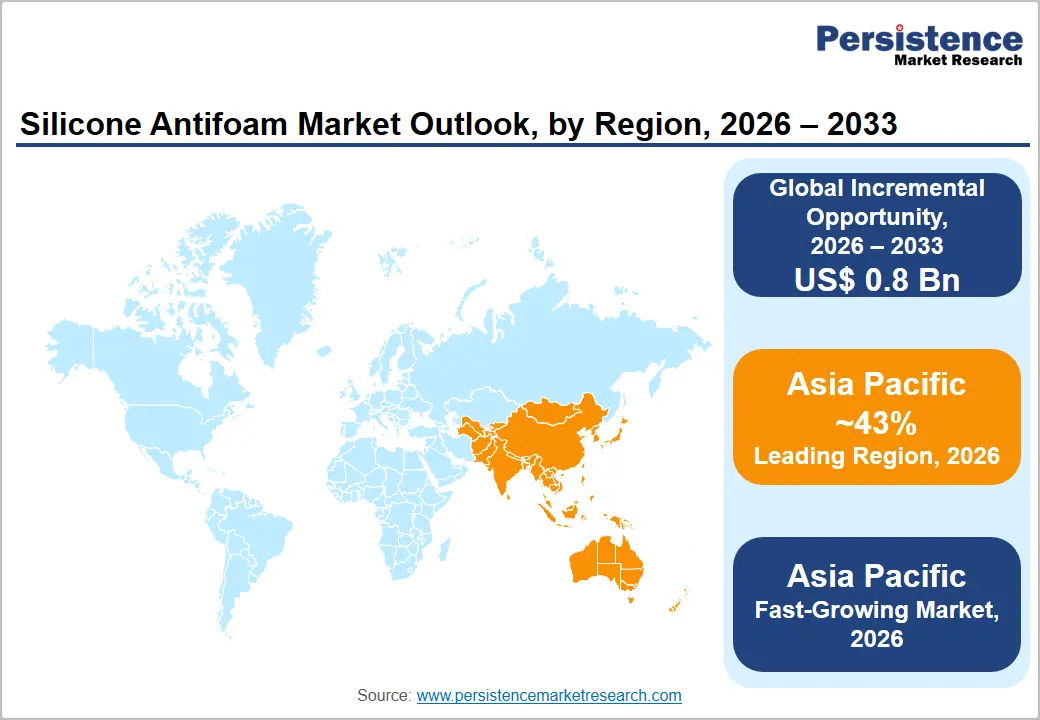
- Regional Leadership: Asia Pacific is projected to capture roughly 43% of the market share by 2026, while Asia Pacific is also forecast to record the fastest growth due to rapid local manufacturing industrialization.
- Competitive Environment: The market reflects a moderately fragmented structure, with key players such as Dow and Wacker Chemie leveraging technology, compliance, and global networks to maintain positioning.
DRO Analysis
Driver - Rising Investments in Water and Wastewater Treatment Infrastructure
Growing urban populations and industrial discharge volumes are increasing pressure on wastewater management systems. Foam generation during aeration, biological treatment, and sludge processing can reduce operational efficiency, creating demand for silicone-based antifoam solutions. Treatment operators are increasingly adopting high-performance formulations that maintain process continuity and reduce maintenance requirements across municipal and industrial facilities.
According to the United States Environmental Protection Agency (EPA), the U.S. maintains more than 16,000 publicly owned wastewater treatment facilities as of 2025. Expansion and modernization of treatment infrastructure are increasing chemical consumption requirements. Silicone antifoam products provide process stability, lower downtime, and enhanced treatment efficiency, supporting wider adoption across water management operations.
Restraint - Volatility in Silicone Raw Material Supply Chains
Production depends on silicone intermediates and specialty chemical feedstocks that are exposed to fluctuations in energy costs, transportation availability, and manufacturing capacity utilization. Supply disruptions can increase procurement costs and inventory requirements, creating pricing pressure for manufacturers and limiting margin expansion across the value chain.
Dependence on specialized raw materials restricts sourcing flexibility during periods of market imbalance. Higher input costs can reduce competitiveness in price-sensitive applications where alternative antifoam technologies remain available. These factors may constrain scalability, particularly for smaller producers operating with limited purchasing leverage.
Opportunity - Development of Environmentally Compatible Silicone Formulations
Industrial buyers are seeking products that combine operational performance with environmental compliance objectives. Development of low-residue, biodegradable-supportive, and highly efficient silicone antifoam formulations presents a pathway for product differentiation. Manufacturers can strengthen competitive positioning through innovation focused on sustainability requirements emerging across industrial operations.
Regulatory initiatives promoting cleaner industrial production are encouraging investment in advanced chemical technologies. Collaboration with water treatment operators, food manufacturers, and pharmaceutical companies can accelerate commercialization. Improved environmental profiles may support premium pricing opportunities while expanding adoption among organizations prioritizing sustainability and compliance objectives.
Category-wise Analysis
Product Type Insights
Oil-based silicone antifoam is anticipated to secure around 35% of the silicone antifoam market share in 2026, reflecting suitability for non-aqueous systems and stability under varied conditions. A major chemical plant in the Midwest U.S. employs this type during solvent-based coatings production to prevent defects. The segment maintains its position through performance in industrial settings where water-based alternatives prove less effective.
Water-based silicone antifoam is expected to be the fastest-growing segment, propelled by environmental preferences and ease of dispersion in aqueous processes. A European wastewater facility integrated this variant in 2025 to enhance aeration efficiency. Demand rises from alignment with sustainability goals and compatibility with modern treatment infrastructure.
Application Insights
Water treatment is poised to dominate with a forecast market share of over 28% in 2026, powered by infrastructure investments and regulatory requirements for effluent quality. A municipal plant in California utilized silicone antifoam to optimize digester operations and reduce energy use. The segment benefits from direct linkage between population growth and treatment capacity needs.
Pharmaceuticals are estimated to be the fastest-growing segment, fueled by rising production of biologics, fermentation-based products, and specialty medicines requiring strict process control standards. Fermentation operations commonly apply silicone antifoams to maintain batch consistency and production efficiency. Growth in pharmaceutical manufacturing capacity, combined with stringent quality requirements, is creating substantial opportunities for advanced foam-management technologies.
End-user Insights
Water treatment is likely to be the leading segment with a projected 30% of the silicone antifoam market share in 2026 due to increasing treatment facility capacity, stricter discharge regulations, and operational efficiency requirements. Municipal wastewater operators routinely use silicone antifoams to improve aeration performance and sludge handling processes.
The pharmaceutical segment is anticipated to be the fastest-growing segment, fueled by expansion of biologics manufacturing, fermentation technologies, and high-value drug production activities. Pharmaceutical processing facilities increasingly integrate advanced antifoam solutions to improve batch consistency and equipment productivity.
Regional Insights
North America Silicone Antifoam Market Trends
North America is expected to account for approximately 22% of the market share in 2026. Strong wastewater treatment infrastructure, advanced pharmaceutical manufacturing, and extensive food processing activities continue to support demand. Ongoing investments in industrial efficiency and environmental compliance are sustaining regional growth.
U.S. Silicone Antifoam Market Insights
The U.S. is projected to hold nearly 78% of the North America market share in 2026. Large-scale municipal wastewater treatment facilities, pharmaceutical production capacity, and chemical manufacturing operations are supporting consumption. Expansion of industrial automation and process optimization initiatives is increasing adoption of advanced foam-control technologies.
Canada Silicone Antifoam Market Insights
Canada is forecast to capture around 14% of the North America market share in 2026. Investments in water treatment modernization, food processing facilities, and resource-based industries are contributing to demand growth. Environmental sustainability programs are encouraging the use of efficient silicone-based process additives.
Europe Silicone Antifoam Market Trends
Europe is expected to represent approximately 28% of the market share in 2026. Strict environmental regulations and strong industrial manufacturing activity are driving utilization across multiple sectors. Increasing focus on sustainable production processes is supporting demand for high-performance antifoam solutions.
Germany Silicone Antifoam Market Insights
Germany is projected to account for nearly 22% of Europe’s market share in 2026. A strong chemical industry base and advanced wastewater treatment infrastructure are creating consistent demand. Industrial modernization initiatives and process efficiency requirements continue to strengthen product adoption.
France Silicone Antifoam Market Insights
France is forecast to hold around 16% of Europe’s market share in 2026. Growth in food processing, pharmaceutical manufacturing, and environmental infrastructure projects is supporting market expansion. Regulatory emphasis on operational efficiency is increasing demand for specialty process chemicals.
Asia Pacific Silicone Antifoam Market Trends
Asia Pacific is expected to lead with a 43% share in 2026 and is also expected to be the fastest-growing market, driven by industrialization, strong base-silicone manufacturing, competitive production costs, wastewater treatment expansion, and rising demand from pulp/paper, textile, petrochemical, agrochemical, and pharmaceutical sectors relocating to the region.
China Silicone Antifoam Market Insights
China is projected to account for nearly 33% of Asia Pacific market share in 2026. Large-scale industrial production, chemical manufacturing expansion, and wastewater treatment investments are supporting consumption growth. Government-backed industrial modernization programs are strengthening demand across key end-use sectors.
India Silicone Antifoam Market Insights
India is forecast to hold approximately 18% of the Asia Pacific market share in 2026. Expansion of pharmaceutical production, food processing facilities, and water treatment infrastructure is driving adoption. Industrial development initiatives and increasing environmental compliance requirements are supporting long-term growth.
Competitive Landscape
The global silicone antifoam market is moderately fragmented, characterized by the presence of multinational silicone manufacturers and specialized process chemical suppliers. Key participants include Dow Inc., Wacker Chemie AG, Momentive Performance Materials, Evonik Industries AG, and Shin-Etsu Chemical Co., Ltd. Competition focuses on formulation performance, regulatory compliance, application expertise, and supply reliability.
Manufacturers are investing in research activities to improve product efficiency, environmental compatibility, and industry-specific performance characteristics. Strategic partnerships with industrial end users support product customization and long-term supply agreements. Geographic expansion, technical service capabilities, and manufacturing optimization remain important competitive differentiators across major industrial application segments.
Companies Covered in Silicone Antifoam Market
- Dow
- Wacker Chemie AG
- Momentive Performance Materials
- Shin-Etsu Chemical Co. Ltd.
- Evonik Industries AG
- Elkem ASA
- BASF SE
- Kemira Oyj
- Ashland Inc.
- Clariant AG
- Huntsman Corporation
- KCC Corporation
- Siltech Corporation
- Supreme Silicones
Frequently Asked Questions
The silicone antifoam market is projected to reach US$1.9 billion in 2026.
Rising demand from wastewater treatment, food processing, pharmaceuticals, and industrial manufacturing drives growth in the silicone antifoam market.
The silicone antifoam market is poised to witness a CAGR of 5.1% from 2026 to 2033.
Development of environmentally compatible silicone formulations and expansion of industrial processing capacity in emerging economies create significant market opportunities.
Some of the key market players include Dow Inc., Wacker Chemie AG, Momentive Performance Materials, Evonik Industries AG, and Shin-Etsu Chemical Co., Ltd.


