




- Nutraceuticals & Functional Foods
- Regenerative Bone Broth Market
Regenerative Bone Broth Market Size, Share and Growth Forecast, 2026-2033
Regenerative Bone Broth Market by Nature (Organic, Conventional), Source (Chicken, Beef, Crops & Vegetables), End-user (Food & Beverage Industry, Pharmaceutical Industry, Nutraceutical Industry, Households), and Regional Analysis for 2026 - 2033

Regenerative Bone Broth Market Size and Trends Analysis
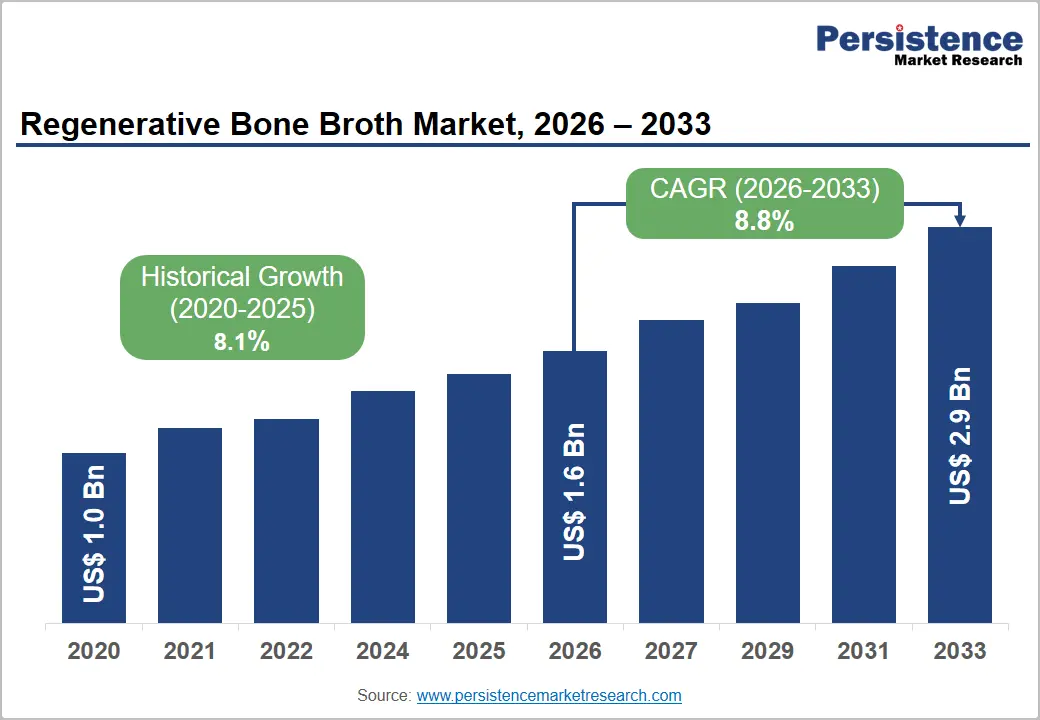
The global regenerative bone broth market size is likely to be valued at US$ 1.6 billion in 2026 and is projected to reach US$ 2.9 billion by 2033, growing at a CAGR of 8.8% during the forecast period from 2026 to 2033, driven by rising demand for protein-rich nutritional broths, clean-label functional foods, and gut-health-oriented diets.
Increasing consumer preference for collagen-based and mineral-dense foods is accelerating adoption across the nutraceutical and food & beverage industries. Additionally, expansion of premium organic food consumption, supported by dietary awareness campaigns from agencies such as the World Health Organization (WHO) and the USDA dietary guidelines, is strengthening demand globally.
Key Industry Highlights:
- Nature-based Leadership: Organic bone broth is expected to lead with 60% share in 2026, while conventional is the fastest-growing at 9.3% CAGR by 2033, driven by affordability and scaling in mass retail channels.
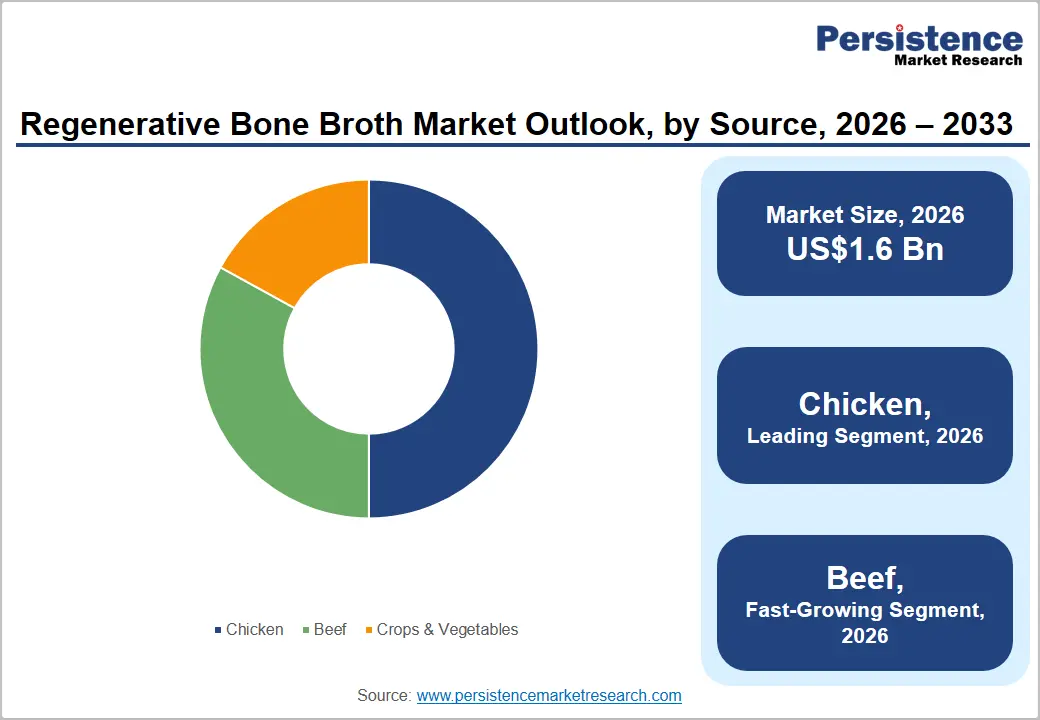
- Source Segment Dynamics: Chicken is expected to dominate with 50% share in 2026, while beef is likely to be the fastest growing at 9.8% CAGR through 2033, supported by premium nutrition, sports recovery, and collagen density positioning.
- End-user Leadership: The food & beverage segment is expected to lead with 47% share in 2026, while nutraceutical is projected to be the fastest-growing at 10.5% CAGR by 2033, driven by collagen supplements and clinical nutrition demand.
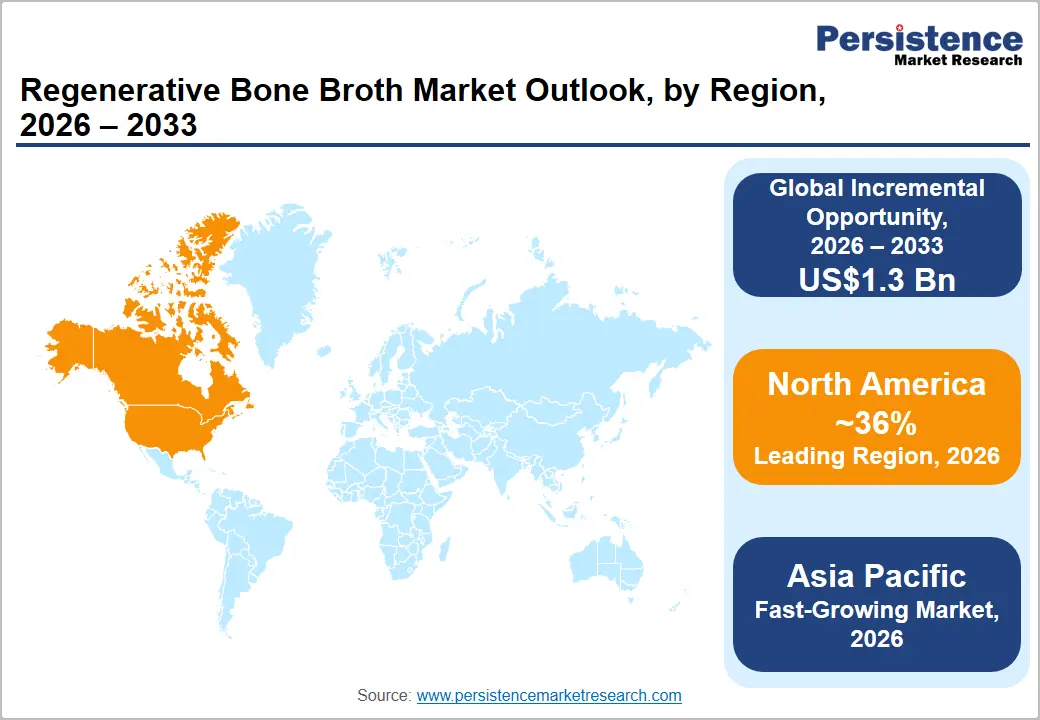
- Regional Market Structure: North America is expected to lead with 36% share in 2026, while Asia Pacific is the fastest-growing at 10% CAGR through 2033, driven by urban wellness trends and rising disposable incomes.
- Competitive Environment: The market is moderately fragmented, with top players holding 35% combined share, competing through innovation, clean-label positioning, and premium functional product expansion.
DRO Analysis
Driver - Rising Demand for Functional and Nutrient-Dense Foods
The global surge in demand for functional foods is a primary driver of the regenerative bone broth market. According to the Food and Agriculture Organization (FAO) and USDA dietary protein consumption reports, global per capita protein intake has increased steadily over the past decade, particularly in urban populations. Bone broth is increasingly recognized for its collagen peptides, amino acids, and micronutrient density.
The global functional food market is expanding at over 7% annually, with bone broth positioned as a premium segment within it. Rising awareness of gut health and joint health is accelerating adoption in both developed and emerging economies. This is significantly expanding demand across nutraceutical and wellness food categories, making bone broth a preferred ingredient in clean-label formulations.
Restraint - High Production Costs and Supply Chain Complexity in Raw Material Procurement
A major restraint in the bone broth market is the high cost associated with sourcing quality raw materials, particularly grass-fed beef bones and organic chicken derivatives. According to OECD agricultural commodity reports, livestock input prices have shown volatility due to feed cost inflation and climate-related disruptions.
The long extraction cycles required for nutrient-dense broth production (often exceeding 12–24 hours) further increase energy and operational costs. Cold-chain logistics for liquid and frozen formats also add distribution expenses, limiting scalability in price-sensitive markets. These cost structures restrict penetration in low-income regions and make large-scale commercialization challenging for small and medium enterprises in the food & beverage industry.
Opportunity - Expansion into Nutraceutical Capsules and Medical Nutrition Applications
A significant opportunity exists in converting bone broth into powdered extracts and encapsulated nutraceutical formats, targeting clinical nutrition and dietary supplement markets. The global dietary supplements market, valued at over US$150 billion (according to NIH and industry association estimates), is increasingly integrating collagen-based bioactives.
Bone broth-derived peptides are gaining traction in orthopedic recovery, anti-aging formulations, and gut microbiome therapies. Emerging research from health institutes such as NIH (National Institutes of Health) highlights collagen’s role in connective tissue health, strengthening pharmaceutical interest. This creates a multi-billion-dollar adjacent opportunity within the nutraceutical industry applications, especially in North America and Asia Pacific.
Category-wise Analysis
Nature Insights
The organic segment is expected to dominate the regenerative bone broth market with almost 60% in 2026, driven by strong consumer preference for clean-label, antibiotic-free, and hormone-free ingredients. Regulatory support from bodies such as the USDA Organic Certification Program and the EU Organic Regulation Framework has strengthened adoption. Organic bone broth is particularly popular in premium retail and wellness-focused channels, contributing significantly to revenue share. Demand is the highest in North America and Europe, where consumers prioritize transparency and sustainability. The segment is also expanding rapidly in urban Asia Pacific markets due to rising disposable income and health awareness.
The conventional segment is likely to grow steadily due to its affordability and scalability in mass-market applications. It is widely used in food service, processed foods, and institutional nutrition programs. Lower production costs and easier supply chain integration make it attractive for large-scale manufacturers. Growth is particularly strong in emerging economies in Asia and Latin America, where price sensitivity remains high. Expansion of packaged broth products in retail supermarkets is further accelerating adoption.
Source Insights
Chicken-based bone broth is projected to hold the largest share of about 50% in 2026, due to its widespread availability, lower cost, and neutral flavor profile. It is extensively used in nutraceutical and functional food applications. Chicken bones provide a high collagen yield, making them ideal for health-focused formulations. The segment benefits from global poultry production efficiency supported by FAO livestock production data. Its versatility across soups, ready-to-drink broths, and powdered supplements strengthens its leadership position.
Beef bone broth is expected to witness a rapid growth due to its higher mineral density and premium positioning. It is increasingly used in sports nutrition and recovery diets. Consumer perception of beef broth as a “rich nutrient source” is driving demand in developed markets. Growth is also supported by increasing adoption of ketogenic and paleo diets, particularly in North America and Europe.
End-user Insights
The food & beverage industry is expected to maintain its dominance with 47% share in 2026, due to widespread incorporation of bone broth in soups, sauces, and ready-to-drink products. Major food manufacturers are reformulating products with natural protein-rich ingredients, aligning with clean-label trends. Retail expansion and e-commerce penetration are further boosting consumption. The segment benefits from strong distribution networks and growing demand for convenience nutrition.
The nutraceutical industry is anticipated to be the fastest-growing segment, driven by rising demand for collagen supplements and functional powders. Bone broth is increasingly used in anti-aging, joint health, and gut health formulations. According to global supplement industry associations, collagen-based nutraceuticals are growing at double-digit rates. Pharmaceutical-grade extraction processes are further enhancing product credibility and adoption.
Regional Analysis
North America Regenerative Bone Broth Market Trends
North America is estimated to hold around 36% share of the global market, led primarily by strong adoption of functional foods, collagen-rich nutrition, and clean-label dietary preferences. Market maturity is high, supported by advanced retail infrastructure, e-commerce penetration, and regulatory clarity under the U.S. FDA, which improves product trust and transparency. Acceptance of bone broth is now mainstream in wellness and preventive nutrition, with increasing integration into daily diets rather than niche health use cases. Growth is further reinforced by rising interest in protein-forward nutrition and gut health solutions.
U.S. Regenerative Bone Broth Market Trends
The U.S. is expected to dominate the North America market with an estimated 83% regional share, driven by strong demand for protein-rich nutritional broths, collagen supplements, and functional beverages. Market acceptance is highly advanced, supported by fitness culture, aging demographics, and strong wellness awareness. Consumers increasingly view bone broth as a daily functional food. Recent developments include the expansion of ready-to-drink and powdered formats, alongside strong venture capital inflows into functional nutrition and food-tech innovation.
Canada Regenerative Bone Broth Market Trends
Canada is expected to account for an estimated 17% of the regional share, with steady growth driven by organic and clean-label consumption trends. Market acceptance is rising in urban centers such as Toronto and Vancouver, where consumers are shifting toward minimally processed and collagen-enriched nutrition products. Demand is supported by growing health awareness and preventive wellness adoption. Recent market developments include the expansion of premium grocery distribution and the increased availability of frozen and shelf-stable bone broth products.
Europe Regenerative Bone Broth Market Trends
Europe is estimated to represent around 28% share of the global bone broth market, supported by strong demand for organic certification-based products, sustainability-led consumption, and traceable food systems. Market acceptance is well-established in Western Europe, where clean-label and ethically sourced nutrition are key purchasing criteria. Bone broth is increasingly positioned within both functional food and nutraceutical categories, reflecting a hybrid traditional-modern consumption pattern. Growth is also supported by rising interest in protein-based wellness diets across urban populations.
Germany Regenerative Bone Broth Market Trends
Germany is estimated to hold around 31% of Europe, making it the largest Europe market for bone broth. Demand is driven by a strong preference for organic-certified functional foods and clinical nutrition applications. Market acceptance is high, particularly among health-conscious consumers and sports nutrition users. Key developments include the expansion of organic product lines and increased integration of bone broth into pharmacy and wellness retail channels.
U.K. Regenerative Bone Broth Market Trends
The U.K. is expected to hold an estimated 21% regional market share, supported by rising demand for collagen-based wellness and protein-rich functional foods. Market acceptance is steadily increasing, particularly among urban consumers adopting preventive health diets. Growth is reinforced by strong e-commerce penetration and premium retail expansion. Recent developments include rising product innovation in ready-to-drink bone broth formats targeting convenience-focused consumers.
Asia Pacific Regenerative Bone Broth Market Trends
Asia Pacific is estimated to account for around 32% share of the global market, making it the fastest-growing regional hub. Growth is driven by rising disposable incomes, rapid urbanization, and strong cultural familiarity with broth-based diets. Market acceptance is accelerating as bone broth shifts from traditional consumption to functional and nutraceutical applications. The region is also emerging as a major production base due to cost advantages and large-scale manufacturing capabilities, strengthening both domestic consumption and export potential.
China Regenerative Bone Broth Market Trends
China is expected to hold an estimated 39% regional market share, driven by large-scale manufacturing strength and strong demand for functional food ingredients and collagen-based nutrition products. Market acceptance is high in urban regions, supported by digital commerce ecosystems and rising health awareness. Growth is reinforced by the expansion of domestic nutraceutical brands and increasing exports of collagen-rich functional ingredients, positioning China as both a consumption and supply leader.
India Regenerative Bone Broth Market Trends
India is expected to account for an estimated 16% of the regional share in 2026, with rapidly increasing adoption of collagen nutrition, gut health products, and preventive wellness supplements. Market acceptance is still emerging but growing quickly in metro cities such as Mumbai, Delhi, and Bengaluru. Demand is supported by rising e-commerce penetration and the expansion of health-focused startups offering powdered and capsule-based bone broth formats, alongside increasing awareness of functional nutrition benefits.
Competitive Landscape
The global regenerative bone broth market is moderately fragmented, with leading players collectively accounting for an estimated ~30–40% share. Key companies such as Nestlé Health Science, Vital Proteins, Campbell-backed brands, and other established wellness food manufacturers leverage strong distribution networks and brand equity. These players are focusing on clean-label positioning, organic certification, and functional nutrition innovation, with growing investments in ready-to-drink, powdered, and collagen-enriched broth formats to strengthen their premium positioning.
Alongside them, niche brands like Kettle & Fire, Ancient Nutrition, and Bonafide Provisions are expanding rapidly through direct-to-consumer channels, e-commerce growth, and subscription-based models, enabling faster product innovation and stronger consumer engagement. Entry barriers remain moderate due to certification and supply chain complexity, but increasing collaboration between startups and large FMCG players is supporting innovation. The market is expected to gradually consolidate as larger companies acquire specialized wellness brands to expand in the functional food and protein-rich nutritional broths segment.
Key Industry Developments:
- In March 2026, Laird Superfood completed the integration of Terrasoul following its US$48 million acquisition, strengthening functional ingredient supply chain capabilities and enhancing scalability for collagen-based nutrition and bone broth product development.
- In March 2025, Kettle & Fire secured a US$43 million secondary buyout led by Colter Ventures, providing liquidity to early investors and supporting expansion across retail distribution, supply chain operations, and new product innovation within the premium bone broth and functional nutrition market.
Companies Covered in Regenerative Bone Broth Market
- Nestlé Health Science
- Kettle & Fire
- Ancient Nutrition
- Vital Proteins
- Osso Good Co.
- Bonafide Provisions
- EPIC Provisions
- Bare Bones Broth Co.
- Swanson Health Products
- Dr. Kellyann
- Broth Masters
- Pacific Foods
- Campbell Soup Company
- Archer Daniels Midland
- General Mills
Frequently Asked Questions
The global regenerative bone broth market is projected to reach US$1.6 billion in 2026.
Rising demand for functional foods, collagen-rich nutrition, and clean-label products drives the market.
The regenerative bone broth market is expected to grow at a CAGR of 8.8% from 2026 to 2033.
Growth opportunities lie in nutraceutical expansion, clinical nutrition applications, and premium protein-based formulations.
Key players include Nestlé Health Science, Vital Proteins, Kettle & Fire, Ancient Nutrition, and Bonafide Provisions.


