




- Technology
- Quantum Warfare Market
Quantum Warfare Market Size, Share, and Growth Forecast, 2026 - 2033
Quantum Warfare Market by Platform (Land-based, Naval-based, Airborne, Space-based), Technology (Quantum Computing, Quantum Communication & Cryptography, Quantum Sensing, Quantum Positioning, Navigation & Timing (PNT), Others), Application and Regional Analysis for 2026 - 2033

Quantum Warfare Market Size and Trends
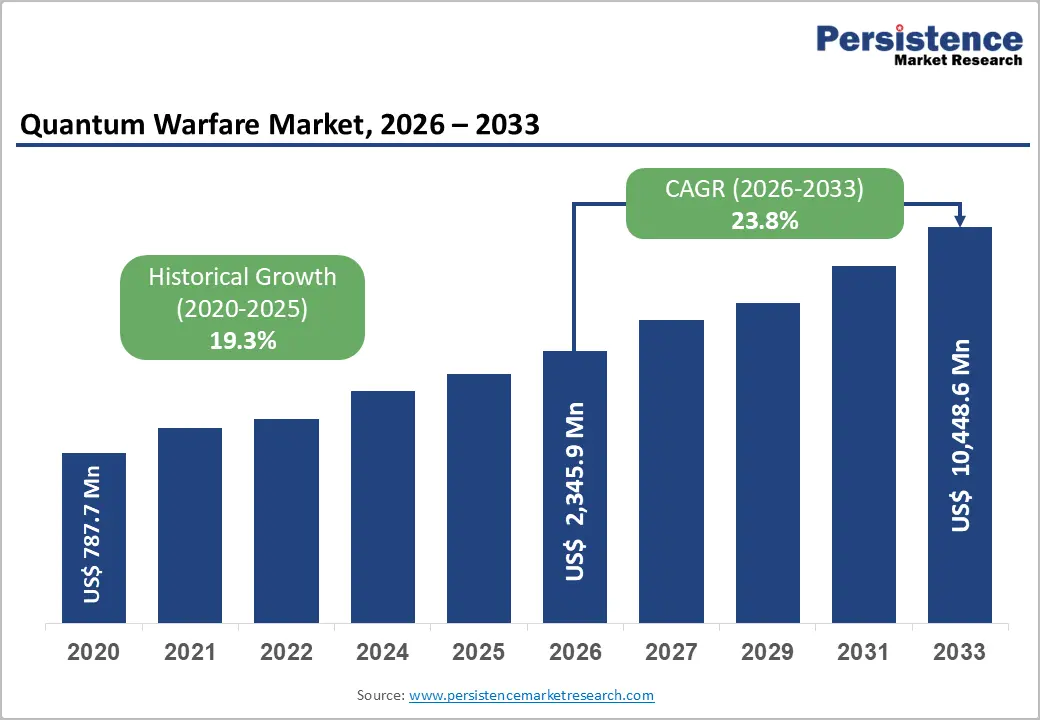
The global quantum warfare market size is projected to rise from US$ 2,345.9 Mn in 2026 to US$ 10,448.6 Mn by 2033. It is anticipated to witness a CAGR of 23.8% during the forecast period from 2026 to 2033, driven by increasing geopolitical tensions and the strategic importance of quantum technologies in modern defense systems.
Governments and defense agencies are prioritizing investments in quantum communication, sensing, and computing to gain tactical superiority. Rapid advancements in quantum encryption and the vulnerability of classical cryptographic systems to quantum attacks are compelling nations to transition toward quantum-secure infrastructures, thereby strengthening long-term market expansion.
Key Industry Highlights:
- Leading Platform: Land-based dominates with over 39% market share in 2026, valued at more than US$ 914.9 Mn, due to ease of deployment, infrastructure stability, and integration with existing defense systems. Space-based platforms are the fastest-growing, driven by demand for global-scale secure communication and resilient navigation systems.
- Leading Technology: Quantum Communication & Cryptography lead with over 35% share in 2026, valued at more than US$ 821.1 Mn, supported by increasing need for secure data transmission and quantum key distribution (QKD). Quantum Computing is the fastest-growing segment, driven by its potential in cryptanalysis, simulation, and advanced defense analytics.
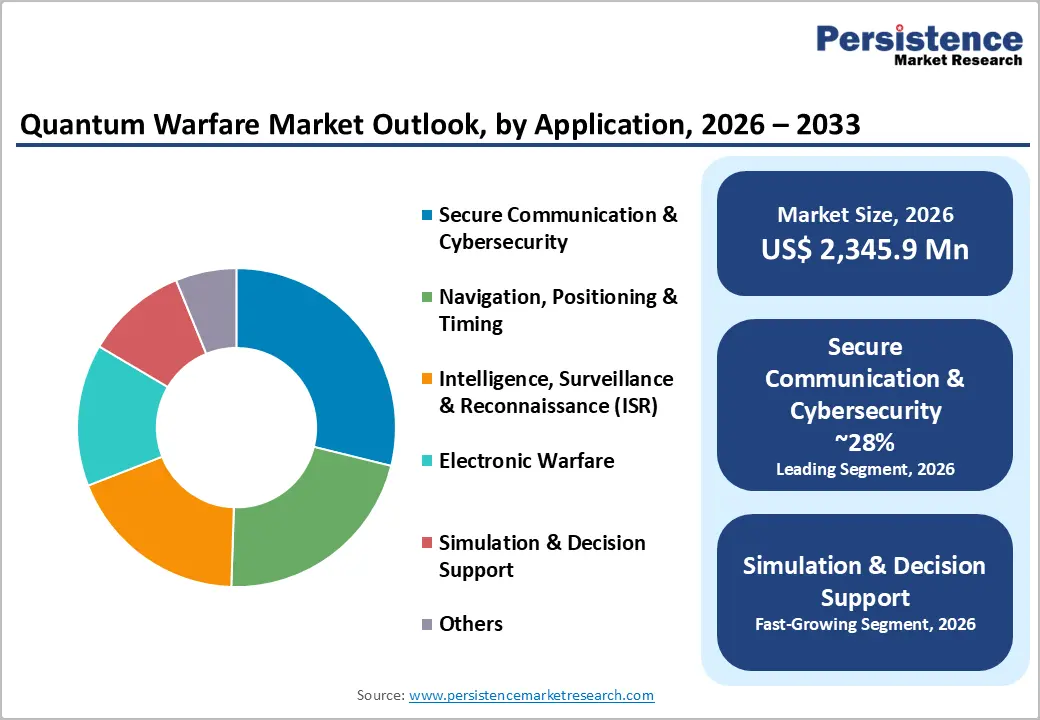
- Leading Application: Secure Communication & Cybersecurity holds the largest share at over 28% in 2026, valued at more than US$ 656.8 Mn, due to the critical importance of protecting military networks from cyber threats. Simulation & Decision Support is the fastest-growing, expanding to a CAGR of 28.6%, driven by demand for real-time battlefield modeling and predictive analytics.
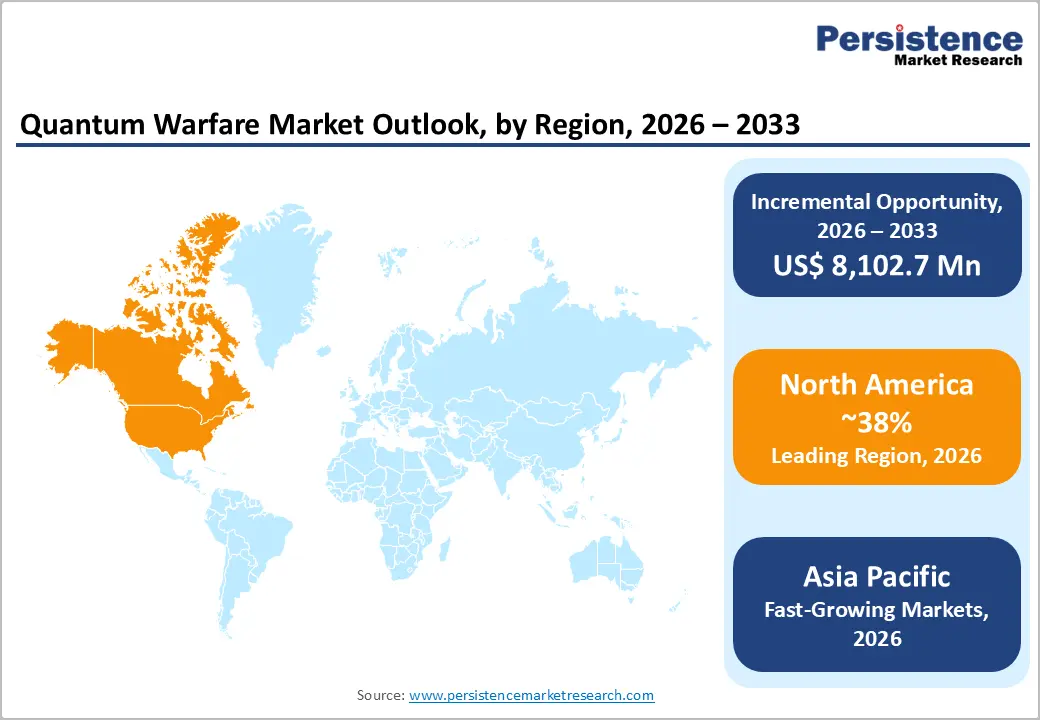
- Leading Region: North America leads with over 38% share in 2026, valued at US$ 891.4 Mn, supported by strong federal funding programs such as the National Quantum Initiative and active defense agency involvement. Asia Pacific is the fastest-growing region with a CAGR of 29.3%, driven by significant investments from China, India, Japan, and Australia in quantum defense capabilities.
| Key Insights | Details |
|---|---|
| Quantum Warfare Market Size (2026E) | US$ 2,345.9 Mn |
| Market Value Forecast (2033F) | US$ 10,448.6 Mn |
| Projected Growth (CAGR 2026 to 2033) | 23.8% |
| Historical Market Growth (CAGR 2020 to 2025) | 19.3% |
DRO Analysis
Driver - Rising Defense Spending on Advanced Technologies
Global defense expenditure surpassed US$ 2.6 trillion in 2025, with significant allocations toward next-generation technologies including quantum warfare capabilities. Nations such as the U.S., China, and Russia are investing heavily in quantum research programs for secure military communication, quantum radar, and enhanced sensing. Quantum systems enable near-unbreakable encryption and superior detection capabilities, which are critical in modern warfare environments. The integration of quantum technologies with emerging platforms such as AI-driven defense systems and cyber warfare tools further accelerates adoption. This aligns with developments seen in the Cybersecurity Market, where quantum-resistant cryptography is becoming a priority for national security agencies.
Increasing Vulnerability of Classical Cryptography
The emergence of quantum computers capable of breaking traditional encryption algorithms, such as RSA and ECC, is creating an urgency for quantum-safe communication systems. Organizations like NIST are actively working on post-quantum cryptography standards, emphasizing the need for transition. Defense agencies are particularly vulnerable as sensitive military data relies on current encryption techniques. Quantum key distribution (QKD) offers theoretically unhackable communication channels, making it highly attractive for military applications. The increasing risk of cyber warfare and espionage is pushing governments to deploy quantum communication infrastructure, driving demand across applications such as secure communication and ISR systems.
Restraint - Technological Immaturity and Decoherence Challenges
Quantum hardware remains in a pre-mature state for full battlefield deployment. The U.S. Department of Defense (DoD) assessed, in its July 2025 evaluation, that fault-tolerant quantum computers capable of performing cryptographically relevant tasks are at least 10 years away. Qubits are highly susceptible to decoherence from temperature fluctuations, vibration, and electromagnetic interference (EMI) conditions endemic to contested military environments. The Defense Advanced Research Projects Agency's (DARPA) Robust Quantum Sensors (RoQS) program specifically exists to address the gap between controlled lab conditions and operational DoD platforms, indicating the challenge remains unresolved. These constraints limit near-term deployability and extend return-on-investment timelines for defense procurement.
Fragmented National Strategy and Skilled Workforce Deficit
A critical structural impediment is the absence of a coherent national quantum warfare strategy in the United States and several allied nations. The Defense Advanced Research Projects Agency (DARPA), military service labs, national laboratories, academia, and industry are each pursuing quantum advances without a national strategy or unifying technical vision. This results in duplicated effort and delayed field deployment. Compounding this, the quantum workforce pipeline remains severely constrained. The Congressional Budget Office (CBO) has flagged workforce development as a primary cost driver in the NQI Reauthorization Act, acknowledging the acute shortage of engineers proficient in quantum systems. This bottleneck inflates program costs and delays timelines.
Opportunity - Defense Modernization in Secure Networking and Quantum Internet Architecture
The biggest opportunity lies in quantum communication networks that connect sensors, computers, and command systems more securely than classical architecture. The Defense Science Board says quantum communications could securely network quantum military sensors and computers, improving performance across distributed environments. This creates a path for systems integrators to build battlefield communication stacks, secure relay systems, and hybrid classical-quantum networking solutions. The opportunity is especially relevant for secure communication & cybersecurity, which is a priority area for ministries of defense and homeland security agencies in both developed and emerging markets.
Quantum Sensing for GPS-Denied Navigation and ISR Applications
The increasing prevalence of GPS jamming and spoofing in modern conflict zones is creating significant demand for quantum-based navigation systems. NATO has acknowledged widespread GPS disruptions impacting both military and civil aviation, reinforcing the need for resilient, GPS-independent navigation. Programs such as DARPA’s RoQS (Robust Quantum Sensors) are accelerating the transition of quantum inertial navigation and atomic clock technologies to operational defense platforms. In 2025, the Defense Innovation Unit (DIU) awarded contracts to major defense contractors, including Lockheed Martin Corporation, to develop quantum-enhanced navigation systems. These advancements highlight significant opportunities for quantum sensing technologies in ISR and mission-critical defense applications.
Category-wise Analysis
Platform Insights
Land-based dominates the market, capturing more than 39% market share in 2026 with a value exceeding US$ 914.9 Mn, due to their immediate deployability, lower infrastructure complexity, and integration with existing military command systems. Defense forces rely heavily on land-based quantum systems for secure communications, intelligence processing, and battlefield situational awareness. These platforms support fixed installations such as command centers, radar stations, and cyber defense hubs where high stability and continuous power supply are critical. It allows easier testing and scaling of emerging quantum technologies before deployment in harsher domains.
Space-based are expected to grow rapidly due to the increasing need for global-scale secure communication and surveillance beyond terrestrial vulnerabilities. Rising concerns over GPS denial, signal spoofing, and cyber warfare in orbit are pushing investments in quantum-enabled space infrastructure. These platforms are essential for long-range intelligence, navigation resilience, and cross-border military coordination. Advancements in miniaturization and launch economics are making space-based quantum systems more viable.
Technology Insights
Quantum Communication & Cryptography holds over 35% market share in 2026, with a value exceeding US$ 821.1 Mn, driven by the urgent need for unbreakable encryption in military communications. Technologies like QKD ensure secure transmission of sensitive defense data across networks. Governments and defense agencies prioritize this segment to protect classified information, command signals, and intelligence data. The rise in cyber warfare and electronic surveillance is accelerating adoption.
Quantum Computing is expected to grow significantly due to its potential to revolutionize defense analytics, cryptanalysis, and complex system modeling. Military organizations require advanced computing to process vast datasets for intelligence gathering, threat detection, and mission planning. Quantum computing enables faster optimization, simulation of warfare scenarios, and breaking of legacy encryption systems, offering a strategic advantage. The need for superior decision-making speed and predictive capabilities is driving investments.
Application Insights
Secure Communication & Cybersecurity command the largest market share at over 28% in 2026, with a value exceeding US$ 656.8 Mn, due to the critical need to protect defense communication networks from interception and cyber threats. Modern warfare increasingly depends on data integrity, secure command chains, and encrypted transmissions, making this application indispensable. The rise in state-sponsored cyberattacks and electronic warfare tactics is accelerating adoption. Military operations demand zero-latency, highly secure communication systems, especially in contested environments.
Simulation & Decision Support is expected to grow at a CAGR of 28.6% due to the increasing need for advanced battlefield modeling and real-time strategic planning tools. Quantum-powered simulations enable defense forces to analyze complex, multi-variable combat scenarios with high precision. This helps in predictive threat assessment, resource allocation, and mission optimization. The growing complexity of modern warfare spanning cyber, space, and electronic domains requires faster and more accurate decision-making systems. Quantum systems enhance AI-driven defense analytics, improving situational awareness and response times.
Regional Insights
North America Quantum Warfare Market Trends
North America holds over 38% share in 2026, reaching US$ 891.4 Mn value, led by the United States’ strong federal funding ecosystem under the National Quantum Initiative, which allocates over US$ 1 billion annually to quantum R&D. Defense prioritization by DARPA and post-quantum cryptography standardization by National Institute of Standards and Technology are accelerating adoption across military systems. Programs such as DARPA’s Quantum Benchmarking Initiative targeting fault-tolerant systems by 2033, along with NSA’s CNSA 2.0 framework, are driving long-term procurement. The region benefits from a strong ecosystem of companies including IBM, Google, and Lockheed Martin, alongside Canada’s growing presence through D-Wave.
Asia Pacific Quantum Warfare Market Trends
Asia Pacific is expected to grow at a significant rate with a CAGR of 29.3%, driven by strong government investments and geopolitical competition, particularly from China, India, Japan, and Australia. China has invested over US$ 15 billion and is a global leader in quantum communication infrastructure, while the People's Liberation Army is actively exploring quantum sensing and cyber applications. India is advancing capabilities under its National Quantum Mission, with the Defence Research and Development Organisation focusing on quantum sensing for defense use cases. Meanwhile, Australia and Japan are progressing in quantum navigation and AI-integrated defense systems, and emerging markets like Singapore and South Korea are supporting growth with US$ 100M+ national programs.
Europe Quantum Warfare Market Trends
Europe is expected to hold more than 22% share by 2026, supported by coordinated investments exceeding US$ 12 billion across major economies and strategic alignment under NATO quantum initiatives. The region emphasizes secure communications and interoperability, with growing adoption of post-quantum cryptography across defense networks. Industrial innovation is led by players such as Thales Group and Quantinuum, alongside infrastructure expansion like IBM’s quantum data center in Germany. Stricter dual-use export controls across countries such as Germany and France are strengthening technological sovereignty and limiting external dependencies.
Competitive Landscape
The global quantum warfare market exhibits a semi-consolidated structure, characterized by the convergence of large-cap defense prime contractors and specialized quantum technology pure-plays. Lockheed Martin, Northrop Grumman, and RTX bring systems integration, defense contract experience, and existing government relationships, while IBM, Google, IonQ, and Quantinuum supply underlying quantum hardware and software. Companies are focusing on government contract capture, strategic M&A, and DARPA/DIU program participation. Emerging models include quantum-as-a-service for defense workloads and joint R&D consortia within alliance frameworks such as AUKUS and NATO.
Key Developments:
- In January 2026, CDS released the Military Quantum Mission Policy Framework, outlining the roadmap to integrate Quantum Communication, Computing, Sensing, and Materials into the Armed Forces. The policy emphasizes civil-military collaboration, jointness among the services, and alignment with the National Quantum Mission to achieve technological dominance on future battlefields.
- In November 2025, IBM selected for Stage B of DARPA’s Quantum Benchmarking Initiative (QBI), aimed at assessing the feasibility of building an industrially fault-tolerant quantum computer by 2033. The initiative evaluates multiple approaches to deliver high-value quantum computing for national security.
Companies Covered in Quantum Warfare Market
- IBM
- Microsoft Corporation
- Intel Corporation
- IonQ Inc.
- Rigetti Computing Inc.
- D-Wave Quantum Inc.
- Quantinuum Ltd.
- ID Quantique SA
- QNu Labs Pvt Ltd
- Arqit Quantum Inc.
- Lockheed Martin Corporation
- Others
Frequently Asked Questions
The global market is projected to be valued at US$ 2,345.9 Mn in 2026.
Rising geopolitical tensions and defense modernization programs are accelerating investments in quantum technologies for strategic military advantage, which are key drivers of the market.
The market is expected to witness a CAGR of 23.8% from 2026 to 2033
The development of quantum-secure communication networks, next-generation sensing systems for GPS-denied environments is creating strong growth opportunities.
IBM, Google, Microsoft Corporation, Intel Corporation, IonQ Inc., Rigetti Computing Inc., D-Wave Quantum Inc., Quantinuum Ltd. are among the leading key players.


