




- Technology
- Cryptocurrency Payment Apps Market
Cryptocurrency Payment Apps Market Size, Share, and Growth Forecast 2026 - 2033
Cryptocurrency Payment Apps Market by Cryptocurrency Type (Bitcoin, Ethereum, Litecoin), Payment Type (In-Store, Online), Operating System (Android, iOS), End-user (Individuals, Businesses), and Regional Analysis, 2026 - 2033

Cryptocurrency Payment Apps Market Size and Trends Analysis
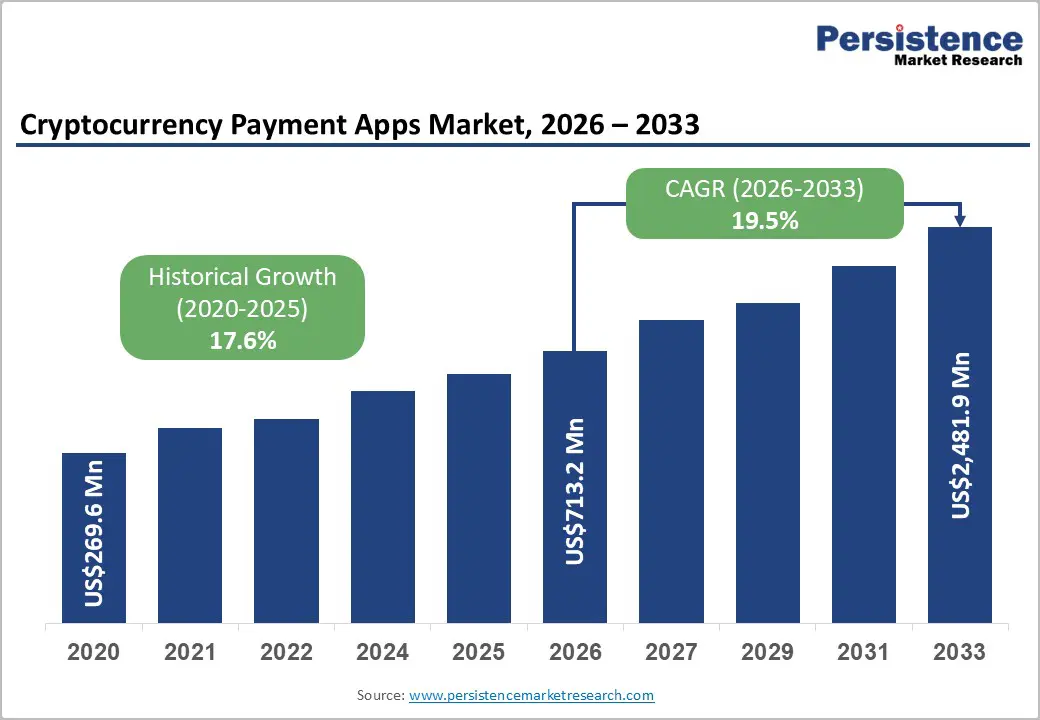
The global cryptocurrency payment apps market size is likely to be valued at US$713.2 million in 2026 and is expected to reach US$2,481.9 million by 2033, growing at a CAGR of 19.5% during the forecast period from 2026 to 2033, driven by rising adoption of stablecoin-based payments for speedy and low-volatility transactions. Increasing demand for low-cost cross-border payment solutions among freelancers and global businesses is also anticipated to fuel growth.
Key Industry Highlights:
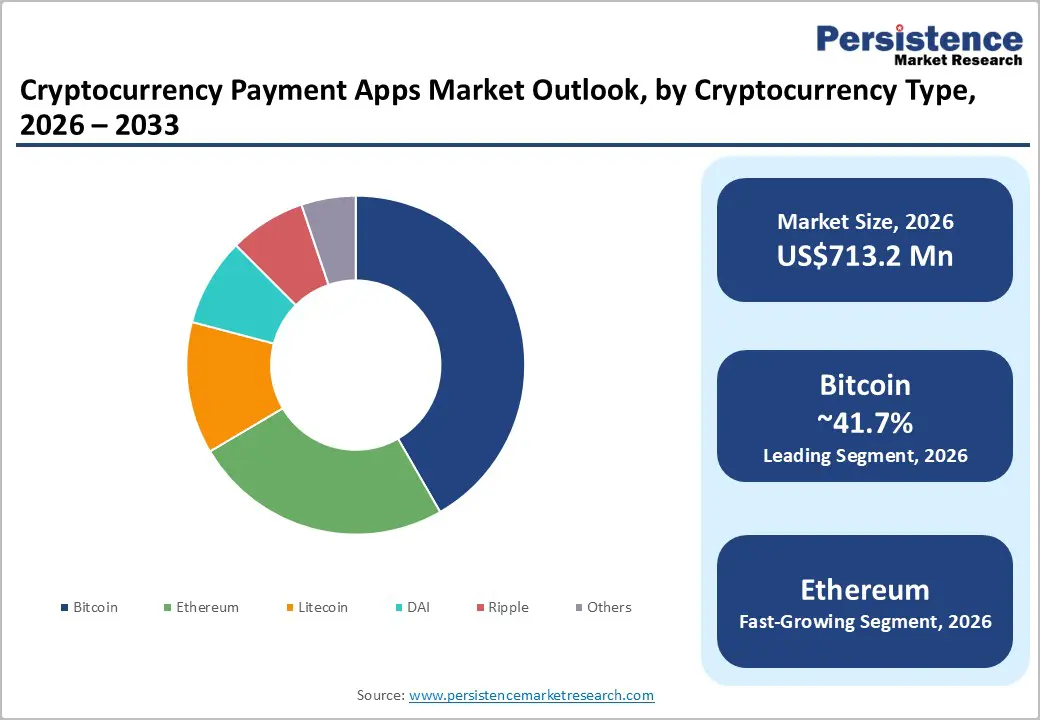
- Leading Cryptocurrency Type: Bitcoin, approximately 41.7% share in 2026, owing to its first-mover advantage and superior network effect.
- Dominant Operating System: Android, nearly 52.2% in 2026, backed by its open interface that enables crypto app developers to deploy features fast and reach a broad global user base.
- Latest Collaboration: In January 2026, Stripe announced a strategic partnership with Crypto.com, set to roll out in early 2026. The collaboration made Crypto.com the first crypto platform to enable direct balance payments through Stripe's infrastructure.
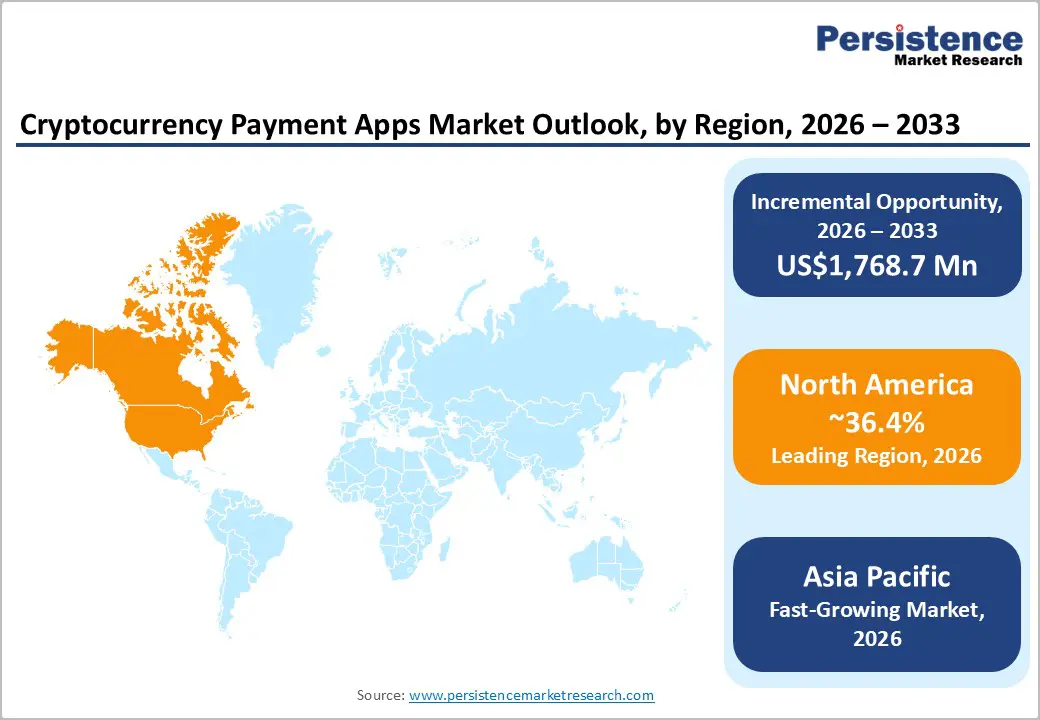
- Leading Region: North America, with about 36.4% share in 2026, spurred by the presence of leading players such as Coinbase and PayPal.
- Fast-growing Region: Asia Pacific, owing to rising cross-border transactions and high mobile wallet penetration.
DRO Analysis
Driver - Final Settlement to Eliminate Disputes and Push Adoption
Crypto payment apps are gaining traction as transactions are permanently recorded on blockchain networks, removing the possibility of chargebacks that burden merchants in card-based systems. This is especially useful in sectors such as digital goods and gaming, where fraud-related disputes are common.
For instance, European Central Bank has highlighted in its digital payments research that irreversible settlement can reduce merchant losses tied to friendly fraud. Companies such as BitPay further promote guaranteed settlements as a key advantage for merchants accepting crypto. This feature improves cash flow predictability and reduces operational costs associated with dispute management, making crypto payment apps highly attractive for online businesses.
Low-Cost Cross-Border Transfers to Fuel Demand
Cryptocurrency payment apps are extending due to their ability to handle cross-border transactions with minimal fees and delays. Traditional remittance systems often involve multiple intermediaries, leading to high costs and settlement delays. In contrast, blockchain-based payments can settle in minutes.
According to data from the World Bank, global remittance fees still average above 6%, which creates a superior use case for crypto alternatives. A key example is Ripple, whose payment network enables near-instant international transfers for financial institutions. This efficiency is pushing adoption among freelancers, exporters, and businesses handling frequent international payments.
Restraint - Limited Recovery Options in Case of Errors or Fraud
A prominent restraint in cryptocurrency payment apps is the inability to reverse or recover funds once a transaction is completed. This creates a high-risk environment for users who may send funds to incorrect addresses or fall victim to scams. The Federal Trade Commission reported that crypto-related fraud losses exceeded US$1 billion in recent years, with recovery rates remaining extremely low due to the irreversible nature of blockchain transactions.
Unlike traditional banking systems that provide dispute resolution mechanisms, crypto payments rely heavily on user accuracy and security awareness. This lack of safety nets continues to slow adoption among less tech-savvy users and mainstream consumers.
Opportunity - Adoption of Expandable Blockchain Layers for Instant Payments
A key opportunity lies in the integration of unique expansion solutions that enable quick and affordable transactions. Payment apps are increasingly using Layer-2 technologies such as the Lightning Network to process high volumes of microtransactions efficiently. The Bitcoin Foundation and related developer communities have documented how these networks reduce congestion on the main blockchain while enabling near-instant settlement. Companies such as Strike already use Lightning to facilitate low-cost global payments, especially in remittance-heavy regions. This shift is opening new use cases such as pay-per-use services and real-time content monetization.
Emergence of Automated Payments Through AI Systems
Another emerging opportunity is the integration of AI-based systems that can execute payments automatically based on predefined conditions. This is gaining traction in areas such as subscription management, supply chain automation, and machine-to-machine transactions. For example, Stripe and Coinbase have explored programmable payments using stablecoins to support automated financial flows. Research discussions from organizations, including International Monetary Fund, also point toward the future role of programmable money in improving efficiency. This capability can transform how businesses handle recurring payments and operational finance.
Category-wise Analysis
Cryptocurrency Type Insights
The bitcoin segment is projected to lead with a share of nearly 41.7% in 2026. Merchants and payment processors have prioritized Bitcoin integration into their existing transaction systems because of its superior brand recognition and high liquidity. Consumers trust it both as a store of value and a medium of exchange, especially for cross-border transactions. Bitcoin's hard cap of 21 million coins creates real scarcity, which has contributed to its value and strengthened its reputation as a digital store of value and hedge against inflation. This ‘digital gold’ narrative gives it staying power that other cryptocurrencies lack.
The Ethereum segment will remain in the second position in 2026, owing to its role as the foundation for Non-Fungible Tokens (NFTs) and the broad digital asset revolution. It was the earliest smart-contract-enabled network, and smart contracts have made it far easier to define ownership and control the transferability of digital assets. As of early 2026, Ethereum commands 66% of global tokenized assets, while BNB Chain holds 10% and Solana controls just 5%. ETH effectively shifted blockchain financial infrastructure from speculation into real payments and settlement.
Operating System Insights
The Android segment is predicted to dominate in 2026 with a share of approximately 52.2%, backed by the sheer proliferation of affordable Android smartphones. They are comparably cheaper than iOS-based devices, making them accessible to a far broader global audience. The open-source nature of Android allows smooth integration with a wide variety of cryptocurrency payment platforms. This flexibility enables developers to roll out frequent updates, integrate robust security features, and deliver diverse functionality to cater to both novice and experienced crypto users.
The iOS segment is expected to showcase the fastest growth rate in the forecast period, backed by a different user profile. iOS users tend to be higher-income and more financially active. iOS crypto payment apps such as Coinbase Wallet, Cash App, and Crypto.com Pay now benefit from Apple's 2025 software-hardware stack, which exposes secure NFC hardware to vetted wallet developers. It makes crypto payments feel as smooth as a standard Apple Pay tap.
Regional Insights
North America Cryptocurrency Payment Apps Market Trends
In 2026, North America is anticipated to lead with a share of nearly 36.4%, spurred by advanced digital infrastructure, favorable regulatory developments, and high smartphone penetration. In 2025 alone, the region witnessed about 49% growth in crypto transaction volumes. This highlighted renewed institutional interest bolstered by the launch of spot Bitcoin ETFs and increased regulatory clarity from the SEC and CFTC. U.S.-based companies such as Coinbase, BitPay, and Strike have fueled innovation by providing extensible and secure payment platforms that support both retail and enterprise-level crypto transactions.
U.S. Cryptocurrency Payment Apps Market Trends
The U.S. is predicted to exhibit exponential growth in the forecast period, bolstered by increasing adoption of cryptocurrencies as a payment method by both consumers and businesses, with leading corporations and retailers beginning to accept digital currencies. Both PayPal and Cash App have deeply integrated crypto into their consumer-facing products.
In 2024, Cash App generated US$16.2 billion in revenue from 57 million monthly users, with about US$38 billion coming from Bitcoin transactions alone. The Consumer Financial Protection Bureau’s (CFPB) oversight of digital payment apps has strengthened consumer protections and increased institutional confidence. Also, Block's continued expansion demonstrates the surging interoperability of crypto and traditional finance infrastructure.
Asia Pacific Cryptocurrency Payment Apps Market Trends
In 2026, Asia Pacific is estimated to be the fastest-growing region, backed by ongoing digital asset adoption, surging demand for borderless payments, and government-supported blockchain projects. Countries such as China, Japan, India, and South Korea are at the leading edge of crypto-focused fintech development. Asia Pacific has emerged as a key growth driver globally, frequently ranking second only to Europe in total transaction volumes and occasionally outpacing North America in monthly totals. Monthly on-chain transaction values in the region tripled from nearly US$81 billion in July 2022 to US$244 billion in December 2024.
Japan Cryptocurrency Payment Apps Market Trends
Japan combines early regulatory maturity with accelerating adoption. It recorded the fastest year-on-year crypto growth in Asia Pacific, with on-chain value received growing 120% in the 12 months to June 2025, outpacing Indonesia (103%), South Korea (100%), India (99%), and Vietnam (55%). The regulatory foundation is uniquely strong.
Japan was the first economy to formally recognize Bitcoin as a legal payment method through the Payment Services Act (PSA) in 2017, and has since developed one of the most comprehensive regulatory frameworks for cryptocurrency globally. A key shift is also underway in how crypto is taxed. The country is considering moving from progressive tax rates of up to 55% on crypto gains to a flat 20% rate, which, if implemented, could significantly boost retail participation.
India Cryptocurrency Payment Apps Market Trends
India's growth is grassroots-driven and structurally deep. Between July 2024 and June 2025, the country processed nearly US$2.36 trillion in cryptocurrency transactions, representing a 69% jump year-over-year. This achievement is fueled by a tech-savvy young population. Around 72% of investors are under 35 in the country.
It is further expanding digital infrastructure, affordable internet access, and massive remittance requirements from India's global diaspora. A key enabler has been the integration of Unified Payments Interface (UPI) by leading crypto exchanges. UPI enables instant, low-cost deposits and withdrawals, lowering the barrier to entry for millions of new users. Platforms such as CoinDCX and CoinSwitch have directly benefited from this.
Europe Cryptocurrency Payment Apps Market Trends
Europe received over US$2.6 trillion in crypto transaction volume over the past year and saw 42% growth (Chainalysis 2024). It was a substantial figure given its already high baseline, which shows the continent's sustained institutional activity. The Markets in Crypto-Assets (MiCA) Regulation took full effect at the start of 2025, providing a harmonized rulebook that has encouraged traditional financial institutions to enter the crypto space. Over 65% of EU-based crypto businesses achieved MiCA compliance by Q1 2025, and more than 30% of institutional investors in the EU increased their crypto holdings after MiCA's investor protection measures took effect.
Germany Cryptocurrency Payment Apps Market Trends
Germany is projected to see steady growth owing to its early regulatory clarity and high consumer trust in licensed financial services. As the first EU country to officially recognize crypto assets as financial instruments, Germany has enabled banks and fintech firms to integrate digital currencies into their portfolios legally.
The country’s BaFin is designated as the national regulator under MiCAR. BaFin has made clear that crypto-asset service providers require authorization starting from December 30, 2024. The government's attitude emphasizes risk mitigation without an outright ban, creating a stable environment for financial institutions to invest in crypto infrastructure.
U.K. Cryptocurrency Payment Apps Market Trends
The U.K. is being propelled by its position as a leading global fintech hub. The Financial Conduct Authority (FCA) has set out ambitious growth measures for 2026, including supporting U.K.-issued stablecoins to provide quick and convenient payments. The FCA is working closely with the Bank of England to develop the stablecoin regulatory regime and is inviting firms to test stablecoin products in its regulatory sandbox.
The U.K.'s crypto rise is further underpinned by high digital literacy, widespread fintech adoption, and the ease of transitioning from mobile banking to crypto platforms. London is the country’s crypto epicenter, hosting most start-ups and trading firms, and acting as the U.K. base for Coinbase, Binance, and platforms such as BCB Group.
Competitive Landscape
The global cryptocurrency payment apps market is highly fragmented but steadily moving toward platform consolidation around stablecoins, merchant integrations, and regulated payment infrastructure. Large fintech and payment companies, including Stripe and PayPal, are increasingly changing the market by embedding stablecoin payments into existing merchant interfaces. Stripe’s re-entry into crypto payments through USDC settlement has intensified competition because merchants can now enable stablecoin acceptance without rebuilding checkout systems.
A key shift in the competitive environment is the rise of stablecoin-first payment infrastructure. Earlier, crypto payment apps relied heavily on volatile assets such as Bitcoin, but most payment volume is now flowing through stablecoins such as USDC and PYUSD. This has reduced volatility concerns for merchants and attracted enterprise participation. Companies are now competing less on crypto acceptance and more on settlement speed, compliance support, cross-bord capabilities, and integration flexibility.
Key Industry Developments:
- In April 2026, MoonPay partnered with Paysafe. The first product launched from the partnership was Pay with Crypto, which allowed customers to use their preferred stablecoin or cryptocurrency to fund their accounts. MoonPay's Commerce Checkouts technology handled instant crypto-to-fiat conversion at the point of deposit.
- In March 2026, Mastercard launched its Crypto Partner Program, a global initiative bringing together more than 85 companies from across the blockchain, fintech, and traditional banking sectors. The program was designed to explore practical applications for on-chain technology within existing payment infrastructure, focusing on cross-border transfers, business-to-business payments, and global payouts.
- In February 2026, MoonPay launched MoonPay Agents, a non-custodial software layer enabling AI agents to hold wallets and move crypto funds without direct human intervention. Once a user completes identity verification and funds a wallet, an AI agent can trade, swap, and transfer digital assets programmatically on the user's behalf.
Companies Covered in Cryptocurrency Payment Apps Market
- Coinbase
- PayPal
- Block Inc.
- Binance
- Crypto.com
- BitPay
- Circle Internet Financial
- MoonPay
- Wirex
- Revolut
- Bitstamp
- Uphold
- Coins.ph
- Paxful
- Skrill
Frequently Asked Questions
The global cryptocurrency payment apps market is projected to be valued at US$713.2 million in 2026.
The market is expected to reach US$2,481.9 million by 2033.
Key market trends include the speedy shift toward stablecoin-based payments and integration of crypto checkout in mainstream platforms.
Bitcoin is expected to be the leading cryptocurrency type with a share of nearly 41.7% in 2026, boosted by its superior liquidity and global recognition.
The market is expected to grow at a CAGR of 19.5% from 2026 to 2033.
Coinbase, PayPal, Block Inc., Binance, and Crypto.com are a few key market players.


